Photo: Benton Collins.
In vinyl's heyday, Roy Matthews ran
EMI's record-pressing plant in Hayes, Middlesex, in the UK. He even had a hand in designing and building new presses for the company. But when EMI, like most other record labels, shut down their plant and scrapped most of their presses, Matthews retired. In 2000, when Matthews was in his 80s, he was lured out of retirement and found himself once again, to his surprise and delight, running a pressing plant using refurbished presses, many of his own design. You can read my interview with him
here, and see photos of the facility, then called Portal Space Records,
here.
I thought of Matthews when, at the 2013 Consumer Electronics Show, I spoke with the chief designer of TechDAS's Air Force One turntable (footnote 1), the considerably younger Hideaki Nishikawa. In vinyl's heyday, Nishikawa was Micro-Seiki's chief engineer. The muscle-car turntables his team designed are still considered very desirable high-performance, high-tech classics. Nishikawa moved on to other pursuits when, with the introduction of the Compact Disc, the LP "died."
Nishikawa seems to be enjoying his return to state-of-the-art turntable design, much as Roy Matthews relished once again running a pressing plant. Nishikawa is currently CEO of Stella Inc., which distributes in Japan such premier brands as Brinkmann, Constellation, Devialet, Einstein, Graham Engineering, Magnepan, Tidal, and Vivid—as well as Stella's own house brand, TechDAS, which makes the Air Force One turntable. Graham's Phantom II Supreme is the Air Force One's tonearm "of record" in Japan, and Graham distributes the Air Force One in the US, Canada, and South America.
Those familiar with Micro-Seiki turntables will immediately recognize the Air Force One's double-lipped vacuum-holddown system. Through an interpreter, I asked Nishikawa if, back in the 1970s, he'd expected to be designing, manufacturing, and distributing turntables in 2013. He evidently didn't quite understand the question, and instead told me he began working on a new turntable because he thought he could use the latest technology to derive more information from LPs than was possible from CDs. He said that he based the Air Force One on Micro-Seiki's former top model, the SX-8000, still a sought-after 'table on the used market, and with which the TechDAS shares its considerable mass.
I asked Nishikawa what the Air Force One's biggest technological improvement was. He mentioned the new air pump's ability to avoid ripple, a problem caused by air turbulence. He added that the motor-control system—digital in the service of analog—is also a major contributor to what he claimed is the new 'table's performance.
As in many Micro-Seiki 'tables, the belt-driven platter of the Air Force One spins on a cushion of air. While this would seem to be an ideally noiseless and frictionless sort of bearing, it has a major problem. Imagine a belt spinning a high-mass platter on a frictionless bearing. If the belt isn't perfectly ground and tensioned, the motor/belt could lose microcontact with the platter and create significant microspeed variations.
In fact, though the TechDAS's platter does float on an air bearing , there is also a centering bearing that rides on grease and that produces the needed friction to damp any residual ripple from the air pump. In addition, the belt tension is precisely adjusted by a microprocessor-controlled auto-procedure that needs to be done only during setup or when replacing the drive belt. Older Micro-Seiki air-bearing 'tables allowed for belt tensioning, but that process was a crude guesstimate compared to this one.
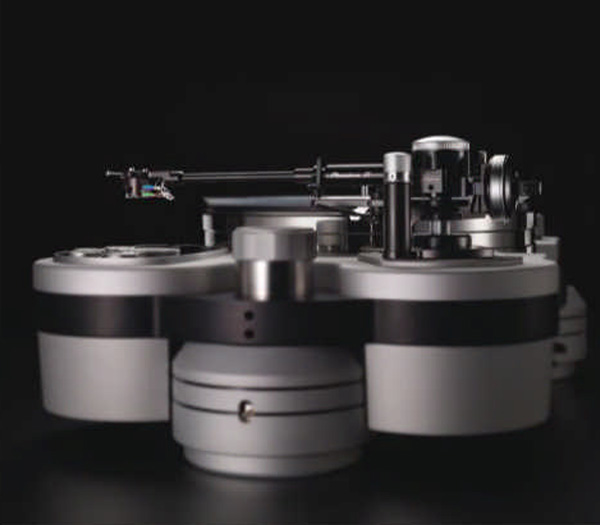
Photo: Benton Collins.
Air Force One, Inside and Out
The TechDAS Air Force One costs $97,000 or $103,000 with the new
Graham Elite arm—an upgrade of the Phantom that Bob Graham says offers better sound, as well as an appearance that complements the Air Force One's. The Elite alone costs about $9500, so the package price saves $3500.
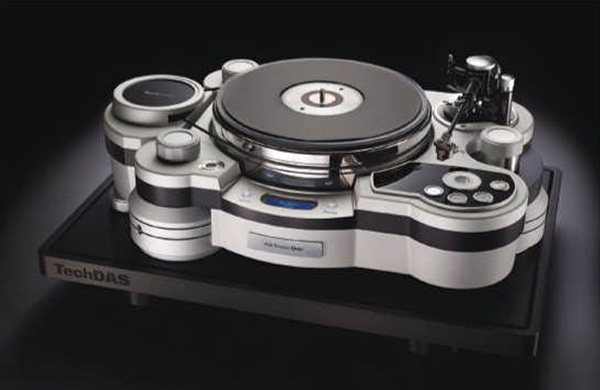
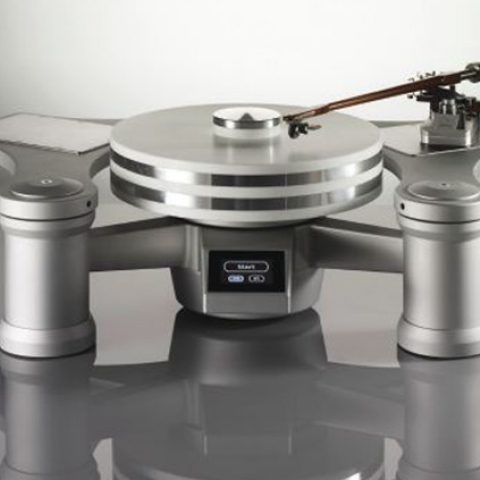
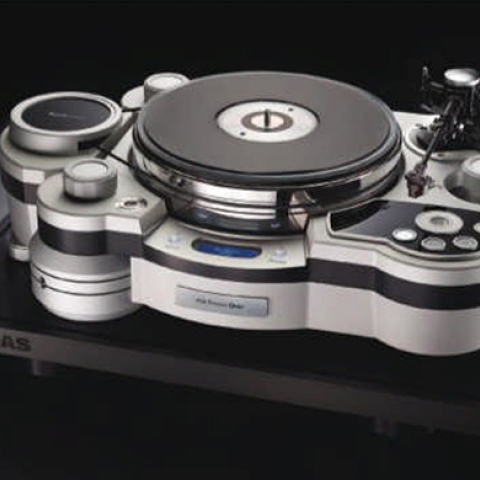
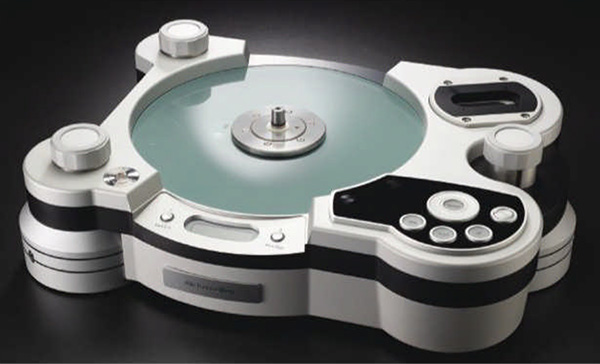
With its curved, chunky lines, the Air Force One—not to be confused with the Forsell Air Force One turntable of the 1990s—is a visually stunning technological tour de force, even if to some its looks may appear too busy and "techie." Its constrained-layer-damped chassis weighs 94lb, and its total weight is 174lb—the Air Force One is
massive. We like mass. The chassis's base layer is made of A5052 aluminum, the middle layer of even stronger A7075 superduralumin, and the upper layer—the turntable's visible exterior—of anodized A5052 aluminum.
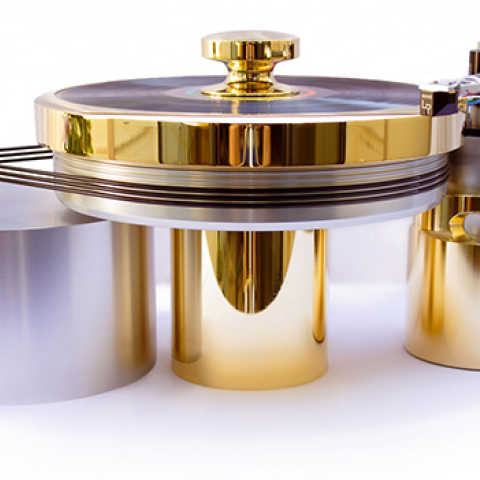
The main platter weighs 41lb and is made of forge-processed (heat increases hardness), nonmagnetic stainless steel. After machining, the bottom surface is polished to mirror smoothness to ensure that the air bearing is fed by a perfectly smooth air stream. The surface of the base facing the platter's underside is of glass, also to ensure a smooth air stream.
Inside the platter is a 1.1-liter air chamber that produces a damping effect to eliminate resonances between the main and the upper platter, which contacts the LP, and for which there are three choices of material: extra-superduralumin, nonmagnetic stainless steel, and methacrylate (acrylic). The buyer can choose one or get all three, though swapping them out takes considerable time and effort, which is a good thing—the bond between the main and secondary platters is mechanically secure and rigid. This secondary platter is
not a record mat. While the publicity blurb says that the three platters are also available without vacuum holddown, for a total of six platter options, you'd be crazy, in my opinion, to
not opt for vacuum holddown.
However, a Poron record mat identical to the one Continuum Audio Labs supplies with their Caliburn turntable is included. Its stated purpose is to reduce static, but it also prevents dust from the platter and LP from being embedded in the grooves by the force of the vacuum holddown.
The designer and importer, Nishikawa and Bob Graham, recommend first the aluminum platter, which was supplied for this review, followed by the stainless steel, and lastly the acrylic, for those who prefer a "softer, less dynamic sound" (their words, my belief).
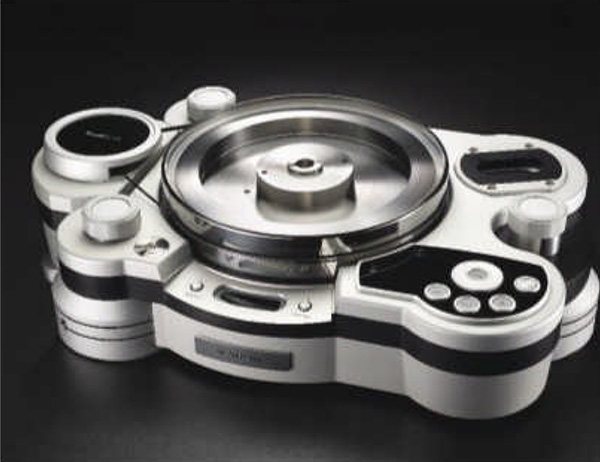
The Air Force One’s belt-drive platter spins on a cushion of air. (Photo: Benton Collins.)
The platter is driven by a flat belt of nonstretching, surface-polished polyurethane fiber and a huge AC synchronous motor housed in a separate, high-mass pod and controlled by a speed-adjustable, dual-50W amplifier that generates a crystal-locked AC waveform.
A sensor mounted on the chassis detects the platter's speed of rotation by reading the tachometer lines inscribed on the bottom of the main platter; with maximal torque applied by the motor until the speed of rotation is correct, at which time the drive voltage is halved. (The essentially frictionless air bearing means that, once the massive platter is up to speed, the motor can be run with minimal torque.) Using a pair of pushbuttons, one on either side of the digital speed indicator mounted on the chassis, the platter's speed can be adjusted in steps of ±0.1rpm, for a total range of adjustment of 10% to either side of 33
1/
3 or 45rpm.
A surprisingly compact, well-finished aluminum enclosure connected to the 'table with an umbilical, incorporates the motor's power amplifier as well as the air-flow–controlling solenoid-operated valves, and four separate, isolated DC power supplies for the control buttons, LEDs, relays, sensors, and logic systems.
Also inside this outboard box, suspended by rubber cords are two absolutely silent, vibration-free, air pumps—one for the vacuum hold-down, one for the air bearing.
Another box, analogous to a DC power supply's capacitor bank, connects the air pump and the 'table and acts as an air condenser to eliminate any minor air ripples. The box's interior is of glass, to prevent any flexure that might produce secondary ripples. Anyone who's ever owned an air-bearing tonearm driven by an aquarium pump, such as
Eminent Technology's E.T. II, and who built a less sophisticated condenser out of a five-gallon water jug filled with aquarium-filter floss, understands the value of such a device.
The Air Force One can accommodate two tonearms simultaneously: a standard 9"or 10" arm in the main mount at the 'table's right rear corner; and, in a mount cantilevered off the 'table's left rear corner, a 10", 11", or 12" arm. Both the main and auxiliary armboards are a soft/hard combination of 12mm-thick ebony or Brazilian rosewood and superduralumin, the design based on vibrational mode analysis.
The Air Force One’s sub-assembly. (Photo: Benton Collins.)
The 'table sits on three adjustable feet, though a running production change has replaced the hybrid adjustable air and liquid-polymer suspension with a simpler one of nonadjustable air and gel "donuts" (remove the name badge on the front panel of the Air Force One to see the nipples, now disabled, where you would have had to occasionally inflate the air bladder). Harmonic Resolution Systems (HRS) manufactures for TechDAS, as a $5300 option, a special version of one of its massive M3X isolation bases that includes machined indents to accept the Air Force One's feet and motor pod.
Setup and Use: Importer Bob Graham set up the Air Force One, and brought along an HRS base, which made sense—I already own and use a double-width HRS SXR rack.
The condenser and main control boxes are remote units that can be placed anywhere within reach of the system's generously long electrical and air conduits. Once the system is switched on from the control box's front panel, you no longer need access to the separate enclosures.
When the turntable was up and running, Graham installed a work-in-progress update of the SME-base version of the Phantom II Supreme tonearm that includes new versions of the headshell shape, Graham's Magneglide stabilization system, and inverted bearing housing. He was also kind enough to set up the second arm mount for the
Kuzma 4Point arm, so that I could easily compare the Air Force One with my reference
Continuum Audio Labs Caliburn, whose secondary armboard also holds a 4Point.
Curiously, Graham told me that his standard 9" arm was not compatible with the Air Force One's main board and that I would have to use a 10" arm wand even though the publicity brochure said it was compatible with 9" arms. In addition, the 11" effective length of the Kuzma 4Point didn't work without the addition of a headshell extender plate. The Kuzma's unique mounting system does present some 'tables with a problem in pivot-to-spindle distance, but why the main armboard's placement relative to the spindle restricts the Graham arm's length to 10" makes me wonder about the Air Force One's ability to accommodate a wide variety of arms, even though TechDAS says the board can be drilled to accommodate them.
It would be best to ask about the Air Force's compatibility with your arm
before buying the 'table. That said, the 10" Phantom II Supreme was an ideal match for the TechDAS. The required headshell extender made the 4Point less so, though it would probably fit without modification on the main arm board.
While TechDAS's instructions insist that the auxiliary armboard's performance matches that of the main board, it seemed to me more of a late add-on than something included in the design from the beginning. That, too, I found curious, considering that Micro-Seiki had a long history of producing 'tables capable of accommodating multiple arms.
Despite the Air Force One's apparent complexity, once the initial speed memorization and belt-calibration processes have been done (both need be done only once, and when changing belts), using it couldn't have been easier. Press the Suction button to activate the vacuum holddown—no spindle suction cup needed. Push the 33
1/
3 or 45rpm button and the platter begins to turn, achieving speed quickly. (For dozers, drinkers, and stoners, a selectable Auto-Off function stops the platter after an hour has passed with neither speed button having been pressed.) At the end of the side, push Stop and then Suction. The vacuum is released, and the system shoots a short burst of air in the opposite direction to aid removal of the LP from the platter. A nice touch!
The backlit buttons (their degree of illumination is adjustable) are relatively close to the stylus when the tonearm is at rest, so be sure when you first set up the arm to lock its lateral position as close as possible to the platter, and, of course, watch what you're doing before you press any buttons.
Sound: I did a good part of my listening with a Lyra Atlas cartridge mounted in the Graham Phantom II Supreme. The TechDAS Air Force One was a sonic masterpiece. That assessment began with what was immediately obvious: an ultra-low noise floor that was close to, if not quite as richly black as, that of the Continuum Caliburn on the MinusK platform. I later confirmed that observation using 24-bit/96kHz recordings of the outputs of both turntables using my modified
Alesis MasterLink.
When I lowered the stylus onto the Air Force One's platter with the volume well up, there was only the subtlest hint of an effervescent
pop through the speakers, and even that quickly plummeted smoothly to black. As with any combination of top-tier turntable and well-made vinyl, music erupted with almost volcanic force from that black backdrop, setting up a holographically three-dimensional image that simultaneously invited physical relaxation and aural excitement. This quality is what listeners first respond to when hearing, unannounced, playback of even a CD-quality recording made from a high performance 'table. I remember the first time I played such a recording at an audio show, one I'd made using
Rockport Technologies' System III Sirius turntable, and getting applause.
The more accurate and consistent a platter's speed, regardless of the intensity of an LP's groove modulations, the greater the ease of sound, the more dramatic the impact of the music, the more relaxed the listener, and the greater the pleasure. This is where, without trying to analyze what's being heard, the listener's more primitive (and probably more accurate) sensory processing dominates. During the many weeks the Air Force One was here, I listened both casually and critically, and in either mode felt no pain—only intensified sensory pleasure accompanied by the almost incongruous relaxation that I feel when I settle into my seat at a concert. That doesn't happen when I listen to digital, especially CDs. Never.
As with Spiral Groove's SG 1.1 and Onedof's One Degree of Freedom turntables, I
wanted to listen to the Air Force One, even knowing that sitting on the stand next to it was a Continuum Caliburn—my own reference 'table. The lower the price at which
that impulse occurs, the more impressive the turntable—which is what made the SG 1.1 so significant. But the Air Force One produced a larger, more generous physical and spatial presentation than the SG-1, accompanied by a more subtle delicacy, particularly in terms of clarity of transient attack and gradations of microdynamics. Then again, the TechDAS costs more than three times as much as the Spiral Groove.
The Air Force One sounded more like the Continuum Caliburn ($160,000 with tonearm and stand). If the transient picture of the Onedof ($150,000 when reviewed) was smooth almost to the point of homogenization for some listeners—at one audio-store listening event, attendees split over which recording 24/96 needle drop of these turntables of Paul Simon's "Diamonds on the Soles of Her Shoes" they preferred—the Air Force One's was ever so slightly sharper than the Caliburn's smoother, somewhat richer transient personality.
The Air Force One came closest to the Caliburn in its portrayal of microdynamics—those small dynamic gestures that turn cardboard into seemingly living plasma. Its eruptive macrodynamic presentation will surely shake any listener who hasn't spent time listening to top-tier 'tables, or who thinks vinyl's dynamics can't compare to digital's.

But as impressive as were the big gestures from the TechDAS, it was the subtle ones that impressed over the long haul. The Air Force One's performance in this regard was among the finest I've experienced here.
My copy of Vladimir Ashkenazy's recording of Rachmaninoff's Piano Concerto 3, with Anatole Fistoulari and the London Symphony (Decca SXL 6057), is a disc of questionable ("VG+") quality. Recorded without edits, in my book it's sonic and musical liquid gold. The somewhat distant perspective and the huge, warm, reverberant sound of Walthamstow Assembly Hall accentuate any pressing defect and/or surface noise. Like the Caliburn's, the Air Force One's suppression of unwanted pops and clicks was as masterful as the performance, while allowing for full musical expression. Only a few turntables do so well at making less-than-pristine records more listenable and thus more enjoyable.
Playing Thelonious Monk's
The London Collection: Volume One (45rpm LPs, Black Lion/ORG Music 1052) on both 'tables with the Kuzma 4Point arm and the Lyra Atlas cartridge demonstrated the Caliburn's somewhat wider range of microdynamic gradations, and more subtle transient attacks with no loss of detail or impact. But it was close.
The same was true of a comparison using "Cotton Fields," from an excellent reissue of Harry Belafonte's
Belafonte Sings the Blues (45rpm LPs, RCA Living Stereo/Impex IMP 6012 45). It demonstrated that while the sounds of both 'tables were sensational in terms of harmonics, space, texture, and microdynamics, the opening walking-bass line accurately revealed subtle differences: the Caliburn's attack was more rounded yet texturally more complex, the resulting low-frequency pulse deeper, with more space behind the bass and the decay into black even more velvety. A lusher nothingness? I don't know how else to express it. But, again—close!

I think many of the subtle but significant audible differences between these two 'tables are accounted for by the Continuum Caliburn's unique tonearm mount, in which the arm is isolated in all three dimensions, and its extraordinary, battery-powered motor and drive system. What are
not close are these two models' prices, which are $60,000 apart.
The combination of its ultrasophisticated technology, exceptional build quality and fit'n'finish, and mesmerizing sound, the last falling just slightly on the analytical side, makes the TechDAS Air Force One one of the more dazzling and technologically impressive super-high-performance turntables. If you can afford one, go for it! If I hadn't already purchased the Caliburn, I would (footnote 2).
Footnote 1: TechDAS, Stella Inc., 51-10 Nakamarucho, Itabashi-ku, Tokyo 173-0026, Japan. Web:
www.techdas.jp. US distributor: Graham Engineering, Inc., 25M Olympia Avenue, Woburn, MA 01801. Tel: (781) 932-8777. Web:
www.graham-engineering.com.
Footnote 2: Mikey took a second listen to the Air Force One in
April 2016.—
Ed.