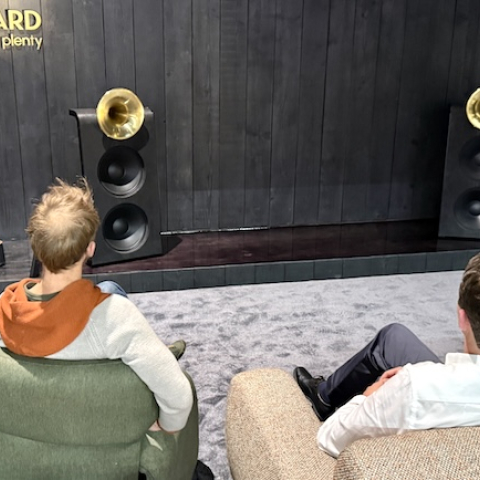
Listen Up!'s Boulder store. "We Speak Analog," says the sign. (Photo: John Atkinson)
I recently spent a week traveling—it was good to get out of the basement! First up, toward the end of May, was an event at the Audio Alternative, in Fort Collins, Colorado. Owner Rick Duplisea is a vinyl fanatic and Linnie whose store—actually, his sprawling home—is packed with gear and LPs. His record collection beats mine. Unfortunately, I didn't have time to look at every album—it would have taken days—but even a quick peek turned up lots of vinyl I wish I owned or even just had a chance to hear. Next time!
I demoed for an appreciative crowd vinyl vs 24-bit/96kHz LP rips via
Vandersteen Model Seven speakers driven by Audio Research gear. Then I let people hear what happens when record labels reissue recordings made from less-than-stellar sources, in this case comparing an original RL (Bob Ludwig) mastered pressing of the Band's second album,
The Band, with a new one from Capitol mastered from who-knows-which digital file. (The analog master tape is missing.)
The new reissue is not sonically pretty: a drab version of the original. Missing are the weight and unique texture of Levon Helm's drum kit, and all the room ambience that ties the music together—but worst of all is the absence of the recording's emotional power. That's what the Fort Collins listeners noticed first.
The poor suckers who buy that reissue will never know what they're missing unless they find an original pressing (not too hard on eBay). When I played one on Rick Duplisea's ARC-Vandersteen system, the sound was "live in Sammy Davis Jr.'s pool cabana"—which was where it was recorded in 1969. Great system!
I had to be dragged me from Duplisea's walls of vinyl to head back to Denver to retailer Listen Up!, where, from 4 to 8pm, AudioQuest/Music Matters' Joe Harley, Audio Research's Dave Gordon, Musical Fidelity's John Quick, and others had a full house of enthusiasts circulating on the half hour from room to room: eight standup sessions without a break. I'm not complaining—it was fun meeting everyone.

Listen Up!'s Colorado Springs store. (Photo: John Atkinson)
The next day, it was on to Listen Up!'s branch in Colorado Springs, home of the Air Force Academy, where, at about the time as our event, the President was giving the commencement address. Somehow, socialism was a much bigger draw than audio that day.
The final evening was at Listen Up!'s shop in Boulder. At all of these events I had played a test pressing of the reissue on LP of Paul Simon's
Graceland (sonically far superior to the original and highly recommended), and compared it to a 24/96 digital transfer of the LP. How cool was it that the album's original engineer, Roy Halee—a vinyl fanatic who also supervised the reissue—was in attendance? Very.
The 24/96 vinyl rips were done using an MSB Platinum Studio analog-to-digital converter—you can read about it at
www.msbtech.com/products/adc.php—feeding the digital input of my
Alesis Masterlink hard-disk recorder. The eight-channel version of the MSB device can be found in many mastering houses. The two-channel version, which costs around $20,000, is remarkably transparent. (If you download HDtracks' version of Cat Stevens's
Tea for the Tillerman, you'll be hearing the MSB Platinum Studio.)
While the folks at Audio Alternative almost unanimously preferred the 24/96 digital files I'd made using the
Continuum Audio Labs Caliburn turntable,
Kuzma 4Point tonearm,
Lyra Atlas cartridge, and Ypsilon VPS 100 phono stage, decoded using an Audio Research D/A converter, to live playback of the LP on a
Linn Sondek LP12 turntable, the crowd at all three Listen Up! venues preferred the LP played on a VPI Classic II turntable to the files.
More than the turntable, I think it was the DAC that made the difference. Instead of the ARC, the Listen Up! events used modestly priced Musical Fidelity DACs and required the use of a USB-to-S/PDIF converter. The Listen Up! attendees couldn't get past a slight grain and too-sharp transient attacks to get to the files' wider dynamics, superior bass, richer harmonic structure, and greater resolution of detail.
Following the dealer events, I toured speaker manufacturer Avalon Acoustics' production facilities, which have recently doubled in size, then spent a few hours listening in Avalon's very large, well-equipped sound room with designer Neil Patel and VP Lucien Pichette. Patel and I found ourselves on the same page in many areas, musically and otherwise. It was a fun evening. I got to the airport hotel around 2am, and was up the next morning at 5:30 for a 7:30 flight home.
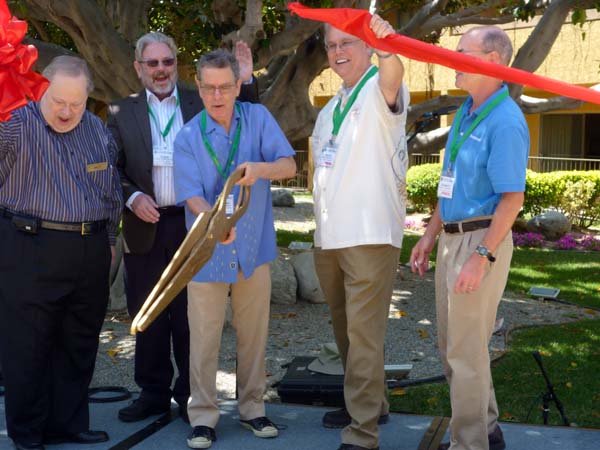
The opening of T.H.E. Show Newport Beach 2012: (from left) Bob Levi, president of the Los Angeles and Orange County Audiophile Society; Stereophile's John Atkinson, Mikey Fremer; Positive Feedback's David Robinson; and The Absolute Sound's Robert Harley.
A few days later it was off again, this time to T.H.E. Show Newport Beach, in California, which I've covered on my
AnalogPlanet website. I won't repeat that report here, other than to say that the amount of new and used vinyl on sale was unprecedented in a lifetime of attending hi-fi shows. (My first was in the 1960s, at the Penn Plaza Hotel, where I watched Henry Kloss introduce the KLH open-reel tape recorder.)
Vinyl infested T.H.E. Show. Anyone wondering whether or not investing in a turntable is a good idea would have been immediately reassured—when the show closed, it turned out that many of the bins had been nearly emptied out. People are enthusiastically buying LPs again. And from the e-mails I get, and from what I was told by the people in Denver and at T.H.E. Show—whether youngsters just getting acquainted with vinyl, or boomers reconnecting to the music of their youth as it was meant to be heard—they're enjoying the hell out of them.
Musical Fidelity M1ViNL MM/MC phono preamplifier
I've owned many Musical Fidelity products over the years: amps, preamps, CD and SACD players. The company's budget phono preamps, such as the current V-LPSII, have always been great values and competent performers, and thus easy to recommend.
The kW Phono Stage, Musical Fidelity's priciest ($3500 when last available) and most ambitious standalone phono preamp, while beautifully built and sonically worthy of respect, sounded almost too clean, and on the sterile side. It was spatially well organized and dynamically generous, but it was also harmonically and texturally stingy; its overall lean sound made for a less than secure connection with my music, particularly when I used a fast, more or less neutral cartridge. While John Atkinson didn't measure the kW for my review of it in the June 2005 "Analog Corner," based on the superb measurements of the phono preamp built into MF's
Tri-Vista kWP preamp, I'm sure the kW would also have measured extremely well.
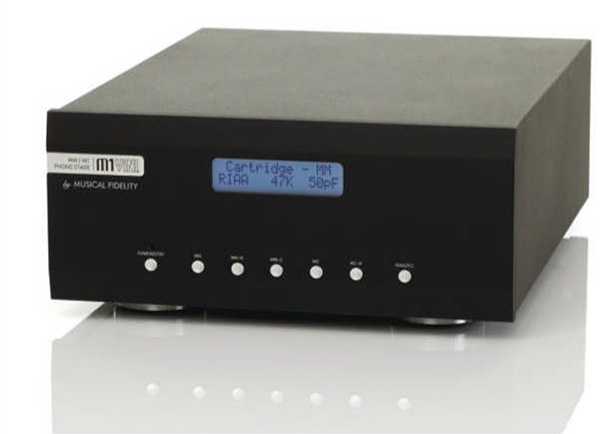
So here comes the M1ViNL, a phono stage based on the kW's circuitry that is far less expensive ($1199) than the kW but, according to Musical Fidelity, sounds much better (footnote 1). It's also among the most convenient-to-use phono preamps at
any price. During playback, via a series of front-panel pushbuttons, you can choose the moving-magnet or moving-coil input, as well as a range of values of capacitance for MM (50, 100, 150, 200, 250, 300, 350, or 400pF), and resistive loading for MC (10, 18, 25, 50, 100, 200, 400, 800, 1600, and 47k ohms). The MM mode even offers a choice of 47k or 68k ohms resistive loading. While 47k ohms is the de facto standard, it's hardly a one-size-fits-all solution. [
68k ohms used to be recommended for the Shure V15 III, etc.—Ed.] The pushbutton resistance values begin at 47k ohms, work their way down to 10 ohms, then go back up again rather than starting over at the highest value. Because there's only one pushbutton, returning to a value just passed requires you to go all the way in one direction and then back the other way. That's this design's only inconvenience.
Via a small but easily read fluorescent screen on the front panel you can monitor the settings, including your choice of RIAA or IEC equalization. The current IEC standard, adopted in 1976, added a 6dB/octave rolloff below 20Hz that's not part of the RIAA pre-emphasis curve imposed on the signal before a lacquer is cut. The rolloff is supposed to act as a "rumble filter," but it has little effect where it would be most useful, and the first-order filter produces frequency-response errors in the audioband. In other words, unless your turntable has a lot of rumble and/or low-frequency feedback problems, stick with RIAA. There are also balanced XLR outputs (600mV) in addition to the unbalanced pair. The M1ViNL's claimed specifications are impressive: RIAA accuracy to ±0.2dB, and in MM mode, the input sensitivity is 3mV in for 300mV out at 1kHz, with a 31dB overload margin and an A-weighted signal/noise ratio of >90dB. The MC input's numbers are similar, but with a S/N of 2dB decreasing to a still extremely impressive >88dB at the M1ViNL's rated 500µV input for 300mV output—more than enough gain for the 0.23mV output of my Ortofon A90 cartridge.
The M1ViNL makes use of the latest low-noise, instrument-grade op-amps. It sounded great. I didn't have the kW Phono Stage here to make direct comparisons, but the M1ViNL hardly sounded sterile or lacking in textural and harmonic detail. It was on the somewhat dry and slightly dark side compared to Manley Labs' tubed
Chinook phono stage, which costs twice as much and was in-house at the time. (See "Analog Corner," August 2012.) Still, the M1ViNL had an inviting midrange warmth and an overall harmonic generosity that the kW lacked.
Paralleling what I remember of the kW's sound, the M1ViNL's reproductions of instrumental attacks were fast and clean—diverging from those memories, it invested some time and space in instrumental sustain; the kW had seemed "event fixated." The results were richer, more colorful, better-fleshed-out aural pictures from the M1ViNL.
If the M1ViNL sounded a bit reserved on top—even "unloaded"—that was fine with me. And its bottom-end performance well matched its top. The bass was very well extended, harmonically fleshed out, and sufficiently well delineated to produce effective rhythm'n'pacing, but not so tight and muscular as to become too prominent, given its overall warm, pleasing sound from top to bottom of the audioband.
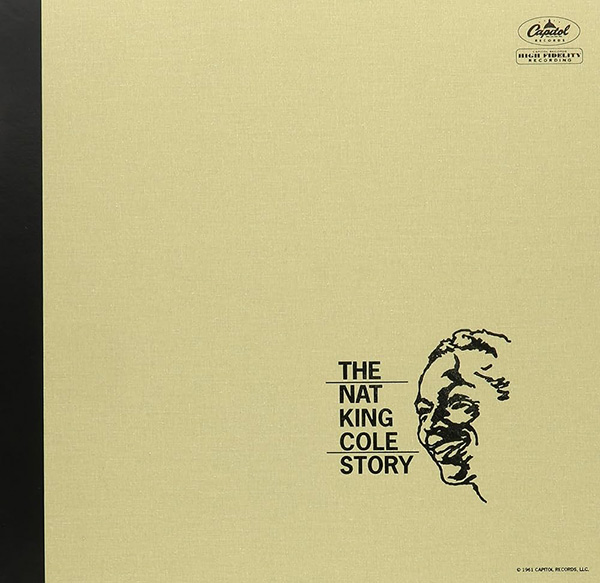
When I play the remarkable 45rpm reissue of
The Nat King Cole Story (5 LPs, Capitol/Analogue Productions APP-SWCL 1613), I expect to hear warmth. The M1ViNL delivered it without sounding mushy. Cole's piano wasn't all tinkly attack; instead, there was richness and texture to the sustain, though it was still somewhat on the dry side compared to the Chinook.
Spatially, the M1ViNL decoded simply miked records, placing solidly three-dimensional images on appropriately sized soundstages. Its dynamic performance was generous, particularly considering the price, though in this regard it can't compete with pricier phono preamps. In other words, rather than overreaching and missing, the M1ViNL kept its performance goals reasonable, shaving off an appropriate (but surprisingly modest!) amount in every performance parameter.
A good balance of various sins of omission mean that the M1ViNL can be enjoyed even in a system of far more costly components—it never called attention to what more highly resolving phono preamps can do that it couldn't, and was completely free of the annoying artifacts of grain, glare, and grunge. The M1ViNL replaced the kW's cool, analytical nature with a more forgiving, highly involving warmth, but without adding slop or a sense that the air had been sucked out of the sound—though it was still on the dry side, particularly in how it rendered low-level information.
A pleasure to use and to look at, inexpensive, and with a pleasing, involving sound, Musical Fidelity's M1ViNL is as easy to recommend as it is to listen to. The only problem is that at $1199, it might be priced
too low for some to consider buying. Don't make that mistake.
Clearaudio Goldfinger Statement high-output MC cartridge
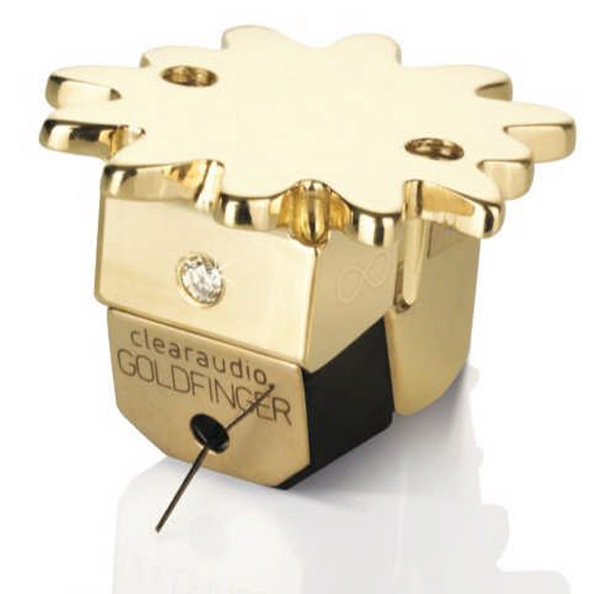
Replacing the Goldfinger V2, which included a ring of eight magnets, the Goldfinger Statement sports "no less than twelve" magnets, according to Clearaudio's website (footnote 2). Clearaudio is not kidding around with this unusual and very expensive ($14,999) high-tech beauty, which is housed in a 14K-gold body with a resonance-damping, "gold fingered" top plate. The intensity of the magnet array is said to have allowed the designers to significantly reduce the moving mass of the 24K-gold coil assembly, which is wound with wire 30% thinner than that used in previous Goldfingers. The cartridge's construction follows a patented Clearaudio design said to ensure electrical, mechanical, and magnetic symmetry. Clearaudio claims that the Goldfinger Statement is the first cartridge to include EMF shielding—not to mention a diamond embedded in its front plate. The seriously exposed boron cantilever is fitted with a Micro HD stylus.
The Goldfinger Statement's unusual specs include a high weight of 17gm and a high output of 0.9mV (at 5cm/s). The coil wire may be 30% thinner, but the Statement's relatively high impedance of 50 ohms indicates that plenty of it was wound on the coils in order to achieve the high output. The compliance is moderate, at 15µm/mN in both planes, and the recommended tracking force is 2.8gm, ±0.2gm. All of this means you must exercise great care with associated gear.
While the Goldfinger Statement's weight would hardly be a problem for Clearaudio's TQ1 Master Reference tangential-tracking tonearm, which has an armtube of relatively low mass (and in fact, the cartridge was probably designed with the TQ1 in mind, to achieve a higher effective vertical mass), I'd be careful about using it with very-high-mass tonearms (eg, those from Dynavector, or
Eminent Technology's ET2); the combination of an arm and cartridge both of very high mass with a medium compliance could bring the combination's fundamental resonant frequency down to the 6Hz region, where it would start to be excited by warp wow energy.
You also must carefully consider the Goldfinger's unusually high output of almost 1mV, which is nearly twice the output of a typical MC cartridge. Around 50dB would be an ideal amount of gain; if your phono preamp's output is fixed at a number considerably higher, you ought to check with its manufacturer about overload margins.
I mounted the Goldfinger in
Continuum Audio Labs' Cobra arm. After making sure that the arm was parallel to the record surface, I had a look through a Dino-Lite USB microscope. The cartridge's cantilever-and-stylus assembly looked similar or identical to what Lyra uses in their Atlas, and, as with my Atlas sample, the Goldfinger's stylus had been inserted in its cantilever at a forward stylus rake angle (SRA) that, to achieve an SRA of 92°, required that the back of the arm be considerably lowered.
I optimized the cartridge's azimuth by using
The Ultimate Analogue Test LP (Analogue Productions AAPT 1) and an Instek GDS-1022 digital oscilloscope, which lets me precisely measure both channel-output balance and crosstalk. The channel-output difference met spec, but unlike H&S Cartridge Clinic's Ice Blue, reviewed last month, which produced separation in excess of 30dB in both channels, the Goldfinger managed 26.5dB in one channel and 24dB in the other, rather than the >30dB spec. This could have been an idiosyncrasy of my review sample, but for $14,999, every unit should precisely meet the published specs.
Not surprisingly perhaps, the one area in which the Goldfinger Statement fell somewhat short was soundstage width, which was only moderate compared to the unrestricted expanse I expected for $14,999. Otherwise, the Goldfinger performed spectacularly in terms of dynamics, and especially in bottom-end extension and authority. Wilson Audio Specialties'
Alexandria XLF speakers—the big ones—were recently installed here (review in the works), and they made clear that the Clearaudio could really plumb the depths and pack a tight-fisted wallop. There was nothing polite or reserved about it.
I returned home from the David H. Koch Theater (yes,
that David H. Koch), where, from a fifth-row-center seat, I'd seen the New York City Ballet perform
A Midsummer Night's Dream, and immediately played a stupendous 45rpm reissue of Peter Maag and the London Symphony's recording of Mendelssohn's music (2 LPs, London CS 6001/ORG 108). Of course, with my speakers not partially hidden in an orchestra pit, it actually sounded
better in some ways than in concert, where the highs had been recessed and the midbass had bloomed.
Like the patron for which the hall is named,
superrich is the only word that describes the glorious string tone produced by the Goldfinger Statement—or should I add
silky smooth, with a natural, nonmechanical sheen? Massed strings seemed to glide through the room on nimble feet before gently evaporating—as I'd just heard them live. Instrumental textures were pleasingly generous without being cloying. The high output helped produce jet-black backgrounds out of which sprang enormous volumes of sound—again, as I'd just heard. If you like a generous, voluminous midrange, the Goldfinger delivered it while maintaining complete control from top to bottom of the audioband.
But that control didn't mean that there was anything about the Goldfinger Statement's top that was polite or constrained. If a recording was icy up there, I heard it as such—but resolved cleanly, to a fine, fine point, without ever sounding etched. However, I had to load the Clearaudio down more than I'd expected to for a 50 ohm cartridge. Its highs sounded tipped up at 200 ohms, but smoothed out nicely at 100 ohms.
One of the Goldfinger's strongest suits was its transient speed and clarity: just right, not too sharp, and certainly not too soft. It managed its richness while remaining bold and forward where appropriate.
Weaknesses? None, other than the narrow soundstage, though other cartridges—particularly those with lower internal impedances, such as the Haniwa and the
Lyra Atlas—retrieve more detail and perhaps are even faster. But do you really need more than the Goldfinger produced? I don't think so, even if you listen exclusively to rock or jazz. Whether or not the Clearaudio Goldfinger Statement will be worth
your $14,999 is something I can't decide for you. Your accountant might have more to say about it, though.
Footnote 1: Musical Fidelity, Wembley, Middlesex, England HA9 0TF, UK (2012). Musical Fidelity (Audio Tuning Vertriebs GmbH), Margaretenstrasse 98, A-1050, Vienna, Austria (2026). Web: musical-fidelity.com. North American distributor: Harmonia Distribution (2026). Email:
Info@harmoniadistribution.com. Web:
www.musicalfidelity.com/north-america
Footnote 2: Clearaudio Electronic GmbH, Erlangen, Germany. Tel: (49) 9131-40300100. Email: info[at]clearaudio.de Web: h
www.clearaudio.de/en/direct/. US distributor: Musical Surroundings, 5662 Shattuck Avenue, Oakland, CA. Tel: (510) 5475006. Email:
info@musicalsurroundings.com. Web:
www.musicalsurroundings.com