Rega Research (footnote 1) sold more turntables in 2012 than in any of its previous 40-odd years of business, and is on target to do so again in 2013. How many turntables is that? I know but can't yet say.
Rega, along with most major makers of audiophile turntables, is participating in an ongoing project I've undertaken that I hope will reveal the true depth of the vinyl resurgence by counting the production of turntables, cartridges, and vinyl records industry-wide. So far, on the hardware side, only the purveyors of plastic turntables have balked. And while those sales numbers are high (probably higher than all of the audiophile manufacturers' sales combined), the aggregated numbers so far reported are impressive, and beyond my most optimistic imaginings.
Because record labels no longer keep large inventories LPs and pressing plants manufacture to order, the number of records pressed should correlate well with how many are sold—certainly, the number should more accurately reflect actual sales than today's reporting methodology, which mostly relies on a very limited sampling of retailers. So far, only a few pressing plants have refused to divulge numbers.
I hope to publish the aggregate numbers by the end of 2013.
Swimming Upstream . . .
. . . is harder than swimming downstream. Makers of turntables who begin with a pricey "statement" design usually have an easier time of later producing lower-priced models. For instance, a far less expensive version of TechDAS's Air Force One turntable ($79,500), which I reviewed in this column last April, is reportedly in the works. I've heard that it may retain many of the Air Force One's features (and, hopefully, much of its sonic performance) while costing as little as $20,000. In the 1970s, Rega Research began building real-world–priced, low-mass, unsuspended turntables equipped with tonearms from Danish and Japanese suppliers. Rega's early 'tables sounded fast, pleasingly lean, and rhythmically assured compared to their lumbering brethren. In the years since, Rega has remained true to its turntable-design philosophy of low-mass, very rigid, unsuspended, motor-onboard construction with belt–driven subplatters and glass platters topped with felt mats—all while swimming incrementally upstream with models that outperformed and mostly cost more than previous efforts.
Rega's decision, in the early 1980s, to invest in the expensive tooling required to make a rigid, one-piece, cast-aluminum tonearm even as the introduction of the Compact Disc loomed, produced immediate and long-term sonic and financial benefits. In addition to greatly improving the sound of its own 'tables with the new RB250 and RB300 tonearms, which featured an armtube that had a tapered thickness, Rega began selling OEM versions of those arms to turntable manufacturers around the world.
A few years ago, when the original tonearm mold finally wore out, Rega redesigned the arm, this time using computer modeling. Although the new, improved version, the RB303, looks superficially like the one it replaced, significant changes were made in the distribution of the arm's mass that improves both its dynamic performance and its ability to damp resonances.
Rega's farthest swim upstream produced the Rega P9 turntable ($4995, discontinued), which replaced Rega's ubiquitous plastic subplatter driven by a single belt with one machined from aluminum and driven by two belts. They swapped out the usual glass platter for one made of a ceramic material similar to what's used in the nosecones of some guided missiles, and made a host of other upgrades, including the RB1000, the finest expression of the basic Rega tonearm. A single tonearm technician could produce dozens of RB300 arms in the time it took to assemble and tweak a single RB1000.
Rega has doubled the size of the factory, then new, that I visited in 1999. When he spoke with me about the company's resurgence, CEO Phil Freeman, who's been 30 years with Rega, said that when the current entry-level turntable, the RP1, was designed and brought to market, he envisioned sales of perhaps 500 a month. Today, monthly sales are about six times that.
New RP8 pokes holes in Rega's design philosophy
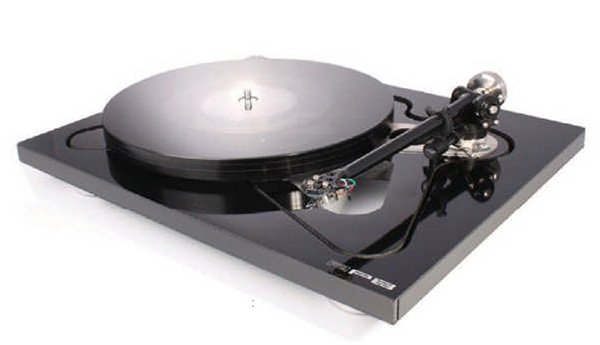
Rega has always made turntables with rigid, low-mass plinths and modest mass. The company's latest models have taken that concept to high-tech extremes with sonically outstanding results. In fact, Rega has discontinued the P9 because it claims the RP8 comes oh, so close to it sonically while costing only $2995 (with tonearm). And if you order the RP8 with Rega's Apheta MC cartridge ($1795 if bought separately) already installed, the package costs only $3995. The upcoming RP10, will be even better, Rega promises. If you thought earlier Rega 'tables had low mass, take a look at the skeletal RP8. It's their lightest, most rigid design yet. The outer frame serves mainly as a support for the dustcover, and can be left in the shipping box if you don't feel your 'table will need protection from dust, people, and/or pussycats.
That leaves the RP8's asymmetric frame, made from a Rega-specified version of Zotek, a new "Space Age" polyolefin foam that's ultrarigid and of ultra-low mass. According to Phil Freeman, the frame—which Rega describes as "skeletal"—begins as a shoebox-sized block of Zotek that's been saturated with nitrogen gas, then shock-vacuumed in a compression chamber to shrink it to a thin, rigid, symmetrical, closed-cell foam. The foam is machined, then sandwiched between two thin layers of a stressed skin structure of phenolic resin to produce a plinth seven times lighter than that of the original Rega 3 while being far more rigid.
The RP8 incorporates Rega's previously developed "stress beam" assembly to link the tonearm and platter hub. This beam's top layer of magnesium and the bottom layer of phenolic produce increased structural rigidity, while its self-damping properties reduce structural resonances and reduce the absorption of external vibration.
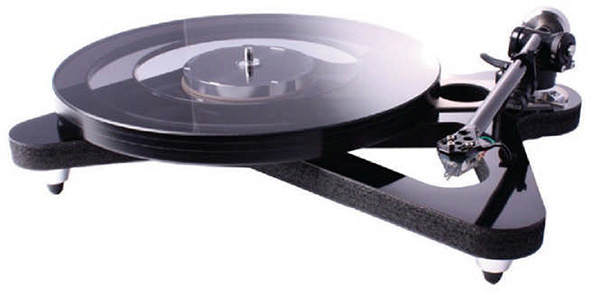
Driving the hub with two belts is a high-spec, 24V, twin-phase motor topped by a dual-grooved, CNC-machined pulley. The RP-8 uses a custom version of the P9's machined aluminum hub. The new RP10 will use a solid-aluminum hub.
As in earlier Regas, each motor unit is tuned to its associated power supply's antivibration circuit, which is incorporated within Rega's outboard TT-PSU power supply. Based on a high-stability, crystal-locked, low-distortion sinewave generator, the TT-PSU generates a balanced 24V AC signal with less than 0.05% distortion.
With the launch a few years ago of the RP3, Rega moved the production of its glass platters to a new high-tech manufacturer that uses CNC machines, ending a 30-year relationship with the maker of the original glass platters. This allowed Rega to add to the platter a bonded outer rim, first used in the RP6, which produced a beneficial flywheel effect. The RP8's newly designed platter shifts the mass still farther toward the platter's perimeter, exponentially increasing the flywheel effect. Freeman claims that the RP8's drive system equals the performance of the mid-1990s P9 at substantially lower cost.
Also new is the RB808 tonearm. It's hand-built, using improved bearings compared with the RB303 and a tighter spindle-fit tolerance. Also new are: its low-mass, precision-engineered, vertical bearing assembly; glossy and very attractive powder-coat finish; and flexible, low-capacitance, German-sourced cables, terminated with twist-clamp plugs.
In short, the RP8 turntable with RB808 tonearm is a very highly evolved embodiment of Rega's core turntable concept, made using previously unavailable materials and construction techniques.
Setup and Use
With my review sample of the RP8 already fitted with Rega's Apheta cartridge, setup was simple—though the two-piece plinth was at first a bit awkward to handle and took some getting used to. After placing the platter on the hub, level the plinth using the three threaded, elastomer-tipped feet, place the counterweight on the tonearm stub, and with the vertical-tracking-force (VTF) spring set to 0, balance the tonearm, then apply the proper VTF as noted in the Apheta's manula. (All Aphetas are supplied with a unique tracking pressure "for optimal; performance," according to Rega.).
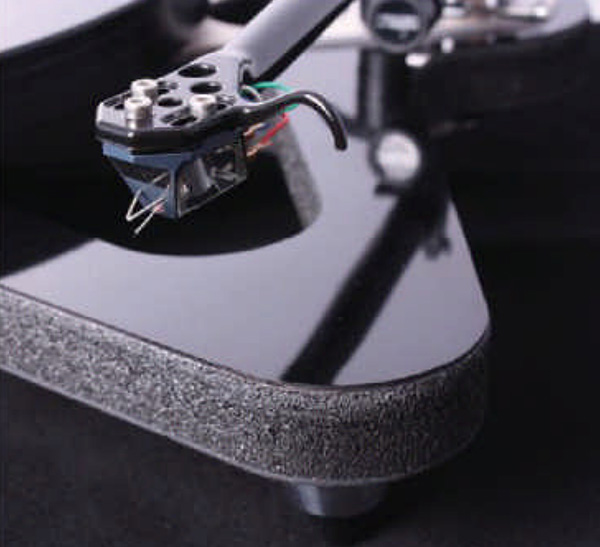
Remember, though, that the RB808's three-point cartridge mount uses Rega's unusual alignment geometry, which minimizes distortion at the inner grooves while maximizing it elsewhere along the arc traced by the stylus. It's best for classical music only, in my opinion, as orchestral recordings often have a climax at the end of the side.
While this makes for relatively fast, easy setup, particularly for novices, those wishing to use a different cartridge will note that, as always with Rega tonearms, there's no easy way to adjust the RB808 for vertical tracking angle (VTA), stylus rake angle (SRA), or azimuth. Using Acoustic Signature's ingenious shims, it's possible to raise the back of the RB808 without first removing it, but if setting the proper SRA of 92° requires lowering the arm, the only solution is to use a thicker mat to raise the platter relative to the arm pivot.
If your cartridge hasn't been perfectly made (few are), and the perpendicularity of its cantilever to the record surface isn't the optimal azimuth setting, you are again out of luck. Rega's position here, as always, is that the structural rigidity obtained by eliminating adjustments trumps all other considerations.
Fast times at Rega Research
A turntable's first job is to spin the platter at the correct speed. Every Rega turntable I've reviewed has run slightly fast. Phil Freeman told me that Rega specs their 'tables to run within a quarter of a percent (±0.25%) of exact speed, preferring any error to be on the fast side of that, which makes sense: The brain better tolerates slightly fast than slightly slow. According to Clearaudio's 300Hz strobe disc and light, the RP8 was running fast at both 331/3 and 45rpm. But how fast? I used Dr. Feickert Analogue's combination of PlatterSpeed iPhone app and the 3150Hz tone on the 7" Adjust+ test record, and checked those results against the 3150Hz tone on The Ultimate Analogue Test LP (Analogue Productions AAPT 1).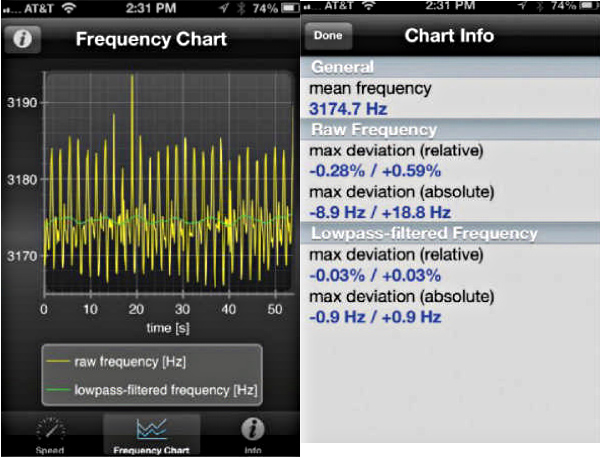
I asked Freeman if there was a way to adjust the speed. He said I could loosen the screws holding the motor to the plinth and adjust the belt's tension. Rega does not recommend this, however, and neither do I. That did lower the speed somewhat, but now the speed consistency had gone completely to hell. If you buy an RP8 and it runs faster than spec, don't mess with it. Return it, or ask Rega to send you a new set of O-rings, to see if that solves the problem. But a turntable costing $2995 should run at the correct speed, within a reasonable deviation of, as Phil Freeman suggests, ±0.25%.
The RP8's plinth was lively, as you might expect of a rigid, lightweight frame. When I tapped on it while a record was playing, the impulse was transmitted, seemingly unimpeded, through the speakers. However, when I tapped on the Harmonic Resolution Systems shelf the RP8 sat on, there was nearly full attenuation. Place the RP8 on a well-engineered shelf.
I listened to the plinth with a stethoscope with the platter spinning and heard a significant high-frequency hum. But when I placed the stethoscope on the stress beam's magnesium top plate, the hum was almost completely gone.
Leave the clingy felt record mat in the box—it attracts dust and produces static electricity. If you use it, be sure to always mute your preamp before you remove a record from the mat, or your system will be rocked by seismic discharges of static electricity that can cause it serious damage. I experienced this in summer, which is usually low in static electricity. Dry winter can be only worse.
If you use the mat and leave the platter spinning throughout your listening session, as Rega suggests, you may lose your cartridge's cantilever. As you lift a record from the still-spinning platter, the mat can (and will) partially cling to the vinyl, spin toward the stylus, and . . . crunch. You have been warned.
Best-sounding Rega turntable ever?
Leaving aside my review sample's speed problem and felt mat (I used Boston Audio's thinner graphite mat), the Rega RP8 more than lived up to my high expectations, with or without its outer frame. (I listened to the RP8 almost exclusively without the frame.)
Sending its signal to Thrax Audio's phono preamp ($21,000, reviewed in the December 2013 issue), which has a prodigious ability to reproduce bass, the RP8 sounded as if it stored or wasted none of the considerable energy produced at the interface of stylus and groove. Had the Thrax been sent any low-frequency slop, it would have poured from my speakers alarmingly. The bass reproduced by the RP8 was taut, exceedingly clean, very well extended, powerful, and masterfully articulated.
 A recent edition of Ray Brown's Soular Energy (two 45rpm, 200gm LPs, Concord Jazz/Analogue Productions AAPJ 268) is reissue perfection. The emphasis is on energy, and these trio arrangements are all about that. Brown's bass is prodigious, Gene Harris's closely miked piano is explosive, and Gerryck King's drums sparkle, pop, and shimmer. When Brown digs for the deepest notes, the Rega didn't give the woody fullness my Continuum rig delivers, but the plucks' power and sensational articulation made a case for the RP8's rendering. The same was true of Harris's piano. There was less woody soundboard, but the transient clarity more than made up for that, with sufficient harmonic and textural follow-through to produce a sufficiently rich, full piano sound that never sounded metallic, tinkly, or incomplete. The musicians emerged from absolute blackness, thanks to the stunningly quiet pressing and the RP8's abilities to suppress what little residual groove noise there was, and to unleash fierce amounts of fully gripped, perfectly timed, pulsating energy.
Jellyfish's 1993 classic, Spilt Milk, contains very busy, densely packed instrumental and vocal arrangements. The album is a witty brew of Beach Boys harmonies, Andy Partridge/XTC exuberance, Queen-style harmonic exclamations, and melodic twists courtesy Difford & Tillbrook. While my big rig better sorted it all out from a superb reissue mastered by John Golden from the original analog master tapes (Charisma/Omnivore OVLP-6), the RP8 never sounded strained or confused.
A recent edition of Ray Brown's Soular Energy (two 45rpm, 200gm LPs, Concord Jazz/Analogue Productions AAPJ 268) is reissue perfection. The emphasis is on energy, and these trio arrangements are all about that. Brown's bass is prodigious, Gene Harris's closely miked piano is explosive, and Gerryck King's drums sparkle, pop, and shimmer. When Brown digs for the deepest notes, the Rega didn't give the woody fullness my Continuum rig delivers, but the plucks' power and sensational articulation made a case for the RP8's rendering. The same was true of Harris's piano. There was less woody soundboard, but the transient clarity more than made up for that, with sufficient harmonic and textural follow-through to produce a sufficiently rich, full piano sound that never sounded metallic, tinkly, or incomplete. The musicians emerged from absolute blackness, thanks to the stunningly quiet pressing and the RP8's abilities to suppress what little residual groove noise there was, and to unleash fierce amounts of fully gripped, perfectly timed, pulsating energy.
Jellyfish's 1993 classic, Spilt Milk, contains very busy, densely packed instrumental and vocal arrangements. The album is a witty brew of Beach Boys harmonies, Andy Partridge/XTC exuberance, Queen-style harmonic exclamations, and melodic twists courtesy Difford & Tillbrook. While my big rig better sorted it all out from a superb reissue mastered by John Golden from the original analog master tapes (Charisma/Omnivore OVLP-6), the RP8 never sounded strained or confused.
 The superb reissue of Joni Mitchell's Court and Spark (Asylum/Elektra/Rhino 81227-76382), expertly remastered by Chris Bellman at Bernie Grundman Mastering, can sound a bit bright and metallic on lesser turntables fitted with middling cartridges, but the RP8 running either the recently updated Transfiguration Phoenix or a now "vintage" Lyra Helikon SL avoided vocal smear, grit, and/or sibilant imprecision. Image solidity and three-dimensionality were the best I've heard from any Rega other than the P9.
Micro- and macrodynamics were well expressed, particularly for a turntable and tonearm at this price. The background pitch-blackness was also well beyond what you'd expect at the price. My big Wilson Audio Specialties Alexandria XLF speakers were fully engaged.
Every playing of every familiar LP emphasized the RP8's remarkable rhythm'n'pace, its expressive dynamic abilities, its precise instrumental attacks against dead-black backdrops. This turntable's overall resolution of detail—particularly low-level reverberant detail—and its handling of instrumental decays were exceptional regardless of price.
Most significant was the consistent integration of all of these elements, which joined forces to produce a great vinyl playback experience. The RP8 speaks with but one voice, and that proved true with a variety of cartridges. (For coverage of Rega's Apheta cartridge and Aria phono preamp, visit analogplanet.com; and read Art Dudley's review of the Apheta in the December 2006 issue.)
Still, those who like a thick, rich sound may find the RP8 somewhat harmonically skeletal. For those folks, a warmer-sounding cartridge might do the trick, but in my opinion that's like removing the low-profile Pirelli P Zero Nero tire s from your Porsche and substituting some all-season "soft rides."
The superb reissue of Joni Mitchell's Court and Spark (Asylum/Elektra/Rhino 81227-76382), expertly remastered by Chris Bellman at Bernie Grundman Mastering, can sound a bit bright and metallic on lesser turntables fitted with middling cartridges, but the RP8 running either the recently updated Transfiguration Phoenix or a now "vintage" Lyra Helikon SL avoided vocal smear, grit, and/or sibilant imprecision. Image solidity and three-dimensionality were the best I've heard from any Rega other than the P9.
Micro- and macrodynamics were well expressed, particularly for a turntable and tonearm at this price. The background pitch-blackness was also well beyond what you'd expect at the price. My big Wilson Audio Specialties Alexandria XLF speakers were fully engaged.
Every playing of every familiar LP emphasized the RP8's remarkable rhythm'n'pace, its expressive dynamic abilities, its precise instrumental attacks against dead-black backdrops. This turntable's overall resolution of detail—particularly low-level reverberant detail—and its handling of instrumental decays were exceptional regardless of price.
Most significant was the consistent integration of all of these elements, which joined forces to produce a great vinyl playback experience. The RP8 speaks with but one voice, and that proved true with a variety of cartridges. (For coverage of Rega's Apheta cartridge and Aria phono preamp, visit analogplanet.com; and read Art Dudley's review of the Apheta in the December 2006 issue.)
Still, those who like a thick, rich sound may find the RP8 somewhat harmonically skeletal. For those folks, a warmer-sounding cartridge might do the trick, but in my opinion that's like removing the low-profile Pirelli P Zero Nero tire s from your Porsche and substituting some all-season "soft rides."
 If you're a Metallica fan, you must hear the 45rpm edition of Metallica (four 45rpm LPs, Warner Bros,) on the RP8! Not that there was anything wrong with how the Rega decoded a recent reissue of an old mono recording of Jascha Heifetz and Emanuel Bay performing Beethoven's Violin Sonatas 8 and 10 (RCA/Impex LM-1914). The RP8 floated a solid, stable, supple, pleasingly silky image of Heifetz's violin between the speakers, reproducing a fine rendering of the recording space, even in mono—as well as of Emanuel Bay's piano, well in the background, microdynamics and harmonics intact.
Despite a few speed bumps along the way, and despite the RB808 tonearm's lack of adjustability of azimuth, VTA, and SRA, Rega's new turntable-tonearm combo is the most exciting and truly revolutionary turntable to be introduced in quite some time. I strongly recommend it to those who want to introduce themselves to high-quality vinyl playback, especially in its $3995 "plug and play" version with the Apheta cartridge. It'll blow your digital mind.
If you're a Metallica fan, you must hear the 45rpm edition of Metallica (four 45rpm LPs, Warner Bros,) on the RP8! Not that there was anything wrong with how the Rega decoded a recent reissue of an old mono recording of Jascha Heifetz and Emanuel Bay performing Beethoven's Violin Sonatas 8 and 10 (RCA/Impex LM-1914). The RP8 floated a solid, stable, supple, pleasingly silky image of Heifetz's violin between the speakers, reproducing a fine rendering of the recording space, even in mono—as well as of Emanuel Bay's piano, well in the background, microdynamics and harmonics intact.
Despite a few speed bumps along the way, and despite the RB808 tonearm's lack of adjustability of azimuth, VTA, and SRA, Rega's new turntable-tonearm combo is the most exciting and truly revolutionary turntable to be introduced in quite some time. I strongly recommend it to those who want to introduce themselves to high-quality vinyl playback, especially in its $3995 "plug and play" version with the Apheta cartridge. It'll blow your digital mind.
Footnote 1: Rega Research Limited, 6 Coopers Way, Temple Farm Industrial Estate, Southend on Sea, Essex SS2 5TE, England, UK, Web: www.rega.co.uk. US distributor: The Sound Organisation, 159 Leslie Street, Dallas, TX 75207. Tel: (972) 234-0182. Fax: (972) 234-0249. Web: www.soundorg.com
. . . is harder than swimming downstream. Makers of turntables who begin with a pricey "statement" design usually have an easier time of later producing lower-priced models. For instance, a far less expensive version of TechDAS's Air Force One turntable ($79,500), which I reviewed in this column last April, is reportedly in the works. I've heard that it may retain many of the Air Force One's features (and, hopefully, much of its sonic performance) while costing as little as $20,000. In the 1970s, Rega Research began building real-world–priced, low-mass, unsuspended turntables equipped with tonearms from Danish and Japanese suppliers. Rega's early 'tables sounded fast, pleasingly lean, and rhythmically assured compared to their lumbering brethren. In the years since, Rega has remained true to its turntable-design philosophy of low-mass, very rigid, unsuspended, motor-onboard construction with belt–driven subplatters and glass platters topped with felt mats—all while swimming incrementally upstream with models that outperformed and mostly cost more than previous efforts.
Rega has always made turntables with rigid, low-mass plinths and modest mass. The company's latest models have taken that concept to high-tech extremes with sonically outstanding results. In fact, Rega has discontinued the P9 because it claims the RP8 comes oh, so close to it sonically while costing only $2995 (with tonearm). And if you order the RP8 with Rega's Apheta MC cartridge ($1795 if bought separately) already installed, the package costs only $3995. The upcoming RP10, will be even better, Rega promises. If you thought earlier Rega 'tables had low mass, take a look at the skeletal RP8. It's their lightest, most rigid design yet. The outer frame serves mainly as a support for the dustcover, and can be left in the shipping box if you don't feel your 'table will need protection from dust, people, and/or pussycats.
Leaving off the cosmetic outer frame reveals the RP8's skeletal form.
The dustcover-holding outer frame, also of Zotek, appears to be made from what's left over from cutting out the plinth. Its three large feet include elastomer bands that self-center the plinth's three elastomer-tipped feet and are the plinth's only points of contact with the frame.
With my review sample of the RP8 already fitted with Rega's Apheta cartridge, setup was simple—though the two-piece plinth was at first a bit awkward to handle and took some getting used to. After placing the platter on the hub, level the plinth using the three threaded, elastomer-tipped feet, place the counterweight on the tonearm stub, and with the vertical-tracking-force (VTF) spring set to 0, balance the tonearm, then apply the proper VTF as noted in the Apheta's manula. (All Aphetas are supplied with a unique tracking pressure "for optimal; performance," according to Rega.).
The RP8 can be supplied with a Rega Apheta cartridge pre-fitted.
Rega had also sent along one of its new Aria moving-magnet/moving-coil phono preamplifiers ($1495). After letting the RP8's platter spin for a few hours to break it in, I began by listening to the complete Rega quartet of RP8 turntable, RB808 tonearm, Apheta cartridge, and Aria phono preamp.
But four unknowns were at least two too many. After a few days' listening to the Rega foursome, I did most of my listening with known cartridges, returning to the complete Rega rig only toward the end of the listening period.
If you don't look very carefully, you won't see the gram markings on the VTF adjustment ring. In fact, until Phil Freeman alerted me to them, I thought Rega had done away with such markings on the RB808. Set the antiskating according to the instructions; plug the multi-pin plug into the TT-PSU power supply, the wall-wart into the TT-PSU and the wall, and the phono cables into the moving-coil input of your phono preamp; and remove the stylus guard. You're ready to spin vinyl.
A turntable's first job is to spin the platter at the correct speed. Every Rega turntable I've reviewed has run slightly fast. Phil Freeman told me that Rega specs their 'tables to run within a quarter of a percent (±0.25%) of exact speed, preferring any error to be on the fast side of that, which makes sense: The brain better tolerates slightly fast than slightly slow. According to Clearaudio's 300Hz strobe disc and light, the RP8 was running fast at both 331/3 and 45rpm. But how fast? I used Dr. Feickert Analogue's combination of PlatterSpeed iPhone app and the 3150Hz tone on the 7" Adjust+ test record, and checked those results against the 3150Hz tone on The Ultimate Analogue Test LP (Analogue Productions AAPT 1).
Fig.1 (left) Rega RP8 speed consistency (Feickert PlatterSpeed iPhone app screenshot). Fig.2 (right) Rega RP8 speed measurements (Feickert PlatterSpeed iPhone app screenshot).
The Feickert combo confirmed two things: first, that the RP8's consistency of speed was excellent (fig.1). Low-pass filtered to remove the contributions of LP eccentricities (green trace), the result was perfectly symmetrical within ±0.02%. The graph looked as good as the numbers, but the RP8's mean frequency for the 3150Hz test signal was 3175Hz (fig.2), and while recording the tone, PlatterSpeed's meter never crossed into the app's correct-speed green zone of ±0.2%. A frequency of 3175Hz is 0.8% faster than 3150Hz. At 0.25%, the 3150Hz tone would have been about 3158Hz. So this RP8 sample ran faster than factory spec, which at least proved I hadn't been sent a specially tweaked reviewer sample.
Leaving aside my review sample's speed problem and felt mat (I used Boston Audio's thinner graphite mat), the Rega RP8 more than lived up to my high expectations, with or without its outer frame. (I listened to the RP8 almost exclusively without the frame.)
A recent edition of Ray Brown's Soular Energy (two 45rpm, 200gm LPs, Concord Jazz/Analogue Productions AAPJ 268) is reissue perfection. The emphasis is on energy, and these trio arrangements are all about that. Brown's bass is prodigious, Gene Harris's closely miked piano is explosive, and Gerryck King's drums sparkle, pop, and shimmer. When Brown digs for the deepest notes, the Rega didn't give the woody fullness my Continuum rig delivers, but the plucks' power and sensational articulation made a case for the RP8's rendering. The same was true of Harris's piano. There was less woody soundboard, but the transient clarity more than made up for that, with sufficient harmonic and textural follow-through to produce a sufficiently rich, full piano sound that never sounded metallic, tinkly, or incomplete. The musicians emerged from absolute blackness, thanks to the stunningly quiet pressing and the RP8's abilities to suppress what little residual groove noise there was, and to unleash fierce amounts of fully gripped, perfectly timed, pulsating energy.
Jellyfish's 1993 classic, Spilt Milk, contains very busy, densely packed instrumental and vocal arrangements. The album is a witty brew of Beach Boys harmonies, Andy Partridge/XTC exuberance, Queen-style harmonic exclamations, and melodic twists courtesy Difford & Tillbrook. While my big rig better sorted it all out from a superb reissue mastered by John Golden from the original analog master tapes (Charisma/Omnivore OVLP-6), the RP8 never sounded strained or confused.
The superb reissue of Joni Mitchell's Court and Spark (Asylum/Elektra/Rhino 81227-76382), expertly remastered by Chris Bellman at Bernie Grundman Mastering, can sound a bit bright and metallic on lesser turntables fitted with middling cartridges, but the RP8 running either the recently updated Transfiguration Phoenix or a now "vintage" Lyra Helikon SL avoided vocal smear, grit, and/or sibilant imprecision. Image solidity and three-dimensionality were the best I've heard from any Rega other than the P9.
Micro- and macrodynamics were well expressed, particularly for a turntable and tonearm at this price. The background pitch-blackness was also well beyond what you'd expect at the price. My big Wilson Audio Specialties Alexandria XLF speakers were fully engaged.
Every playing of every familiar LP emphasized the RP8's remarkable rhythm'n'pace, its expressive dynamic abilities, its precise instrumental attacks against dead-black backdrops. This turntable's overall resolution of detail—particularly low-level reverberant detail—and its handling of instrumental decays were exceptional regardless of price.
If you're a Metallica fan, you must hear the 45rpm edition of Metallica (four 45rpm LPs, Warner Bros,) on the RP8! Not that there was anything wrong with how the Rega decoded a recent reissue of an old mono recording of Jascha Heifetz and Emanuel Bay performing Beethoven's Violin Sonatas 8 and 10 (RCA/Impex LM-1914). The RP8 floated a solid, stable, supple, pleasingly silky image of Heifetz's violin between the speakers, reproducing a fine rendering of the recording space, even in mono—as well as of Emanuel Bay's piano, well in the background, microdynamics and harmonics intact.
Footnote 1: Rega Research Limited, 6 Coopers Way, Temple Farm Industrial Estate, Southend on Sea, Essex SS2 5TE, England, UK, Web: www.rega.co.uk. US distributor: The Sound Organisation, 159 Leslie Street, Dallas, TX 75207. Tel: (972) 234-0182. Fax: (972) 234-0249. Web: www.soundorg.com