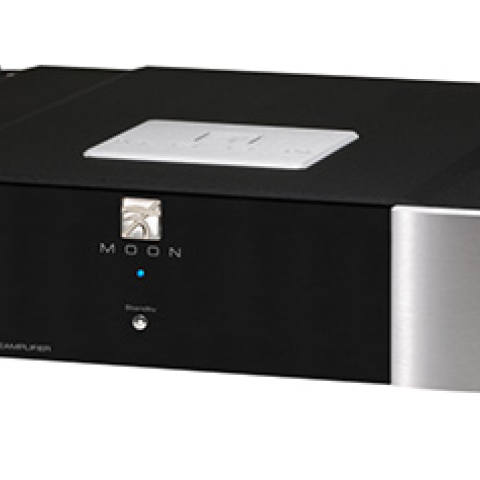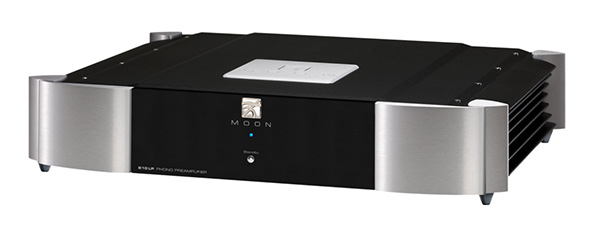
Simaudio entered the phono-preamplifier market in 2007, with the moderately priced Moon LP5.3 ($1400); went down-market with the Moon LP3 ($549); then stepped up its game with the Moon 310LP ($1900), which could be upgraded by adding the 320S outboard power supply ($1400). The company then built on the 310LP's success to develop the Moon 110LP ($650). These climbings up and down the price ladder represent smart marketing, and have yielded benefits trickled down to the patient and budget-conscious audiophile.
Their proven success with phono preamps has encouraged Simaudio to now go way upscale: The Moon Evolution 810LP ($12,000) is the company's no-holds-barred entrant in the premium end of the market, and the first phono preamp in its Evolution line of high-end models.
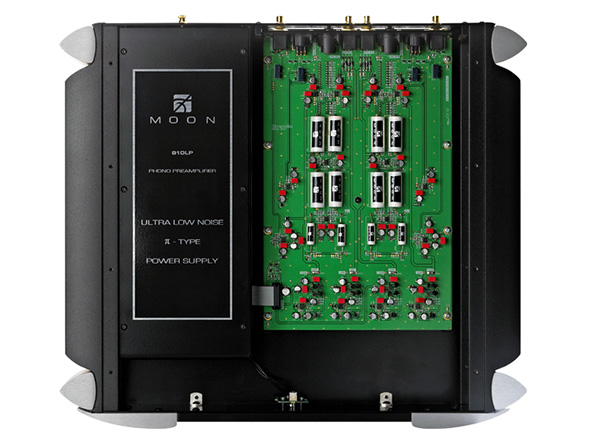
Occupying the same slim, curving case as the Moon Evolution 650D and 750D DAC-transports, the Moon Evolution 810LP is a structurally sound, rigid component weighing 40lb (18kg) and measuring 18.75" (480mm) wide by 4" (100mm) high by 16.81" (430mm) deep. Inside are the power supply, in its own enclosure of 14-gauge steel, and the four-layer circuit board, on which pure copper tracings are printed, the latter mounted on a five-point, gel-based, floating suspension system derived from the Moon Evolution 850P preamplifier.
The circuitry of the dual-mono 810LP is fully balanced. The power supply features a high-quality toroidal power transformer, "pi-type" (capacitor, resistor, capacitor) filtering, multiple voltage-regulation stages, and 40,000µF of capacitance. Simaudio claims power-supply performance that betters that of battery supplies in terms of voltage regulation and signal/noise ratio.
The 810LP's active circuitry includes four stages of Simaudio's Moon Low Voltage (M-LoVo) DC regulation, which uses integrated and discrete parts to produce a claimed noise floor of –150dB relative to 1.0V, DC–100kHz. Matched, 1% tolerance metalized polypropylene film capacitors and other high-quality components are used throughout—as you'd expect in a $12,000 phono preamp.
The 810LP offers unprecedented configurability via an eye-blurring array of DIP switches on its bottom panel, mounted there to provide the shortest signal paths. You have choices of: 64 impedance loads, from 12.1 ohms to 47k ohms; 16 capacitance settings, from 0 to 1120pF; and 16 gain settings, from 40 to 70dB. You can also choose RIAA or IEC equalization, not that there's any reason to forsake the former.
That level of flexibility, and the specification of high input-overload margins, make credible Simaudio's claim that the 810LP will "work with virtually any available phono cartridge."
Roll Over, Beethoven; You Too, U2: Turning the heavy Moon Evolution 810LP on its back reveals the banks of DIP switches, as well as a silkscreened chart showing their 96 settings. It can be disorienting, especially for the spatially challenged. "On" is represented by a white box, "Off" as a black box—but as often as I reminded myself of that while throwing the DIPs with the red plastic stylus Simaudio supplies, I often got confused. Maybe that's just me, but before you flip the unit back on its feet and hook it up, it would be a good idea to triple-check your settings.
Flexibility in gain and loading is a good thing. But, practically speaking, do you need to be able to choose between 39.1 and 40.7 ohms? Are you going to disconnect the 810LP, turn it over, switch from 39.1 to 40.7, turn the unit back over, reconnect, and listen to the difference? Really? You are? Knock yourself out.
I'm in this to play tunes, not play with gear. Of course, if it doesn't sound just right, I can't stand that either, but I've found that, in most cases, a great place to start is to multiply by 10 the cartridge's own internal resistance, then add a bit of margin. And that's usually where I end up—unless it sounds wrong.
 Simaudio doesn't suggest listening to and setting the 810LP's loading and gain with the unit on its back so I didn't try it—but that would make configuring the preamp much more convenient.
More important questions are how much gain your cartridge requires, and how much is too much. Given the 810LP's overload margins for MC cartridges—eg, at 60dB gain, the overloads are 10mV RMS (RCA) and 20mV RMS (XLR)—and considering that 10mV is more than twice the output of a typical moving-magnet cartridge, the chances of overloading the 810LP's input are slim to none. This doesn't mean you shouldn't set the gain with care.
Your present phono preamp might not have such generous overload margins, nor might it be capable of outputting 10/20V RMS (single-ended/balanced)—which you definitely don't want to pump into your line-level preamp. So let me digress here. Ideally, your phono preamp's maximum output should be about 1 or at most 1.5V, compared with the 2V most CDs players max out at. Why? Typical power amplifiers produce full output when driven with between 1.5 and 3V. Most preamplifiers produce unity gain—ie, the input voltage equals the output voltage—with their volume pots at half to two-thirds full. That's a comfortable region within which to operate.
Without getting into the math (mathophobes: logarithms involved), here are some general guidelines: Moving-magnet cartridges, which average around 4.5mV output, require approximately 36dB of gain to produce 1V output. Lower-output MMs (1–3mV) need 43–50dB. Moving-coil cartridges that output between 0.3 and 1mV require 50–60dB of gain, and MCs with really low outputs of 0.15–0.3mV need 60dB or more.
Too little gain and you'll have noise, poor dynamics, and will possibly have to turn your preamp all the way up to get adequate volume, if you get it at all. Too much gain can produce distortion, but even if it doesn't, too much output will restrict your line-level preamp's ability to provide adequate volume adjustability; you might be restricted to the lower, coarser territory of the volume control's taper.
Simaudio doesn't suggest listening to and setting the 810LP's loading and gain with the unit on its back so I didn't try it—but that would make configuring the preamp much more convenient.
More important questions are how much gain your cartridge requires, and how much is too much. Given the 810LP's overload margins for MC cartridges—eg, at 60dB gain, the overloads are 10mV RMS (RCA) and 20mV RMS (XLR)—and considering that 10mV is more than twice the output of a typical moving-magnet cartridge, the chances of overloading the 810LP's input are slim to none. This doesn't mean you shouldn't set the gain with care.
Your present phono preamp might not have such generous overload margins, nor might it be capable of outputting 10/20V RMS (single-ended/balanced)—which you definitely don't want to pump into your line-level preamp. So let me digress here. Ideally, your phono preamp's maximum output should be about 1 or at most 1.5V, compared with the 2V most CDs players max out at. Why? Typical power amplifiers produce full output when driven with between 1.5 and 3V. Most preamplifiers produce unity gain—ie, the input voltage equals the output voltage—with their volume pots at half to two-thirds full. That's a comfortable region within which to operate.
Without getting into the math (mathophobes: logarithms involved), here are some general guidelines: Moving-magnet cartridges, which average around 4.5mV output, require approximately 36dB of gain to produce 1V output. Lower-output MMs (1–3mV) need 43–50dB. Moving-coil cartridges that output between 0.3 and 1mV require 50–60dB of gain, and MCs with really low outputs of 0.15–0.3mV need 60dB or more.
Too little gain and you'll have noise, poor dynamics, and will possibly have to turn your preamp all the way up to get adequate volume, if you get it at all. Too much gain can produce distortion, but even if it doesn't, too much output will restrict your line-level preamp's ability to provide adequate volume adjustability; you might be restricted to the lower, coarser territory of the volume control's taper.
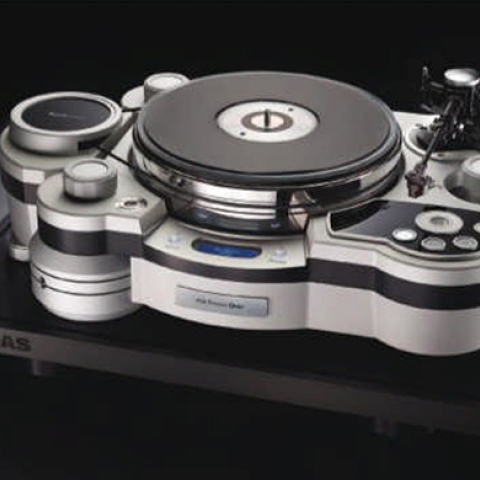
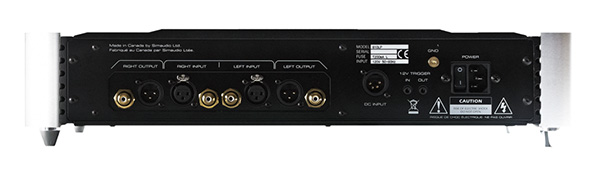 On the Moon Evolution 810LP's rear panel are one pair each of single-ended RCA and balanced XLR inputs and outputs. I used the single-ended outputs because my darTZeel NHB-18NS preamp is optimized for single-ended use. I used the 810LP's balanced inputs with the Graham Engineering Phantom Supreme tonearm, mounted on the Spiral Groove SG 1.1 turntable that I reviewed in the November 2012 issue and fitted with a set of Cardas Golden Cross DIN-to-XLR cables. Also on the 810LP's rear panel is a DC jack for a future outboard power-supply upgrade.
Once you've configured the 810LP's DIP switches, the only control you'll use is the front panel's Standby/On button. Keep in mind that if you frequently switch cartridges, unless those carts have identical electrical characteristics, you'll be unplugging, disconnecting, turning over, and adjusting the 810LP's DIPs every time you swap one out. That will make the 810LP a nonstarter for some—unless they have a second phono preamp for use with their other cartridges.
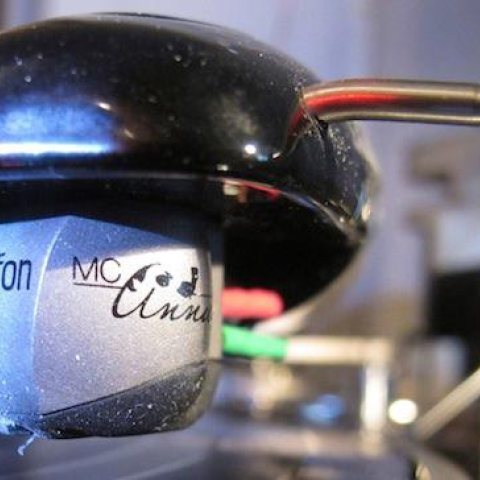
The Sound: Speaking of cartridges, first up was the Ortofon Anna, a low-output (0.2mV) MC with an internal impedance of 6 ohms. I set the 810LP's gain to 62.5dB, the loading to 57.5 ohms.
Like Simaudio's earlier, Moon phono preamps, the 810LP was dead quiet. Even the budget Moons are quiet, but only a few phono preamps, such as Boulder's 1008 and 2008, are this quiet. Music dramatically erupted out of pitch-blackness from today's best-pressed, 180gm, 45rpm LPs. Microdynamics and small dynamic shifts were precisely portrayed, as you'd expect from backgrounds so "black." Not surprisingly, Simaudio claims an impressive signal/noise ratio of 105dB at 60dB gain.
On the Moon Evolution 810LP's rear panel are one pair each of single-ended RCA and balanced XLR inputs and outputs. I used the single-ended outputs because my darTZeel NHB-18NS preamp is optimized for single-ended use. I used the 810LP's balanced inputs with the Graham Engineering Phantom Supreme tonearm, mounted on the Spiral Groove SG 1.1 turntable that I reviewed in the November 2012 issue and fitted with a set of Cardas Golden Cross DIN-to-XLR cables. Also on the 810LP's rear panel is a DC jack for a future outboard power-supply upgrade.
Once you've configured the 810LP's DIP switches, the only control you'll use is the front panel's Standby/On button. Keep in mind that if you frequently switch cartridges, unless those carts have identical electrical characteristics, you'll be unplugging, disconnecting, turning over, and adjusting the 810LP's DIPs every time you swap one out. That will make the 810LP a nonstarter for some—unless they have a second phono preamp for use with their other cartridges.
The Sound: Speaking of cartridges, first up was the Ortofon Anna, a low-output (0.2mV) MC with an internal impedance of 6 ohms. I set the 810LP's gain to 62.5dB, the loading to 57.5 ohms.
Like Simaudio's earlier, Moon phono preamps, the 810LP was dead quiet. Even the budget Moons are quiet, but only a few phono preamps, such as Boulder's 1008 and 2008, are this quiet. Music dramatically erupted out of pitch-blackness from today's best-pressed, 180gm, 45rpm LPs. Microdynamics and small dynamic shifts were precisely portrayed, as you'd expect from backgrounds so "black." Not surprisingly, Simaudio claims an impressive signal/noise ratio of 105dB at 60dB gain.
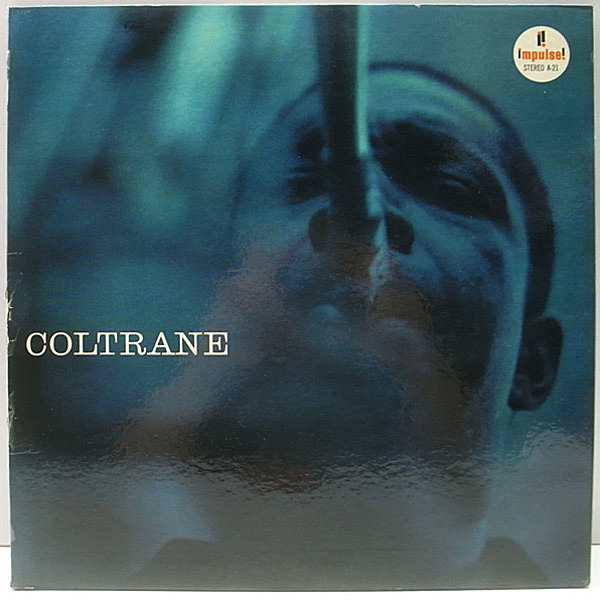 The 810LP's other immediately noticeable quality was the precision of its overall transient response and its freedom from glaze, glare, and smear. A friend gave me a mint original pressing of John Coltrane's Coltrane (LP, Impulse! A-21), a 1962 recording engineered and mastered by Rudy Van Gelder in Englewood Cliffs, New Jersey. My friend had picked it up for $6 at an antique store.
Elvin Jones's cymbal work was reproduced with utmost precision and clarity. The cymbals rang and chimed aggressively and naturally, with fierce, clean attacks, somewhat stingy sustain, and clean but fast decay. The tonality, while appropriately bright, was never overaccentuated.
Jimmy Garrison's double bass was equally nimble, and superbly defined physically, while Coltrane's sax blasts were appropriately sharp and brassy, if not the last word in reediness—something particularly obvious with the somewhat opaque-sounding soprano he plays on "Inchworm."
In terms of black backgrounds, top-to-bottom transient response, image definition, dynamic contrasts at both ends of the scale, and rhythm'n'pacing, the Moon Evolution 810LP was worth its considerable price. It was a model of rhythmic and spatial organization.
Also commensurate with the 810LP's price were its bottom-end dynamic punch and nimbleness, though it was bettered in those regards, as best I can recall, by the big Boulder 2008 ($36,000) and the Vitus MP-P201 Masterpiece ($60,000), both of which cost much more and both of which are in the same sonic camp. Both of those models were startling; the 810LP was merely impressive.
The 810LP's most obvious strong suits were its transparency and its transient cleanness. It set up a wide, reasonably deep soundstage that, no matter how bright and hard the recording, never jumped closer than the speakers' front baffles and was never harsh or edgy or etchy—unless the recording was.
Interestingly, though the 810LP produced naturally sharp and clean high-frequency transients that were as speedy as I could want or imagine, and that those in the tube camp will no doubt find too aggressive, its top end wasn't as fully airy and extended as that of the far more expensive Ypsilon VPS-100 ($26,000) with MC-16 transformer ($2800). I did open up the 810LP's loading to as much as 500 and 1000 ohms while running both the Ortofon Anna and the Lyra Atlas with no change in my findings.
The 810LP's other immediately noticeable quality was the precision of its overall transient response and its freedom from glaze, glare, and smear. A friend gave me a mint original pressing of John Coltrane's Coltrane (LP, Impulse! A-21), a 1962 recording engineered and mastered by Rudy Van Gelder in Englewood Cliffs, New Jersey. My friend had picked it up for $6 at an antique store.
Elvin Jones's cymbal work was reproduced with utmost precision and clarity. The cymbals rang and chimed aggressively and naturally, with fierce, clean attacks, somewhat stingy sustain, and clean but fast decay. The tonality, while appropriately bright, was never overaccentuated.
Jimmy Garrison's double bass was equally nimble, and superbly defined physically, while Coltrane's sax blasts were appropriately sharp and brassy, if not the last word in reediness—something particularly obvious with the somewhat opaque-sounding soprano he plays on "Inchworm."
In terms of black backgrounds, top-to-bottom transient response, image definition, dynamic contrasts at both ends of the scale, and rhythm'n'pacing, the Moon Evolution 810LP was worth its considerable price. It was a model of rhythmic and spatial organization.
Also commensurate with the 810LP's price were its bottom-end dynamic punch and nimbleness, though it was bettered in those regards, as best I can recall, by the big Boulder 2008 ($36,000) and the Vitus MP-P201 Masterpiece ($60,000), both of which cost much more and both of which are in the same sonic camp. Both of those models were startling; the 810LP was merely impressive.
The 810LP's most obvious strong suits were its transparency and its transient cleanness. It set up a wide, reasonably deep soundstage that, no matter how bright and hard the recording, never jumped closer than the speakers' front baffles and was never harsh or edgy or etchy—unless the recording was.
Interestingly, though the 810LP produced naturally sharp and clean high-frequency transients that were as speedy as I could want or imagine, and that those in the tube camp will no doubt find too aggressive, its top end wasn't as fully airy and extended as that of the far more expensive Ypsilon VPS-100 ($26,000) with MC-16 transformer ($2800). I did open up the 810LP's loading to as much as 500 and 1000 ohms while running both the Ortofon Anna and the Lyra Atlas with no change in my findings.
 Playing a recent and spectacular-sounding reissue of Dave Brubeck's Time Out (two 45rpm LPs, Columbia/Analogue Productions APJ 8192-45) through the Ypsilon and the Simaudio made clear that the 810LP had somewhat tighter and better-controlled bass definition, but less extension and less textural definition at both frequency extremes, less air, and a somewhat less expansive but still superbly focused soundstage. The 810LP was drier than the Ypsilon at both ends of the audioband, which was hardly surprising: the Ypsilon employs a vacuum tube.
As in other comparisons of top-quality solid-state and tubed phono preamps, the 810LP was more boldly analytical than texturally graceful: more precise with transients, less generous in sustain and decay; more bow on string than resonant wooden body; more vocal cords, less chest. In short, the 810LP retains Simaudio's house sound, if the very similar and equally pleasing Moon Evolution 650D DAC-transport is a reliable indicator of that sound.
Ortofon's Anna is not analytical, nor is the latest version of the ultra-low-inductance Haniwa HCTR01, though both cartridges are ultradetailed, and subjectively more linear than romantic. When I switched to the HCTR01 from the Anna, the 810LP's sonic character was unchanged.
The Lyra Atlas is somewhat more to the point, yet it, too, was very well served by the 810LP, particularly in terms of dynamic expression and transient clarity. It never sounded bright or hard, just fast, detailed, and ultraclean.
Still, I think the 810LP would be better suited to warmer, more romantic cartridges than to faster, leaner ones—depending, of course, on the present sound of your system and what direction you might want that sound to go in.
Playing a recent and spectacular-sounding reissue of Dave Brubeck's Time Out (two 45rpm LPs, Columbia/Analogue Productions APJ 8192-45) through the Ypsilon and the Simaudio made clear that the 810LP had somewhat tighter and better-controlled bass definition, but less extension and less textural definition at both frequency extremes, less air, and a somewhat less expansive but still superbly focused soundstage. The 810LP was drier than the Ypsilon at both ends of the audioband, which was hardly surprising: the Ypsilon employs a vacuum tube.
As in other comparisons of top-quality solid-state and tubed phono preamps, the 810LP was more boldly analytical than texturally graceful: more precise with transients, less generous in sustain and decay; more bow on string than resonant wooden body; more vocal cords, less chest. In short, the 810LP retains Simaudio's house sound, if the very similar and equally pleasing Moon Evolution 650D DAC-transport is a reliable indicator of that sound.
Ortofon's Anna is not analytical, nor is the latest version of the ultra-low-inductance Haniwa HCTR01, though both cartridges are ultradetailed, and subjectively more linear than romantic. When I switched to the HCTR01 from the Anna, the 810LP's sonic character was unchanged.
The Lyra Atlas is somewhat more to the point, yet it, too, was very well served by the 810LP, particularly in terms of dynamic expression and transient clarity. It never sounded bright or hard, just fast, detailed, and ultraclean.
Still, I think the 810LP would be better suited to warmer, more romantic cartridges than to faster, leaner ones—depending, of course, on the present sound of your system and what direction you might want that sound to go in.
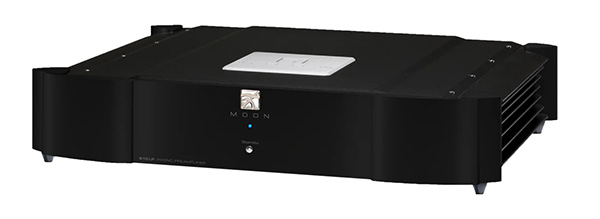 Summing Up: Simaudio's Moon Evolution 810LP gave me maximum quiet; exceptional transparency; precise, fast, clean transients that were never hard or etchy; muscular macrodynamics; delicate, refined microdynamics; tonally neutral but less-than-generous harmonic structures; modest sustain; fast but clean decay; and a somewhat dry, cool overall sound. It was a commendably blank slate on which you can paint with your favorite "colorful" cartridge.
Listening to a variety of cartridges at many different loading settings, and using Wilson Audio Specialties' XLF loudspeakers, I finished my appraisal of the 810LP more respectful and impressed than in love. But you know what Tina Turner says.
Fono Acustica Sinfo power distributor
Summing Up: Simaudio's Moon Evolution 810LP gave me maximum quiet; exceptional transparency; precise, fast, clean transients that were never hard or etchy; muscular macrodynamics; delicate, refined microdynamics; tonally neutral but less-than-generous harmonic structures; modest sustain; fast but clean decay; and a somewhat dry, cool overall sound. It was a commendably blank slate on which you can paint with your favorite "colorful" cartridge.
Listening to a variety of cartridges at many different loading settings, and using Wilson Audio Specialties' XLF loudspeakers, I finished my appraisal of the 810LP more respectful and impressed than in love. But you know what Tina Turner says.
Fono Acustica Sinfo power distributor
Would you pay $10,000 for a power strip? Probably not, but the folks at Fono Acustica (footnote 2) believe there are just enough maybes out there to design and market one. The Sinfo is a curvaceous, unusually attractive, six-outlet power strip made of solid Panzerholz (Tankwood), a "high tech natural wood product" manufactured at a single German factory. Fono Acustica claims that Tankwood "protects from not only vibration but also electric-magnetic wave or external noise contamination." (Roll your eyes now.) The six outlets are top-of-the line Oyaide Supremes, while the IEC connector is Oyaide's "R" power inlet. The shell is 30% glass-filled polybutylene terephthalate polyester (PBT), which is said to be durable, and to resist heat and absorb vibrations. The blades are trimmed down from a phosphor-bronze slab, hand-polished, then plated with a combination of platinum and palladium. That's a lot of effort to produce an IEC jack.
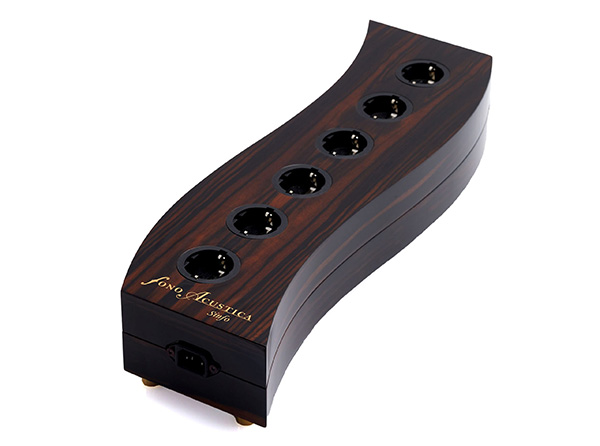 Less is more, and Fono Acustica makes you pay for the privilege: The Sinfo contains no capacitors, inductive filters, or transformers (which I think is a good thing). Instead, the outlets are connected with wire that Fono Acustica describes as "thermo-treated precious metal conductors blended in proprietary ratios . . . in massive bundles, deployed on both hot and neutral sides of ground . . . [using] special geometry that must be formed by hand and air insulated dielectrics with ultra-effective shielding."
And that's what you get for your $10,000—more than many spend on an entire system. This product is not aimed at them.
-er vs Blind Tests: Blind listening tests, in my experience and opinion, often produce stupid results—as when recording engineers couldn't distinguish between a lush-sounding VTL 300 power amplifier and an ear-bleeding Crown DC300. That occurred during a blind test in which I participated some years back. I think an -er test, in which test subjects can see which components they're comparing and are asked to rate them on a scale of sliding -ers (darker/brighter, richer/thinner, etc.), produces more useful results. Audition, make private notes, and compare results. If there's consensus, you're getting somewhere.
I had the Sinfo here for the same few months I also had a second Shunyata Research Hydra Triton power distributor ($4995, see "Analog Corner," January 2012). I went back and forth between the two, plugging my amplifiers into each and into the wall, and listening. Is this what a grown man does with his time? Well, this one does.
I set up the same test for friends and an industry person or two, without saying anything about my own preferences, and asking them what differences they heard, if any. Every one of them described what they heard in more or less the words I'd used (but hadn't said to them): Compared to the system's sound when plugged into the wall, the Shunyata Triton provided blacker backgrounds, better bottom-end control, and an overall "cleanness" that everyone heard, whether they liked it or thought it too sterile and austere. Compared to the system's sound when plugged into the wall, they said the Fono Acustica Sinfo sounded "lusher," "richer," "sweeter," "more beautiful," etc. Which is what I'd heard. To others, the Sinfo sounded too saccharine.
Was the wall sound "correct," and the system's sound when plugged into either the Triton or the Sinfo the result of additive or subtractive colorations? I don't know, but for whatever reason or reasons, Fono Acustica's AC and speaker cables did the same thing as the Sinfo. The one word that always came to my mind was lush.
I thought the sound through the Triton was more honest than the wall sound. As a reviewer, I'm not interested in listening to my system through rose-tinted hearing aids. However, some megabuck systems might need such roadside beautification, and adding a Sinfo might be less expensive than replacing an expensive component. As for why a block of wood containing six high-quality outlets connected with short runs of exotic wire produced such results, don't ask me. I just know it did.
Less is more, and Fono Acustica makes you pay for the privilege: The Sinfo contains no capacitors, inductive filters, or transformers (which I think is a good thing). Instead, the outlets are connected with wire that Fono Acustica describes as "thermo-treated precious metal conductors blended in proprietary ratios . . . in massive bundles, deployed on both hot and neutral sides of ground . . . [using] special geometry that must be formed by hand and air insulated dielectrics with ultra-effective shielding."
And that's what you get for your $10,000—more than many spend on an entire system. This product is not aimed at them.
-er vs Blind Tests: Blind listening tests, in my experience and opinion, often produce stupid results—as when recording engineers couldn't distinguish between a lush-sounding VTL 300 power amplifier and an ear-bleeding Crown DC300. That occurred during a blind test in which I participated some years back. I think an -er test, in which test subjects can see which components they're comparing and are asked to rate them on a scale of sliding -ers (darker/brighter, richer/thinner, etc.), produces more useful results. Audition, make private notes, and compare results. If there's consensus, you're getting somewhere.
I had the Sinfo here for the same few months I also had a second Shunyata Research Hydra Triton power distributor ($4995, see "Analog Corner," January 2012). I went back and forth between the two, plugging my amplifiers into each and into the wall, and listening. Is this what a grown man does with his time? Well, this one does.
I set up the same test for friends and an industry person or two, without saying anything about my own preferences, and asking them what differences they heard, if any. Every one of them described what they heard in more or less the words I'd used (but hadn't said to them): Compared to the system's sound when plugged into the wall, the Shunyata Triton provided blacker backgrounds, better bottom-end control, and an overall "cleanness" that everyone heard, whether they liked it or thought it too sterile and austere. Compared to the system's sound when plugged into the wall, they said the Fono Acustica Sinfo sounded "lusher," "richer," "sweeter," "more beautiful," etc. Which is what I'd heard. To others, the Sinfo sounded too saccharine.
Was the wall sound "correct," and the system's sound when plugged into either the Triton or the Sinfo the result of additive or subtractive colorations? I don't know, but for whatever reason or reasons, Fono Acustica's AC and speaker cables did the same thing as the Sinfo. The one word that always came to my mind was lush.
I thought the sound through the Triton was more honest than the wall sound. As a reviewer, I'm not interested in listening to my system through rose-tinted hearing aids. However, some megabuck systems might need such roadside beautification, and adding a Sinfo might be less expensive than replacing an expensive component. As for why a block of wood containing six high-quality outlets connected with short runs of exotic wire produced such results, don't ask me. I just know it did.
Footnote 1: Simaudio Ltd., 1345 Newton Rd., Boucherville, Quebec J4B 5H2, Canada. Tel: (877) 980-2400. Web: www.simaudio.com Footnote 2: Fono Acustica, Andalucía, Spain. Web: www.Fono-acustica.com. US distributor (2012): HiFi One, Carlsbad, CA. Tel: (612) 817-1599. Web: www.rbhifi1.com/
Simaudio doesn't suggest listening to and setting the 810LP's loading and gain with the unit on its back so I didn't try it—but that would make configuring the preamp much more convenient.
More important questions are how much gain your cartridge requires, and how much is too much. Given the 810LP's overload margins for MC cartridges—eg, at 60dB gain, the overloads are 10mV RMS (RCA) and 20mV RMS (XLR)—and considering that 10mV is more than twice the output of a typical moving-magnet cartridge, the chances of overloading the 810LP's input are slim to none. This doesn't mean you shouldn't set the gain with care.
On the Moon Evolution 810LP's rear panel are one pair each of single-ended RCA and balanced XLR inputs and outputs. I used the single-ended outputs because my darTZeel NHB-18NS preamp is optimized for single-ended use. I used the 810LP's balanced inputs with the Graham Engineering Phantom Supreme tonearm, mounted on the Spiral Groove SG 1.1 turntable that I reviewed in the November 2012 issue and fitted with a set of Cardas Golden Cross DIN-to-XLR cables. Also on the 810LP's rear panel is a DC jack for a future outboard power-supply upgrade.
Once you've configured the 810LP's DIP switches, the only control you'll use is the front panel's Standby/On button. Keep in mind that if you frequently switch cartridges, unless those carts have identical electrical characteristics, you'll be unplugging, disconnecting, turning over, and adjusting the 810LP's DIPs every time you swap one out. That will make the 810LP a nonstarter for some—unless they have a second phono preamp for use with their other cartridges.
The Sound: Speaking of cartridges, first up was the Ortofon Anna, a low-output (0.2mV) MC with an internal impedance of 6 ohms. I set the 810LP's gain to 62.5dB, the loading to 57.5 ohms.
The 810LP's other immediately noticeable quality was the precision of its overall transient response and its freedom from glaze, glare, and smear. A friend gave me a mint original pressing of John Coltrane's Coltrane (LP, Impulse! A-21), a 1962 recording engineered and mastered by Rudy Van Gelder in Englewood Cliffs, New Jersey. My friend had picked it up for $6 at an antique store.
Elvin Jones's cymbal work was reproduced with utmost precision and clarity. The cymbals rang and chimed aggressively and naturally, with fierce, clean attacks, somewhat stingy sustain, and clean but fast decay. The tonality, while appropriately bright, was never overaccentuated.
Playing a recent and spectacular-sounding reissue of Dave Brubeck's Time Out (two 45rpm LPs, Columbia/Analogue Productions APJ 8192-45) through the Ypsilon and the Simaudio made clear that the 810LP had somewhat tighter and better-controlled bass definition, but less extension and less textural definition at both frequency extremes, less air, and a somewhat less expansive but still superbly focused soundstage. The 810LP was drier than the Ypsilon at both ends of the audioband, which was hardly surprising: the Ypsilon employs a vacuum tube.
Summing Up: Simaudio's Moon Evolution 810LP gave me maximum quiet; exceptional transparency; precise, fast, clean transients that were never hard or etchy; muscular macrodynamics; delicate, refined microdynamics; tonally neutral but less-than-generous harmonic structures; modest sustain; fast but clean decay; and a somewhat dry, cool overall sound. It was a commendably blank slate on which you can paint with your favorite "colorful" cartridge.
Listening to a variety of cartridges at many different loading settings, and using Wilson Audio Specialties' XLF loudspeakers, I finished my appraisal of the 810LP more respectful and impressed than in love. But you know what Tina Turner says.
Would you pay $10,000 for a power strip? Probably not, but the folks at Fono Acustica (footnote 2) believe there are just enough maybes out there to design and market one. The Sinfo is a curvaceous, unusually attractive, six-outlet power strip made of solid Panzerholz (Tankwood), a "high tech natural wood product" manufactured at a single German factory. Fono Acustica claims that Tankwood "protects from not only vibration but also electric-magnetic wave or external noise contamination." (Roll your eyes now.) The six outlets are top-of-the line Oyaide Supremes, while the IEC connector is Oyaide's "R" power inlet. The shell is 30% glass-filled polybutylene terephthalate polyester (PBT), which is said to be durable, and to resist heat and absorb vibrations. The blades are trimmed down from a phosphor-bronze slab, hand-polished, then plated with a combination of platinum and palladium. That's a lot of effort to produce an IEC jack.
Less is more, and Fono Acustica makes you pay for the privilege: The Sinfo contains no capacitors, inductive filters, or transformers (which I think is a good thing). Instead, the outlets are connected with wire that Fono Acustica describes as "thermo-treated precious metal conductors blended in proprietary ratios . . . in massive bundles, deployed on both hot and neutral sides of ground . . . [using] special geometry that must be formed by hand and air insulated dielectrics with ultra-effective shielding."
And that's what you get for your $10,000—more than many spend on an entire system. This product is not aimed at them.
-er vs Blind Tests: Blind listening tests, in my experience and opinion, often produce stupid results—as when recording engineers couldn't distinguish between a lush-sounding VTL 300 power amplifier and an ear-bleeding Crown DC300. That occurred during a blind test in which I participated some years back. I think an -er test, in which test subjects can see which components they're comparing and are asked to rate them on a scale of sliding -ers (darker/brighter, richer/thinner, etc.), produces more useful results. Audition, make private notes, and compare results. If there's consensus, you're getting somewhere.
Footnote 1: Simaudio Ltd., 1345 Newton Rd., Boucherville, Quebec J4B 5H2, Canada. Tel: (877) 980-2400. Web: www.simaudio.com Footnote 2: Fono Acustica, Andalucía, Spain. Web: www.Fono-acustica.com. US distributor (2012): HiFi One, Carlsbad, CA. Tel: (612) 817-1599. Web: www.rbhifi1.com/