There are incredible values in audio, and then there are incredible values. The ones that deserve italics are those like Pioneer's SP-FS52 floorstanding speaker, designed by TAD's Andrew Jones and recently reviewed. I covered them on analogplanet.com because I've received so many e-mails from freshly minted (sorry) young vinyl enthusiasts looking to trade up from their computer speakers. Vinyl has that effect on the soul.
Only $360—and often much less—will buy you a pair of SP-FS52s, which deliver more than a whiff of what high-end sound is all about. The online blowback I received for having dared to review a budget product has been exceeded only by the blowback I regularly get for reviewing super-expensive stuff.
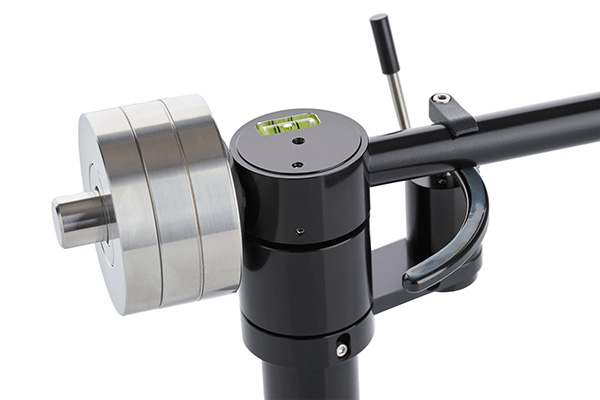
 AMG Viella 12 turntable and 12J2 tonearm
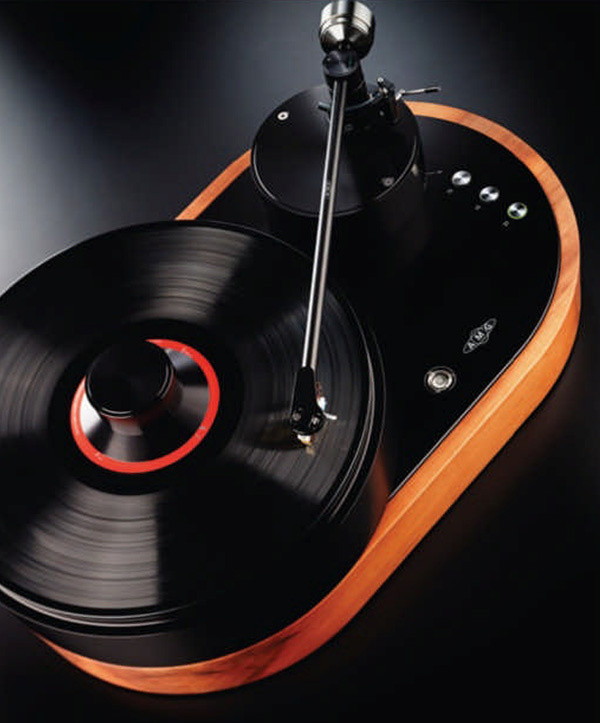
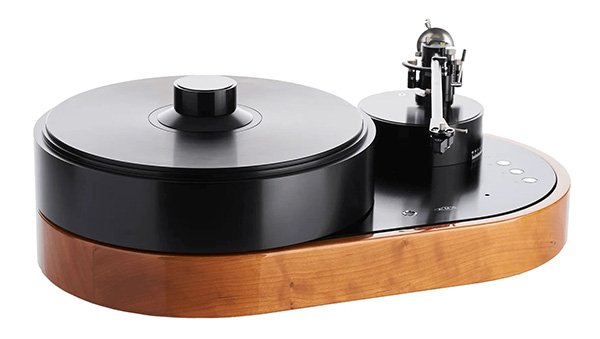
The Viella 12 belt-drive turntable and the 12J2, its 12"-long tonearm, from Analog Manufaktur Germany (AMG; footnote 1), is also an incredible value. (No $16,500 turntable gets italics, even with a tonearm thrown in.)
Sadly, the turntable's chief designer, Werner Roeschlau, died unexpectedly last February, at age 62. The news came as a shock; I'd spent time with him at the 2013 Consumer Electronics Show, learning all about his unique design, and found him to be a sweet, humble guy. Roeschlau's son, Julian Lorenzi, a trained mechanical engineer, with whom he codesigned the V12 and 12J2, takes over as managing director. Lorenzi was already overseeing production at AMG's factory, north of Munich, Germany, as well as day-to-day operations, so the transition should be smooth, however personally painful. The pair also codeveloped other products that will soon appear, including the 9J2, a 9" version of the tonearm compatible with many other turntables, and a direct replacement for, among others, the Rega, Linn, and Clearaudio arms introduced at Munich's High End 2013 show.
Superficially at least, the Viella 12 looks like a turntable that might have come from the house of Brinkmann. That's because, according to AMG's website, for more than a decade Roeschlau's factory produced "key precision parts for some of the world's most highly regarded turntables," including Brinkmanns.
As in those big Brinkmann 'tables, the machining and fit'n'finish of the V12 are stellar, and dominated by a massive platter. This one is a two-piece sandwich of black-anodized, aircraft-grade aluminum, 12.5" in diameter and weighing 24.25lb. It has a weighted rim to increase the flywheel effect, a top surface of PVC, a decoupled spindle, and a true inverted, threaded reflex clamp of anodized aluminum.
The Viella 12's total weight, including platter, is 56.4lb, and its overall dimensions are 20 5/8" wide by 8" high by 12 7/16" deep. The ellipsoid-shaped plinth is made of aircraft-grade aluminum. Inside this, between the tonearm and the platter bearing, is the motor: a two-pulse, brushless, low-speed, precision 24V DC model, acoustically decoupled from the plinth by five mounts of rubber and metal. The motor has sintered bronze bearings and a cured and polished axis, and bears Lorenzi's name; I assume he designed it. The motor controller is outboard, in a small, black box.
The massive platter bearing is an example of machining excellence: a small stainless-steel subplatter sits atop a hardened-steel axle 16mm in diameter, which rides on two sealed, hydrodynamically lubricated radial bearings. The statically lubricated axial thrust bearing rides on a pad of generous size. When the main platter is fitted atop the subplatter, the polished-steel motor pulley beneath is no longer visible, hidden in the space between the platter's weighted rim and inner hub.
The tonearm mount is a large-diameter, rotatable, bayonet type machined of solid aluminum, with a convenient built-in gauge for setting pivot-to-spindle distance.
Next to the arm mount, at the open end of the plinth, are three backlit capacitively operated buttons (as on the Philips 212, which oldsters will remember), one each for 33 1/3, 45, and 78rpm. Each of these speeds can be adjusted by holding down its button for five seconds, then using the remaining two buttons to raise or lower the speed. Tiny screwdrivers not needed. I like that.
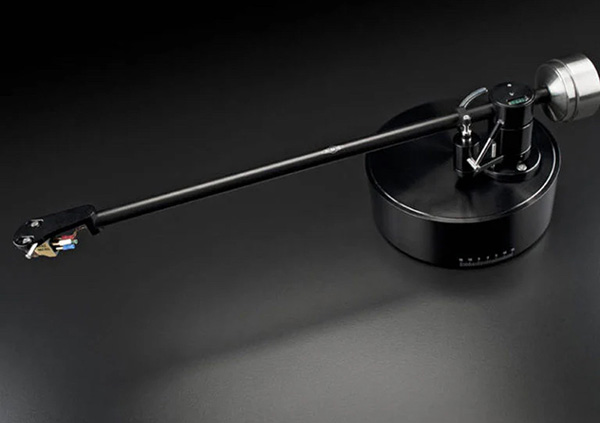 12J2 tonearm: This 12"-long arm has a unique, dual-pivot, vertical bearing system that uses springs of 0.5mm-diameter steel wire—similar to those used in helicopter rotor heads, says AMG—instead of the usual gimbaled variety. Thus, no chatter is possible.
Adjusting a cartridge's azimuth is easily accomplished: Loosen a side-mounted locking screw at the pivot and, with a screw on the top of the pivot, vary the height of one vertical bearing relative to the other. The horizontal motion bearing (mounted vertically) is more conventional: an axle of hardened tool steel with a needle roller bearing.
The anodized-aluminum armtube has an effective mass of 12gm, and the wire inside it is made of multiple gauges of copper. A Teflon sleeve decouples the two-piece counterweight. The decoupled magnetic antiskating system has one ring magnet and two bar magnets, their fields carefully isolated within the bearing housing.
A cylindrical threaded riser and a precision locking system produce slop-free adjustments of vertical tracking angle (VTA) during play. The bottom of the arm post is fitted with a five-pin DIN jack that requires a vertically oriented DIN plug attached to a flexible neck, so that it can be bent and threaded through an opening in the side of the plinth. That arrangement limited me to the DIN-to-RCA cable AMG supplies, so I couldn't ascertain what effect the latter had on the sound.
Every way of adjusting a tonearm has been carefully considered and made possible with fresh ideas skillfully applied. Could you ask for more? Yes—that it perform well, and sound good, too!
12J2 tonearm: This 12"-long arm has a unique, dual-pivot, vertical bearing system that uses springs of 0.5mm-diameter steel wire—similar to those used in helicopter rotor heads, says AMG—instead of the usual gimbaled variety. Thus, no chatter is possible.
Adjusting a cartridge's azimuth is easily accomplished: Loosen a side-mounted locking screw at the pivot and, with a screw on the top of the pivot, vary the height of one vertical bearing relative to the other. The horizontal motion bearing (mounted vertically) is more conventional: an axle of hardened tool steel with a needle roller bearing.
The anodized-aluminum armtube has an effective mass of 12gm, and the wire inside it is made of multiple gauges of copper. A Teflon sleeve decouples the two-piece counterweight. The decoupled magnetic antiskating system has one ring magnet and two bar magnets, their fields carefully isolated within the bearing housing.
A cylindrical threaded riser and a precision locking system produce slop-free adjustments of vertical tracking angle (VTA) during play. The bottom of the arm post is fitted with a five-pin DIN jack that requires a vertically oriented DIN plug attached to a flexible neck, so that it can be bent and threaded through an opening in the side of the plinth. That arrangement limited me to the DIN-to-RCA cable AMG supplies, so I couldn't ascertain what effect the latter had on the sound.
Every way of adjusting a tonearm has been carefully considered and made possible with fresh ideas skillfully applied. Could you ask for more? Yes—that it perform well, and sound good, too!
 Setup: Reasonably good instructions and an impressively well-thought-out design made unpacking and setting up the AMG a pleasurable experience. Julian Lorenzi and I, with Garth Leerer, from AMG's US distributor, Musical Surroundings, together set up the Viella 12 and 12J2, and installed in the latter a Clearaudio Goldfinger Statement cartridge.
The Viella 12's unsuspended, mass-loaded design means that its sound will greatly depend on what it sits on. I used an oversize Harmonic Resolution Systems M3-1925 base on an HRS MXR Signature stand. After using the V12's built-in spirit level to check that it was level, I unscrewed the three tiny points recessed into the bottom of the plinth, and evenly raised its bottom off the base's surface.
Because the V12's drive belt rides on an inner hub and a motor pulley that are both made inaccessible by the platter, a special tool is required to pull the belt beyond the outer platter's diameter. With the belt around the hub and the tool stretching the belt, you lower the platter directly over the subplatter, onto two wooden spacers that raise the platter enough to let you slide the belt down off the tool, allowing it to snap into place on the pulley. Carefully remove the spacers and the platter falls into place. Platter spinning, the V12 looks like a direct- or rim-drive turntable.
If you're used to setting up clunky, bruiser tonearms, AMG's very compact, wristwatch-like 12J2 will require a period of adjustment. Its vertical bearing really is a spring, as you'll feel while balancing the arm. Its bouncy behavior takes some getting used to, as you'll discover when setting the cartridge's vertical tracking force (VTF), but you'll come to appreciate the precision and responsiveness of the various adjustment mechanisms. However, because the I2J2's long cantilever juts far past the edge of the plinth, you've got to be careful not to bump it.
As I looked at the AMG 'table and arm, now completely set up, it seemed to scream "Money well spent! Good choice! Let's play records!"
Sounds As Good As It Looks: I'd reviewed the Clearaudio Goldfinger Statement cartridge ($15,000) in my September 2012 column, and so had a fairly clear recollection of its sound as installed in Continuum Audio Labs' Cobra tonearm and Caliburn turntable; to refresh those memories, I reread my column.
Installed in the AMG, this sample of the Goldfinger struck me as sounding somewhat smoother and sweeter than the original. Though the new sample may have given up a little to the other in terms of transient snap and attack speed, and its ability to starkly separate out individual three-dimensional images was not quite as startling, it more than compensated for this with a lusher midband that jelled the tonal picture from top to bottom.
Of course, when that observation was made, it was impossible to know whether what I was hearing was a result of the 'table's or the tonearm's or the cartridge's performance, or the interaction of all three. Whichever was contributing to which, the overall sound held together remarkably well and exhibited exceptional transparency and freedom from mechanical artifacts. The AMG-Clearaudio combo was rhythmically agile, with an attractive "jump" factor aided by nimble, well-defined bass, though bass lines weren't as deeply executed as with the much bigger, and 10 times more expensive, Caliburn rig.
As long as the front end was unfamiliar, why not also play unfamiliar records, to enjoy what sonic pleasures (or lack thereof) could be had, before reverting to the usual suspects?
Setup: Reasonably good instructions and an impressively well-thought-out design made unpacking and setting up the AMG a pleasurable experience. Julian Lorenzi and I, with Garth Leerer, from AMG's US distributor, Musical Surroundings, together set up the Viella 12 and 12J2, and installed in the latter a Clearaudio Goldfinger Statement cartridge.
The Viella 12's unsuspended, mass-loaded design means that its sound will greatly depend on what it sits on. I used an oversize Harmonic Resolution Systems M3-1925 base on an HRS MXR Signature stand. After using the V12's built-in spirit level to check that it was level, I unscrewed the three tiny points recessed into the bottom of the plinth, and evenly raised its bottom off the base's surface.
Because the V12's drive belt rides on an inner hub and a motor pulley that are both made inaccessible by the platter, a special tool is required to pull the belt beyond the outer platter's diameter. With the belt around the hub and the tool stretching the belt, you lower the platter directly over the subplatter, onto two wooden spacers that raise the platter enough to let you slide the belt down off the tool, allowing it to snap into place on the pulley. Carefully remove the spacers and the platter falls into place. Platter spinning, the V12 looks like a direct- or rim-drive turntable.
If you're used to setting up clunky, bruiser tonearms, AMG's very compact, wristwatch-like 12J2 will require a period of adjustment. Its vertical bearing really is a spring, as you'll feel while balancing the arm. Its bouncy behavior takes some getting used to, as you'll discover when setting the cartridge's vertical tracking force (VTF), but you'll come to appreciate the precision and responsiveness of the various adjustment mechanisms. However, because the I2J2's long cantilever juts far past the edge of the plinth, you've got to be careful not to bump it.
As I looked at the AMG 'table and arm, now completely set up, it seemed to scream "Money well spent! Good choice! Let's play records!"
Sounds As Good As It Looks: I'd reviewed the Clearaudio Goldfinger Statement cartridge ($15,000) in my September 2012 column, and so had a fairly clear recollection of its sound as installed in Continuum Audio Labs' Cobra tonearm and Caliburn turntable; to refresh those memories, I reread my column.
Installed in the AMG, this sample of the Goldfinger struck me as sounding somewhat smoother and sweeter than the original. Though the new sample may have given up a little to the other in terms of transient snap and attack speed, and its ability to starkly separate out individual three-dimensional images was not quite as startling, it more than compensated for this with a lusher midband that jelled the tonal picture from top to bottom.
Of course, when that observation was made, it was impossible to know whether what I was hearing was a result of the 'table's or the tonearm's or the cartridge's performance, or the interaction of all three. Whichever was contributing to which, the overall sound held together remarkably well and exhibited exceptional transparency and freedom from mechanical artifacts. The AMG-Clearaudio combo was rhythmically agile, with an attractive "jump" factor aided by nimble, well-defined bass, though bass lines weren't as deeply executed as with the much bigger, and 10 times more expensive, Caliburn rig.
As long as the front end was unfamiliar, why not also play unfamiliar records, to enjoy what sonic pleasures (or lack thereof) could be had, before reverting to the usual suspects?
 From a shelf of unplayed classical LPs I pulled one at random: pianist Leon Fleisher with George Szell and the Cleveland Orchestra in performances of the Grieg and Schumann piano concertos (Epic BC 1080).
Rumor has it that Szell kept his AR-3a speakers under his couch: he'd listen to acetates and ask for more treble. No wonder many of his Epic recordings with the Cleveland sound harsh, metallic, and spatially diffuse. I figured that this one probably would, too, and be dynamically compressed, given its playing times of about 30 minutes per side; throw in some distortion for good measure.
But no! However it was miked, the recording was from a front-of-balcony perspective, but the piano sound was mesmerizingly convincing, and not at all muffled or indistinct or metallic, as I'd expected: Fleisher's touch on the keys was reproduced with great precision and delicacy, with a profusion of microdynamic contrasts, despite the less-than-pitch-black vinyl noise floor (not the AMG's fault). The piano's tonality, and its physical focus in the reverberant Severance Hall, were precisely and richly drawn—and, for anyone who's ever heard a piano concerto in such a space, absolutely believable. Particularly impressive was the reproduction of Fleisher's pianissimo playing. The most delicate touches of fingers on keys were reproduced with an appropriately soft yet cleanly delineated attack and a feathery sustain.
The hall's ambience was not as fully fleshed out as I would later hear it with the Continuum rig with the Goldfinger Statement, but the coherence of the entire sound—especially its dense, rich midband, the precision of attacks, the grace of decays—indicated a turntable that had all its shit together big time, as they say in sophisticated audiophile circles.
Before switching to the more familiar Lyra Atlas cartridge, I measured the AMG tonearm and cartridge to see if their nimble but not fully extended bass was a result of too high a resonant frequency. After all, the arm is relatively light, and the +3gm recommended VTF of the 13.96gm Goldfinger (I weighed it) would indicate a low suspension compliance. But the horizontal and vertical resonant frequencies were both in the desired range of 8–12Hz, so the 12J2 arm is good to go with low-compliance cartridges.
Atlas Didn't Shrug: The Lyra Atlas's sound was better engraved in my memory, so once I'd installed it in the 12J2—it was the first cartridge I'd installed entirely by myself in the AMG arm, and the procedure was a mechanical pleasure—I sat down with specific expectations in mind. This time, I first played a series of very familiar recordings. What I heard was an Atlas that sounded more like a Lyra Kleos on steroids—not a bad thing!
The biggest surprise was hearing the rich, expansive, velvety midband that I'd heard with the Goldfinger Statement (and later confirmed with an Ortofon A90). That's the Kleos's defining sonic character—see my review in January 2011—and it turned out to be the Viella 12's as well. I hesitate to call it a coloration; for me, it was a musically pleasing personality that arrived unencumbered by any serious unwanted baggage. The only negative was a slight spatial congestion in the midband. No big deal, in my opinion.
In no way did this quality obscure the resolution of midband detail.
From a shelf of unplayed classical LPs I pulled one at random: pianist Leon Fleisher with George Szell and the Cleveland Orchestra in performances of the Grieg and Schumann piano concertos (Epic BC 1080).
Rumor has it that Szell kept his AR-3a speakers under his couch: he'd listen to acetates and ask for more treble. No wonder many of his Epic recordings with the Cleveland sound harsh, metallic, and spatially diffuse. I figured that this one probably would, too, and be dynamically compressed, given its playing times of about 30 minutes per side; throw in some distortion for good measure.
But no! However it was miked, the recording was from a front-of-balcony perspective, but the piano sound was mesmerizingly convincing, and not at all muffled or indistinct or metallic, as I'd expected: Fleisher's touch on the keys was reproduced with great precision and delicacy, with a profusion of microdynamic contrasts, despite the less-than-pitch-black vinyl noise floor (not the AMG's fault). The piano's tonality, and its physical focus in the reverberant Severance Hall, were precisely and richly drawn—and, for anyone who's ever heard a piano concerto in such a space, absolutely believable. Particularly impressive was the reproduction of Fleisher's pianissimo playing. The most delicate touches of fingers on keys were reproduced with an appropriately soft yet cleanly delineated attack and a feathery sustain.
The hall's ambience was not as fully fleshed out as I would later hear it with the Continuum rig with the Goldfinger Statement, but the coherence of the entire sound—especially its dense, rich midband, the precision of attacks, the grace of decays—indicated a turntable that had all its shit together big time, as they say in sophisticated audiophile circles.
Before switching to the more familiar Lyra Atlas cartridge, I measured the AMG tonearm and cartridge to see if their nimble but not fully extended bass was a result of too high a resonant frequency. After all, the arm is relatively light, and the +3gm recommended VTF of the 13.96gm Goldfinger (I weighed it) would indicate a low suspension compliance. But the horizontal and vertical resonant frequencies were both in the desired range of 8–12Hz, so the 12J2 arm is good to go with low-compliance cartridges.
Atlas Didn't Shrug: The Lyra Atlas's sound was better engraved in my memory, so once I'd installed it in the 12J2—it was the first cartridge I'd installed entirely by myself in the AMG arm, and the procedure was a mechanical pleasure—I sat down with specific expectations in mind. This time, I first played a series of very familiar recordings. What I heard was an Atlas that sounded more like a Lyra Kleos on steroids—not a bad thing!
The biggest surprise was hearing the rich, expansive, velvety midband that I'd heard with the Goldfinger Statement (and later confirmed with an Ortofon A90). That's the Kleos's defining sonic character—see my review in January 2011—and it turned out to be the Viella 12's as well. I hesitate to call it a coloration; for me, it was a musically pleasing personality that arrived unencumbered by any serious unwanted baggage. The only negative was a slight spatial congestion in the midband. No big deal, in my opinion.
In no way did this quality obscure the resolution of midband detail.
 In fact, the AMG's resolution of just such detail was one of its most attractive qualities. A member of the New York Audiophile society requested that I burn him a CD-R of singer Johnny Hartman's obscure (and desirable) penultimate album, Once in Every Life (Beehive 7012). I played it first on the Continuum, with the Ortofon Anna cartridge, then on the Viella 12, with the Lyra Atlas.
While the Continuum-Ortofon did better jobs of delivering the depth and power of Hartman's rich baritone and carving out the spaces, the AMG-Atlas seemed to produce more details of intonation in the middle of Hartman's range. That's far preferable to a 'table that can express the very bottom, but only with a "muddy hangover." I'm sure that the Viella 12's midrange resolution, and its freedom from overhang there and lower in the audioband, were among the key factors that made its sound so appealing.
Like Spiral Groove's $31,000 combo of SG 1.1 turntable and Centroid arm, the V12-12J2 made me want to play it—at little more than half the price.
In the AMG rig, the Lyra Atlas couldn't produce all of the stupendous bass power, dynamic slam, upper-frequency transient speed, or notable image-carving abilities that I've heard from this cartridge with other turntables and arms. All of those qualities were down a few notches, in balanced amounts, to produce that Lyra-Kleos-on-steroids sound, including the Kleos's most attractive and important quality: the ability to express a recording's various musical components as an organic whole irreducible to its component parts.
In fact, the AMG's resolution of just such detail was one of its most attractive qualities. A member of the New York Audiophile society requested that I burn him a CD-R of singer Johnny Hartman's obscure (and desirable) penultimate album, Once in Every Life (Beehive 7012). I played it first on the Continuum, with the Ortofon Anna cartridge, then on the Viella 12, with the Lyra Atlas.
While the Continuum-Ortofon did better jobs of delivering the depth and power of Hartman's rich baritone and carving out the spaces, the AMG-Atlas seemed to produce more details of intonation in the middle of Hartman's range. That's far preferable to a 'table that can express the very bottom, but only with a "muddy hangover." I'm sure that the Viella 12's midrange resolution, and its freedom from overhang there and lower in the audioband, were among the key factors that made its sound so appealing.
Like Spiral Groove's $31,000 combo of SG 1.1 turntable and Centroid arm, the V12-12J2 made me want to play it—at little more than half the price.
In the AMG rig, the Lyra Atlas couldn't produce all of the stupendous bass power, dynamic slam, upper-frequency transient speed, or notable image-carving abilities that I've heard from this cartridge with other turntables and arms. All of those qualities were down a few notches, in balanced amounts, to produce that Lyra-Kleos-on-steroids sound, including the Kleos's most attractive and important quality: the ability to express a recording's various musical components as an organic whole irreducible to its component parts.
 I don't want to leave the impression that the Viella 12 lacked the slam and authority that separates really great from merely modest platter spinners. All I had to do was play a stupendous-sounding reissue of Vangelis's score for Blade Runner (Audio Fidelity AFZLP 154) to hear a huge, stable, transparent, three-dimensional space, insistent bass weight with taut control, overall detail resolution, and top-to-bottom dynamic authority—each just a few notches below what the supertables can manage.
Many big 'tables do all or some of these things better, but few, if any, in my experience, manage it at the AMG's price—and none that include a tonearm. What set the V12 apart was the way it finessed and balanced all of these factors to produce a satisfying, seamless, organic whole.
For instance, I can think of far more expensive 'tables that produce more bass weight and authority, but they can't match the Viella 12's nimble bass control and low-frequency textural resolution, not to mention its rich midrange. Try James Blake's Overgrown (Atlas/Polydor 10LP) and you'll hear what I mean.
Give the realities of today's market in top-tier turntables, the Viella 12–12J2 combo should cost over $25,000. How can it be sold for $16,500? I don't know the details of the deal struck by AMG and Musical Surroundings, but I know this: If I had to sell my Continuum Caliburn and scale back, the AMG rig would be on my short list, along with the Air Force One, the TW Acustic Raven, the Spiral Groove SG 1.1 and Centroid, the Brinkmann Balance, and a handful of others. The AMG combo costs far less than any of them, yet seems as well made, with sound at least as good.
And that's why the AMG Viella 12 and 12J2 are an incredible value. They'll lift your spirits with every LP you play.
I don't want to leave the impression that the Viella 12 lacked the slam and authority that separates really great from merely modest platter spinners. All I had to do was play a stupendous-sounding reissue of Vangelis's score for Blade Runner (Audio Fidelity AFZLP 154) to hear a huge, stable, transparent, three-dimensional space, insistent bass weight with taut control, overall detail resolution, and top-to-bottom dynamic authority—each just a few notches below what the supertables can manage.
Many big 'tables do all or some of these things better, but few, if any, in my experience, manage it at the AMG's price—and none that include a tonearm. What set the V12 apart was the way it finessed and balanced all of these factors to produce a satisfying, seamless, organic whole.
For instance, I can think of far more expensive 'tables that produce more bass weight and authority, but they can't match the Viella 12's nimble bass control and low-frequency textural resolution, not to mention its rich midrange. Try James Blake's Overgrown (Atlas/Polydor 10LP) and you'll hear what I mean.
Give the realities of today's market in top-tier turntables, the Viella 12–12J2 combo should cost over $25,000. How can it be sold for $16,500? I don't know the details of the deal struck by AMG and Musical Surroundings, but I know this: If I had to sell my Continuum Caliburn and scale back, the AMG rig would be on my short list, along with the Air Force One, the TW Acustic Raven, the Spiral Groove SG 1.1 and Centroid, the Brinkmann Balance, and a handful of others. The AMG combo costs far less than any of them, yet seems as well made, with sound at least as good.
And that's why the AMG Viella 12 and 12J2 are an incredible value. They'll lift your spirits with every LP you play.
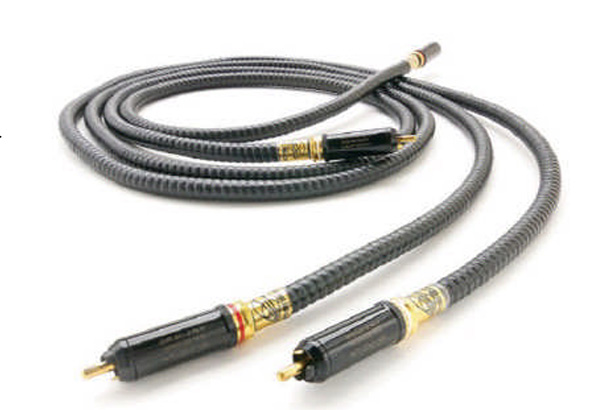 Teresonic Clarison Gold interconnect
Finding the right interconnect to link your step-up transformer to your phono preamp can be a daunting task. The voltages involved are so low that you need both low resistance and effective shielding to avoid problems with hum and radio-frequency (RF) Teresonic claims that the conductors used in their Clarison Gold interconnect are 99.999% solid gold (footnote 2). The Clarison Gold's solid-core hot and ground conductors are separated by an internal insulating screen, and each channel's cable is enclosed in a "high-tech" shield of spiral-wound shield of galvanized ferromagnetic material. The review samples had external ground wires, terminated in spades, that drained off any residual hum when connected to the ground lug of my Ypsilon MC-16 transformer.
The Clarison Gold is handmade using gold-plated crimp sleeves (no soldering) and gold-plated RCA plugs; a 1m pair costs $2985.
Linking my Ypsilon step-up transformer and phono preamp, the Clarison Golds were dead quiet, and free from hum and RF. They produced a liquid, delicate, but not overly lush midrange, a sweet yet soaring top end, and clean, nimble bass. They weren't as detailed as the far more expensive TARA Labs Zero ($15,900/1m pair), but I have hum and RF problems with the Zeros when I use them in the same position in my system. And other cables I've tried there have sounded too soft. The Teresonic Clarison Gold is a great choice for this application, and easy to recommend to those who can afford it.
Footnote 1: Analog Manufaktur Germany (AMG). Web: www.amg-turntables.com. US distributor: Musical Surroundings, 5662 Shattuck Avenue, Oakland, CA 94609 (2013). Sierra Sound, PO Box 510, Wilton, CA 95693. Tel: (916) 717-4344. Web: www.sierrasound.net/ (2025).
Footnote 2: Teresonic LLC, San Jose, CA 95125. Tel: (877) 287-1649.
AMG Viella 12 turntable and 12J2 tonearmThe Viella 12 belt-drive turntable and the 12J2, its 12"-long tonearm, from Analog Manufaktur Germany (AMG; footnote 1), is also an incredible value. (No $16,500 turntable gets italics, even with a tonearm thrown in.)
12J2 tonearm: This 12"-long arm has a unique, dual-pivot, vertical bearing system that uses springs of 0.5mm-diameter steel wire—similar to those used in helicopter rotor heads, says AMG—instead of the usual gimbaled variety. Thus, no chatter is possible.
Adjusting a cartridge's azimuth is easily accomplished: Loosen a side-mounted locking screw at the pivot and, with a screw on the top of the pivot, vary the height of one vertical bearing relative to the other. The horizontal motion bearing (mounted vertically) is more conventional: an axle of hardened tool steel with a needle roller bearing.
Setup: Reasonably good instructions and an impressively well-thought-out design made unpacking and setting up the AMG a pleasurable experience. Julian Lorenzi and I, with Garth Leerer, from AMG's US distributor, Musical Surroundings, together set up the Viella 12 and 12J2, and installed in the latter a Clearaudio Goldfinger Statement cartridge.
The Viella 12's unsuspended, mass-loaded design means that its sound will greatly depend on what it sits on. I used an oversize Harmonic Resolution Systems M3-1925 base on an HRS MXR Signature stand. After using the V12's built-in spirit level to check that it was level, I unscrewed the three tiny points recessed into the bottom of the plinth, and evenly raised its bottom off the base's surface.
Because the V12's drive belt rides on an inner hub and a motor pulley that are both made inaccessible by the platter, a special tool is required to pull the belt beyond the outer platter's diameter. With the belt around the hub and the tool stretching the belt, you lower the platter directly over the subplatter, onto two wooden spacers that raise the platter enough to let you slide the belt down off the tool, allowing it to snap into place on the pulley. Carefully remove the spacers and the platter falls into place. Platter spinning, the V12 looks like a direct- or rim-drive turntable.
From a shelf of unplayed classical LPs I pulled one at random: pianist Leon Fleisher with George Szell and the Cleveland Orchestra in performances of the Grieg and Schumann piano concertos (Epic BC 1080).
Rumor has it that Szell kept his AR-3a speakers under his couch: he'd listen to acetates and ask for more treble. No wonder many of his Epic recordings with the Cleveland sound harsh, metallic, and spatially diffuse. I figured that this one probably would, too, and be dynamically compressed, given its playing times of about 30 minutes per side; throw in some distortion for good measure.
But no! However it was miked, the recording was from a front-of-balcony perspective, but the piano sound was mesmerizingly convincing, and not at all muffled or indistinct or metallic, as I'd expected: Fleisher's touch on the keys was reproduced with great precision and delicacy, with a profusion of microdynamic contrasts, despite the less-than-pitch-black vinyl noise floor (not the AMG's fault). The piano's tonality, and its physical focus in the reverberant Severance Hall, were precisely and richly drawn—and, for anyone who's ever heard a piano concerto in such a space, absolutely believable. Particularly impressive was the reproduction of Fleisher's pianissimo playing. The most delicate touches of fingers on keys were reproduced with an appropriately soft yet cleanly delineated attack and a feathery sustain.
In fact, the AMG's resolution of just such detail was one of its most attractive qualities. A member of the New York Audiophile society requested that I burn him a CD-R of singer Johnny Hartman's obscure (and desirable) penultimate album, Once in Every Life (Beehive 7012). I played it first on the Continuum, with the Ortofon Anna cartridge, then on the Viella 12, with the Lyra Atlas.
While the Continuum-Ortofon did better jobs of delivering the depth and power of Hartman's rich baritone and carving out the spaces, the AMG-Atlas seemed to produce more details of intonation in the middle of Hartman's range. That's far preferable to a 'table that can express the very bottom, but only with a "muddy hangover." I'm sure that the Viella 12's midrange resolution, and its freedom from overhang there and lower in the audioband, were among the key factors that made its sound so appealing.
I don't want to leave the impression that the Viella 12 lacked the slam and authority that separates really great from merely modest platter spinners. All I had to do was play a stupendous-sounding reissue of Vangelis's score for Blade Runner (Audio Fidelity AFZLP 154) to hear a huge, stable, transparent, three-dimensional space, insistent bass weight with taut control, overall detail resolution, and top-to-bottom dynamic authority—each just a few notches below what the supertables can manage.
Teresonic Clarison Gold interconnectFinding the right interconnect to link your step-up transformer to your phono preamp can be a daunting task. The voltages involved are so low that you need both low resistance and effective shielding to avoid problems with hum and radio-frequency (RF) Teresonic claims that the conductors used in their Clarison Gold interconnect are 99.999% solid gold (footnote 2). The Clarison Gold's solid-core hot and ground conductors are separated by an internal insulating screen, and each channel's cable is enclosed in a "high-tech" shield of spiral-wound shield of galvanized ferromagnetic material. The review samples had external ground wires, terminated in spades, that drained off any residual hum when connected to the ground lug of my Ypsilon MC-16 transformer.
Footnote 1: Analog Manufaktur Germany (AMG). Web: www.amg-turntables.com. US distributor: Musical Surroundings, 5662 Shattuck Avenue, Oakland, CA 94609 (2013). Sierra Sound, PO Box 510, Wilton, CA 95693. Tel: (916) 717-4344. Web: www.sierrasound.net/ (2025).