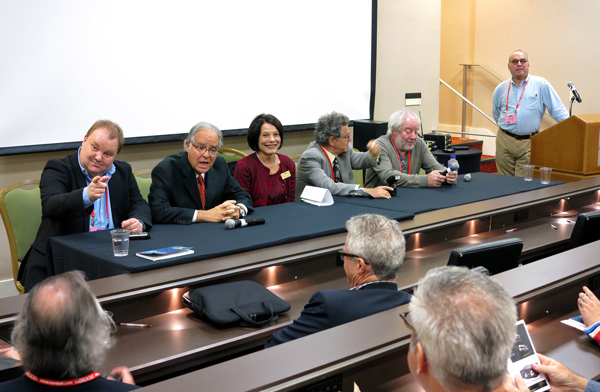
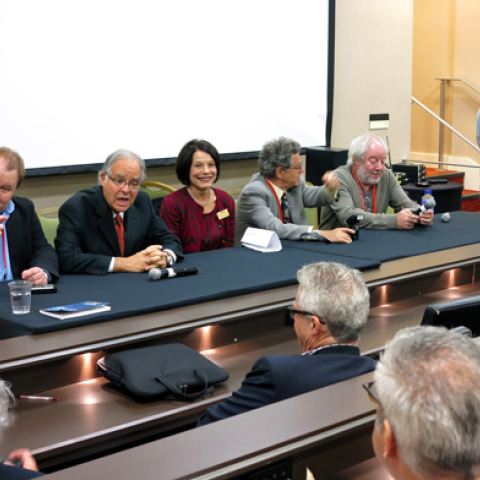
The "High-End Audio: Regaining the High Ground" panel at the 2012 RMAF (from right to left): Ken Kessler, Roy Hall (Music Hall), Michael Fremer, Kathy Gornik (Thiel), Peter McGrath (Wilson), and Alan Sircom (HiFi Plus). (Photo: Art Dudley)
Analogplanet.com covered new products exhibited at the 2012 Rocky Mountain Audio Fest in Denver last October (
Stereophile's full coverage can be found
here); in this month's column I'll comment on the show generally, and specifically on two seminars.
RMAF's growth over the past few years has been phenomenal. This year's attendance appeared to be substantial—according to Show organizer Marjorie Baumert, approximately 431 companies were represented by 150 exhibitors, and there were about 3600 attendee-days—and while many manufacturers weren't represented, there was a good mix of major brands and upstarts. Certainly attendees could not have been disappointed by what they saw and heard—unless, like me, they thought too few rooms were demonstrating with turntables, and in too many, the only source component was a computer. Still, the number of new analog products introduced at RMAF was gratifying and impressive.
Too Little Information!
I've had a stormy relationship with Roy Gregory, a man who has worn hats on both sides of the fence. After a long stint as editor of UK magazine
HiFi Plus and working for cable manufacturer Nordost, he's currently UK editor of the website theaudiobeat.com.
A few years ago, when I was unable to attend RMAF, Gregory ran turntable-setup seminars in which he stated that users would get less-than-satisfactory results using "one of those turntable-setup DVDs."
This, of course, is not true, and I thought it obvious that he was referring to the DVDs that I have produced. I called Gregory out on it in a rather heated e-mail. He told me that it was "not all about you, Mikey, there are other turntable set-up DVDs." When I asked him to name another, he couldn't.
We've buried the hatchet on that episode. However, at the 2012 RMAF Gregory ran a series of seminars that posed the question of which was better: original vinyl pressings or reissues. I wasn't going to attend, until I heard from someone that I'd been singled out by name in one seminar, when Gregory compared the original pink-label Island pressing of Cat Stevens's
Tea for the Tillerman with Analogue Productions' recent reissue, along with a few other pressings of this album.
A reader came up to me and told me that Gregory had somewhat dismissively said of the Analogue Productions reissue, before making the comparison and demonstrating to the audience that it was not nearly as good as the original, "This is Mikey's favorite."
Now, if you read my
review of that reissue, you'll find that instead of assigning it a ranking, I described how it sounded. That's how I try to review reissues—unless there's something clearly wrong, as there was with a recent Speakers Corner reissue of Michel Legrand's
Legrand Jazz (Columbia CS 1250), which for some reason had been sourced from a mono tape that had been electronically reprocessed for stereo, when the original was a wonderful stereo recording made at Columbia's 30th Street Studios.
I wrote that the Cat Stevens reissue definitely sounded different from the original: brighter, more forward, definitely more dynamic, and with better transient response. But I didn't rank it. I wrote that the reissue had been cut from the actual master tape, and that, yes, if your system lacks bottom end, the record will sound bright; and that if you play it too loud, it can sound unpleasant, particularly during musically exclamatory moments. But the better your stereo, I wrote, the better AP's
Tea for the Tillerman will sound.
I do like the original pink-label pressing, a copy of which I bought new, but I think the reissue has some superior qualities the original lacks. Still, your reaction will depend on your system and your taste—which is generally the case with well-done reissues
sourced AAA from master tapes.
I didn't appreciate the word going out to RMAF attendees that AP's reissue was "my favorite," so I decided to attend the session to hear what Gregory was saying.
To an audience of around 20 people, Gregory said, "Show of hands: How many of you think originals always sound better?"
A few hands went up, but not mine.
"How many of you think 180gm reissues always sound better?"
A few hands went up. Not mine.
"I guess, then," Gregory concluded, "the rest of you are just not sure."
Though it's not good form, I felt obliged to blurt out, "No, Roy, the rest of us probably think as I do: Sometimes the original is better, and sometimes the reissue is better." There seemed to be affirmation from the audience about that rather obvious comment.
Then, using a very nice if bass-limited system that included a
VPI Classic III turntable, an Audio Research phono preamplifier, a Lindemann integrated amplifier, and a pair of
Wilson Audio Specialties Duettes, hooked up with Nordost Heimdall cables and mounted on Stillpoints rack and footers, Gregory played a series of very short excerpts comparing various pairings of original and reissue pressings, beginning with Mobile Fidelity Sound Lab's reissue of Elvis Costello's
This Year's Model. But rather than ask the audience what they heard and thought, he told them what
he thought: "Obviously, the original is much better." (I paraphrase.) The person next to me muttered, "I think the MoFi sounded better." And so it went with a few comparisons.
Why not let the attendees offer their opinions? What's the point of forcing yours down their throats? Gregory did make a few good points—about the cost of originals, how to tell what really is an original, and how to find one in excellent condition—but it would have been far more useful to everyone had he allowed audience members to participate.
When Gregory compared a UK Decca 1971 edition and a reissue of Holst's
The Planets, conducted by Zubin Mehta, he also compared the standard RIAA equalization curve against Decca's own
ffss curve, and declared
ffss clearly the right and superior curve, adding that unless your phono preamp can play various EQ curves, buying an original made using a curve you
can't play would be a waste of money.
When Gregory began the Cat Stevens comparison, I did blurt out, before the music played, that I'd
never said that the Analogue Productions reissue, mastered by the late, great George Marino, was "my favorite," and when the comparison was over, Roy and I had a lively debate.

Roy Gregory (left) and Michael Fremer (right) debate LP provenance. (Photo: Jason Victor Serinus)
Yet again, Gregory made clear in no uncertain terms that the original Cat Stevens LP was "better"—or perhaps he softened his approach and said it was the one he would prefer to listen to. To which I said, "Roy, these do sound totally different, but it seems to me that your job is really to describe
how they are different rather than telling anyone which is 'best' or which one you prefer, particularly if the reissue has been carefully sourced using the original tape, with the box containing the original mastering engineer's notes, as this one was."
I then turned to the audience and said, "Have any of you actually heard what an Ovation guitar sounds like? Close up, it can slice your eardrums. It is bright and brittle, just as on the reissue. It sounds fine until the hard strums, and then,
Ouch!" A few in the audience corroborated that.
And, I pointed out, the attack of the double bass sounded rather soft on the original and far more natural on the reissue. In fact, as pleasant as the original is, it sounds like a photo looks made with petroleum jelly on the lens. In the end, I said, the original is a very pleasing, soft, romantic-sounding record that those of us lucky enough to own an original pressing certainly enjoy, but the reissue is clearly more dynamic, more transparent, and more like what you'd hear in the studio. Which you might prefer is a matter of taste. In this case, according to both Marino and Analogue Productions' owner, Chad Kassem, what was not in question was which is more accurate to the master tape—which is not necessarily what the engineer and/or artist intended!
In fact, when you make the comparison, it sounds almost as if the original LP had been mastered with Dolby-A when the master tape hadn't been so recorded, which would help to produce a soft, rolled-off top end. This definitely did happen with Tamla's original LP edition of Stevie Wonder's
Songs in the Key of Life, which made the Speakers Corner reissue sound brighter and harder—but it was
right! I don't know about the Cat Stevens reissue in that regard, but Chad Kassem was concerned about the brightness and so tried remastering it with various degrees of top-end rolloff.
I eventually got to hear those different masterings, and yes, they sounded more pleasant—but the guitar was muted, the explosiveness of the musical outbursts diminished, and the overall musical excitement dulled. Had it been my decision, I'd have done as Kassem did: give people the superbly recorded tape—not exactly transferred flat, which is apparently what the notes said was done with the original, but without a sonic scrim.
Still, that comparison was a matter of different sonic tastes or listening philosophies or whatever. Where I really had to get into it with Gregory and his seminar partner, Dennis Davis, a very knowledgeable record guy, was the issue of applying Decca's
ffss EQ curve to stereo pressings, particularly those mastered as late as the 1970s.
I told both of them that I have an original UK Decca boxed set of
Homage to Pavlova (2 LPs, Decca SET 523-4)
and the original US London edition (2 LPs, London). The two pressings have
identical matrix numbers, which means they were pressed from stampers made from the same lacquers. Both the Decca and the London end in "-3W," which means the third lacquer cut by Harry Fisher. "Third lacquer" doesn't necessarily mean "third pressing." Often, the first and sometimes the second lacquers were ruined.
In any case, both the Decca and London versions of this record have the same lacquer number, the same mother number (1),
and the same stamper number. Just as EMI used a numbering code based on "GRAMOPHLTD" (with "G" being 1, "R" being 2, etc.; "LG" was the 81st stamper), Decca used "BUCKINGHAM."
So, other than the labels, the US and UK pressings were
identical. On the back of the London box it says, as it does on virtually
every London "Blueback" pressing, "USE THE RIAA CURVE." Check out some of your own.
Then how can the UK edition possibly use the
ffss code and the US edition the RIAA code when they are
identical pressings? Obviously, they can't. I've seen images of Decca Records production sheets showing a particular title, with the different label and sleeve orders for the UK and the US (footnote 1).
Can it be that the records were actually cut using the
ffss curve, and London printed on their jackets "USE THE RIAA CURVE" simply to (falsely) reassure buyers that they would be playing them back correctly?
This question was posed to at least one veteran Decca engineer by a writer at another magazine; the engineer
insisted that Decca adopted the RIAA curve in 1955 and called it the "New London" or "new
ffrr" curve, though its specs were identical to the RIAA's.
There are people who, when comparing US and UK editions, swear that the Deccas sound better. Perhaps they are hearing normal pressing variations and drawing the wrong conclusions from what they clearly heard. Nevertheless, at the RMAF Davis and Gregory insisted that the UK Deccas require the
ffss curve and sound better that way. They are not alone in this belief, which is why AMR, Audio Research, and others include the
ffss curve in their phono stages. AMR insists that it has documentation to back up its assertion, but I've yet to see any from anyone. I think it's a myth—just as is the claim that Deccas and Londons pressed from the same stamper sound different. If you want to use the various EQ curves as tone controls, knock yourself out—but don't be deluded into thinking you're playing these records more accurately.
After that part of the discussion, I got into it again with Roy Gregory, this time about claims made in certain circles that Columbia Records continued using its own proprietary curve well into the 1970s or 1980s, because some Columbia records sound "better" using the Columbia curve. Gregory said, in so many words, that he agreed with that observation.

The Absolute Vinyl van, in the parking lot outside RMAF. (Photo: Michael Fremer)
When I first read this bit of what I knew to be nonsense, I called a mastering engineer who used to work for Sony, which bought Columbia Records in 1988. He was in contact with some of the true veterans of the Columbia Records of the 1950s, and passed on to them some of the online claims I'd read.
They responded in no uncertain terms. They may by now be elderly, but they were no less feisty than teens. One e-mailed, "Are they on crack? We switched to the RIAA curve in the mid-'50s. Everyone did." All of these veterans insisted that Columbia's lathes were changed to electronics that adopted the RIAA curve sometime before the stereo era, but definitely
by the stereo era.
Some years later, when the record business exploded, and certainly by the late 1960s or early '70s, many mastering jobs were farmed out to independent shops like Sterling and Masterdisk, and certainly by then all of Columbia Records' lathes and those of independent contractors had adopted the RIAA curve. So when you read assertions to the contrary, do yourself a favor: Ignore them.
But Roy Gregory was insistent that the Columbia curve was used well beyond the mid-'50s. When I told him what those veteran mastering engineers had said, he said, "You know about big corporation bullshit. They say whatever. You think they really swapped out all of those lathes?"
"All they have to do is change the electronics," I replied. But it was clear that Gregory and Davis are set in their beliefs.
While comparing various pressings of a Decca recording of Holst's
The Planets, with Zubin Mehta and the Los Angeles Philharmonic, Gregory demonstrated what he said were the sonic effects of making tiny changes in vertical tracking angle (VTA) and stylus rake angle (SRA) on VPI's
JMW Memorial tonearm.
In order to make a 1° change in SRA, you need to raise or lower the back of a 9" tonearm by a not-insignificant 4mm. Making a "tiny" change will change SRA by a fraction of a degree. Is that really audible? Incorrectly setting SRA produces measurable intermodulation distortion as the stylus incorrectly traces the groove's angled vertical modulations. There's no magic involved in this; the effects are measurable and audible.
I refer you to Jon M. Risch's "More than One Vertical Tracking Angle," originally published in
Audio magazine in March 1981. The article goes into all of this in great detail, and provides measurements. (Courtesy The Bonnier Group, we've republished the article
here.) When you set SRA at 92°, IM distortion is minimized for virtually every LP you own. This is because all cutter heads must be angled
beyond 90° so that the highly flammable thread of cut lacquer can be safely extracted by vacuum as soon as it's cut.
Measurements show that 92° minimizes or eliminates IM distortion. This can be confirmed audibly as well. In other words, when setting SRA via measurements, there's an unmistakable correlation between 92° and minimum IM distortion. But if you
start at 92°, making a "tiny" change to VTA/SRA should
not be audible.
Even using a digital microscope, the measurement of SRA won't be 100% accurate—there's some subjectivity in the measured angles—but you can come extremely close. Then you can further fine-tune the angle by ear, which will surely correlate with measured minimum IM distortion. But once the SRA is set at precisely 92°, tiny changes from that setting should not result in audible sonic changes.
However, if you use a true unipivot tonearm such as the VPI, tiny changes in SRA and VTA also result in changes in the
azimuth angle, because of the offset angle of the headshell. And tiny shifts in azimuth are definitely audible and measurable. If you've correctly set the SRA to 92° and then hear differences when making truly tiny shifts in VTA/SRA, I suggest that one of two things is happening: 1) You're using a true unipivot tonearm, and what you're hearing is an easily audible change in azimuth angle; or 2) you're imagining you heard a difference. I realize that will "inflame parts of the base," but it's what I believe to be true and measurable.

Peter McGrath, Kathy Gornik, and Michael Fremer looking suitably grim at Ken Kessler's panel discussion. (Photo: John Atkinson)
Ken Kessler: "More Rich People, Please"
Friday evening at RMAF 2012, UK-based journalist Ken Kessler
chaired a panel on the subject of how the audio industry needs to attract more affluent people to our hobby. The panelists were Dan D'Agostino, Music Hall's Roy Hall, Thiel Audio's Kathy Gornik, Wilson Audio Specialties' Peter McGrath,
HiFi Plus editor Alan Sircom, and me.
It clearly irked Kessler that Rolex, Ferrari, and other makers of luxury goods do such a better job of marketing to the world's wealthy than do manufacturers of high-end audio gear. He made the case that, without the strong participation of this demographic, our industry is just about doomed.
I don't think our industry's future
does depend on reaching a large percentage of the super-rich. Our appeal is far more specialized, and our commitment requirements more severe, than what it might take to convince a wealthy watch wearer to strap a Rolex to his wrist, or a commuter to put a Ferrari in her garage. At least until you can show off your hi-fi on your wrist or on the street, we're not likely to win much of that demographic—though with some effort, we probably can get more of it than we now are.
I spoke about what I saw as audio's bright future, thanks in part to the resurgence of vinyl. When I asked how many in the audience shopped in used-record stores, nearly every hand went up—which surprised even me.
"And when you look around in those stores, who's buying those records?" I asked. "Old people like most of us, or kids?"
The answer was unanimous: "Kids!"
Case closed. It's a great time to be a vinyl enthusiast and an audiophile. The future is bright, and coming to you at 33
1/
3 revolutions per minute.

Mikey's point of view at Ken Kessler's panel discussion. (Photo: Jason Victor Serinus)
Footnote 1: The Decca brandname was owned by a different company in the US. Back in the 1970s, I visited Decca's UK pressing plant in New Malden and watched identical pressings being labeled with either London labels, for the US market, or Decca labels, for the rest of the world.—
John Atkinson