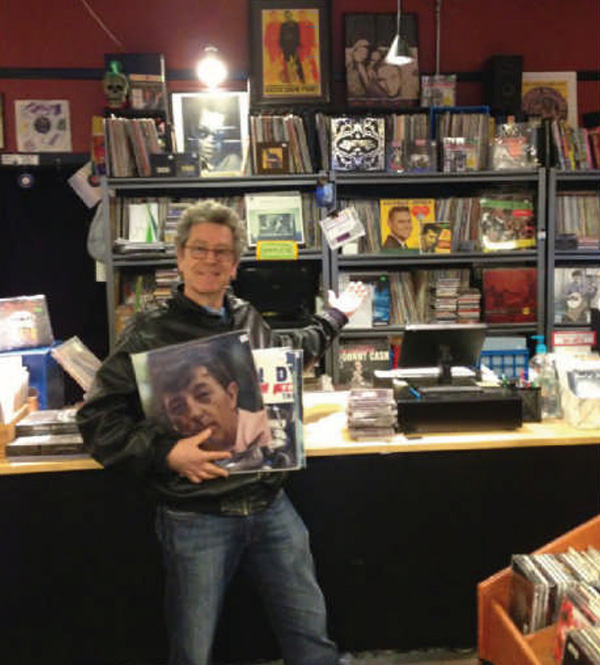
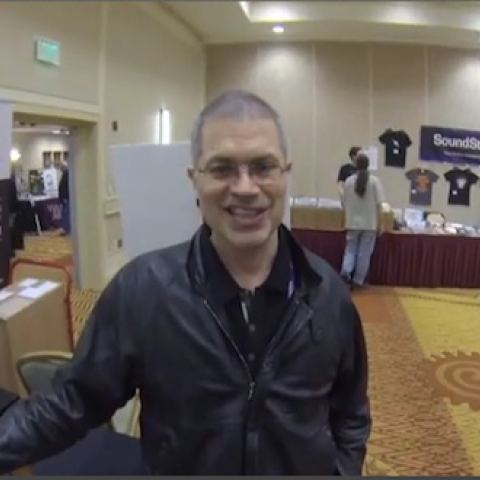
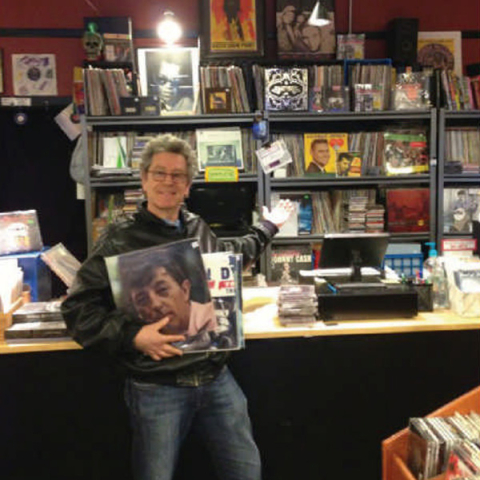
Photo: Shane Buettner.
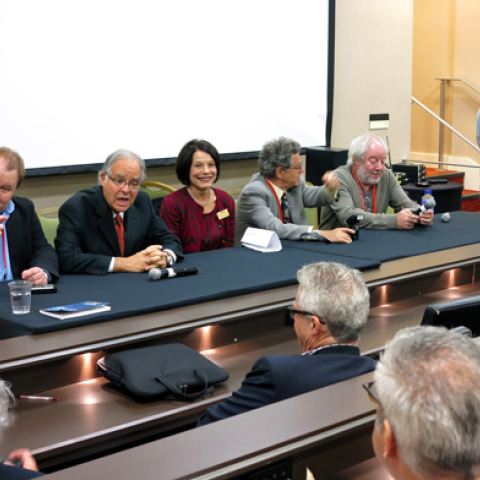
I was in Seattle last February to take part in one of the popular "Music Matters" events promoted by retailer Definitive Audio. Definitive's Mark Ormiston and Craig Abplanalp and their crew really know how to produce a memorable evening for both their customers and the manufacturers who fly in to demonstrate their gear. I was there to talk about . . . guess what?
Rather than fly home the next morning, I stuck around for a few days to do some serious record shopping.
My friend Shane Buettner, former editor of
Home Theater magazine and currently AudioQuest's VP of communications, had invited me to stay at his house for the weekend, and to drive me around Seattle to visit the city's vinyl hot spots—not that I needed to twist his tonearm. The vinyl bug bit Shane a while back, and now he's seriously infected, with the swollen record racks and runny bank account to prove it (footnote 1).
Seattle is a great town for used-record stores. New York is among the worst. Why? There are plenty of LPs in New York, that's for sure. Maybe New Yorkers don't part with them as easily as Seattleites do. Or maybe Seattleites are more into sharing.
Neptune Music Co., a crowded basement store across from the hotel on Brooklyn Avenue where I stayed the first two nights, was a great place to start. I picked up a few good albums there, including one new to me: Sarah Vaughan's
Gershwin Live!, an early-'80s concert with the Los Angeles Philharmonic conducted by Michael Tilson Thomas, produced by minimal-miking fan Steve Epstein (LP, Columbia FM 37277).
There was even a copy of the rare "RL" (Robert Ludwig) mastering of Led Zeppelin's
II, which was quickly pulled and replaced with a more compressed version because, the story goes, Ludwig's version skipped on Ahmet Ertegun's daughter's turntable. Unfortunately, it looked chewed up, so I passed.
Friday was
the day. A Definitive Audio customer had alerted me to M&L Records, on Ravenna Avenue, a store that turned out to be unfamiliar to the owners of the other shops we later visited. It's run by Morrie Kuhlmann, who seemed less interested in records than in the vintage Revell and Monogram model kits he also sells.
Nonetheless, I found some unusual vinyl at M&L, including Dial Records' first release. I think this is a different Dial from the one Charlie Parker recorded for in the 1940s. Dial #1, a recording of Bartók's Sonata for Two Pianos and Percussion, was worth buying for the cover alone, with art by David Stone Martin, whose line drawings illustrated more than 400 album covers in the 1940s and '50s, including many classic jazz albums for Clef, Mercury, Norgran, RCA, and Verve.
While breathing dust at M&L and enjoying it, I checked my e-mails and saw one from old friend and former Boston morning-radio star Charles Laquidara, of WBCN-FM's
The Big Mattress (1969–1996), who'd posted the following on his Facebook page and then sent it to me directly:
"I have been looking . . . Can only find vinyl . . . I don't own a record player. Can you help? Can someone get a pristine version of this album on vinyl; transfer it to CD or mp3 and send it to me? I will pay.
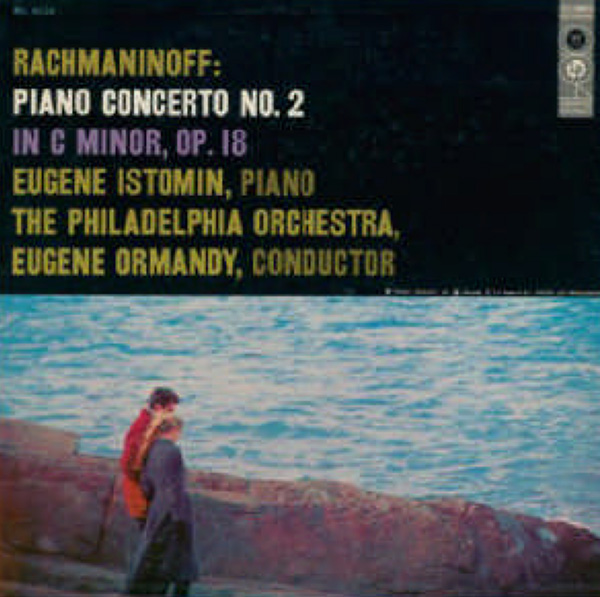
"1. It has to be this particular recording. Rachmaninoff Piano Concerto No.2. Eugene Istomin/Eugene Ormandy/Columbia Masterworks.
"2. It cannot be vinyl or cassette. But here's what the original cover looked like. [Charles included an image of the album cover.]
"3. It has to be perfect sound quality; no scratches.
"Any hope? I would kill to get this album. (Not on vinyl, please. I don't have a player. Not on cassette either . . . )
"When I was kind of alone in an apartment on Benefit Street in Providence and a first-year student at [Rhode Island School of Design], fresh out of Milford, MA high school, I began getting turned on to classical music and this was one of the albums that helped me get through the next two years—until I drove out to California to try to be a 'movie stah.' A haunting piece for me; lots of memories."
Okay, Charles repeats himself—but that sometimes happens when you need a vinyl fix, even if you don't own a turntable. I'm sure there was even some drooling and perhaps a loss of bladder control, but that, too, can happen when you need a vinyl fix. Right, Shane?
I immediately e-mailed back something like: "You're in luck! I'm in Seattle, a great record town—I'm sure I can find a copy here!"
Three or four stores on and much later that day—actually, that evening—I found myself at Bop Street Records, on NW Market Street. Bop is on the pricey side, but they have a huge, well-organized selection. Eating dust and digging through buried crates can be fun, but when you
need something, it's worth paying a little more to look where it should be . . . and find it. There it was: a stone mint copy of Charles's album—and for such a clean copy, $18 wasn't too bad.
Here's the great part of the story. This album had had a grip on my friend when he was a young college student because of both the music and the cover art: a photo of a couple strolling along a bulkhead. As Charles recalled it, in response to a Facebook stranger who'd replied to his original post:
"The fact that the piece was written by Sergei Rachmaninoff and was being played by [Eugene Istomin], someone with a very Eastern European name, and the minor-key exoticness of the melody itself . . . Seeing 'that couple' on the album cover was very fascinating to my very young mind. The outdoor scene I fantasized was an ocean on some European shore, or somewhere by the Bering Sea, or some very mysterious faraway place. And on that cover were two young kids—Yugoslavian, German, French, or Russian lovers walking along an ocean stonewall—somewhere in a very intriguing, very strange and wonderful 'other side' of the world. Play the music while looking at it from that perspective and it's pretty awesome—especially if you're only 20 years old."
Turns out that that Facebook stranger, Paul Jeswald, had a story of his own about that cover photo:
"No joke, Charles, that is my Dad, Joe Jeswald, and my stepmother, June Jeswald. My Dad was a painter in Gloucester [Massachusetts], and apparently knew the photographer.
"My Dad passed away in 2009—he was a well known painter on the North Shore, and also the founder of Montserrat School of Visual Art [now Montserrat College of Art] in Beverly [MA]. My stepmother is alive and well in Hamilton [MA], recently retired from Pingree School, where she taught dance and ran the art department. I just got off the phone with her, so here is the album cover story . . .
"The photographer was Lee Friedlander. My folks met him when they were living in NYC in the '50s. In the late '50s, they moved to Rockport [MA], and Lee came to visit while doing a photo project for a magazine. Dad and Mom were featured in the piece, which was called 'Will This Marriage Succeed?' The photo on the album cover was from that visit, and was taken on the shore rocks in Rockport, probably in '56 or '57.
"I hope that the true history of the cover does not lessen your love for the music! . . . At least the rocky shore of Cape Ann is a beautiful spot, though not exotic and foreign. And though they were both Americans, Joe and June were a lovely young couple, both artists in their right, and extremely good looking. Dad's work is unique, darkened by his WWII experiences, and tempered by his training in Paris during the '40s. Our last name, before the ancestors went through Ellis Island, was Gesualdo, an old Italian family. That music is one of my favorite classical pieces, and during my teen years I found playing time for it in between the Stones, Hendrix, Janis Joplin, Clapton, Beatles, etc."
Charles: "So great to hear all this! You don't even know how much of an impression that photo on the album meant to me."
Lee Friedlander is still working at 79, and has had a distinguished career. He's best known in certain circles for having taken, in the late 1970s, the nude black-and-white photos of Madonna, then a "20 year old dancer trying to make ends meet," that later appeared in the September 1985 issue of
Playboy.
Now, do you think any digital download will ever produce such an incredible story? Or even a CD booklet? That's just a small sampling (poor word choice) of the power of vinyl.
After writing the above, but before handing in this column, I had dinner with Wilson Audio Specialties' Peter McGrath, and his wife, Elizabeth. I told them this story. Turns out that Peter, who is not only a highly regarded recording engineer but himself an excellent photographer, is a friend of Lee Friedlander's—who, he said, is also an avid audiophile.
Speaking of unbroken circles, UMG's reissue of the Nitty Gritty Dirt Band's epic, three-LP
Will the Circle Be Unbroken, cut by Chris Bellman from the original analog master tapes, sounds far superior to the fine-sounding original. Don't miss it (unless you don't like acoustic country).
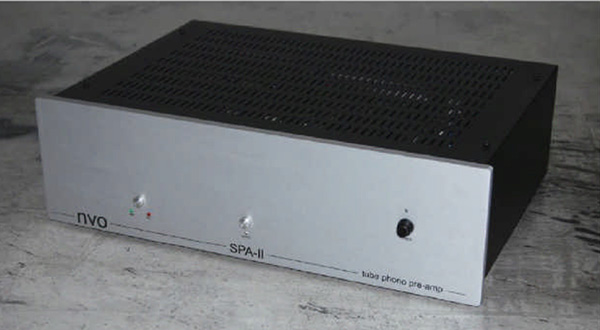 NVO SPA-II phono preamplifier
In this column I have the luxury of exploring products that don't have wide US distribution. The SPA-II, from New Valve Order (NVO), is an all-tube, moving-coil/moving-magnet phono preamp imported from Cyprus by Sounds of Silence (footnote 2). And I do mean all tube: 22 of 'em. The SPA-II has no step-up transformers, yet manages to produce 62dB of gain. You can read designer Andreas Hadjiminas's story at nvoaudio.blogspot.com.
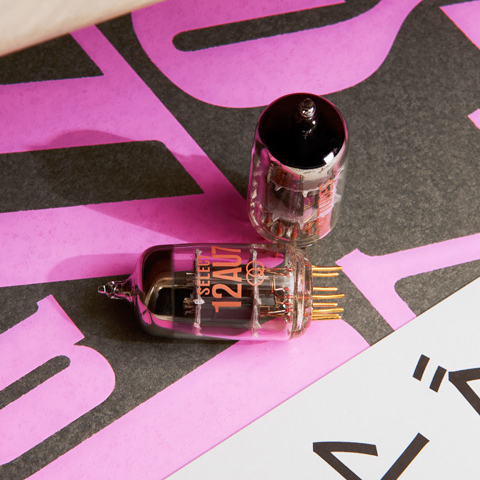
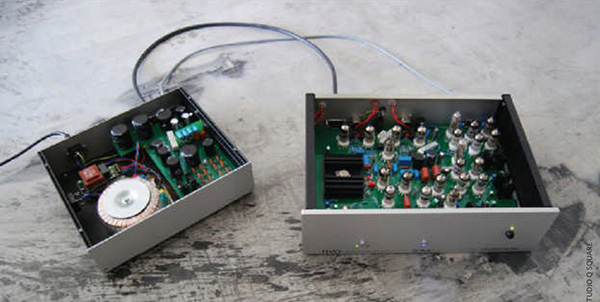
The SPA-II has a hefty outboard dual-mono power supply connected to the main chassis via a pair of umbilicals terminated with multipin, computer-style connectors. Eight tubes are used for supply and heater regulation. For the MC input, Hadjiminas uses two Russian 6C45Pi single-triode tubes per channel. This tube's hefty plate allows it to be run with current in excess of 40mA. RIAA equalization, combining passive and active stages, uses a pair of 12AX7 tubes per channel and a 12AU7 cathode-follower output tube—a familiar configuration.
Hadjiminas claims that the SPA-II, which he designed using circuit-simulation software, has precision components in its RIAA network and a frequency range of 20Hz–200kHz. No distortion or signal/noise specs are provided.
Everything inside the SPA-II is neatly laid out on a single, large circuit board. Parts and overall construction quality appear high, though the chassis is on the shallow side—not the best environment for a 22-tube design. On the other hand, this essentially hand-built phono preamp, each unit of which is individually tuned and tested, lists for a very reasonable $6500. Sounds of Silence sells it for $5850, including shipping.
On the front panel are buttons for power, MC/MM, and Mono/Stereo, with an LED for each (two for MC/MM). On the rear are high-quality RCA inputs and outputs, and "convenience" XLR inputs. That's it! The SPA-II won't win any awards for its Spartan appearance, but if your main interest is in having the best sound for the lowest possible price, you'll have no problem with the NVO's more-than-acceptable looks.
MC loading is done with RCA or XLR plugs fitted with resistors. If you're running XLR phono leads, you'd load with RCA plugs, and vice versa. With no loading plugs, the SPA-II's input impedance is 1000 ohms—too high, in my opinion, for most MC cartridges. So load away!
NVO's manual warns you to turn off the SPA-II when switching between MC and MM, to avoid a thump. No big deal—there's only one set of inputs, and you're not going to be swapping input cables "live," are you?
Sound: For an all-tube design, the SPA-II was
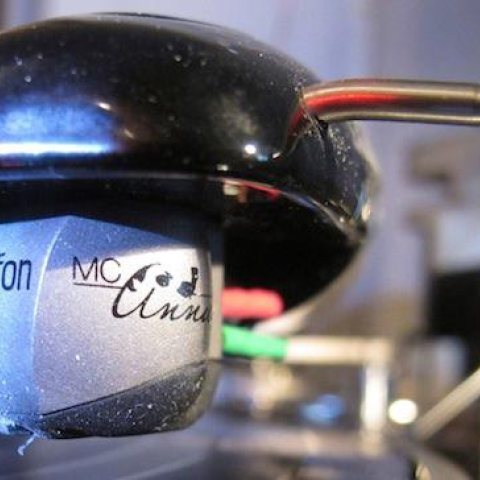
very quiet—in fact, it's the quietest all-tube phono preamp I've ever heard. And its gain was more than sufficient for the Ortofon Anna's 0.2mV output.
On the other hand, it put out an enormous amount of heat. Leave plenty of space above it; ideally, set it on a top shelf. It was also microphonic—at least, my sample was—so it'll be best to keep it away from speakers and set it on a good foundation.
Any all-tube design in a less-than-rigid chassis will benefit from firm footing. I used four of Stillpoints' Ultra SS feet, and placed a pair of HRS Damping Plates on the top panel, being careful to leave the NVO's ventilation slots unblocked by supporting the Plates on four more Stillpoints.
So configured, the NVO produced all of what tube fans love, particularly in a front-end application, without any of the noisy negatives. The overall tonal balance was on the warm, rich, full side in the mids, with generous extension on top and an impressively well-controlled bottom—but if you like taut and lean down there, the SPA-II isn't for you.
I figured the NVO's sonic personality would be perfectly suited for listening to the Electric Recording Company's (
www.theelectricrecordingco.com) meticulously produced, three-LP reissue of J.S. Bach's Sonatas and Partitas for Unaccompanied Violin, recorded by the Hungarian violinist Johanna Martzy for EMI in 1954–55. [
See "Listening" elsewhere in this issue—Ed.]
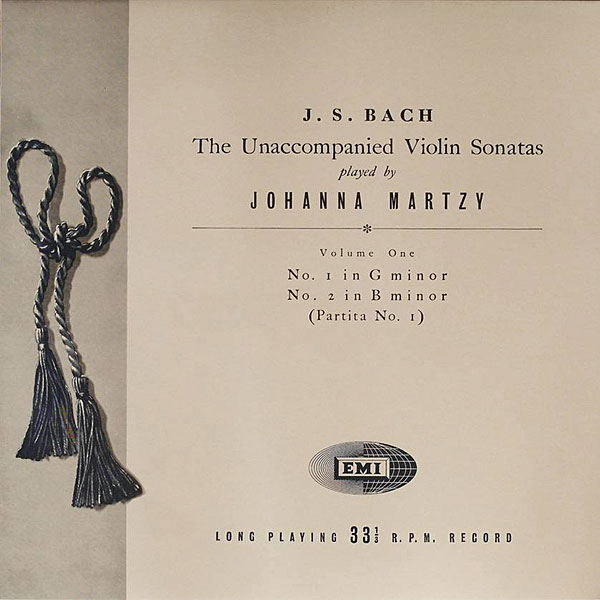
Martzy (1924–1979) made quite a splash early on. She began touring at age 13, made her American debut in 1957, and a year later performed the Mendelssohn Concerto in e with Leonard Bernstein and the New York Philharmonic. But her few recordings didn't sell in great numbers, and by the late '60s, she'd all but disappeared. Still, Martzy's legend is such that copies of the original three-LP set on UK Columbia sell for over $5000.
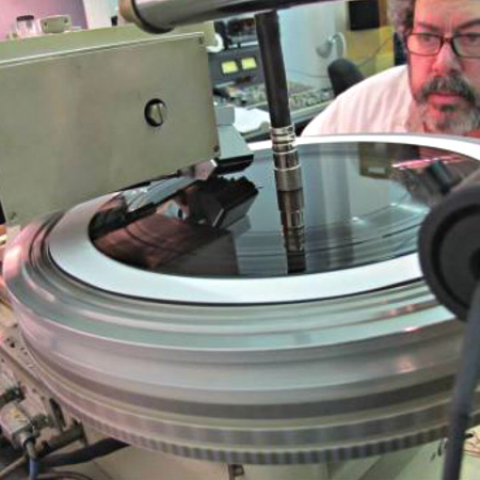
The Electric Recording Co. has meticulously re-created the original all-tube mastering chain, from the Lyrec/EMI playback deck to the Ortofon DS522 mono cutter head, remastered from the original analog tapes, and pressed the three high-quality, 180gm LPs in separate limited editions of 300 copies each. They've even reproduced the original jackets using vintage printing presses.
The results are physically and sonically stunning. Each of the three records will set you back around $450. The OBI is in English, Japanese, Korean, and Chinese. The Electric Recording Co. knows its audience.
The recording's original producer didn't attempt to transport Martzy to your listening room, but you to the space in which she performed. In mono, you "see" Martzy from some distance, but the results through the NVO were tonally and texturally visceral and sensational.
This is what tubes are meant to reproduce.
The upper reaches of Martzy's violin were reproduced with a soaring sweetness, while its lower range was full-bodied without being overripe. More important, the musical flow, from top to bottom and vice versa, was seamlessly expressed. Martzy's delicate, fluttering vibrato produced flowing micro-events of rarefaction and compression that, though small in gesture produced physical macro-reactions in me.
The NVO well delineated the recording's dynamic expressiveness, and was impressive at separating the image of the violin from the moderately reverberant space in which it was played. Switching to the Ypsilon combo of MC-16 transformer and VPS-100 phono preamplifier produced no loss of texture or tonality or anything else, but tightened image focus and, especially, increased transparency—though for more than five times the NVO's price.
Acoustic music and unprocessed, naturally recorded voices produced fleshy, holographic, three-dimensional images that seemed to float into the room unrestricted by electronic artifacts.
The Vinyl Collection, a recent boxed set of Norah Jones's albums (7 LPs, Blue Note/Analogue Productions AAPP NJBOX 33), paired perfectly with the NVO, as did a recent reissue of
Sinatra's Swingin' Session!!!, a frivolous but fun album arranged by Nelson Riddle (LP, Capitol/Mobile Fidelity Sound Lab MFSL 1-407). The SPA-II did four things particularly well: Sinatra's voice, the growl of the low brass, the bass drum, the sense of studio space.
The NVO was okay for hard rock, but I can't see buying it if that's most or all of what you listen to. It moderately softened the hard edges of sharp transients, and made "pleasant" things that should have had more sharply defined edges. And, as always, its sound will depend on your associated gear and what you're in need of—and prefer.
The warranty is stated as two years excluding tubes, so the cost of replacing 22 tubes must be taken into account. None of these tubes is particularly expensive and all are readily available, unless you want to roll some vintage types. But if you do, you'll probably lose some of the SPA-II's unusually quiet operation.
Summing Up: To those opposed to MC transformers and who like tubes, the NVO SPA-II offers much: It's unusually quiet, even with a 0.2mV cartridge; its rich sound isn't cloyingly tubey; its balance of micro- and macrodynamics is impressive; and its low-end extension is very well controlled for an all-tube phono stage. It excels in all the ways a good tubed phono stage can, and particularly in harmonics, textures, and timbres. It's well made, and $5850 strikes me as reasonable for its sound and appearance. If Sounds of Silence offers a money-back guarantee, I don't see much risk in trying it out.
Footnote 1: In 2015
Shane Buettner founded premium LP reissue company Intervention Records; see
https://interventionrecords.com/ and
www.youtube.com/live/LkBnU6yPPaU?si=0cE-1n8OwJVDaYFL.—
Ed.
Footnote 2: New Valve Order (NVO), Nicosia, Cyprus. Web: nvoaudio.blogspot.com. US distributor (2013): Sounds of Silence, 14 Salmon Brook Drive, Nashua, NH 03062. Tel: (603) 888-5104. Web:
www.soundsofsilence.com.