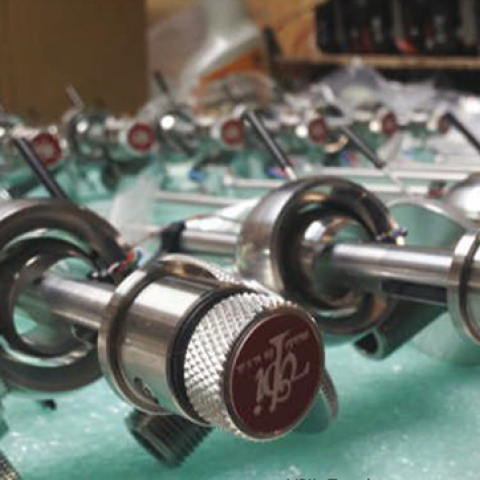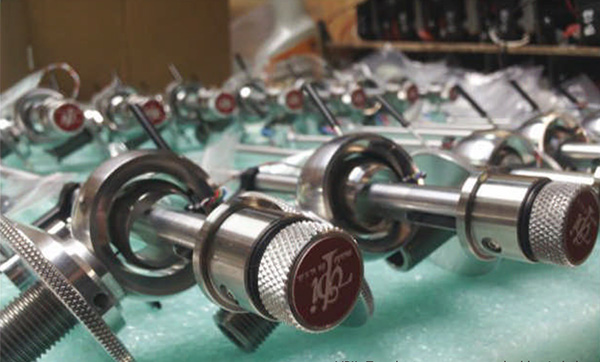
VPI's Traveler tonearm uses a double-gimbal bearing for horizontal and vertical movement.
Audiophiles who attend my seminars on turntable setup often ask the most basic questions about tonearms, including the meanings of terms with which I (incorrectly) assume everyone is familiar. This is a good thing—it indicates that new people are entering the ranks of vinyl enthusiasts. This column is for them.
Here I don't discuss so-called "tangential tracking" or "linear tracking" tonearms, or those that use magnets and monofilament instead of more typical bearings. I feel those are best discussed separately.
I am not a mechanical engineer. I don't even play one on TV. But over the years, I've learned a lot about tonearms and their mechanics from a number of tonearm designers, some of whom have degrees in mechanical engineering.
The basic geometric parameters of tonearms are: the pivot-to-spindle distance (the accuracy of which is critical when drilling an armboard, to ensure that the other design parameters can be met); the tonearm's effective length (a straight line measured from the tonearm pivot to the stylus tip); the overhang (the distance between the spindle and the stylus when the arm is theoretically placed directly over the spindle); and the offset angle (the angle between the cantilever and a line drawn between the stylus tip and the arm's horizontal pivot). Why are these parameters important? When a lacquer or DMM copper disc is being cut on a lathe, the cutter head moves in a straight line, radially across the surface of the disc, maintaining the same tangency to the cut groove throughout the entire side. A pivoted tonearm, however, describes an arc across the record surface. Obviously, a pivoted arm can't maintain consistent tangency to the groove, and so produces what is called tracking error. The geometric calculations necessary to maximize cartridge performance by minimizing tracking error and thus audible distortion have been known since the 1930s, when they were calculated by the mathematician Erik Löfgren, and later by H.G. Baerwald. (You can read about this in far greater detail in "Arc Angles: Optimizing Tonearm Geometry," Keith Howard's authoritative article in the March 2010 issue of Stereophile.)
I've discussed these at length in earlier columns. Tonearms that don't permit the careful adjustment of all three parameters can't possibly maximize a cartridge's performance. If your tonearm doesn't include adjustability of vertical tracking angle (VTA) and stylus rake angle (SRA), stick with the less aggressively profiled styli and stay away from Shibata and other line-contact styli. If you can't adjust your cartridge's azimuth—that is, the perpendicularity of its stylus when viewed from in front of the cartridge—I still recommend measuring its crosstalk performance. If you've spent a few thousand dollars on a cartridge, you should get reasonably good channel separation (>25dB) and crosstalk matching (within 3dB), though many cartridge makers say these figures are unrealistically high, especially if you can't adjust azimuth.
 It ain't the meet, it's the motion!
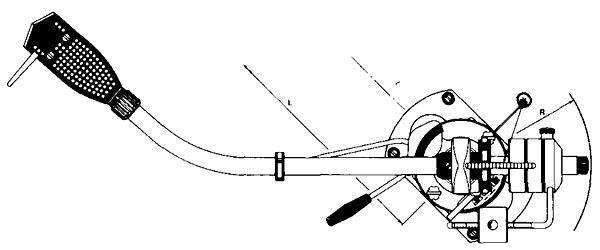
On to dynamic considerations—that is, how the tonearm performs when in motion. The two basic types of pivoted tonearms are gimbaled-bearing and unipivot, variants of which include a knife edge, used on older SME arms (above); and dual pivots, used by Continuum, La Luce, Basis, and a few others. The goal is to have ultralow friction, so neither the arm's horizontal nor its vertical motion is restricted. A gimbaled tonearm uses traditional ball-race bearings for both vertical and horizontal movement. If the arm's horizontal motion is restricted by the vertical bearing, the record groove's outer wall will have to be pressed, by the platter's motion, with greater force against the stylus in order to move it, resulting in greater pressure on the right channel and less on the left channel (inner wall). When an eccentric record, with an off-center hole, is played, the increase and decrease in pressure will alternate between the groove walls, causing record wear as the stylus careens back and forth. Sound quality, too, will suffer. If the arm's vertical movement is restricted by friction in its horizontal bearing, there is a similar problem with warped records, resulting in rhythmic shifts in vertical tracking force (VTF), and electrical nonlinearities caused by the cartridge's moving magnet or coil not maintaining its position within the generating system.
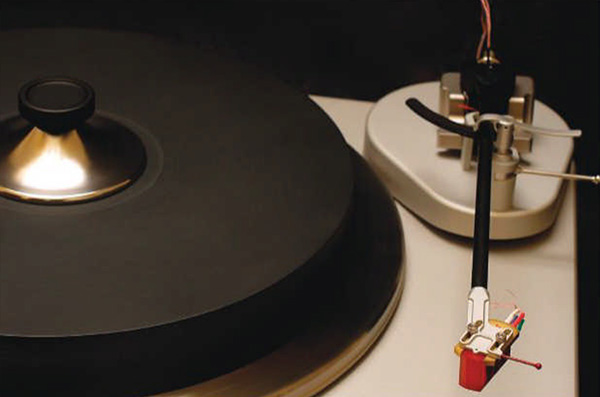 The closer the horizontal bearing is to the stylus's plane of play, the narrower the arm's vertical arc, and thus the less prone it is to warp wow, a speed variation caused by the arm's "time-traveling" fore and aft as the arm moves up and down along that arc. Spiral Groove's Centroid tonearm (above) is one of the few in which the horizontal bearing remains in the stylus's plane of play, regardless of VTA.
Obviously, a low-friction bearing is necessary for proper tracking, but not at the cost of high bearing play, ie, a bearing with a lot of looseness. Producing low-friction bearings that don't chatter is costly, and the differences in sonic quality among otherwise similar bearings of varying tolerances are huge—as anyone who's traded up among Rega arms can attest.
Unipivot designs, in which the arm's movements in both the horizontal and vertical planes share a single pivot point, can offer ultralow friction as well as low chatter, depending on both the precision of the bearing and how effectively the bearing is loaded. The audible consequences of small physical irregularities on the unipivot point can be profound.
The closer the horizontal bearing is to the stylus's plane of play, the narrower the arm's vertical arc, and thus the less prone it is to warp wow, a speed variation caused by the arm's "time-traveling" fore and aft as the arm moves up and down along that arc. Spiral Groove's Centroid tonearm (above) is one of the few in which the horizontal bearing remains in the stylus's plane of play, regardless of VTA.
Obviously, a low-friction bearing is necessary for proper tracking, but not at the cost of high bearing play, ie, a bearing with a lot of looseness. Producing low-friction bearings that don't chatter is costly, and the differences in sonic quality among otherwise similar bearings of varying tolerances are huge—as anyone who's traded up among Rega arms can attest.
Unipivot designs, in which the arm's movements in both the horizontal and vertical planes share a single pivot point, can offer ultralow friction as well as low chatter, depending on both the precision of the bearing and how effectively the bearing is loaded. The audible consequences of small physical irregularities on the unipivot point can be profound.
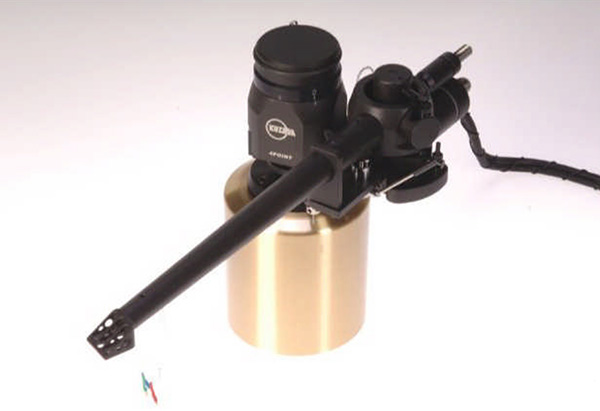 Because unipivots can also move in planes other than the desired horizontal and vertical, they require a stable distribution of weight, such as the outrigger weights Graham Engineering introduced many years ago in their 2.0 arm. Other variants provide stability with a second pivot point—or, in the case of Kuzma's 4Point (above), a pair of pivots in each plane of motion. While these designs are more stable than a conventional unipivot, such stability comes at the expense of diluting the single-point load concentration, ie, the load is spread over two or four points rather than one, though mass carefully applied can help compensate.
Graham's Magna-Glide system uses two magnets and an ABEC7 bearing to provide stability without unloading the single-point bearing, but the springy magnet system will inevitably have a resonant frequency that affects the sound. The point is, every problem has a solution, and every solution creates a problem. Good design is the effective management of all of these problems.
A Balancing Act
Because unipivots can also move in planes other than the desired horizontal and vertical, they require a stable distribution of weight, such as the outrigger weights Graham Engineering introduced many years ago in their 2.0 arm. Other variants provide stability with a second pivot point—or, in the case of Kuzma's 4Point (above), a pair of pivots in each plane of motion. While these designs are more stable than a conventional unipivot, such stability comes at the expense of diluting the single-point load concentration, ie, the load is spread over two or four points rather than one, though mass carefully applied can help compensate.
Graham's Magna-Glide system uses two magnets and an ABEC7 bearing to provide stability without unloading the single-point bearing, but the springy magnet system will inevitably have a resonant frequency that affects the sound. The point is, every problem has a solution, and every solution creates a problem. Good design is the effective management of all of these problems.
A Balancing ActA tonearm can be stable-balanced, neutral-balanced, or unstable-balanced. Most arms are stable-balanced; ie, the arm's center of gravity is below its pivot point. This helps stability, particularly in unipivot arms, but it also means that when the arm is moved from its preferred rest position, there will be an opposing force that tends to return the arm to that position. In practical terms, this means that such an arm's VTF will change depending on where you measure it. The higher you raise the arm when you take the reading, the greater the VTF, as the arm fights to return to its preferred rest position in the groove. In other words, to ensure accurate measurement of VTF, you should set stylus on the scale as close as possible to the record surface.

Graham's B44 Phantom Supreme (photo: Ken West).
In a neutral-balanced arm, the pivot and center of gravity are in the same plane. (Graham's B44 Phantom Supreme is such a design.) More important than the accuracy of the measured VTF is that the VTF won't change when the arm is displaced by a record warp, nor will the arm seek to return to its previous position. You can easily check your arm's balance by measuring the VTF at, and then well above, the record surface.
It should be clear from the discussion thus far that the closer your counterweight is to the pivot, the better. If your tonearm has various counterweights, choose the heaviest that will apply the correct VTF closest to the pivot.
Uh-oh—Newton's Second Law of Motion alert: Force equals mass multiplied by acceleration (F=ma). A tonearm's equivalent mass is the mass that, when substituted for all the individual masses of the armtube, headshell, cartridge, screws, etc., and placed at the stylus, will accelerate at the same rate as the arm when subjected to the same force applied at the stylus. The equivalent mass is difficult to calculate precisely, but it determines the frequency of the resonance that results from the interaction of the tonearm's effective mass and the cartridge's suspension compliance. The higher the mass and the greater the suspension's compliance, the lower will be the combination's resonant frequency. And vice-versa. A softly sprung (high-compliance), heavy (high-mass) automobile will produce a spongy, "pitchy" ride, and bottom out or severely dip when it encounters a pothole. A stiffly sprung (low-compliance), lightweight car will give a bone-rattling ride, and probably put your bumper on a collision course with the edge of the pothole: below the resonant frequency, the mass (car) and the end being oscillated (spring) virtually move together, as if they were solidly connected: When the wheel drops, the body does too. Increasingly above the resonant frequency, the mass will remain still even as the spring oscillates. That's how we want a car to ride—so that its suspension drops into the pothole even as the car continues on, level with the road. Back in the world of cartridge suspensions and tonearms, we want our car (the tonearm) to remain still, even as the spring (the cantilever) oscillates as a result of the stylus encountering modulation at musical frequencies (16Hz–20kHz+) in the grooves. Therefore, we want the resonant frequency to be below 16Hz; if it's above that frequency, it means a big, unwanted boost in low-frequency response.
Most tonearms have a rigidly coupled counterweight. Those that have counterweights that are decoupled from the arm tube are claimed to have lower effective mass, which in theory would lower inertia and produce more responsive performance. There's not space here to go into the explanation of how decoupled counterweights behave, but if the counterweight's suspension is tuned so that the resonance due to its mass and its decoupling compliance coincides with the tonearm/cartridge suspension resonance, the latter's peak will be suppressed—which is good, assuming the resonance is in the 8–12Hz region. However, suppressing the resonant peak can creates two smaller peaks on either side of it. The upper one will be rolled off (at 12dB/octave) well before 16Hz or so, so that one is fine. The lower peak, however, will be below the original one, and van get too close to the warp wow region. However, it can be suppressed with damping. A properly functioning decoupled counterweight requires very careful matching to the tonearm and cartridge.
These devices, when used properly, can reduce the resonant peak's amplitude at the expense of widening its quality factor (Q), and thus extending the response above and below the resonant frequency. The rule of thumb is less is more, in order not to overdamp the system and roll off the response above the desired point. Let your ears be your guide.
Tonearm armtubes are another source of resonances that require damping or some sort of resonance control. Some materials, such as solid wood, are said to be inherently well damped, but I suspect the more respected tonearm makers use specially treated wood. After all, wood is used in musical instruments; clearly, wood resonates and can be subject to warping, depending on the temperature and humidity. Arthur Khoubesserian, a veteran designer of turntables and tonearms, originally for Pink Triangle and now for The Funk Firm, pays particular attention to arm resonances in his designs. He contends—and has the measurements to back up those claims—that stuffing a tube with damping material does little to suppress tube resonances, because the vibrations in the arm material travel along the outside of the tube. Instead, he uses an internal cross-beam brace with no internal damping (patent pending) that, his measurements demonstrate, effectively suppresses tube resonances. What the arm is mounted on also counts, whether it's stainless steel, aluminum, brass, or acrylic. There you're usually at the mercy of the turntable manufacturer, though modifications and adherents to all kinds of substitute materials abound.