The Trinity Electronic Design Phono Preamplifier
The quest for vinyl quiet seems, at best, quixotic. By "vinyl quiet" I don't mean "quiet vinyl," which we now reliably get from pressing plants like QRP, RTI, Pallas, and a few others. I'm referring to makes of phono preamplifiers who set as a primary design goal electronic "quiet," ie, an absence or minimum of electronic noise. A stylus coursing through the groove of even the quietest LP still produces a considerable amount of noise. If you've ever made a digital file from an LP using an analog-to-digital converter equipped with a level meter, you know what I'm talking about.
Yet despite what such meters display, practically speaking, to the ears, a clean LP in good condition is quiet when first amplified, even by a multi-tubed phono preamp that itself doesn't measure as being low in self-generated noise.
In fact, many of us would argue that digital "quiet" is, in many ways, unnatural sounding, and that another type of noise, which I'll call "digital noise," seems to take a non-aural pathway to the brain, and is more fatiguing than intrinsic vinyl noise. This "non-aural digital noise" is felt more than heard, and after a long period of being subjected to it, its absence produces both an unusual sense of "quiet" and especially of "drop the shoulders" relief and relaxation—especially if there's been an instant switch to vinyl playback.
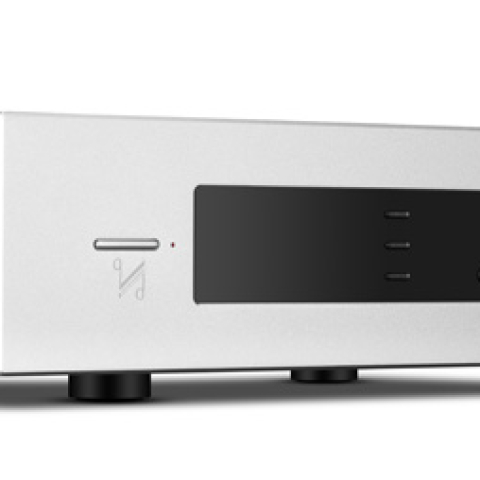
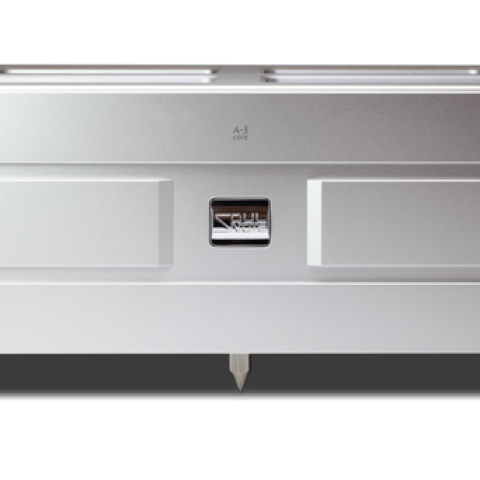
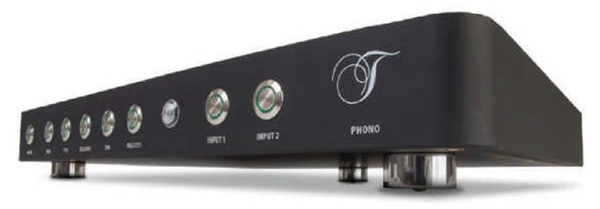
While attending the High End Show in Munich in spring 2013, Audioarts' Gideon Schwartz and I met with Trinity Electronic Design's designer, Dietmar Bräuer (footnote 2), who held in his hand the Phono Preamplifier's impeccably laid out, "unstuffed" circuit board. Standing on the crowded, noisy main floor, Bräuer began explaining, with great enthusiasm at Autobahn speed, the finer points of his fully balanced design. I tried to feign interest and to share his excitement, but it was late in the afternoon of a full day of walking the High End floors, when technical details of circuit designs tend to drift by like so much flotsam. Even when primed for "dielectric absorption," this non-engineer finds the written word far easier to grasp. After about 10 minutes, and feeling wobbly on my feet, I looked at my watch and made my getaway, no disrespect meant. Some months later, the Trinity Phono ($34,750) arrived in a very snazzy plastic flight cases (yes, plastic can be snazzy).
 Thrax Audio Orpheus phono preamplifier
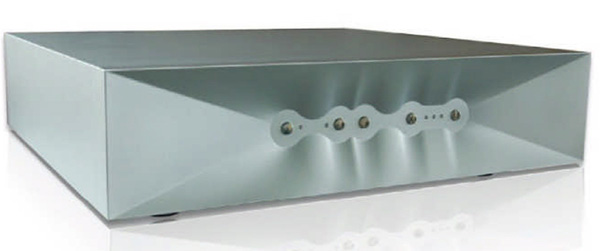
Based in Bulgaria (footnote 3), Thrax Audio builds a full line of electronics that includes a remote-controlled line-level preamp, a direct-heated-triode tubed monoblock amplifier, a class-A hybrid tube/FET amplifier, a discrete ladder-type DAC (designed for Thrax by MSB), and the Orpheus phono preamplifier. While Thrax's profile in the US is relatively low, its worldwide reputation for designing and building innovative products is well established. Engineer-in-chief and company owner Rumen Artarski is a member of the Audio Engineering Society, and has presented papers at the organization's biannual conferences. The Orpheus ($21,000) is a vacuum-tube phono stage. It uses a low-noise German D3a pentode tube wired as a triode for both moving-magnet gain, and to produce sufficiently high output impedance to feed the passive LCR, constant-impedance, RIAA equalization section. The RIAA circuit features custom-made coils, wound by Sowter in the UK with Cardas-supplied wire, and paper/foil capacitors. The equalized signal then feeds a second tube—a Russian triode similar to a WE417—to provide the necessary output gain, loaded by a Hashimoto isolation transformer. The additional gain required by moving-coil cartridges is provided by an amorphous-core Lundahl 1931 transformer with 1:8 and 1:16 selectable primaries. The full-wave, tube-rectified power supply uses a C-core gapped transformer with symmetrical field cancelling windings and chokes for smoothing.
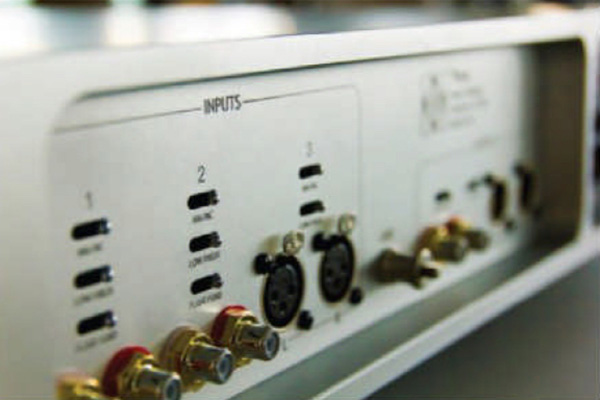 Elegant appearance and packaging, superb build quality, and pleasing ergonomics are as you'd expect in a $21,000 phono preamp. The Orpheus has three switchable inputs, two RCA and one XLR. The latter is for use with balanced cartridges/tonearms; switches on the rear-panel allow the single-ended RCA jacks to have their grounds lifted in case of hum. All three can be set for MM or MC "high" or "low. The "high" setting is for low-internal-impedance cartridges, and offers about 60dB gain and an input impedance of 40–50 ohms; the "low" setting is for high-internal-impedance cartridges, with 54dB gain and an input impedance of 200 ohms). Output is via single-ended RCA or balanced XLR, the former again capable of having their grounds lifted. On the front panel are pushbuttons for On/Off, Mute, Phase ("polarity"), and Input Select Previous and Next. Particular attention has been paid to grounding problems.
With the variety of turntables, cartridges, and external step-up transformers I used to test the Thrax's transparency, backgrounds were 100% hum free. And despite the five tubes (two each per channel plus the tube rectifier), any noise was also inaudible.
The all-in-one-box "high/low" MC approach will appeal to many, but might be problematic for the superfinicky who demand greater control of loading. Practically speaking, Atarski's choices should work well with most cartridges. They did for the superlow-output (0.2mV) Ortofon Anna and the higher-output (0.5mV) Lyra Atlas, both low-impedance designs. A premium version of the Orpheus boasting silver wiring and a step-up transformer with a mu-metal core is also available.
Elegant appearance and packaging, superb build quality, and pleasing ergonomics are as you'd expect in a $21,000 phono preamp. The Orpheus has three switchable inputs, two RCA and one XLR. The latter is for use with balanced cartridges/tonearms; switches on the rear-panel allow the single-ended RCA jacks to have their grounds lifted in case of hum. All three can be set for MM or MC "high" or "low. The "high" setting is for low-internal-impedance cartridges, and offers about 60dB gain and an input impedance of 40–50 ohms; the "low" setting is for high-internal-impedance cartridges, with 54dB gain and an input impedance of 200 ohms). Output is via single-ended RCA or balanced XLR, the former again capable of having their grounds lifted. On the front panel are pushbuttons for On/Off, Mute, Phase ("polarity"), and Input Select Previous and Next. Particular attention has been paid to grounding problems.
With the variety of turntables, cartridges, and external step-up transformers I used to test the Thrax's transparency, backgrounds were 100% hum free. And despite the five tubes (two each per channel plus the tube rectifier), any noise was also inaudible.
The all-in-one-box "high/low" MC approach will appeal to many, but might be problematic for the superfinicky who demand greater control of loading. Practically speaking, Atarski's choices should work well with most cartridges. They did for the superlow-output (0.2mV) Ortofon Anna and the higher-output (0.5mV) Lyra Atlas, both low-impedance designs. A premium version of the Orpheus boasting silver wiring and a step-up transformer with a mu-metal core is also available.
 Was that due to euphonic colorations? Who cares, when it can preternaturally bring to life the velvet-voiced Nick Drake in the recent, meticulously produced boxed set Bryter Layter, producing a thrillingly three-dimensional image of the singer in the room, if with the loss of some studio detail and sense of space. That's a trade-off I'll take every time.
The Orpheus pulled the front of the stage back somewhat compared to the Trinity Phono, or even to the Ypsilon VPS-100 phono preamp, and it didn't illuminate as well the rear and corners of the stage—but what did appear on that stage had great body and fleshy physicality, if somewhat at the expense of maximum possible rhythm'n'pacing.
The Orpheus's richness never descended into tubey bloat, or a pronounced tonal coloration that attached itself to every recording. Its top-end "tuck" was subtle enough that cymbals and other percussion produced satisfying shimmer and precise transient attacks. With RCA Living Stereo reissues, this midrange richness helped produce rich, burnished brass, and luxurious string tone without homogenizing massed strings.
Was that due to euphonic colorations? Who cares, when it can preternaturally bring to life the velvet-voiced Nick Drake in the recent, meticulously produced boxed set Bryter Layter, producing a thrillingly three-dimensional image of the singer in the room, if with the loss of some studio detail and sense of space. That's a trade-off I'll take every time.
The Orpheus pulled the front of the stage back somewhat compared to the Trinity Phono, or even to the Ypsilon VPS-100 phono preamp, and it didn't illuminate as well the rear and corners of the stage—but what did appear on that stage had great body and fleshy physicality, if somewhat at the expense of maximum possible rhythm'n'pacing.
The Orpheus's richness never descended into tubey bloat, or a pronounced tonal coloration that attached itself to every recording. Its top-end "tuck" was subtle enough that cymbals and other percussion produced satisfying shimmer and precise transient attacks. With RCA Living Stereo reissues, this midrange richness helped produce rich, burnished brass, and luxurious string tone without homogenizing massed strings.
Footnote 1: See Martin Colloms's "Balance: Benefit or Bluff?":—Ed. Footnote 2: Trinity Electronic Design GmbH, Johann Wieser Ring 11, DE-85609 Aschheim, Germany. Tel: (49) (0)89/201-865-77. Web: www.trinity-ed.de. Footnote 3: Thrax Audio Ltd. Copenhagen Blvd, bl. 289, Druzhba 2, 1582 Sofia, Bulgaria. Tel. +3592 988 9555. Web: www.thrax.bg.