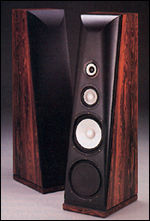
Jim Thiel's Coherent Sound speakers all have excellent time coherence, and the CS7.2 is no exception. The impulse response (fig.6) has a coherent shape, though the tail is overlaid with ringing from the two HF resonances discussed earlier. The step response (fig.7) has an almost perfect right-triangle shape, though the 6kHz ringing can be seen and there is a little too much overshoot, this partly due to the measuring microphone but mainly due to the slightly rising tweeter response on-axis. As a result, the acoustic phase response (fig.8) is flat, with a minimum-phase characteristic, over almost all the audio band. (The phase error due to the CS7.2's departure from a flat response has been subtracted from this graph.) But note the wrinkles in this so-called "excess-phase" response around 6kHz, which I assume are associated with the resonant peak in this region. 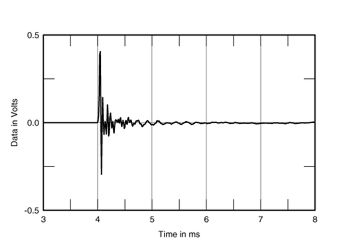 Fig.6 Thiel CS7.2, impulse response on tweeter axis at 50" (5ms time window, 30kHz bandwidth).
 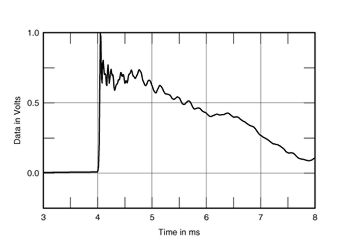 Fig.7 Thiel CS7.2, step response on tweeter axis at 50" (5ms time window, 30kHz bandwidth).
 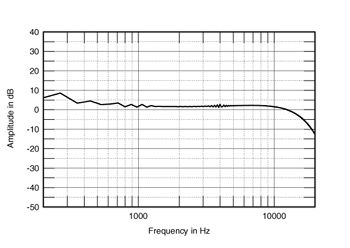 Fig.8 Thiel CS7.2, excess-phase response on tweeter axis at 50" (5 degrees/vertical div.). Finally, the Thiel's waterfall plot (fig.9) reveals a generally clean decay, marred only by ridges of delayed energy not only at 5.6kHz and 21kHz, as expected, but also one at 4.1kHz—exactly the frequency of a response notch. Again, I am puzzled why this resonant behavior made its presence known only sometimes.
 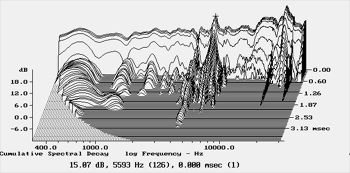 Fig.9 Thiel CS7.2, cumulative spectral-decay plot at 50" (0.15ms risetime). The Thiel CS7.2 combines some fine measured performance attributes—time coherence, excellent bass extension, and wide, even dispersion—with some that leave me perplexed, such as its mid-treble resonant behavior. Its use of first-order crossover slopes with the attendant overlap between drive-unit passbands and its limited top-octave dispersion will make room setup more arduous than usual. But with care, the speaker can—as Brian found—be made to sing.—John Atkinson
Fig.6 Thiel CS7.2, impulse response on tweeter axis at 50" (5ms time window, 30kHz bandwidth). Fig.7 Thiel CS7.2, step response on tweeter axis at 50" (5ms time window, 30kHz bandwidth). Fig.8 Thiel CS7.2, excess-phase response on tweeter axis at 50" (5 degrees/vertical div.). Finally, the Thiel's waterfall plot (fig.9) reveals a generally clean decay, marred only by ridges of delayed energy not only at 5.6kHz and 21kHz, as expected, but also one at 4.1kHz—exactly the frequency of a response notch. Again, I am puzzled why this resonant behavior made its presence known only sometimes. Fig.9 Thiel CS7.2, cumulative spectral-decay plot at 50" (0.15ms risetime). The Thiel CS7.2 combines some fine measured performance attributes—time coherence, excellent bass extension, and wide, even dispersion—with some that leave me perplexed, such as its mid-treble resonant behavior. Its use of first-order crossover slopes with the attendant overlap between drive-unit passbands and its limited top-octave dispersion will make room setup more arduous than usual. But with care, the speaker can—as Brian found—be made to sing.—John Atkinson