Music often brings me joy, awe, and, if I'm lucky, something close to transcendence, but it's not my only route there. A few years ago, on a sunny January day in Madrid's Prado museum, I went looking for Hieronymus Bosch's The Garden of Earthly Delights. Locating the 12'-wide Dutch masterpiece, painted around 1500, was harder than it should have been because the name "Bosch" appears nowhere in the museum's brochure or signage. Eventually I realized the problem. Centuries ago, the Spaniards rechristened him El Bosco, the name he has been known by in Spain ever since (footnote 1).
I finally found the room. The five or six people standing in front of the painting soon left, and suddenly I had the triptych to myself. Even accounting for scale, it made a much deeper impression than I'd expected. Bosch packed the three panels with exuberant, disturbing, trippy scenes—an eschatological drama of appetite and damnation. Tableaus of sexual pleasure, some mixed with violence and supernatural punishment, are everywhere. Grotesqueries abound. We see a pig in a nun's habit. Women are encircled by a parade of naked men riding horses, donkeys, unicorns, camels, and other exotic or imaginary beasts. A flock of birds swarms through a hutlike structure that seems to be made from scrimshawed pasta. Et cetera.
I kept noticing details I hadn't seen before. This surprised me, because an old friend owned a large poster of the painting. I'd studied it with fascination half a dozen times. By the time I went to Spain, I thought I knew the work. I was wrong. The poster had preserved the composition while losing much of what made the painting itself so absorbing: its scale, texture, and the incredible colors. The work looked alive, ripe, diaphanous. The paint seemed impossibly vibrant for being more than five centuries old.
I flashed back to the Prado visit now and again while listening to Rockport's new Lynx speakers. Not for the first time, I found myself thinking about the distance between an original experience and its reproduction. Of course, that gap is the daily business of an audio reviewer. What was unusual about the Rockports was how clearly they revealed character that lesser reproductions had obscured.
 BR>
BR>
I live on Mount Desert Island, Maine, so factory visits are never just a drive away; usually flights are involved. Not so with Rockport. A few summers ago, I drove a pleasant two hours down Maine's scraggly coast to tour the company's South Thomaston base, where I met founder and director of technology Andy Payor and president and owner Josh Clark. Rockport has since added a 10,000ft2 facility in Westbrook, 80 miles farther south, where most of the "industrial" operations are performed. For now, the South Thomaston location remains the company's center for R&D and assembly work. Business is good. Rockport currently has seven people on the payroll but expects to hire more to help deal with year-over-year growth.
Earlier this year, Clark and sales director Jon Zimmer delivered the Lynxes to my home in a small freight trailer without the usual custom crates.
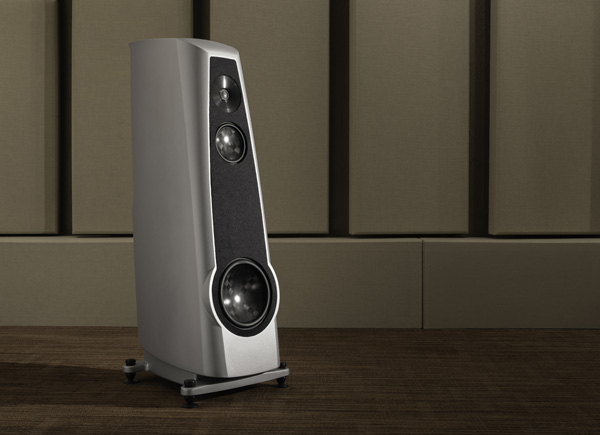
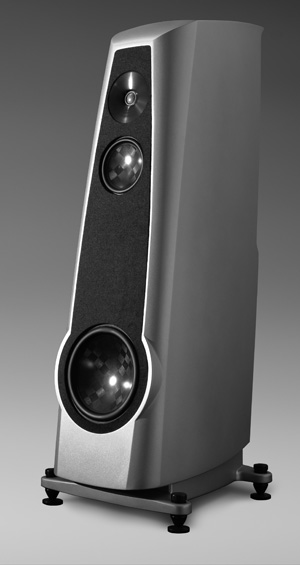
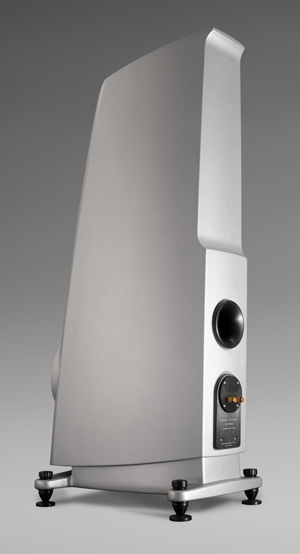
I liked what I saw. 4' tall and 12" wide, with dramatically rounded front edges and a forward-sloping top, the Lynx looks substantial without seeming hulking. A tall black fascia surrounding the drivers resembles an enormous keyhole or an upward-pointing cannon barrel. The Lynx is a three-way design with a 10" woofer, 6" midrange, and 1" beryllium-dome tweeter in a machined-aluminum waveguide. The crossover frequencies are set at 150Hz and 2.1kHz; Rockport specifies extension from 23Hz to 30kHz. Each Lynx weighs 305 lb, roughly the weight of four adult lynxes.
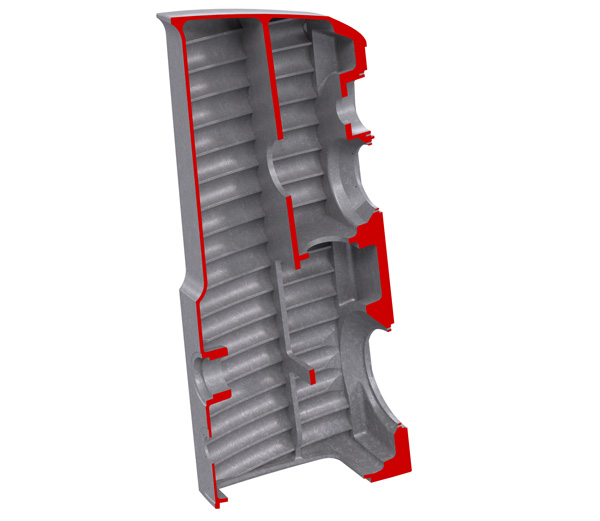
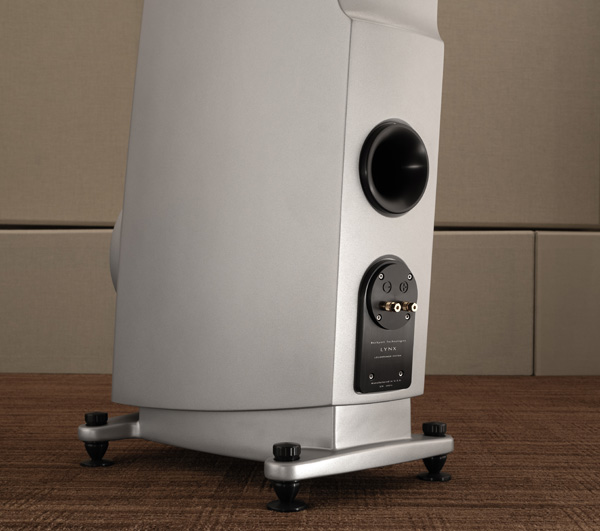 Why so heavy? Rockport intended the Lynx cabinet to approach the inertness of its more expensive enclosures without inheriting their cost. The two models above the Lynx—the $215,000/pair, 560 lb Lyra and the $159,000/pair, 360 lb Orion—use nesting-doll–style aluminum shells with a viscoelastic layer between them. The Lynx is different. It has a single thick-walled aluminum casting that incorporates internal ribs, bracing, and isolated driver chambers. More than 85 lb of viscoelastic goo is bonded to each enclosure's interior in five separate operations.
The cast-aluminum base incorporates outriggers on adjustable spikes and a chamber for the crossover, which is individually calibrated and then encased in epoxy to suppress minute vibrations.
The single-shell construction, which needs no fasteners or joinery, produces substantial savings: The Lynx costs $83,000–$94,000/pair depending on finish—as little as 40% of the price of a pair of Lyras. Installation and fine-tuning took my guests a couple of hours, during which I was useful only for supplying coffee, mineral water, and banter. Clark and Zimmer used a laser level, several tape measures, and their ears to determine the Lynxes' ideal positions, toe-in, and rake in my 21' × 15' room. I was assured that every buyer can expect a trained Rockport dealer to perform the same setup.
The duo also demonstrated new magnetic grilles, which replace push-fit versions affixed by split plastic pegs. Looking doleful, Clark confessed that in a moment of inattention, he'd once pressed one of those pegs straight through a tweeter membrane. Magnetic grilles are superior. (A little guiltily, I left them in my gear closet throughout my two-and-a-half-month evaluation.)
Why so heavy? Rockport intended the Lynx cabinet to approach the inertness of its more expensive enclosures without inheriting their cost. The two models above the Lynx—the $215,000/pair, 560 lb Lyra and the $159,000/pair, 360 lb Orion—use nesting-doll–style aluminum shells with a viscoelastic layer between them. The Lynx is different. It has a single thick-walled aluminum casting that incorporates internal ribs, bracing, and isolated driver chambers. More than 85 lb of viscoelastic goo is bonded to each enclosure's interior in five separate operations.
The cast-aluminum base incorporates outriggers on adjustable spikes and a chamber for the crossover, which is individually calibrated and then encased in epoxy to suppress minute vibrations.
The single-shell construction, which needs no fasteners or joinery, produces substantial savings: The Lynx costs $83,000–$94,000/pair depending on finish—as little as 40% of the price of a pair of Lyras. Installation and fine-tuning took my guests a couple of hours, during which I was useful only for supplying coffee, mineral water, and banter. Clark and Zimmer used a laser level, several tape measures, and their ears to determine the Lynxes' ideal positions, toe-in, and rake in my 21' × 15' room. I was assured that every buyer can expect a trained Rockport dealer to perform the same setup.
The duo also demonstrated new magnetic grilles, which replace push-fit versions affixed by split plastic pegs. Looking doleful, Clark confessed that in a moment of inattention, he'd once pressed one of those pegs straight through a tweeter membrane. Magnetic grilles are superior. (A little guiltily, I left them in my gear closet throughout my two-and-a-half-month evaluation.)
 The Maine thing about speaker design
Before he purchased Rockport Technologies in 2019 for an undisclosed sum, Josh Clark spent more than 20 years at Transparent Audio, which is based farther south in Saco, Maine. Though he now owns and runs the place, Clark described his "apprenticeship in Andy's art" as largely a matter of calibration work: Over the past six-plus years, the two have measured and listened to every newly produced pair of speakers, making small last-minute crossover adjustments. Evidently, Clark is a quick study. "I'm now better at loudspeaker design and calibration than Andy ever was," he told me with a twinkle, "but I still let him contribute to protect his fragile ego." The ribbing is affectionate. Payor, though steeped in science, stressed that there is indeed an art to loudspeaker design. It begins with deciding which qualities to emphasize, which compromises to accept, and how to prevent one impressive attribute from upsetting the balance of the whole. Even a seemingly simple design question, he pointed out, allows for "literally endless permutations." For the Lynx, Rockport wanted a full-range speaker capable of handling wide dynamic swings without requiring an enormous cabinet. "Hands-down, the chief arbiter of a clean wave launch from a loudspeaker is enclosure shape," Payor said. On a conventional flat baffle, sound traveling across the cabinet front reaches a sharp edge and diffracts. That edge behaves like a second source, interfering with the drivers' direct output and producing comb filtering and phase irregularities that can make the speaker easier to identify as the source of the sound. Rockport counters this with broad chamfers and by varying the distances from each driver to the cabinet edges. Payor considers that control essential to convincing imaging: A speaker that fails to manage diffraction, he said, "never gets entirely out of the way sonically."
The Lynx's 10" woofer is derived from, though not identical to, the 10" drivers used in the Lyra. Its 4-ohm motor, suspension, cone, surround, and spider are optimized for low mass, low friction, and high sensitivity. The company says the woofer remains pistonic to about 1.8kHz, far above its 150Hz crossover point; by then, the crossover has reduced its output by more than 72dB. The Lynx uses a rear-firing port, which, when I listened, called no attention to itself. The single woofer reaches a claimed 23Hz, and in my room the bass had the scale and pressure of a much larger speaker without the chuffing or one-note bloom that sometimes betrays a ported design.
 The midrange and tweeter are the same drivers used in the Lyra. During the installation visit, Zimmer handed me a domed sample of the spread-tow carbon-fiber sandwich composite (footnote 2) used for Rockport's woofer and midrange cones. It was astonishingly light—the 6" midrange cone weighs less than 8gm, a little over a quarter ounce—but stiff enough that I imagined I could put my full weight on the piece without flexing or breaking it. Rockport's aim is to combine very low moving mass with enough rigidity to prevent bending and resonance within and beyond the driver's passband. Once a cone flexes, it no longer moves as a single piston; different parts of its surface move out of phase, creating resonances that can store and release energy after the signal has changed.
The Lynx tweeter's waveguide raises sensitivity by roughly 6dB through part of the lower treble, reduces the required dome excursion, and controls dispersion so that the tweeter's off-axis output better matches that of the larger midrange near the crossover. It also improves acoustic loading, increasing dynamic capability where the wavelengths are longer and the handoff is most demanding. The aim is coherence through the crossover without drawing attention to the tweeter. That distinction carries into Payor's view of resolution. He dislikes the idea that a revealing speaker must sound clinical.
"High resolution and musicality are not mutually exclusive attributes in loudspeaker design," he told me. A speaker with an elevated midrange or treble and lean, tightly damped bass may sound revealing on some recordings, but emphasizing part of the spectrum is not the same as preserving information. For Payor, real resolution depends on correct tonal proportions, linear dynamic behavior, low enclosure noise, low driver friction, and the ability to reproduce very small signals without losing them below the transducers' mechanical resolution thresholds.
Rockport calls that threshold the "resolution floor." Every driver reaches a point where friction and other losses prevent a very small signal from producing proportional motion. Lowering that floor allows more low-level musical information to survive. For Payor, the point is not detail for its own sake: "There's really no point in pursuing high-end audio if your system doesn't move you emotionally."
It was time to find out whether the Lynxes could.
The midrange and tweeter are the same drivers used in the Lyra. During the installation visit, Zimmer handed me a domed sample of the spread-tow carbon-fiber sandwich composite (footnote 2) used for Rockport's woofer and midrange cones. It was astonishingly light—the 6" midrange cone weighs less than 8gm, a little over a quarter ounce—but stiff enough that I imagined I could put my full weight on the piece without flexing or breaking it. Rockport's aim is to combine very low moving mass with enough rigidity to prevent bending and resonance within and beyond the driver's passband. Once a cone flexes, it no longer moves as a single piston; different parts of its surface move out of phase, creating resonances that can store and release energy after the signal has changed.
The Lynx tweeter's waveguide raises sensitivity by roughly 6dB through part of the lower treble, reduces the required dome excursion, and controls dispersion so that the tweeter's off-axis output better matches that of the larger midrange near the crossover. It also improves acoustic loading, increasing dynamic capability where the wavelengths are longer and the handoff is most demanding. The aim is coherence through the crossover without drawing attention to the tweeter. That distinction carries into Payor's view of resolution. He dislikes the idea that a revealing speaker must sound clinical.
"High resolution and musicality are not mutually exclusive attributes in loudspeaker design," he told me. A speaker with an elevated midrange or treble and lean, tightly damped bass may sound revealing on some recordings, but emphasizing part of the spectrum is not the same as preserving information. For Payor, real resolution depends on correct tonal proportions, linear dynamic behavior, low enclosure noise, low driver friction, and the ability to reproduce very small signals without losing them below the transducers' mechanical resolution thresholds.
Rockport calls that threshold the "resolution floor." Every driver reaches a point where friction and other losses prevent a very small signal from producing proportional motion. Lowering that floor allows more low-level musical information to survive. For Payor, the point is not detail for its own sake: "There's really no point in pursuing high-end audio if your system doesn't move you emotionally."
It was time to find out whether the Lynxes could.
 Force and finesse
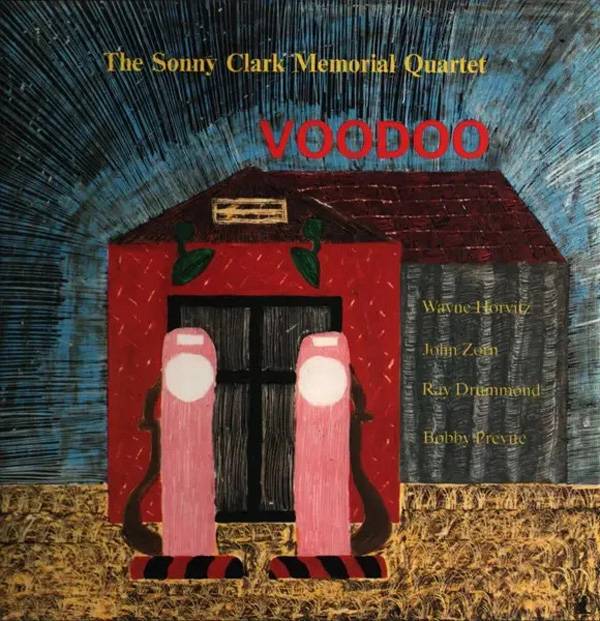
On "Cool Struttin'," from the Sonny Clark Memorial Quartet's Voodoo (16/44.1 FLAC, Black Saint/Qobuz), Ray Drummond's double bass had a little more definition in its lower reaches than I remember hearing from either the Magico S2 or the Estelon X Diamond Mk II. I didn't specifically listen for it, and it didn't exactly announce itself, but there it was. It wasn't a matter of added grunt or exaggerated weight. The Rockports' bass was more like a muscle that ripples a little closer, more visibly, near the skin.
Joseph Alessi's Trombonastics (16/44.1 FLAC, Summit/Qobuz) gave the Lynxes something very different to work with. In the fourth movement of Bizet's Carmen Fantasy, "Habanera," Alessi and pianist Ami Fujiwara take a sudden turn toward jazz and swing. The playfulness is built into the composition, but Alessi finds more of it than most players would. Through the Lynxes, I could hear what happened to each note after he released it into the room.
The following movement, "Danse bohème," is a display of great virtuosity. Its 16th-note passages are difficult to play on a heavy concert trombone, but Alessi dispatches them with grit, grace, and accuracy. His tone remains homogeneous throughout the instrument's register; no note sounds conspicuously brighter or darker than the one preceding it. His rich, rutting tone reminds me of Stefan Schulz, whose Berlin Recital album I love, but the two players differ in character. Schulz's bass trombone sound is larger, more expansive and resonant, with more air around it. Alessi's is tightly focused: brilliant without being bright, authoritative without turning aggressive. The Lynxes made the distinction between the two musicians unusually easy to hear.
The speakers' ability to clarify musical character without dissecting it also served Neu!'s self-titled 1972 debut album (16/44.1 FLAC, Grönland/Qobuz). Michael Rother and Klaus Dinger had both passed through an early incarnation of Kraftwerk before forming Neu!, and the connection to Autobahn is unmistakable. Rother's guitar often behaves less like a conventional melodic instrument than a continuously moving surface, while Dinger's motorik drumming barely varies, swings, or breathes. It simply advances, relentless and monotonous but captivating all the same. The music suggests an open highway, a fixed speed, and no particular need to arrive. Through the Lynxes, that ostinato pulse remained taut.
In the mood for more 1970s German rock, I cued up Popol Vuh's Hosianna Mantra, also from 1972 (16/44.1 FLAC, Cherry Red/Qobuz). My Van Halen– and Elvis Costello–addled brain would have had no patience for this music in the 1970s. Now I find it moving, partly because, like so much other underappreciated music, it has simply remained available, waiting to be discovered long after its maker retired from music or passed away. Popol Vuh's Florian Fricke couldn't have guessed that a Maine-based Dutchman would begin to appreciate his work 25 years after his death. Somewhere, perhaps, an adventurous teenager in Tokyo or a graybeard in New Delhi is making the same discovery. It's enough to make me a bit misty.
 The Lynxes respected Hosianna Mantra's patience, allowing its acoustic textures and silences to develop without pushing the music forward or polishing away its strangeness. Their resolution drew me further into the recording.
Michael Jackson's "Wanna Be Startin' Somethin'," from Thriller (24/44.1 FLAC, Epic-Legacy/Qobuz), began another run of recordings driven by rhythm. The South African–influenced chant ("Mama se mama sa mamacoosa"; footnote 3) emerged with fabulous clarity, while the hyperclean instrumental parts gripped one another like cogs in a machine. Apart from the guitar and voices, the arrangement sounds electronically generated, yet everything about it feels like live tissue. The Lynxes gave the track great forward motion while keeping its densely interlocked parts distinct.
I remembered that Jackson borrowed the "Mama se" chant from Cameroonian saxophonist Manu Dibango's 1972 disco track "Soul Makossa" (footnote 4). This led me down a Dibango rabbit hole. "Wouro," from Best Of (16/44.1 FLAC, Universal-Mercury/Qobuz) is a festive three-chord blues with an infectious pulse. The horn stabs deliciously behind the beat. Tenor saxophone and trumpet occupy almost the same place in the mix rather than being panned apart, but the Lynxes supplied enough resolution to again distinguish the individual tones of the instruments.
The Lynxes respected Hosianna Mantra's patience, allowing its acoustic textures and silences to develop without pushing the music forward or polishing away its strangeness. Their resolution drew me further into the recording.
Michael Jackson's "Wanna Be Startin' Somethin'," from Thriller (24/44.1 FLAC, Epic-Legacy/Qobuz), began another run of recordings driven by rhythm. The South African–influenced chant ("Mama se mama sa mamacoosa"; footnote 3) emerged with fabulous clarity, while the hyperclean instrumental parts gripped one another like cogs in a machine. Apart from the guitar and voices, the arrangement sounds electronically generated, yet everything about it feels like live tissue. The Lynxes gave the track great forward motion while keeping its densely interlocked parts distinct.
I remembered that Jackson borrowed the "Mama se" chant from Cameroonian saxophonist Manu Dibango's 1972 disco track "Soul Makossa" (footnote 4). This led me down a Dibango rabbit hole. "Wouro," from Best Of (16/44.1 FLAC, Universal-Mercury/Qobuz) is a festive three-chord blues with an infectious pulse. The horn stabs deliciously behind the beat. Tenor saxophone and trumpet occupy almost the same place in the mix rather than being panned apart, but the Lynxes supplied enough resolution to again distinguish the individual tones of the instruments.
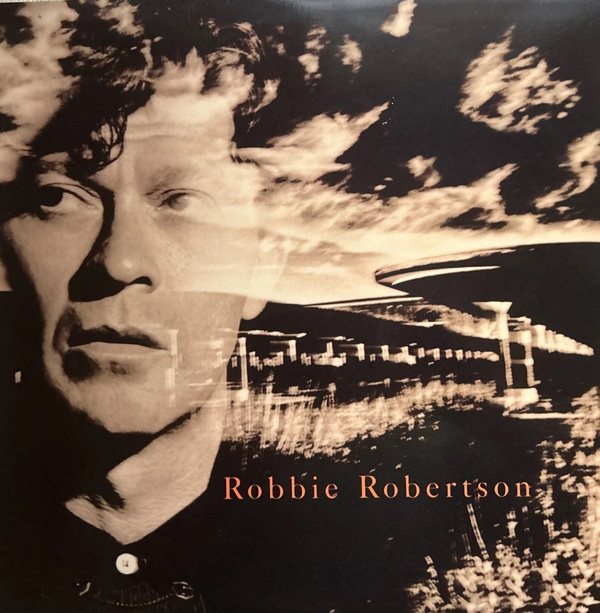 A different kind of heat emanates from Robbie Robertson's highly evocative "Somewhere Down the Crazy River," off Robbie Robertson (LP, Geffen GHS 24160). From the opening notes, the Southern air is thick with cicadas, river mud, humidity and a half-lit juke joint that just might be a mirage. Sam Llanas is hardly a conventional backing singer here; he materializes behind Robertson like an apparition. The Lynxes deepened the atmosphere without making anything conspicuous. They also conveyed the feverishness and preserved the odd indefinite distances (courtesy of producer Daniel Lanois) among the recording's voices and instruments.
To wrap things up, I played the title track from Bessie Smith's Empty Bed Blues (LP, Columbia CG 30450). It's a combo of her formidable voice, a few instruments, and an abundance of innuendo: "He boiled my first cabbage, and he made it awful hot. Then he put in the bacon and overflowed the pot."
The Lynxes could not remove the recording limitations of a century ago. Probably no speaker could. But they did recover Smith: the force of her delivery, her command of timing, and her winking, cheerful raunch.
A different kind of heat emanates from Robbie Robertson's highly evocative "Somewhere Down the Crazy River," off Robbie Robertson (LP, Geffen GHS 24160). From the opening notes, the Southern air is thick with cicadas, river mud, humidity and a half-lit juke joint that just might be a mirage. Sam Llanas is hardly a conventional backing singer here; he materializes behind Robertson like an apparition. The Lynxes deepened the atmosphere without making anything conspicuous. They also conveyed the feverishness and preserved the odd indefinite distances (courtesy of producer Daniel Lanois) among the recording's voices and instruments.
To wrap things up, I played the title track from Bessie Smith's Empty Bed Blues (LP, Columbia CG 30450). It's a combo of her formidable voice, a few instruments, and an abundance of innuendo: "He boiled my first cabbage, and he made it awful hot. Then he put in the bacon and overflowed the pot."
The Lynxes could not remove the recording limitations of a century ago. Probably no speaker could. But they did recover Smith: the force of her delivery, her command of timing, and her winking, cheerful raunch.
 Presence and authority
The Lynxes make their authority known quickly. Force and slam are part of their appeal. For all its physical presence, the bass remained articulate and fully joined to the music above it. The Rockports are street sluggers: muscular, direct, and eager to show what they can do. The Magico S2s that preceded them here are more like trained athletes. They play just as powerfully but leaner. Rockport bass enters the room first, as it were, sometimes with a little, well, wave; the Magico bass reveals itself without asking for notice. What makes the Lynx unusual is that its authority does not come from an especially fat or tall enclosure. It can produce the scale and pressure of a much larger speaker without visually taking over the room.
Bosch's The Garden of Earthly Delights loses something every time it becomes a postcard, print, or image on a screen. The Rockport speakers reminded me that the best reproductions—and the best reproducers—can preserve enough of an original's scale, life, and color to bring the whole vividly back into view. Having the Lynxes in my room put a smile on my face every day. Anyone shopping at this level should make a point of auditioning them.
Footnote 1: In 1568, the Duke of Alba (sent by the Spanish Crown to crush the Dutch Revolt and stop Protestantism) confiscated the painting from William of Orange. Eventually it ended up in Spain. As a Dutchman, I expect to be over this any century now. Footnote 2: Spread tow refers to carbon-fiber tows, or bundles of filaments, that are mechanically flattened into thin, wide tapes, then woven into sheets, producing a smooth checkerboard pattern. Because the fibers remain straighter and undergo less crimping than in a conventional weave, the finished composite can be made thinner and lighter while retaining high stiffness and tensile strength. Spread-tow carbon fiber is commonly used in aerospace and motorsports applications, drones, and high-end bicycle frames.
Footnote 3: Which all my life I'd misheard as one of the following: "Mama sad, mama sent my moccasin"; "Gonna save mama-san from my cousin"; and occasionally "What you say 'bout a side of Michael sauce." Finally using Roon's "view lyrics" feature proved ... enlightening.
Footnote 4: This unauthorized use led to a legal dispute and an eventual financial settlement.
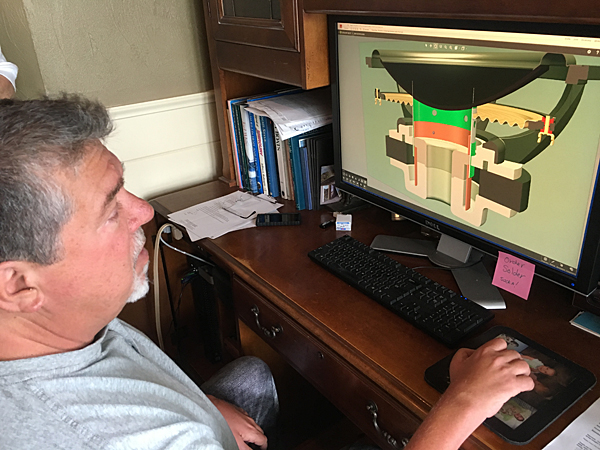
BR>Rockport's founder and director of technology, Andy Payor. (Photo: John Atkinson.)
A heavy hitter arrivesI live on Mount Desert Island, Maine, so factory visits are never just a drive away; usually flights are involved. Not so with Rockport. A few summers ago, I drove a pleasant two hours down Maine's scraggly coast to tour the company's South Thomaston base, where I met founder and director of technology Andy Payor and president and owner Josh Clark. Rockport has since added a 10,000ft2 facility in Westbrook, 80 miles farther south, where most of the "industrial" operations are performed. For now, the South Thomaston location remains the company's center for R&D and assembly work. Business is good. Rockport currently has seven people on the payroll but expects to hire more to help deal with year-over-year growth.
Why so heavy? Rockport intended the Lynx cabinet to approach the inertness of its more expensive enclosures without inheriting their cost. The two models above the Lynx—the $215,000/pair, 560 lb Lyra and the $159,000/pair, 360 lb Orion—use nesting-doll–style aluminum shells with a viscoelastic layer between them. The Lynx is different. It has a single thick-walled aluminum casting that incorporates internal ribs, bracing, and isolated driver chambers. More than 85 lb of viscoelastic goo is bonded to each enclosure's interior in five separate operations.
The Maine thing about speaker designBefore he purchased Rockport Technologies in 2019 for an undisclosed sum, Josh Clark spent more than 20 years at Transparent Audio, which is based farther south in Saco, Maine. Though he now owns and runs the place, Clark described his "apprenticeship in Andy's art" as largely a matter of calibration work: Over the past six-plus years, the two have measured and listened to every newly produced pair of speakers, making small last-minute crossover adjustments. Evidently, Clark is a quick study. "I'm now better at loudspeaker design and calibration than Andy ever was," he told me with a twinkle, "but I still let him contribute to protect his fragile ego." The ribbing is affectionate. Payor, though steeped in science, stressed that there is indeed an art to loudspeaker design. It begins with deciding which qualities to emphasize, which compromises to accept, and how to prevent one impressive attribute from upsetting the balance of the whole. Even a seemingly simple design question, he pointed out, allows for "literally endless permutations." For the Lynx, Rockport wanted a full-range speaker capable of handling wide dynamic swings without requiring an enormous cabinet. "Hands-down, the chief arbiter of a clean wave launch from a loudspeaker is enclosure shape," Payor said. On a conventional flat baffle, sound traveling across the cabinet front reaches a sharp edge and diffracts. That edge behaves like a second source, interfering with the drivers' direct output and producing comb filtering and phase irregularities that can make the speaker easier to identify as the source of the sound. Rockport counters this with broad chamfers and by varying the distances from each driver to the cabinet edges. Payor considers that control essential to convincing imaging: A speaker that fails to manage diffraction, he said, "never gets entirely out of the way sonically."
The midrange and tweeter are the same drivers used in the Lyra. During the installation visit, Zimmer handed me a domed sample of the spread-tow carbon-fiber sandwich composite (footnote 2) used for Rockport's woofer and midrange cones. It was astonishingly light—the 6" midrange cone weighs less than 8gm, a little over a quarter ounce—but stiff enough that I imagined I could put my full weight on the piece without flexing or breaking it. Rockport's aim is to combine very low moving mass with enough rigidity to prevent bending and resonance within and beyond the driver's passband. Once a cone flexes, it no longer moves as a single piston; different parts of its surface move out of phase, creating resonances that can store and release energy after the signal has changed.
The Lynx tweeter's waveguide raises sensitivity by roughly 6dB through part of the lower treble, reduces the required dome excursion, and controls dispersion so that the tweeter's off-axis output better matches that of the larger midrange near the crossover. It also improves acoustic loading, increasing dynamic capability where the wavelengths are longer and the handoff is most demanding. The aim is coherence through the crossover without drawing attention to the tweeter. That distinction carries into Payor's view of resolution. He dislikes the idea that a revealing speaker must sound clinical.
Force and finesseOn "Cool Struttin'," from the Sonny Clark Memorial Quartet's Voodoo (16/44.1 FLAC, Black Saint/Qobuz), Ray Drummond's double bass had a little more definition in its lower reaches than I remember hearing from either the Magico S2 or the Estelon X Diamond Mk II. I didn't specifically listen for it, and it didn't exactly announce itself, but there it was. It wasn't a matter of added grunt or exaggerated weight. The Rockports' bass was more like a muscle that ripples a little closer, more visibly, near the skin.
The Lynxes respected Hosianna Mantra's patience, allowing its acoustic textures and silences to develop without pushing the music forward or polishing away its strangeness. Their resolution drew me further into the recording.
Michael Jackson's "Wanna Be Startin' Somethin'," from Thriller (24/44.1 FLAC, Epic-Legacy/Qobuz), began another run of recordings driven by rhythm. The South African–influenced chant ("Mama se mama sa mamacoosa"; footnote 3) emerged with fabulous clarity, while the hyperclean instrumental parts gripped one another like cogs in a machine. Apart from the guitar and voices, the arrangement sounds electronically generated, yet everything about it feels like live tissue. The Lynxes gave the track great forward motion while keeping its densely interlocked parts distinct.
A different kind of heat emanates from Robbie Robertson's highly evocative "Somewhere Down the Crazy River," off Robbie Robertson (LP, Geffen GHS 24160). From the opening notes, the Southern air is thick with cicadas, river mud, humidity and a half-lit juke joint that just might be a mirage. Sam Llanas is hardly a conventional backing singer here; he materializes behind Robertson like an apparition. The Lynxes deepened the atmosphere without making anything conspicuous. They also conveyed the feverishness and preserved the odd indefinite distances (courtesy of producer Daniel Lanois) among the recording's voices and instruments.
To wrap things up, I played the title track from Bessie Smith's Empty Bed Blues (LP, Columbia CG 30450). It's a combo of her formidable voice, a few instruments, and an abundance of innuendo: "He boiled my first cabbage, and he made it awful hot. Then he put in the bacon and overflowed the pot."
Presence and authorityThe Lynxes make their authority known quickly. Force and slam are part of their appeal. For all its physical presence, the bass remained articulate and fully joined to the music above it. The Rockports are street sluggers: muscular, direct, and eager to show what they can do. The Magico S2s that preceded them here are more like trained athletes. They play just as powerfully but leaner. Rockport bass enters the room first, as it were, sometimes with a little, well, wave; the Magico bass reveals itself without asking for notice. What makes the Lynx unusual is that its authority does not come from an especially fat or tall enclosure. It can produce the scale and pressure of a much larger speaker without visually taking over the room.
Footnote 1: In 1568, the Duke of Alba (sent by the Spanish Crown to crush the Dutch Revolt and stop Protestantism) confiscated the painting from William of Orange. Eventually it ended up in Spain. As a Dutchman, I expect to be over this any century now. Footnote 2: Spread tow refers to carbon-fiber tows, or bundles of filaments, that are mechanically flattened into thin, wide tapes, then woven into sheets, producing a smooth checkerboard pattern. Because the fibers remain straighter and undergo less crimping than in a conventional weave, the finished composite can be made thinner and lighter while retaining high stiffness and tensile strength. Spread-tow carbon fiber is commonly used in aerospace and motorsports applications, drones, and high-end bicycle frames.