The quest to review the Pearl Acoustics Model One began at the 2025 Montreal Audiofest, which I was covering for Stereophile. It was there I crossed paths in a hallway with Galion Audio's Thomas Tan, who also hosts the YouTube channel Thomas & Stereo. "Rob! Rob!" he called out through a stream of visitors between us. "You have to hear my TS A20 power amp driving Pearl Acoustics speakers!"
"You mean the speaker from Joseph Audio?" I asked over bobbing heads.
"No! The company is Pearl Acoustics. The speaker is the Sibelius."
I'd never heard of the speaker or the brand, but I promised Thomas I'd check it out.
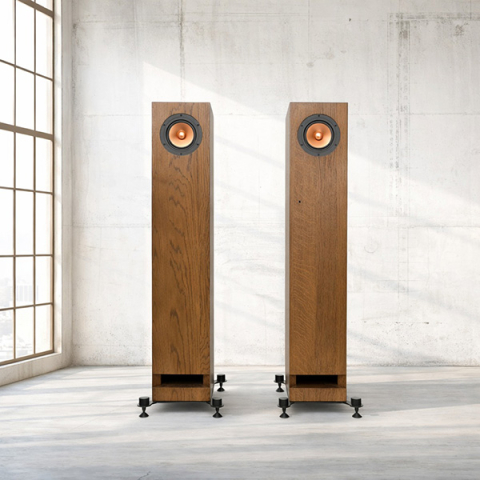
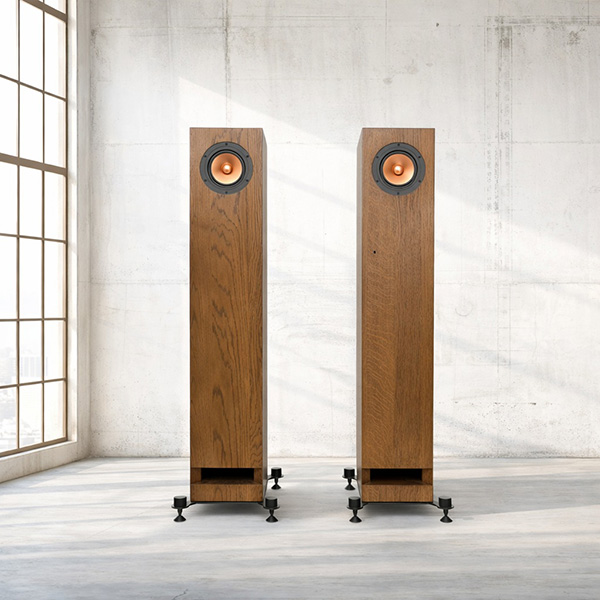
When I finally visited the room, I was perplexed by the excitement Thomas had shown in the hallway, which he carried into the exhibit room. I expected something more imposing: big woofers, perhaps, or a gaping horn mouth. Instead, the Sibelius was elegantly slim and not particularly tall. It was attractive in an understated, clean-lined way—but where were the drivers?
"That's it," said Thomas, pointing to a single 4" driver positioned at the top of the baffle.
"So the woofer is underneath the cabinet?" I wondered aloud, then quickly noticed the horizontal vent at the base of the speaker: There was no place for a down-firing woofer to go.
"No!" he replied with a toothy grin. "That driver is it!"
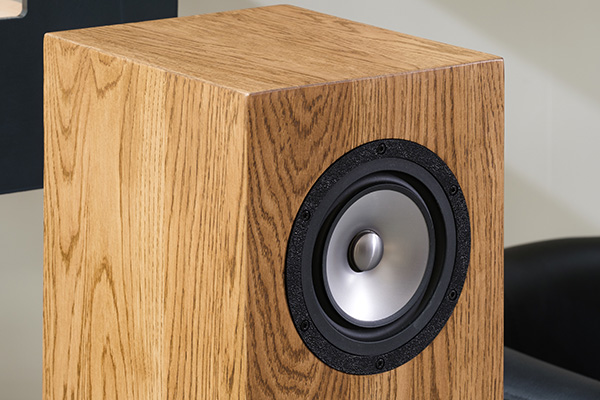 I felt my heart sink, not because I have anything against full-range drivers—but 4"? Sure, this was a quintessential point-source design, but still: I couldn't help thinking about all that music in a recording—not just the frequency range but the compounded musical energy, the physicality of the lowest bass notes, the abundance of information trying to get out into the room. With the Sibelius, it would all have to squeeze through that tiny cone, and that rectangular vent at the bottom.
Not expecting much—at least nothing out of the ordinary—I sat in the front row. Visitors were flowing in, smiling, and chattering as if they were in on a secret. When the last available seat was taken, people piled against the back wall and spilled to the sides, standing shoulder-to-shoulder.
Thomas then introduced the speaker's designer, Harley Lovegrove, a Brit based in Belgium, where the speaker is manufactured. Harley explained the design philosophy and suggested that the best way to understand the Model One's 4" driver was to think of it as a microphone in reverse.
"A microphone's diaphragm is very small, often less than an inch in diameter, yet it captures the entire range of frequencies," he said. "We don't need or use separate bass, midrange, and treble microphones."
Once he finished speaking, I settled into my seat, expecting an enjoyable but standard show demo. Then the drum solo kicked in, and it was as if I'd been dropped into a USS Enterprise Holodeck program. Whoosh! The air felt denser and I felt more closed in. I was in a virtual recording space, with one of the most palpably recreated drum kits I'd ever heard spread out in front of me, down to the height of the drums on their stands. People next to me gasped audibly. I suddenly felt self-conscious: What was I witnessing here?
The easy answer was: drum hits so lifelike they seemed 3D printed; microscopic resolution, in the rapids-like churning of the air between the strikes and off the nearby walls; elaborate tonal gradations; intricate vibrational patterns set off by strikes on drum skins; the slam of the bass drum. The transparency and degree of verisimilitude to a real drum set took my breath away. It was hard to reconcile the presence and impact I was hearing with the single tiny speaker cone I was seeing. It defied common sense.
"Bass walloped," I wrote in my show report (scroll down to the foot of the page), along with describing tone as "textural," detail as "granular," and the soundstage as "walk-through enveloping."
It was quite the demo, but had it ended there, I might have suspected the Sibelius was a one-trick pony, able to reproduce that one drum solo really well but maybe not much else. Then songs by Paul Simon and Diana Krall poured out, sounding lavishly detailed and tonally pure, with vividly rendered vocals and soundstages like Persian rugs—richly and colorfully patterned. Suffice to say that my pre-demo assumptions couldn't have been more wrong. I was blown away by the presentation, as was most of the crowd, judging by the reactions I noticed. The Sibelius seemed to beat the laws of physics. But it wasn't magic. As explained in the product literature, "The Model One isn't radically new. Instead, it represents a 'no cost spared' reintegration of proven acoustic principles."
As I left the exhibit room that day, I wondered how the Sibelius would sound in my room, with music and a system I knew well. Thus was planted the seed of this review—for the Sibelius.
I felt my heart sink, not because I have anything against full-range drivers—but 4"? Sure, this was a quintessential point-source design, but still: I couldn't help thinking about all that music in a recording—not just the frequency range but the compounded musical energy, the physicality of the lowest bass notes, the abundance of information trying to get out into the room. With the Sibelius, it would all have to squeeze through that tiny cone, and that rectangular vent at the bottom.
Not expecting much—at least nothing out of the ordinary—I sat in the front row. Visitors were flowing in, smiling, and chattering as if they were in on a secret. When the last available seat was taken, people piled against the back wall and spilled to the sides, standing shoulder-to-shoulder.
Thomas then introduced the speaker's designer, Harley Lovegrove, a Brit based in Belgium, where the speaker is manufactured. Harley explained the design philosophy and suggested that the best way to understand the Model One's 4" driver was to think of it as a microphone in reverse.
"A microphone's diaphragm is very small, often less than an inch in diameter, yet it captures the entire range of frequencies," he said. "We don't need or use separate bass, midrange, and treble microphones."
Once he finished speaking, I settled into my seat, expecting an enjoyable but standard show demo. Then the drum solo kicked in, and it was as if I'd been dropped into a USS Enterprise Holodeck program. Whoosh! The air felt denser and I felt more closed in. I was in a virtual recording space, with one of the most palpably recreated drum kits I'd ever heard spread out in front of me, down to the height of the drums on their stands. People next to me gasped audibly. I suddenly felt self-conscious: What was I witnessing here?
The easy answer was: drum hits so lifelike they seemed 3D printed; microscopic resolution, in the rapids-like churning of the air between the strikes and off the nearby walls; elaborate tonal gradations; intricate vibrational patterns set off by strikes on drum skins; the slam of the bass drum. The transparency and degree of verisimilitude to a real drum set took my breath away. It was hard to reconcile the presence and impact I was hearing with the single tiny speaker cone I was seeing. It defied common sense.
"Bass walloped," I wrote in my show report (scroll down to the foot of the page), along with describing tone as "textural," detail as "granular," and the soundstage as "walk-through enveloping."
It was quite the demo, but had it ended there, I might have suspected the Sibelius was a one-trick pony, able to reproduce that one drum solo really well but maybe not much else. Then songs by Paul Simon and Diana Krall poured out, sounding lavishly detailed and tonally pure, with vividly rendered vocals and soundstages like Persian rugs—richly and colorfully patterned. Suffice to say that my pre-demo assumptions couldn't have been more wrong. I was blown away by the presentation, as was most of the crowd, judging by the reactions I noticed. The Sibelius seemed to beat the laws of physics. But it wasn't magic. As explained in the product literature, "The Model One isn't radically new. Instead, it represents a 'no cost spared' reintegration of proven acoustic principles."
As I left the exhibit room that day, I wondered how the Sibelius would sound in my room, with music and a system I knew well. Thus was planted the seed of this review—for the Sibelius.
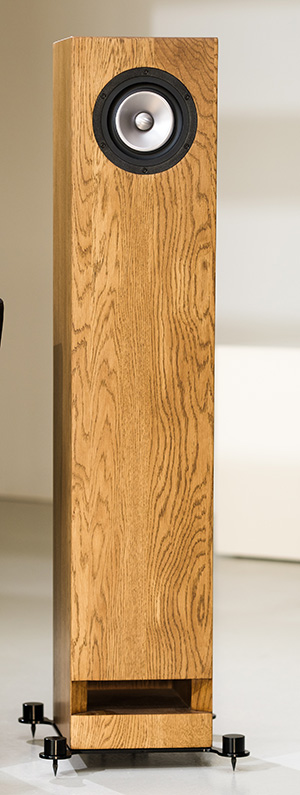 The Model One
So, why am I talking about the Sibelius when this review should be about the Model One?
"They're exactly the same speaker," Harley told me during our interview. "As the business started expanding its product range, a name change was considered a good idea: 'one' driver, our 'first' design, and so on. There was also a perception from younger people that the Sibelius was only for classical music. Another perception was that most of our clients and prospects didn't know Sibelius."
There were no changes to the design, "and nothing planned for the next 20 years!" Harley said. "We believe we have it right, and like a violin luthier, when you believe you have it right, you'd be very unwise to change it. Of course, if something were to dramatically improve in terms of materials or laws of physics, we would need to reflect on that, but that isn't something we've witnessed. Pearl Acoustics is about longevity—all our products are designed to last decades without maintenance."
On the other hand, should the Model One require maintenance, it comes with a 10-year warranty covering any manufacturing defects, except for the driver's diaphragm; apparently that's one trade-off for their small size. Also, the 4" cone is made from an extremely thin but rigid magnesium alloy, to keep mass very low for improved efficiency. Drive them too hard, and they can fail. As Pearl Acoustics Director Ajay Verma told me, the company sells "replacements, should the customer damage them."
The Model One stands just over 3'6" (1010mm) high, 9" (225mm) wide, and 11.6" (300mm) deep. Significantly, the speaker's architecture is based on Paul Voigt's Voigt pipe principle—more on this in a moment.
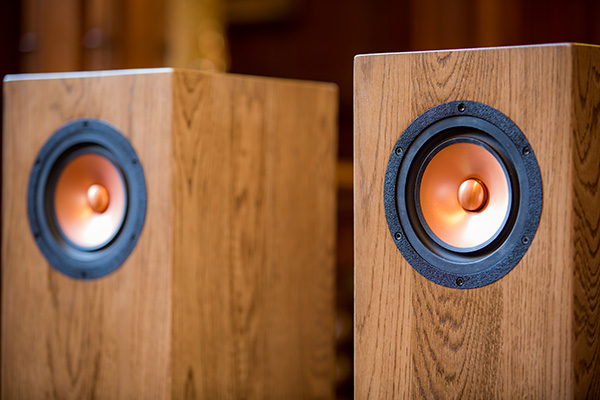 I asked Harley to elaborate on his mike-in-reverse analogy.
"A microphone converts soundwaves into electrical signals, while a loudspeaker performs the opposite task, converting electrical signals back into soundwaves," he said, adding: "Most studio microphones use extremely small diaphragms, often less than an inch in diameter. These thin metallic discs respond to sound pressure waves in two different ways." At low frequencies, the diaphragm moves back and forth. At high frequencies, it flexes.
"When a full range of frequencies arrives simultaneously, both behaviors occur at once: the diaphragm moves back and forth while also vibrating. The Model One's driver designer, Mark Fenlon of Markaudio, understood this behavior extremely well. His goal was to design a loudspeaker cone that mirrors the behavior of a microphone diaphragm, allowing a single driver to reproduce the entire audio spectrum, like a microphone in reverse."
"A single point source—one driver—has no phasing issues whatsoever," he said. "The soundwaves it produces radiate into the room completely in phase. This gives many advantages, most notably a wonderfully wide and deep soundstage, where the listener may not only hear a very lifelike image in front of them, but to the side of the listening position and even behind it.
"In general, single-driver loudspeakers can produce this effect far easier and more accurately than most multiple drive unit systems," he continued. "Why that is can be summed up by one word: coherence. Everything acts together as one. Because there is only one source, the brain can detect and process the audible data more easily than sound coming from multiple sources. A single source is also very likely to have low distortion. Imagine it this way: Throw a stone into the middle of a pond and watch the ripples form into pure circles. Now imagine what happens when you throw three different sized stones into the same pond at exactly the same time. The colliding ripples cause what we call interference, and this is exactly what happens when sound is produced from multiple drivers."
"Take, for instance, a two-way design, which typically uses deep cones for the mid/bass unit to ensure rigidity. The side effect is that the mid frequencies are projected into the room in a directional and focused way—like a megaphone—while the lower frequencies are omnidirectional. This 'megaphone' effect invariably colors the sound.
"It's why the Model One provides a level of detail that many designs can't match," he said. "And this comes down to the next challenge: using a crossover, which the Model One doesn't. There are many crossover designs, but each introduces some degree of phase shifting, where one driver is out of sync with another.
"These phasing issues can largely be overcome with additional circuitry, but at a cost," he warned. "Increasing complexity adds distortion. Each driver also has its own physical properties, introducing a certain degree of incoherence. All this can result in the loss of the minutiae of detail."
Harley cautioned that not all single-driver designs are built equally. "Some use step filters, which act very much like crossovers, holding back certain frequencies which would otherwise be too loud. In the case of the Model One, there are no step filters, or other electronics, in the signal path. The wires from the output of the amplifier are directly coupled to the single voice coil in the driver.
"To achieve the most realistic soundstage and sense of spatiality," he continued, "you need to keep everything in perfect phase."
The cone's 4" size was also critical.
"It has extremely low mass," Harley said. "This allows the diaphragm to return to its resting position almost instantly, allowing it to capture the minutest sonic details."
There's one downside to the cone's small size—and the ultralight voice coil the driver uses: It's not very efficient. Most crossover-less, single-driver speakers have very high sensitivity, but the Model One's sensitivity is average, at a specified 87dB/W/m. This low sensitivity is offset, however, by the fact that the Model One's impedance presents an easy load to an amplifier, with a specified nominal impedance of 7.2 ohms and an impedance curve said to rarely drop below 6 ohms.
As for the bass, "While larger cones can move more air, their greater mass also means they take longer to stop and return to rest. This can obscure detail and lose information."
"Another problem of big cones is that as the diameter of the cone increases, the center of the cone tends to move and accelerate before the outer edge. This causes the cone to deform and flex. Even the slightest deformation causes sonic degradation.
"Keeping a large cone both rigid and lightweight is extremely difficult. When flexing occurs, different parts of the cone generate slightly different sound wave patterns."
I asked Harley to elaborate on his mike-in-reverse analogy.
"A microphone converts soundwaves into electrical signals, while a loudspeaker performs the opposite task, converting electrical signals back into soundwaves," he said, adding: "Most studio microphones use extremely small diaphragms, often less than an inch in diameter. These thin metallic discs respond to sound pressure waves in two different ways." At low frequencies, the diaphragm moves back and forth. At high frequencies, it flexes.
"When a full range of frequencies arrives simultaneously, both behaviors occur at once: the diaphragm moves back and forth while also vibrating. The Model One's driver designer, Mark Fenlon of Markaudio, understood this behavior extremely well. His goal was to design a loudspeaker cone that mirrors the behavior of a microphone diaphragm, allowing a single driver to reproduce the entire audio spectrum, like a microphone in reverse."
"A single point source—one driver—has no phasing issues whatsoever," he said. "The soundwaves it produces radiate into the room completely in phase. This gives many advantages, most notably a wonderfully wide and deep soundstage, where the listener may not only hear a very lifelike image in front of them, but to the side of the listening position and even behind it.
"In general, single-driver loudspeakers can produce this effect far easier and more accurately than most multiple drive unit systems," he continued. "Why that is can be summed up by one word: coherence. Everything acts together as one. Because there is only one source, the brain can detect and process the audible data more easily than sound coming from multiple sources. A single source is also very likely to have low distortion. Imagine it this way: Throw a stone into the middle of a pond and watch the ripples form into pure circles. Now imagine what happens when you throw three different sized stones into the same pond at exactly the same time. The colliding ripples cause what we call interference, and this is exactly what happens when sound is produced from multiple drivers."
"Take, for instance, a two-way design, which typically uses deep cones for the mid/bass unit to ensure rigidity. The side effect is that the mid frequencies are projected into the room in a directional and focused way—like a megaphone—while the lower frequencies are omnidirectional. This 'megaphone' effect invariably colors the sound.
"It's why the Model One provides a level of detail that many designs can't match," he said. "And this comes down to the next challenge: using a crossover, which the Model One doesn't. There are many crossover designs, but each introduces some degree of phase shifting, where one driver is out of sync with another.
"These phasing issues can largely be overcome with additional circuitry, but at a cost," he warned. "Increasing complexity adds distortion. Each driver also has its own physical properties, introducing a certain degree of incoherence. All this can result in the loss of the minutiae of detail."
Harley cautioned that not all single-driver designs are built equally. "Some use step filters, which act very much like crossovers, holding back certain frequencies which would otherwise be too loud. In the case of the Model One, there are no step filters, or other electronics, in the signal path. The wires from the output of the amplifier are directly coupled to the single voice coil in the driver.
"To achieve the most realistic soundstage and sense of spatiality," he continued, "you need to keep everything in perfect phase."
The cone's 4" size was also critical.
"It has extremely low mass," Harley said. "This allows the diaphragm to return to its resting position almost instantly, allowing it to capture the minutest sonic details."
There's one downside to the cone's small size—and the ultralight voice coil the driver uses: It's not very efficient. Most crossover-less, single-driver speakers have very high sensitivity, but the Model One's sensitivity is average, at a specified 87dB/W/m. This low sensitivity is offset, however, by the fact that the Model One's impedance presents an easy load to an amplifier, with a specified nominal impedance of 7.2 ohms and an impedance curve said to rarely drop below 6 ohms.
As for the bass, "While larger cones can move more air, their greater mass also means they take longer to stop and return to rest. This can obscure detail and lose information."
"Another problem of big cones is that as the diameter of the cone increases, the center of the cone tends to move and accelerate before the outer edge. This causes the cone to deform and flex. Even the slightest deformation causes sonic degradation.
"Keeping a large cone both rigid and lightweight is extremely difficult. When flexing occurs, different parts of the cone generate slightly different sound wave patterns."
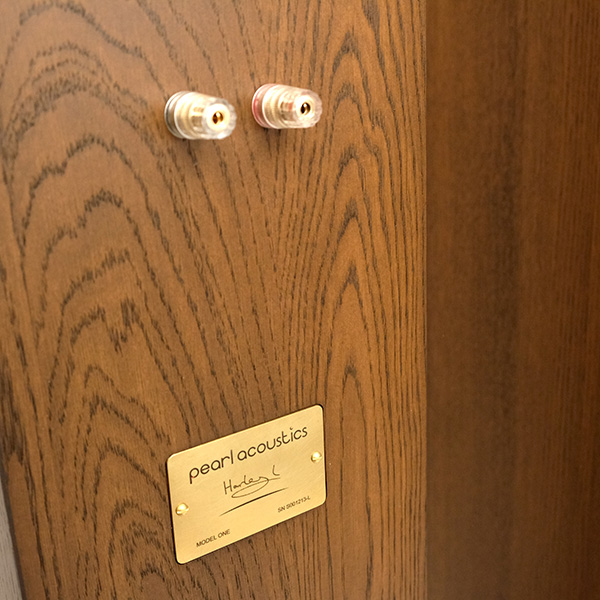 The driver is only half the equation; the Model One's cabinet, based on the Voigt pipe design, is the other half. In a conventional speaker enclosure, the rear soundwave cancels the sound produced by the front of the cone. In a Voigt pipe, the rear wave is delayed so that it exits the enclosure in phase with the front wave, which it does through the vent at the base of the baffle. "The two waves reinforce each other, increasing acoustic output," explained Harley. "Especially in the lower bass region."
Another characteristic of the Voigt pipe design is its tapered internal geometry, which works much like a horn or an acoustical instrument. Harley: "Consider the double bass. When a player plucks a string, the vibration travels down through the bridge into the front of the body of the instrument. The front panel excites a large volume of air, which escapes through the small f-holes, producing loud and powerful low frequencies.
"The Model One operates on a similar principle," he said. "The energy from the rear of the driver excites a column of air inside its enclosure. That air is then released through the front port in a controlled manner, allowing the system to produce very deep and well-defined bass from a relatively small initial movement."
The driver is only half the equation; the Model One's cabinet, based on the Voigt pipe design, is the other half. In a conventional speaker enclosure, the rear soundwave cancels the sound produced by the front of the cone. In a Voigt pipe, the rear wave is delayed so that it exits the enclosure in phase with the front wave, which it does through the vent at the base of the baffle. "The two waves reinforce each other, increasing acoustic output," explained Harley. "Especially in the lower bass region."
Another characteristic of the Voigt pipe design is its tapered internal geometry, which works much like a horn or an acoustical instrument. Harley: "Consider the double bass. When a player plucks a string, the vibration travels down through the bridge into the front of the body of the instrument. The front panel excites a large volume of air, which escapes through the small f-holes, producing loud and powerful low frequencies.
"The Model One operates on a similar principle," he said. "The energy from the rear of the driver excites a column of air inside its enclosure. That air is then released through the front port in a controlled manner, allowing the system to produce very deep and well-defined bass from a relatively small initial movement."
I felt my heart sink, not because I have anything against full-range drivers—but 4"? Sure, this was a quintessential point-source design, but still: I couldn't help thinking about all that music in a recording—not just the frequency range but the compounded musical energy, the physicality of the lowest bass notes, the abundance of information trying to get out into the room. With the Sibelius, it would all have to squeeze through that tiny cone, and that rectangular vent at the bottom.
The Model OneSo, why am I talking about the Sibelius when this review should be about the Model One?
I asked Harley to elaborate on his mike-in-reverse analogy.
"A microphone converts soundwaves into electrical signals, while a loudspeaker performs the opposite task, converting electrical signals back into soundwaves," he said, adding: "Most studio microphones use extremely small diaphragms, often less than an inch in diameter. These thin metallic discs respond to sound pressure waves in two different ways." At low frequencies, the diaphragm moves back and forth. At high frequencies, it flexes.
"When a full range of frequencies arrives simultaneously, both behaviors occur at once: the diaphragm moves back and forth while also vibrating. The Model One's driver designer, Mark Fenlon of Markaudio, understood this behavior extremely well. His goal was to design a loudspeaker cone that mirrors the behavior of a microphone diaphragm, allowing a single driver to reproduce the entire audio spectrum, like a microphone in reverse."
The driver is only half the equation; the Model One's cabinet, based on the Voigt pipe design, is the other half. In a conventional speaker enclosure, the rear soundwave cancels the sound produced by the front of the cone. In a Voigt pipe, the rear wave is delayed so that it exits the enclosure in phase with the front wave, which it does through the vent at the base of the baffle. "The two waves reinforce each other, increasing acoustic output," explained Harley. "Especially in the lower bass region."
Another characteristic of the Voigt pipe design is its tapered internal geometry, which works much like a horn or an acoustical instrument. Harley: "Consider the double bass. When a player plucks a string, the vibration travels down through the bridge into the front of the body of the instrument. The front panel excites a large volume of air, which escapes through the small f-holes, producing loud and powerful low frequencies.
"The Model One operates on a similar principle," he said. "The energy from the rear of the driver excites a column of air inside its enclosure. That air is then released through the front port in a controlled manner, allowing the system to produce very deep and well-defined bass from a relatively small initial movement."