
I heard my first genuinely awesome hi-fi through a pair of Tannoy speakers. The 15" Monitor Blacks were installed in wardrobe-sized Siemens cabinets that the owner had wrangled from a decommissioned recording studio in Austria. They were hooked up to a pair of vintage McIntosh mono amps. This happened in Moscow just after the collapse of the Soviet Union, and I was 21. Discovering that system in the city where I'd grown up was like finding a perfectly stored bottle of 1945 Haut-Brion at a strip-mall Cinnabon.
Five years later, having spent some time pressing my nose against the windows of hi-fi shops, I heard another pair of Tannoys, this time at the old Stereo Exchange on lower Broadway in Manhattan. A friend who worked there played me a pair of 10" Monitor Golds in homemade plywood cabinets, and the music that emerged made every contemporary speaker I'd heard sound dull, gray, and forgettable.
So you could say that Tannoys are part of my audiophile origin story. Their distinctive sound, like a favorite childhood dish, is hardwired in my brain. For several years, I lived with a pair of Ardens as my primary speakers, and even after I sold them, I haven't been able to get Tannoys out of my mind for long. There's something about the effortless euphony with which they reproduce music that still sends shivers down my back.
Permit me a bit of history: During the 1930s, Tannoy made speakers for everything from sporting events to political rallies and later supplied the British military and government. After the war, its products had become so ubiquitous in the UK that "Tannoy" became a generic term for a public-address system.
But it wasn't until 1947 that the company introduced its dual-concentric driver—known informally as the Monitor Black—in which a high-frequency compression driver sat in the throat of the 15" woofer and used the woofer's cone as a horn. The dual concentric behaved as a time- and phase-aligned point source and, at the time of its introduction, was probably the most accurate speaker in existence.
The 15" Monitor Black, the later 12" version, and subsequent dual-concentric drivers in this classic series were all designed by Chief Engineer Ronnie Rackham. They included the Monitor Silver (15" and 12", introduced in 1953), the Red (1961), the Gold (1967), and the HPD (1976); the last three drivers were made in 15", 12", and 10" versions. All used large alnico magnets, paper-pulp woofers, and heavy cast frames.
By the time Tannoy unveiled the HPD series, its drivers had become nearly as ubiquitous in British recording studios and homes as earlier Tannoys had been in factories and schools three decades earlier. Though the company made many speakers afterward, this series remains its most popular and iconic, still used today by thousands of audiophiles around the globe.
After I moved to a place with a smaller listening room about a year ago and had to retire the large and lovely Klipsch La Scalas, it was only a matter of time before my mind turned to Tannoy. Little by little I began haunting the usual online marketplaces, asking around, and trying to decide how much I was willing to spend.
The oldest versions of the Tannoy drivers, which have the lightest cones and the highest sensitivity, are the most collectible and are reputed to sound best. They are also the most expensive. Original-condition Monitor Blacks are virtually unobtainable in matched pairs, while a clean pair of Silvers commands prices that easily exceeded my budget. That left the still costly and rare Reds and the far-easier-to-find Golds.
I figured that the 15" models were too large for my 12' × 16' room and limited my search to the slightly more agile-sounding 12" and 10" units, which have the added benefit of costing less and requiring smaller enclosures. About that: Tannoy made wonderful drivers but tended to regard speaker cabinets as something of an afterthought. In fact, when the Black was introduced, Tannoy doesn't even seem to have made a cabinet for it; the first was the Autograph, released in 1953. Some Tannoy enclosures from the 1960s and '70s—like the IIILZ, the Mallorcan, and the Berkeley—were woefully cramped for the drivers they housed, compressing dynamics, limiting bass, and preventing the music from breathing. That's why some hobbyists who use vintage Tannoys choose to build their own enclosures. I've made a handful of simple speaker cabinets but didn't relish the prospect of awakening my ancient Black & Decker jigsaw from its storage-closet slumber.
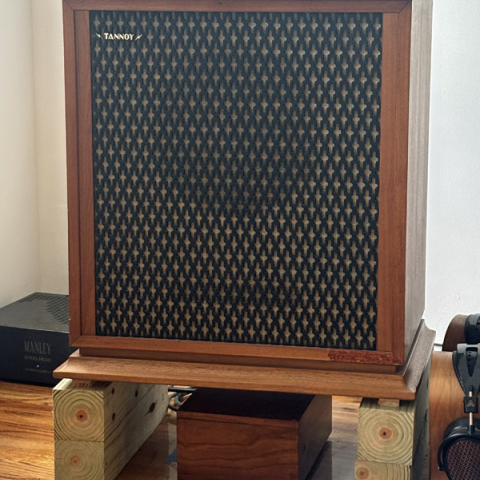
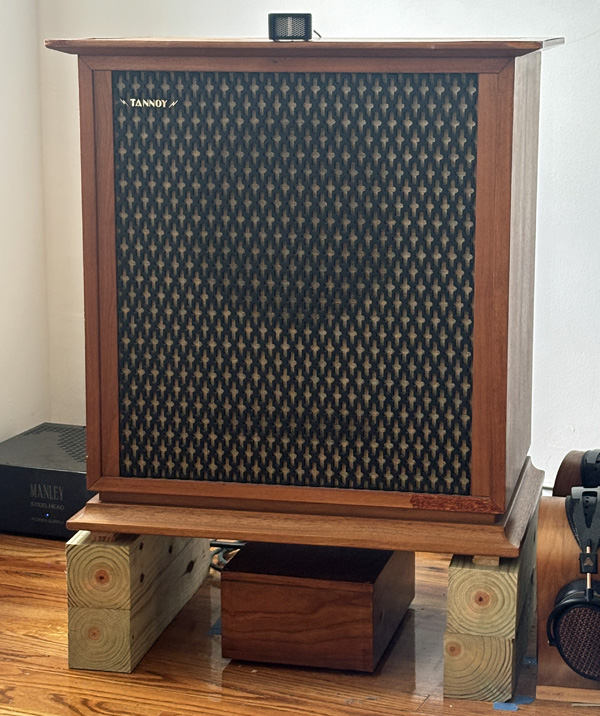
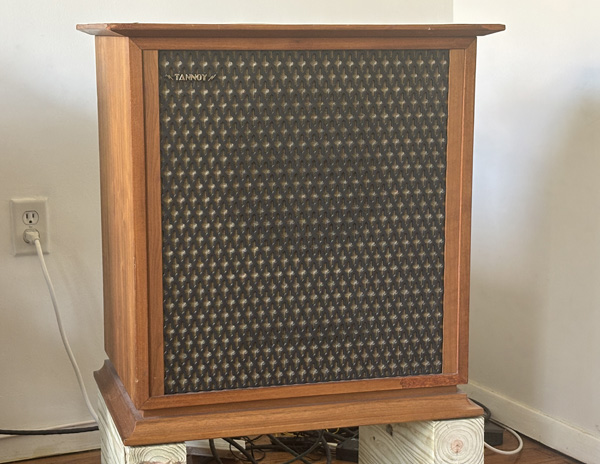 After a few months of searching, I zeroed in on a pair of 12" Monitor Golds on Facebook Marketplace. The drivers (the later version with the rubber surrounds) and original crossovers were housed in period-appropriate lowboy Stuart cabinets in a tastefully chipped "honey oak" veneer. Made for the US market, the Stuarts were a product of the late '60s Spanish Revival craze, a reaction against the minimalism and coldness of midcentury design. With their wooden fretwork grilles, they were intended to evoke the "Mediterranean villa" aesthetic. Having lived with the similarly styled Altec Valencias, I found their slightly cheesy look appealing.
In the end I bought them because of the humane asking price and, I'm ashamed to admit, the fact they were being sold by the drummer in a favorite band. I enjoy name-dropping as much as the next guy but will abstain from saying more about the seller, except that he turned out to be funny and kind and even offered to haul the speakers and me across the Manhattan Bridge in his SUV. Delightfully, the sale included the original 1974 sales receipt from midtown's Harvey Electronics as well as an armful of vintage Tannoy "literature."
At 25.5" high, 24.5" wide, and 16.9" deep, the bass-reflex Stuarts were intended to blend in with the console TVs and credenzas of the period, but their squat form factor means that, when sitting on the floor, the tweeter was level with my knees. To get the speakers off the ground and closer to my ears, I placed two lengths of 4 × 4 under each side of the cabinet, then tilted the speakers back slightly by placing some rubber feet under the front edges of the wood supports. The Tannoys sounded best about a foot from the wall and 6' apart.
With their circa-92dB sensitivity and gentle impedance curve, the Golds made a lovely match for the Manley Mahi amplifiers. On the plus side, they reminded me how much I love the effortless dynamics, robust bass response, outstanding tactility, and wonderfully relaxed presentation of Tannoy coaxials. Unfortunately, they were also too warm, with a rolled-off top end (even with the crossovers' treble controls set to maximum), plodding transients, and opaque, grainy textures. They were fun to listen to, but I knew they could sound better.
The first place to look was the crossover. The electrolytic capacitors were nearly as old as me and had almost certainly dried out. I also suspected that the high-frequency rolloff and "energy" controls weren't helping matters. Rather than just replace the caps, I decided to source new crossovers.
Just then I happened to mention this project to my friend Adam Wexler, a dealer in vintage and new hi-fi here in Brooklyn, who surprised me by volunteering that he had a pair of outboard crossovers made for Tannoy 15" Monitor Golds, left over from some speakers he'd sold a while back. Did I want to hear them?
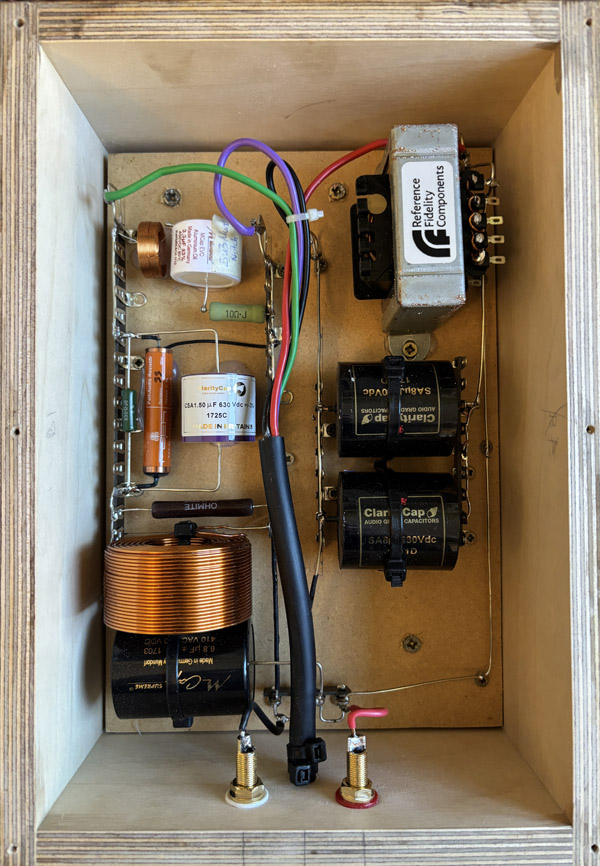 Reference Fidelity Components crossovers
The crossovers Wexler brought by several days later contained decidedly high-end parts (like Mundorf and Clarity CSA caps and PathAudio film resistors). They were assembled with skill and taste and placed in two wooden enclosures the size of shoeboxes. A sticker inside said they were made by Reference Fidelity Components of Dursley, England. Before long, I was emailing with the company's owner, Paul Coupe (footnote 1), who seemed to know more about Tannoys than possibly anyone alive. To my relief, he told me that Wexler's crossovers would work just as well with my 12" Golds as with the 15" Golds they had been made for. All I had to do was install four-pin XLR chassis-mount receptacles in the rear panel of the Stuart cabinets, connect the drivers to said receptacles (inside the cabinets), and plug the external crossovers into their business ends. After sourcing Neutrik XLR connectors and new cables and plugs for the Monitor Golds from a south England outfit called MainlyTannoy, then spending a Saturday morning spraying chipboard dust around my living room with a Forstner bit, I was ready to rock.
Being aware of the crossover's crucial role in a speaker's sound, I was still unprepared for what I heard. Everything I enjoy about this Tannoy sound was preserved and improved, nearly everything I disliked banished. Treble reappeared. Bass was tighter and went deeper. The 52-year-old Golds now sounded as transparent as most contemporary perfectionist speakers, with nary a hint of grain. Transient response was brisk, and the soundstage had grown wider, taller, and deeper. I'd rather not resort to clichés like "cataclysmic" or "jaw-dropping" to describe the changes I heard, but you get the idea. Coupe told me that a new pair of these crossovers goes for around £1550, which is more than I paid for the Tannoys. But if you're planning to live with one of these vintage speakers, the effect of these beautifully made components can be transformative.
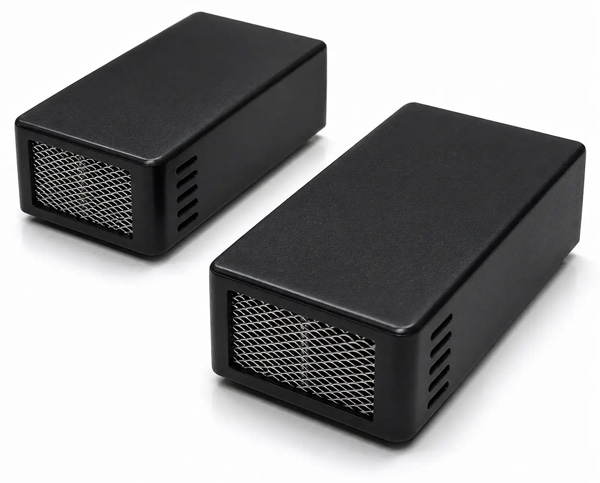 Townshend Maximum supertweeters
I loved listening to the souped-up Golds, but I suppose it's not in an audiophile's nature to stop tinkering. Could the treble use a touch more extension and definition? A friend who uses Quad 57s had recently reported great results using supertweeters from Townshend Audio (footnote 2). Mindful of that company's effective and non-extortionate isolation products, which I wrote about in a previous column, I gave them a try. Small but surprisingly heavy because of their powerful neodymium magnets, the Maximums ($1709/pair) are meant to be placed on top of your speaker cabinets. They use a connector that goes between the binding posts and the speaker cables. A tiny knob on the back sets each unit's output, and after some fiddling, I settled about halfway up the dial at 3.
I expected to hear more treble extension on things like cymbals—and I did—but didn't anticipate the tighter, more solid bass or the improvements to the Tannoys' coherence. Studies have shown that the presence of frequencies above the range of human hearing can enhance intelligibility and immersion. Go figure. Though the effect of the Townshends isn't earth-shattering, it is easily heard and entirely lovely. They require no surgery to use and are reasonably attractive. They are staying on top of the Tannoys.
In the meantime, I can't stop thinking about the corner-style Rutland cabinets that Paul Coupe designed for 12" Gold and HPD drivers. Something about their fortress-like construction and English cottage core charm speaks to me. Though Coupe no longer builds them, he offered to sell me the plans, and I've been speaking to a few local fabricators. More to come, hopefully soon.
 Dolly Parton (1946–2026)
Dolly Parton was sleight of hand personified. After she died in August, at 80, many of us began to realize that she was far stranger and more compelling than the singer we thought we knew. Everything about her was fake, except the things that mattered.
Country music, especially in its '60s heyday, sold authenticity. It was the quality that trumped looks, hard work, even genuine talent. Many of country's household names, like Ernest Tubb and Kitty Wells, were homely men and women with plain singing voices but deep reserves of relatability. Wells, the owner of 35 Top 10 singles and a cast-iron skillet of a voice, had a lifelong habit of skating off key. "Kitty, honey, that was a little flat," producer Owen Bradley would murmur from the booth during recording sessions. But fans embraced Wells not despite but because she was someone you could have met at the laundromat or a junior-high PTA meeting.
So how to make sense of Parton, who for a half-century stepped onto the stage at the Grand Ole Opry in platinum wigs, fake lashes, 2" acrylic nails, 6" heels, and outfits that hugged every curve of her literally unbelievable 40-20-36 frame? She looked like no one who had ever lived. She turned even her face—which over recent decades took on the timeless yet eerie look of a surgeon's reinvention—into an artwork. As Parton never tired of reminding us, she was in on the joke. But why did this generational talent—and sunflower of a human being—transform herself into an Appalachian drag queen, a term she used fondly and often? And why did we enjoy her so much?
People with even a passing interest in Parton know something about her childhood, spent among 11 siblings in a one-room cabin on the banks of the Little Pigeon River in east Tennessee. The cabin had no internal plumbing or running water, and her mother, Avie, washed the family's clothes in the river, even in winter. When Parton was born, her father, Robert, a sharecropper, paid the doctor who delivered her with a sack of cornmeal.
Beginning in the late 1960s, Parton mined the painful parts of this upbringing for some of her finest songs. "In the Good Old Days (When Times Were Bad)" and "Coat of Many Colors" announced her not just as a serious songwriter but as someone with a singular knack for writing simply and memorably about the complexities of nostalgia, class, and belonging.
And, perhaps most vividly, about being a woman. Though a record executive warned Parton that no one would take her seriously as long as she "looked more like a hooker than a singer," her songs had more to say than anyone else's about the double standards and outright discrimination women faced. It was the first of her sleights of hand. In 1966, the year Loretta Lynn charted with the hair-pulling anthem "You Ain't Woman Enough (To Take My Man)," and two years before Tammy Wynette's "Stand by Your Man"—still the best-selling country single by a woman—Parton released "Dumb Blonde." The chorus went, "Just because I'm blonde/Don't think I'm dumb/'Cause this dumb blonde ain't nobody's fool." It launched a career-spanning series of songs that spoke honestly about women's lives, including the hard-nosed "Just Because I'm a Woman," the harrowing "Down from Dover," and the astonishing "Jolene." Parton worked out the rhythm to "9 to 5" by playing it on her acrylic nails, which were credited on the album as a musical instrument.
What sometimes got lost is how funny she was. Not just in the self-deprecating asides—"It takes a lot of money to look this cheap"—but also in her songwriting. On an early number about a shiftless neighbor titled "He's a Go Getter," she sang, "He's a go getter, go getter/When his wife gets off from work, he'll go get her." Asked by a talk-show host about the first thing she did in the mornings, Parton replied, "I usually get up, put on my clothes, and go home."
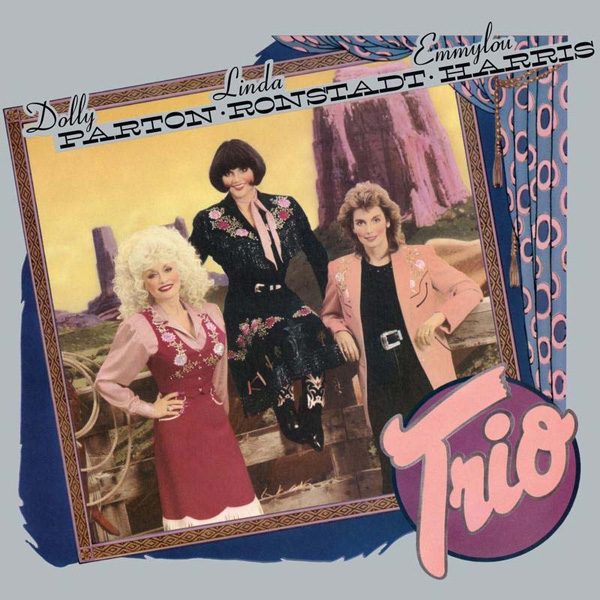 Then there was the lovely fact of her voice, with that instantly recognizable vibrato that sounded like a willow leaf trembling in the breeze. Even on the saddest and most morose ballads, that voice conveyed Parton's unsinkable affection for the world. Both Emmylou Harris and Linda Ronstadt called her their favorite singer, and it is on their magical two-volume collaboration, Trio, that you can hear Parton's voice in its purest, most transporting guise. Just listen to her on "Wildflowers" or "Rosewood Casket" and I dare you not to get a little verklempt.
Probably her most remarked-upon feat of misdirection was convincing her millions of fans that she was apolitical. While keeping clear of electoral politics, Parton was steadfast and outspoken in her support for nearly everyone in the country who tended to be dismissed, exploited, or overlooked: African Americans, women, children, LGBTQ people, the Southern poor. In 2016, when wildfires tore through east Tennessee, she mailed $10,000 to every family that had lost a home. After a supermarket tabloid outed her chauffeur as a transgender man in 1990, Parton kept him on her payroll for three decades and called him a friend in her memoir. In honor of her father, who couldn't read, she sent hundreds of millions of books to one in six American children. She even funded the development of the COVID vaccine. Though she could have been a billionaire, Parton chose to give much of her fortune away, and do it quietly. It is a testament to her intelligence, goodness, and innate grace that she made these profoundly political gestures seem like acts of simple decency.
If the very private person under the kabuki makeup wasn't on offer, over the years the contents of Parton's heart and mind became clearer and more radiant. The character and the person grew into each other until they became difficult to tease apart.
And Parton seemed to be having more and more fun. I saw her only once, at a free July 4th concert on the West Lawn of the US Capitol in Washington, DC. She was pushing 60 but walked onstage packed into an eye-popping sequined stars-and-stripes ensemble that included matching heels and a pillbox hat. The second Gulf War had begun, and Parton winked and said, "I'd like you to meet shock ... and ... awe," hoisting up one overflowing cup of her bodice and then the other to the audience's delight. (That entrance reminded me that she'd once entered a Dolly Parton lookalike contest and lost—to a man.) But the mirth and laughter dissipated when she broke into "Light of a Clear Blue Morning," a minor hit she wrote in the 1970s: "I've been looking for the sunshine/You know I ain't seen it in so long/But everything's gonna work out just fine."
Certain Buddhist sects teach that great artists are enlightened beings who live among us to help relieve our suffering. I have no idea whether that's true, but the fact that Parton lived among us makes me want to believe it. Her music is a reminder of what anyone who listens to her must surely feel: Dolly loved us.
Footnote 1: Reference Fidelity Components ceased operations at the end of July 2026 due to owner Paul Coupe having spinal health issues. See facebook.com/ReferenceFidelityComponents/.—Ed.
Footnote 2: Townshend Audio, 7 Bridge Road, East Molesey, Surrey, KT8 9EU, UK. Tel: (44) 208 979 2155. Email: mail@townshendaudio.com. Web: townshendaudio.com.
After a few months of searching, I zeroed in on a pair of 12" Monitor Golds on Facebook Marketplace. The drivers (the later version with the rubber surrounds) and original crossovers were housed in period-appropriate lowboy Stuart cabinets in a tastefully chipped "honey oak" veneer. Made for the US market, the Stuarts were a product of the late '60s Spanish Revival craze, a reaction against the minimalism and coldness of midcentury design. With their wooden fretwork grilles, they were intended to evoke the "Mediterranean villa" aesthetic. Having lived with the similarly styled Altec Valencias, I found their slightly cheesy look appealing.
In the end I bought them because of the humane asking price and, I'm ashamed to admit, the fact they were being sold by the drummer in a favorite band. I enjoy name-dropping as much as the next guy but will abstain from saying more about the seller, except that he turned out to be funny and kind and even offered to haul the speakers and me across the Manhattan Bridge in his SUV. Delightfully, the sale included the original 1974 sales receipt from midtown's Harvey Electronics as well as an armful of vintage Tannoy "literature."
Reference Fidelity Components crossoversThe crossovers Wexler brought by several days later contained decidedly high-end parts (like Mundorf and Clarity CSA caps and PathAudio film resistors). They were assembled with skill and taste and placed in two wooden enclosures the size of shoeboxes. A sticker inside said they were made by Reference Fidelity Components of Dursley, England. Before long, I was emailing with the company's owner, Paul Coupe (footnote 1), who seemed to know more about Tannoys than possibly anyone alive. To my relief, he told me that Wexler's crossovers would work just as well with my 12" Golds as with the 15" Golds they had been made for. All I had to do was install four-pin XLR chassis-mount receptacles in the rear panel of the Stuart cabinets, connect the drivers to said receptacles (inside the cabinets), and plug the external crossovers into their business ends. After sourcing Neutrik XLR connectors and new cables and plugs for the Monitor Golds from a south England outfit called MainlyTannoy, then spending a Saturday morning spraying chipboard dust around my living room with a Forstner bit, I was ready to rock.
Townshend Maximum supertweetersI loved listening to the souped-up Golds, but I suppose it's not in an audiophile's nature to stop tinkering. Could the treble use a touch more extension and definition? A friend who uses Quad 57s had recently reported great results using supertweeters from Townshend Audio (footnote 2). Mindful of that company's effective and non-extortionate isolation products, which I wrote about in a previous column, I gave them a try. Small but surprisingly heavy because of their powerful neodymium magnets, the Maximums ($1709/pair) are meant to be placed on top of your speaker cabinets. They use a connector that goes between the binding posts and the speaker cables. A tiny knob on the back sets each unit's output, and after some fiddling, I settled about halfway up the dial at 3.
Dolly Parton (1946–2026)Dolly Parton was sleight of hand personified. After she died in August, at 80, many of us began to realize that she was far stranger and more compelling than the singer we thought we knew. Everything about her was fake, except the things that mattered.
Then there was the lovely fact of her voice, with that instantly recognizable vibrato that sounded like a willow leaf trembling in the breeze. Even on the saddest and most morose ballads, that voice conveyed Parton's unsinkable affection for the world. Both Emmylou Harris and Linda Ronstadt called her their favorite singer, and it is on their magical two-volume collaboration, Trio, that you can hear Parton's voice in its purest, most transporting guise. Just listen to her on "Wildflowers" or "Rosewood Casket" and I dare you not to get a little verklempt.
Probably her most remarked-upon feat of misdirection was convincing her millions of fans that she was apolitical. While keeping clear of electoral politics, Parton was steadfast and outspoken in her support for nearly everyone in the country who tended to be dismissed, exploited, or overlooked: African Americans, women, children, LGBTQ people, the Southern poor. In 2016, when wildfires tore through east Tennessee, she mailed $10,000 to every family that had lost a home. After a supermarket tabloid outed her chauffeur as a transgender man in 1990, Parton kept him on her payroll for three decades and called him a friend in her memoir. In honor of her father, who couldn't read, she sent hundreds of millions of books to one in six American children. She even funded the development of the COVID vaccine. Though she could have been a billionaire, Parton chose to give much of her fortune away, and do it quietly. It is a testament to her intelligence, goodness, and innate grace that she made these profoundly political gestures seem like acts of simple decency.
If the very private person under the kabuki makeup wasn't on offer, over the years the contents of Parton's heart and mind became clearer and more radiant. The character and the person grew into each other until they became difficult to tease apart.
Footnote 1: Reference Fidelity Components ceased operations at the end of July 2026 due to owner Paul Coupe having spinal health issues. See facebook.com/ReferenceFidelityComponents/.—Ed.