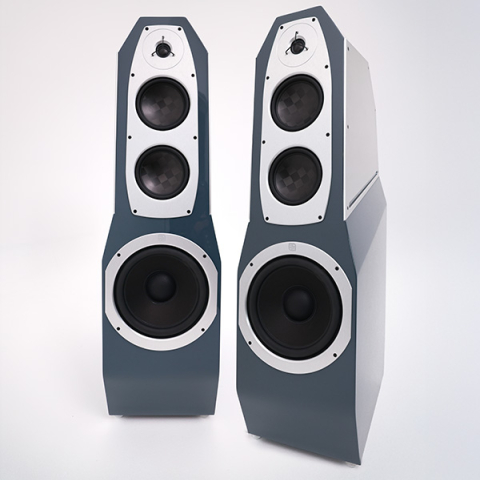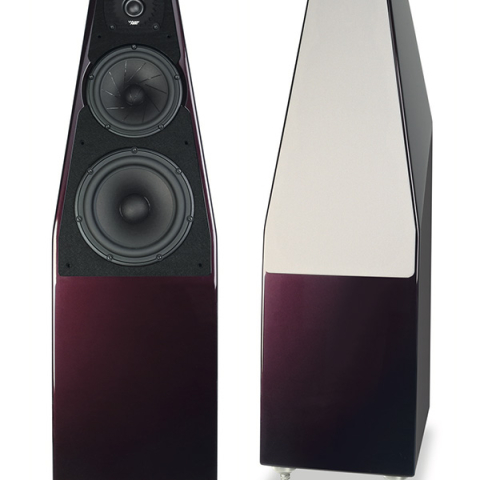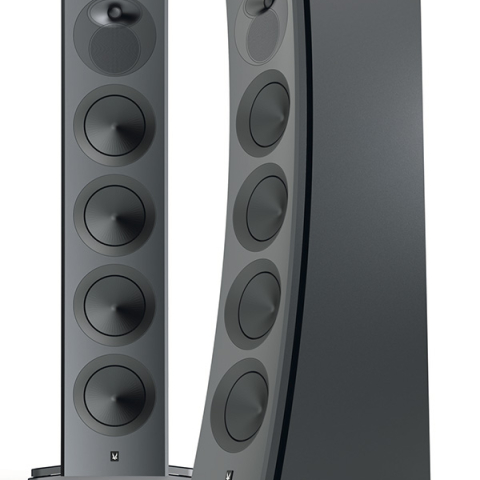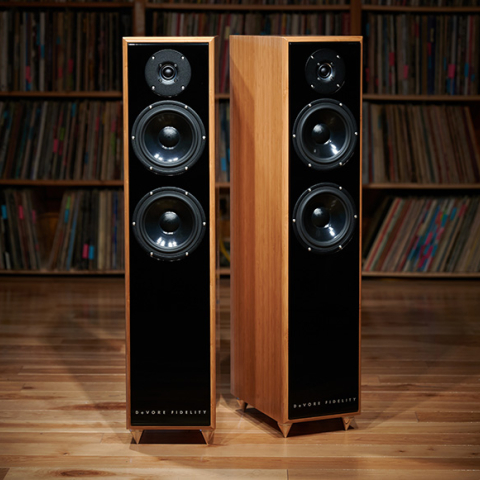
Imagine being a Michelin-star–level chef, but your food is delivered via carrier pigeon in the middle of winter. The inherent compromise must be infuriating, exacerbated by complaints from customers displeased with the food's presentation, temperature, and guano topping. Now consider speaker designers. They devote their lives to optimizing the combination of materials, cabinet shapes, drivers, and crossovers—and then their love child is placed in rooms they have no control over and fed with electronics, some of which are, through sheer statistical probability, going to be suboptimal. Yet they persevere, toiling away at refining their designs, aware of the compromise that's coming. We should be endlessly grateful they continue to cast their pearls before us.
One thing speaker designers can do is to design speakers that minimize room interactions. Lithuanian manufacturer Silent Pound does this, in some novel ways. We can only understand their solution once we've established what the problem is. So:
The problem
In simple, general terms, sound is directional at higher frequencies. With conventional speakers, the highest treble shoots out the front like a narrow cone. As the frequency drops, the cone of sound widens until it wraps backward around the speaker. Bass radiates omnidirectionally (footnote 1). Turn your speakers around, and you'll hear what I mean.
Most of us, I'd wager, have sidewalls within 5' or so from our speakers. Even a linear on-axis frequency response can sound spectrally tilted because the listening position also receives the wall reflections, which contain less of the higher frequencies that were dispersed in the narrower cone. If the speaker's frequency response is preemptively tuned to compensate for this, it instead sounds wrong without reflections. This is one reason toe-in affects spectral balance; you might be seated inside on-axis linearity the whole time, but you're getting more or less nonlinear reflected sound mixed in.
And it gets worse. A speaker commonly has different drivers handling different frequencies, and driver design affects dispersion width. Unfortunately, this means that the cone of dispersion can narrow as frequency goes up, only to suddenly widen again as a different driver takes over. Thus you get a bumpy spectral profile in the off-axis sound that the walls reflect (footnote 2).
If you go low enough, bass is omnidirectional by definition. Almost all speaker designs, even with very well-behaved directivity in the mids and highs, assume that the room will provide bass reinforcement. Some embrace this, making speakers tuned to be placed close to walls and thus likely sound anemic in free field. Others urge customers to keep at least 3' of distance to any boundaries lest the sound become boomy. Then there are speakers with tuning via pluggable ports or jumpers, all of them hoping the result will be free of carrier pigeon excrement in all the rooms they end up in.
 The solution(s)
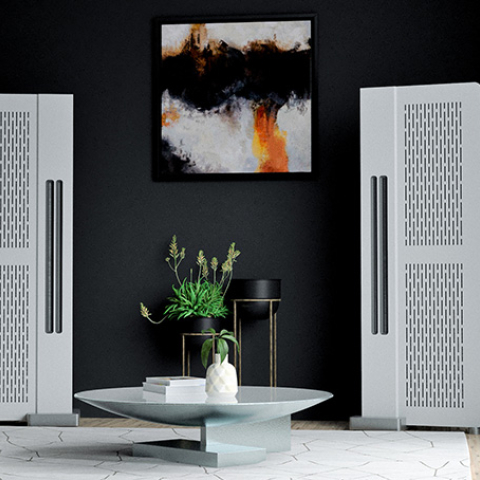
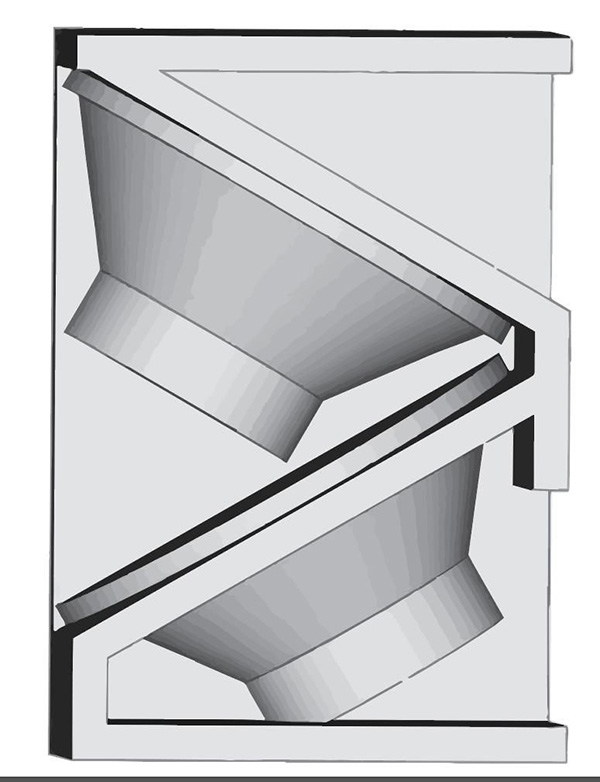
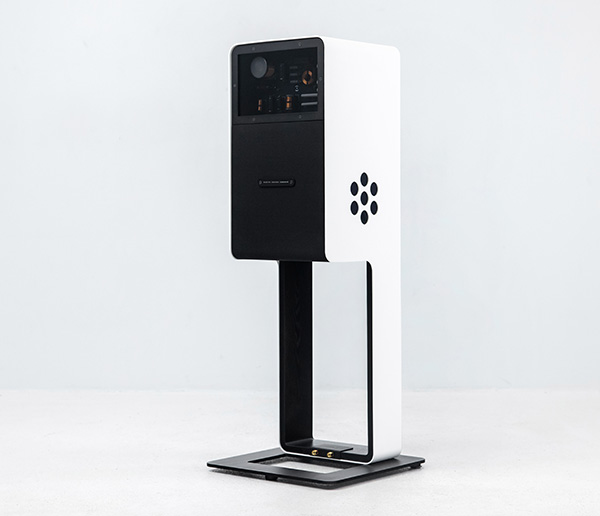
Starting at the bottom: The Bloom is a dipole in the bass, with two 12" drivers. To fit them into this small enclosure, they're stacked, one leaning forward and one leaning back (see diagram above). Their separate wavefronts meet at the speaker's sides and cancel out, forming the figure-8 bass dispersion that dipoles are known for. This reduces the amount of bass in side reflections. Designer Andrius Balciumas explained another effect: "Since the front and rear radiation are not in the same phase, the rear wall changes the way those waves combine in the room. As a result, moving a dipole closer to the back wall can reduce the deepest bass by a few decibels instead of increasing it." Bass wavelengths are so long that at most domestic back wall distances, the reflected sound remains mostly in phase with the direct sound. But as you ascend the frequency spectrum into shorter wavelengths, this stops being true, and dipoles suffer from summation and cancellation artifacts caused by the reflected sound. Above the bass, the Blooms are not dipoles. I first thought the flower pattern of seven circles on their sides was a vent to let the negative phase of the drivers cancel out the forward positive phase to achieve a more cardioid dispersion, like the active Dutch & Dutch 8c does. But that pattern, it turns out, is purely decorative. The summation of front and rear waves is done inside the cabinet, through a patent-pending (footnote 3) mid-frequency enclosure.
That leaves the treble. I'll let Silent Pound's co-founder, Martynas erkšnys, explain.
 "In the high frequencies, a compression driver is used in a coaxial configuration with the midrange driver. In this system, the midrange diaphragm also functions as part of the waveguide, together with our own phase plug design. This coaxial geometry, combined with waveguide loading and phase control, helps maintain directivity and reduce unwanted sound radiation into the room at high frequencies."
The result is sound that is directed mostly forward. Silent Pound says that, across the loudspeaker's operating bandwidth, lateral radiation around ±90° is reduced by more than 10dB relative to the forward output, meaning that less than approximately 10% of the acoustic energy remains in the side directions.
Physical form
"In the high frequencies, a compression driver is used in a coaxial configuration with the midrange driver. In this system, the midrange diaphragm also functions as part of the waveguide, together with our own phase plug design. This coaxial geometry, combined with waveguide loading and phase control, helps maintain directivity and reduce unwanted sound radiation into the room at high frequencies."
The result is sound that is directed mostly forward. Silent Pound says that, across the loudspeaker's operating bandwidth, lateral radiation around ±90° is reduced by more than 10dB relative to the forward output, meaning that less than approximately 10% of the acoustic energy remains in the side directions.
Physical form
Silent Pound should be praised for the clarity and brevity of the descriptions on their website, in the setup guide I received (written for dealers), and for the answers the company provided to all my questions. They know what they want to say and how to say it, and that instills confidence.
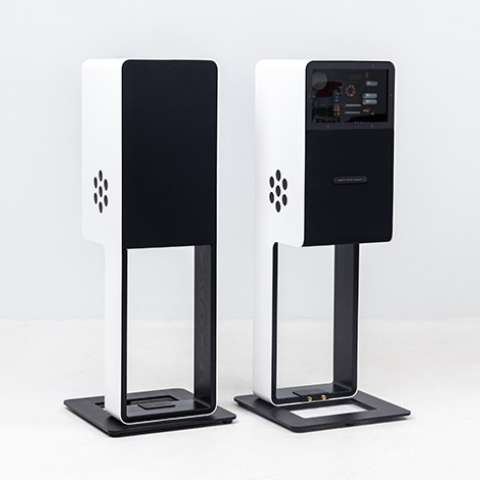
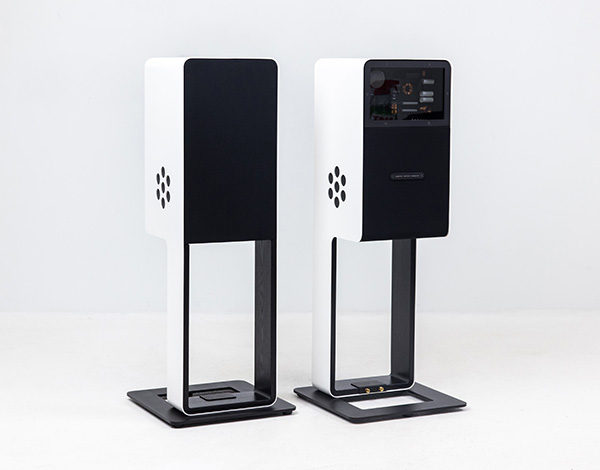
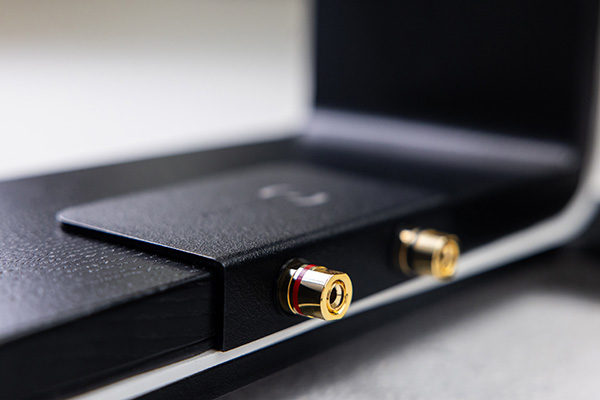
But I object to these speakers being called "standmounts." The Bloom has an outer shell made of thick metal, a single piece that encloses the entire speaker. There's no separate stand, unless you count the 0.315" (8mm)–thick metal base plate, which attaches with eight bolts. The speaker terminals are at the bottom—yay!—connected invisibly through the legs up to the cabinet. These speakers, I propose, are floorstanders with a hole in them.
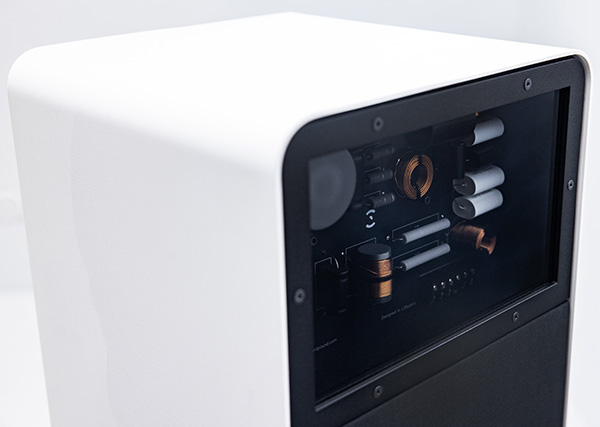
 They're neither small nor large: The square top is the size of an LP sleeve. At 88lb apiece, they're heavier than they look. A vigorous knock on the enclosure revealed it to be about as inert as bedrock. The grille is not removable, and I came to appreciate the invisibility of the drivers; it took my mind away from frequency response and toward basking in the music. The exquisitely tidy crossover is displayed behind a tempered glass pane on the back.
My room is 31m2, or 333ft2, right in the middle of Silent Pound's recommended 15–50m2. Suggested amplifier power for their 87dB sensitivity is 80–300Wpc into 4 ohms. I used two amplifiers, both of which are specified to deliver 300Wpc into 4 ohms: an MBL C51 and a Devialet Astra. Indeed, their power was sufficient. The speakers shipped brand new from Silent Pound; the company recommends 200 hours of play to allow things to settle. I happily exceeded that number before I started to listen closely.
They're neither small nor large: The square top is the size of an LP sleeve. At 88lb apiece, they're heavier than they look. A vigorous knock on the enclosure revealed it to be about as inert as bedrock. The grille is not removable, and I came to appreciate the invisibility of the drivers; it took my mind away from frequency response and toward basking in the music. The exquisitely tidy crossover is displayed behind a tempered glass pane on the back.
My room is 31m2, or 333ft2, right in the middle of Silent Pound's recommended 15–50m2. Suggested amplifier power for their 87dB sensitivity is 80–300Wpc into 4 ohms. I used two amplifiers, both of which are specified to deliver 300Wpc into 4 ohms: an MBL C51 and a Devialet Astra. Indeed, their power was sufficient. The speakers shipped brand new from Silent Pound; the company recommends 200 hours of play to allow things to settle. I happily exceeded that number before I started to listen closely.
 Placement and acoustics
My room favors slightly pointy listening triangles, with the speakers farther from me than the distance between them. I tried challenging that, but extensive experimentation ultimately landed the Blooms in a similar setup, with about 3' to the front wall. When toed in so that they pointed directly at the listening position, the sound warped weirdly outside the sweet spot; I had only about 2' from side to side where they sounded good. With less toe-in—I could clearly see the stylized flowers on their insides—imaging held up better, but I suspected that the sidewalls meddled more. Beyond the reflection's spectral response, the time delay between direct and reflected sound causes image, texture, and transient smearing that a speaker can't solve. I placed 4' acoustic diffusion panels along each sidewall, which dramatically transformed the soundstage, rendering it far more solid and resolving. Why diffusion and not absorption? Silent Pound says, "Overdamping a room with absorption can remove life; with directional systems, more targeted and moderate acoustic treatment often works better." This aligns well with my experience.
The Blooms' directivity likely helps these speakers perform well in a broader variety of rooms, but there is no panacea that exempts them from placement fiddling, and they still benefit from appropriate room treatment.
 Bass behavior
With some speakers, bass performance has the physics-defying control and precision of an elite dancer: impressive but also alien or unreal. At the other end of the spectrum is bass more akin to the body language of a child who has just discovered a new playground: Ecstatic movement conveys some of the purest and most profound human joy. If you've ever found pleasure watching only one of the two, you'll have a much easier time shopping for speakers. I'm cursed with a desire for a union of the two poles. The Blooms lean decidedly toward the latter, but with some twists. The most remarkable aspect of the Blooms' bass performance was that my ribcage was rattling at what an app on my phone measured as a mere 76dB(A). I hope it's not pneumonia. The bass sweeps on Senking's "Closing Eyes," from Dazed (16/44.1 FLAC, Raster-Noton RN142EP), sounded unusually loud at the start, which is a bit over 100Hz. Maybe that's what made my ribcage rattle.
Aaron Parks's "Peaceful Warrior," from Invisible Cinema (16/44.1 FLAC, Blue Note/Tidal), is a nine-minute narrative jazz journey that Roon Radio once lured me into. Here it sounded more live—more alive—and intimately energetic than I've ever heard it. Perhaps other speakers could wring more detail from this recording, but that's both hypothetical and beside the point. So is the possibility that a hump might exist in the frequency response—also moot. Anyway, I didn't care. I was too busy smiling from the presentation's sense of aliveness, which clearly was emanating from the bass.
Speaking of Roon Radio, it served up "Satori" from Rodrigo y Gabriela's Live in Japan (16/44.1 FLAC, Tidal). The Blooms' bass punch lent this live recording more of that live-concert vibe than other speakers do, providing a persuasive illusion of sitting close to the stage. Wow, I thought, this is addictive.
 My playlist of test tracks should perhaps be stable over time, but in reality it is constantly churning. A track that has somehow stayed for years is Iona Fortune's "Xu," from Tao of I (16/44.1 FLAC, Optimo Music/Tidal). I had forgotten why I'd even added it, but here it excited the upper/mid bass to the point that it severely distracted from the musical contents, at least relative to how I've always heard it. No speaker placement I tried provided a solution. "Xu" gets to stay on the list.
Over the past year, six different speakers have played in this room, in addition to the Blooms. All delivered deeper bass than the Bloom's –3dB at 31Hz. None of them have exhibited this same midbass intensity, but none of them were dipoles, either, so maybe that's the whole story. We'll see what the measurements say. Regardless, with rare exceptions (including "Xu"), that midbass punch was not just benign but desirable. If mere mention of spectral bumps causes you to dismiss these speakers, you might have spent too much time in the corners of the internet where "Linearity" is a deity's name. The reality is more complex. I would never describe these speakers' joyous vitality—their vital joy—as a fault, even if it comes at an occasional small musical price.
Techno? Tech yes
My playlist of test tracks should perhaps be stable over time, but in reality it is constantly churning. A track that has somehow stayed for years is Iona Fortune's "Xu," from Tao of I (16/44.1 FLAC, Optimo Music/Tidal). I had forgotten why I'd even added it, but here it excited the upper/mid bass to the point that it severely distracted from the musical contents, at least relative to how I've always heard it. No speaker placement I tried provided a solution. "Xu" gets to stay on the list.
Over the past year, six different speakers have played in this room, in addition to the Blooms. All delivered deeper bass than the Bloom's –3dB at 31Hz. None of them have exhibited this same midbass intensity, but none of them were dipoles, either, so maybe that's the whole story. We'll see what the measurements say. Regardless, with rare exceptions (including "Xu"), that midbass punch was not just benign but desirable. If mere mention of spectral bumps causes you to dismiss these speakers, you might have spent too much time in the corners of the internet where "Linearity" is a deity's name. The reality is more complex. I would never describe these speakers' joyous vitality—their vital joy—as a fault, even if it comes at an occasional small musical price.
Techno? Tech yes
No speakers I've had here have done techno this well. If you reflexively wince at the mention of techno, especially in an audiophile context, I'd argue that you're missing out. This music is commonly heard via bass-heavy PA systems, which have the same midbass character I described above, which makes music sound more live, injecting that fat sound-system character. Daniel[i] & Purl's WHS 03 (16/44.1 FLAC, Whispering Signals/Tidal) sounds less like the dancefloor and more like the residual echo of a night out, a foggy dream you dream as your body realigns its chemical balance. This music is subtle, deep, and lush, with hallucinatory shifts and changes wrapped in evocative atmospheres that felt especially warm through the Blooms.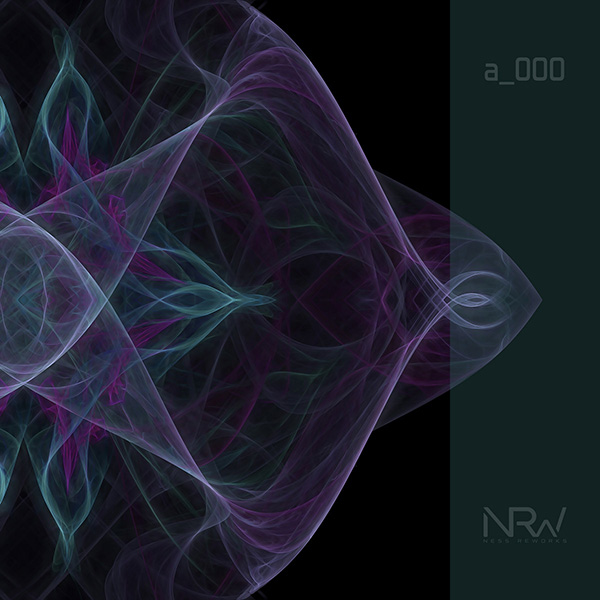 Reworked (16/44.1 FLAC, The Gods Planet/Tidal) contains four tracks by Italian techno veteran Ness, remixed by four contemporaries. "Noumenon," the opener—overhauled by Bażej Malinowski—feels like a night journey on a train through mining colonies in outer space. This music, with soaring, echoing atmospheres over the chugging kickdrum and bass line, is a great example of what these speakers do so well. The closing track, "Carex"—given an electro-rhythm treatment by personal favorite Ruhig—should not be missed, either.
Back to the sublime: Fellow Swede Birds ov Paradise has three environment-themed EPs on appropriately named Hypnus Records. The sounds (re)produced by the Blooms were so lush and deep that the air felt palpably humid as "Fog," from the EP Bayou (16/44.1 FLAC, Hypnus Records/Tidal), poured from the speakers.
Moving on up
Reworked (16/44.1 FLAC, The Gods Planet/Tidal) contains four tracks by Italian techno veteran Ness, remixed by four contemporaries. "Noumenon," the opener—overhauled by Bażej Malinowski—feels like a night journey on a train through mining colonies in outer space. This music, with soaring, echoing atmospheres over the chugging kickdrum and bass line, is a great example of what these speakers do so well. The closing track, "Carex"—given an electro-rhythm treatment by personal favorite Ruhig—should not be missed, either.
Back to the sublime: Fellow Swede Birds ov Paradise has three environment-themed EPs on appropriately named Hypnus Records. The sounds (re)produced by the Blooms were so lush and deep that the air felt palpably humid as "Fog," from the EP Bayou (16/44.1 FLAC, Hypnus Records/Tidal), poured from the speakers.
Moving on up
This is anecdotal, but I've had remarkable experiences with speakers whose tweeters extend fairly low in frequency. Such speakers tend to sound especially coherent. These Blooms, which cross over to the tweeter at a lowish 1.4kHz, behave as a single sonic organism. If there's anything to critique, it's that treble—and especially complex sounds like cymbals—on some occasions appeared to lack that last degree of incisiveness. A JPEG image can look terrific until you zoom in and notice that fine textural detail has been averaged into a uniform sameness. To even notice this, I had to perform the sonic equivalent of zooming in, like blowing up an image in Photoshop. Still, take note if hyper-resolution in the five-digit frequencies is a big priority.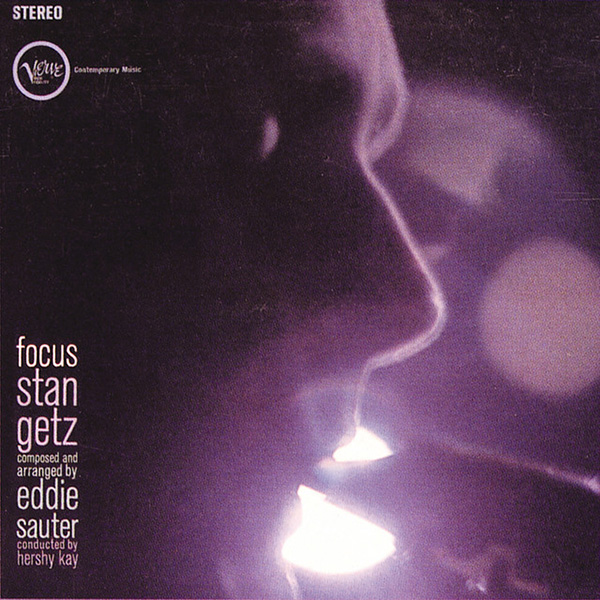 Anyway, there's a flip side. Stan Getz and Eddie Sauter's "I'm Late, I'm Late" from Focus (16/44.1 FLAC, Verve/Tidal) can sound shrill on some systems, but it didn't here. Nor did the slight textural smearing of cymbals I hear with some systems occur with this track. The drive and musical life force were remarkable. The reverb enveloping Roy Haynes's drums was presented in so much detail it's almost distracting—how on earth was this recorded? All the life force with none of the distractions.
I have a tendency to wander into metal's outermost fringes. I'll smuggle mentions of that music into future reviews; today's source of iron comes courtesy of my brother, who's been spreading the gospel of Swedish stoner/sludge/doom band Domkraft, for which I am deeply grateful. Their 2023 album Sonic Moons (16/44.1 FLAC, Magnetic Eye Records/Tidal) is a force of nature. The gravity, crunch, and howling resonant guitar psychedelia—the wrecking-ball swing underneath soaring vocals—belie both this band's size (it's a trio) and the speakers' size (they're rather small). Playing loud was uncommonly pleasant—never shouty or shrill. Perhaps this is due in part to their forgiving treble character. I suspect, however, that it has much to do with controlled directivity's reduction of malignant room interaction.
Anyway, there's a flip side. Stan Getz and Eddie Sauter's "I'm Late, I'm Late" from Focus (16/44.1 FLAC, Verve/Tidal) can sound shrill on some systems, but it didn't here. Nor did the slight textural smearing of cymbals I hear with some systems occur with this track. The drive and musical life force were remarkable. The reverb enveloping Roy Haynes's drums was presented in so much detail it's almost distracting—how on earth was this recorded? All the life force with none of the distractions.
I have a tendency to wander into metal's outermost fringes. I'll smuggle mentions of that music into future reviews; today's source of iron comes courtesy of my brother, who's been spreading the gospel of Swedish stoner/sludge/doom band Domkraft, for which I am deeply grateful. Their 2023 album Sonic Moons (16/44.1 FLAC, Magnetic Eye Records/Tidal) is a force of nature. The gravity, crunch, and howling resonant guitar psychedelia—the wrecking-ball swing underneath soaring vocals—belie both this band's size (it's a trio) and the speakers' size (they're rather small). Playing loud was uncommonly pleasant—never shouty or shrill. Perhaps this is due in part to their forgiving treble character. I suspect, however, that it has much to do with controlled directivity's reduction of malignant room interaction.
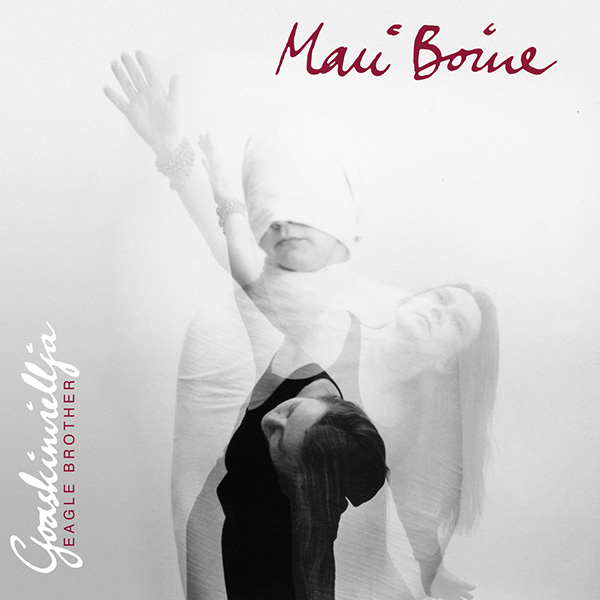 I wanted to hear more vocals. I played Sami chanteuse Mari Boine's "Goaskinviellja" (16/44.1 FLAC ripped from CD, Verve World 521388–2). The title track's savory, sustained notes from voice and guitar glided through the air like sky lanterns. A minute from the end, a synthetic reverb envelops Boine's voice, its introduction as clear as I've heard it. The drums here felt more visceral than I'm used to, in a great way. That bass, again, that life force.
I must have played Clarice Jensen's "From A to B," from In Holiday Clothing out of the Great Darkness (24/96 FLAC, 130701/Tidal), 15 times already. The blend of her cello and its surrounding reverb is intensely rewarding through most speakers. It was so flavorful here, across several dimensions, that I kept dipping my hand in the cookie jar, again and again.
Olivier Messiaen's Turangalîla-Symphonie has been invoked in many Stereophile reviews because it is musically dense, colorful, and spectacular. In searching for a version I liked, I played a movement or two from one recording and hopped to the next. The search stopped after one version immediately made me think, "this sounds very special" and "I wonder if it's hi-rez?" Sure enough, Gustavo Gimeno conducting the Toronto Symphony Orchestra with Marc André Hamelin on piano is served up in 24/192 (FLAC, Harmonia Mundi/Tidal). Nathalie Forget's Ondes Martenot sweeps in the fifth movement shoved the air in the room around like a snowplow, but I could still follow each instrument and section effortlessly, even in the most wildly thrashing outbursts. Waves permeate this performance; up and down through the scales, in intensity, across the soundstage, in instrumental timbre and scale. A system that fails to convey the musical intent can make you seasick, but here the ride was pure thrill.
I wanted to hear more vocals. I played Sami chanteuse Mari Boine's "Goaskinviellja" (16/44.1 FLAC ripped from CD, Verve World 521388–2). The title track's savory, sustained notes from voice and guitar glided through the air like sky lanterns. A minute from the end, a synthetic reverb envelops Boine's voice, its introduction as clear as I've heard it. The drums here felt more visceral than I'm used to, in a great way. That bass, again, that life force.
I must have played Clarice Jensen's "From A to B," from In Holiday Clothing out of the Great Darkness (24/96 FLAC, 130701/Tidal), 15 times already. The blend of her cello and its surrounding reverb is intensely rewarding through most speakers. It was so flavorful here, across several dimensions, that I kept dipping my hand in the cookie jar, again and again.
Olivier Messiaen's Turangalîla-Symphonie has been invoked in many Stereophile reviews because it is musically dense, colorful, and spectacular. In searching for a version I liked, I played a movement or two from one recording and hopped to the next. The search stopped after one version immediately made me think, "this sounds very special" and "I wonder if it's hi-rez?" Sure enough, Gustavo Gimeno conducting the Toronto Symphony Orchestra with Marc André Hamelin on piano is served up in 24/192 (FLAC, Harmonia Mundi/Tidal). Nathalie Forget's Ondes Martenot sweeps in the fifth movement shoved the air in the room around like a snowplow, but I could still follow each instrument and section effortlessly, even in the most wildly thrashing outbursts. Waves permeate this performance; up and down through the scales, in intensity, across the soundstage, in instrumental timbre and scale. A system that fails to convey the musical intent can make you seasick, but here the ride was pure thrill.
 I'll offer a soft landing: Zoltan Fecso and Anna Morley's Desire Path (24/48 FLAC, Oxtail Recordings/Tidal) is a sonic cushion of meditative vibraphone and resonant synths. Track 3, "A Pooled Reflection," rides so high on that midbass intensity that it disrupts what is otherwise a delicate and harmonious recording. The price these speakers' special virtues occasionally ask you to pay.
Having reluctantly packed up the Blooms, I revisited "A Pooled Reflection" with my Focal Scalas. The bass boominess receded enough to no longer be as distracting, but other things changed, too. Tones were less like sonic flowers (in Bloom, as it were) and more like manmade objects, cast in a fine mold rather than sprung from soil. Music felt more zoomed in, more intimate. I've lived with these Scalas for 14 years because I love them, but I have been made irreversibly aware there are qualities they're missing.
Conclusion
I'll offer a soft landing: Zoltan Fecso and Anna Morley's Desire Path (24/48 FLAC, Oxtail Recordings/Tidal) is a sonic cushion of meditative vibraphone and resonant synths. Track 3, "A Pooled Reflection," rides so high on that midbass intensity that it disrupts what is otherwise a delicate and harmonious recording. The price these speakers' special virtues occasionally ask you to pay.
Having reluctantly packed up the Blooms, I revisited "A Pooled Reflection" with my Focal Scalas. The bass boominess receded enough to no longer be as distracting, but other things changed, too. Tones were less like sonic flowers (in Bloom, as it were) and more like manmade objects, cast in a fine mold rather than sprung from soil. Music felt more zoomed in, more intimate. I've lived with these Scalas for 14 years because I love them, but I have been made irreversibly aware there are qualities they're missing.
Conclusion
The lateral attenuation—"constant directivity"—is impressive and useful, but it's not what I'll remember the most about the Blooms. What I'll remember was an everyday occurrence: my face snapping to a smile, looking up from my notes and books and records as if I'd heard the familiar voice of a dear friend calling my name. The dear friend in this case was the music's spirit, liberated from unwarranted ornamentation and overprocessing. That quality—a sense of intimate emotional sincerity—is immensely valuable in a loudspeaker, but it's not everything. I've heard and appreciated even greater detail, though never in a speaker with these qualities. The Bloom's bass is like a friend's distinctive laugh that some might find peculiar: Sometimes it grabs more attention than you wish, but it's a laugh! Laughter means you're having fun. Laughter is life. These speakers are endearing, full of life and joy. If your idea of a good time is to dissect music at the cellular level, don't bother. If you love to rock out, to soar, to gaze inwards—to dance, to laugh, to cry—if you wish home listening could seem more alive, do I ever have a speaker for you.
Footnote 1: Strictly speaking, the energy radiates forward out of the speaker driver. A wavelength is the basic unit of sound energy, the minimum unit it makes sense to consider. When that wavelength is larger than the things you compare it to—your head, the speaker, the room—then practically by definition it has no direction. 100Hz has a wavelength of about 11'; 40Hz—roughly the lowest frequency on a bass (upright or guitar)—has a wavelength of 28', bigger than a lot of listening rooms. Sound localization depends on your ability to detect time-of-arrival differences and level differences between your two ears. But those wavelengths are very large compared to the distance between your ears. There's not much difference in level, and time-of-arrival difference no longer has any real meaning. It isn't just a matter of perception: At frequencies with wavelengths that are large compared to the speaker, the energy wraps around the speaker itself and propagates in all directions at the speed of sound.—Jim Austin Footnote 2: This is the other reason toe-in matters: Even with no sidewall reflection, the horizontal dispersion of a typical loudspeaker isn't even. The frequency balance changes as you move to the side. Footnote 3: See patents.google.com/patent/EP4465657A1/en.
In simple, general terms, sound is directional at higher frequencies. With conventional speakers, the highest treble shoots out the front like a narrow cone. As the frequency drops, the cone of sound widens until it wraps backward around the speaker. Bass radiates omnidirectionally (footnote 1). Turn your speakers around, and you'll hear what I mean.
The solution(s)Starting at the bottom: The Bloom is a dipole in the bass, with two 12" drivers. To fit them into this small enclosure, they're stacked, one leaning forward and one leaning back (see diagram above). Their separate wavefronts meet at the speaker's sides and cancel out, forming the figure-8 bass dispersion that dipoles are known for. This reduces the amount of bass in side reflections. Designer Andrius Balciumas explained another effect: "Since the front and rear radiation are not in the same phase, the rear wall changes the way those waves combine in the room. As a result, moving a dipole closer to the back wall can reduce the deepest bass by a few decibels instead of increasing it." Bass wavelengths are so long that at most domestic back wall distances, the reflected sound remains mostly in phase with the direct sound. But as you ascend the frequency spectrum into shorter wavelengths, this stops being true, and dipoles suffer from summation and cancellation artifacts caused by the reflected sound. Above the bass, the Blooms are not dipoles. I first thought the flower pattern of seven circles on their sides was a vent to let the negative phase of the drivers cancel out the forward positive phase to achieve a more cardioid dispersion, like the active Dutch & Dutch 8c does. But that pattern, it turns out, is purely decorative. The summation of front and rear waves is done inside the cabinet, through a patent-pending (footnote 3) mid-frequency enclosure.
"In the high frequencies, a compression driver is used in a coaxial configuration with the midrange driver. In this system, the midrange diaphragm also functions as part of the waveguide, together with our own phase plug design. This coaxial geometry, combined with waveguide loading and phase control, helps maintain directivity and reduce unwanted sound radiation into the room at high frequencies."
The result is sound that is directed mostly forward. Silent Pound says that, across the loudspeaker's operating bandwidth, lateral radiation around ±90° is reduced by more than 10dB relative to the forward output, meaning that less than approximately 10% of the acoustic energy remains in the side directions.
Physical formSilent Pound should be praised for the clarity and brevity of the descriptions on their website, in the setup guide I received (written for dealers), and for the answers the company provided to all my questions. They know what they want to say and how to say it, and that instills confidence.
They're neither small nor large: The square top is the size of an LP sleeve. At 88lb apiece, they're heavier than they look. A vigorous knock on the enclosure revealed it to be about as inert as bedrock. The grille is not removable, and I came to appreciate the invisibility of the drivers; it took my mind away from frequency response and toward basking in the music. The exquisitely tidy crossover is displayed behind a tempered glass pane on the back.
My room is 31m2, or 333ft2, right in the middle of Silent Pound's recommended 15–50m2. Suggested amplifier power for their 87dB sensitivity is 80–300Wpc into 4 ohms. I used two amplifiers, both of which are specified to deliver 300Wpc into 4 ohms: an MBL C51 and a Devialet Astra. Indeed, their power was sufficient. The speakers shipped brand new from Silent Pound; the company recommends 200 hours of play to allow things to settle. I happily exceeded that number before I started to listen closely.
Placement and acousticsMy room favors slightly pointy listening triangles, with the speakers farther from me than the distance between them. I tried challenging that, but extensive experimentation ultimately landed the Blooms in a similar setup, with about 3' to the front wall. When toed in so that they pointed directly at the listening position, the sound warped weirdly outside the sweet spot; I had only about 2' from side to side where they sounded good. With less toe-in—I could clearly see the stylized flowers on their insides—imaging held up better, but I suspected that the sidewalls meddled more. Beyond the reflection's spectral response, the time delay between direct and reflected sound causes image, texture, and transient smearing that a speaker can't solve. I placed 4' acoustic diffusion panels along each sidewall, which dramatically transformed the soundstage, rendering it far more solid and resolving. Why diffusion and not absorption? Silent Pound says, "Overdamping a room with absorption can remove life; with directional systems, more targeted and moderate acoustic treatment often works better." This aligns well with my experience.
Bass behaviorWith some speakers, bass performance has the physics-defying control and precision of an elite dancer: impressive but also alien or unreal. At the other end of the spectrum is bass more akin to the body language of a child who has just discovered a new playground: Ecstatic movement conveys some of the purest and most profound human joy. If you've ever found pleasure watching only one of the two, you'll have a much easier time shopping for speakers. I'm cursed with a desire for a union of the two poles. The Blooms lean decidedly toward the latter, but with some twists. The most remarkable aspect of the Blooms' bass performance was that my ribcage was rattling at what an app on my phone measured as a mere 76dB(A). I hope it's not pneumonia. The bass sweeps on Senking's "Closing Eyes," from Dazed (16/44.1 FLAC, Raster-Noton RN142EP), sounded unusually loud at the start, which is a bit over 100Hz. Maybe that's what made my ribcage rattle.
My playlist of test tracks should perhaps be stable over time, but in reality it is constantly churning. A track that has somehow stayed for years is Iona Fortune's "Xu," from Tao of I (16/44.1 FLAC, Optimo Music/Tidal). I had forgotten why I'd even added it, but here it excited the upper/mid bass to the point that it severely distracted from the musical contents, at least relative to how I've always heard it. No speaker placement I tried provided a solution. "Xu" gets to stay on the list.
No speakers I've had here have done techno this well. If you reflexively wince at the mention of techno, especially in an audiophile context, I'd argue that you're missing out. This music is commonly heard via bass-heavy PA systems, which have the same midbass character I described above, which makes music sound more live, injecting that fat sound-system character. Daniel[i] & Purl's WHS 03 (16/44.1 FLAC, Whispering Signals/Tidal) sounds less like the dancefloor and more like the residual echo of a night out, a foggy dream you dream as your body realigns its chemical balance. This music is subtle, deep, and lush, with hallucinatory shifts and changes wrapped in evocative atmospheres that felt especially warm through the Blooms.
Reworked (16/44.1 FLAC, The Gods Planet/Tidal) contains four tracks by Italian techno veteran Ness, remixed by four contemporaries. "Noumenon," the opener—overhauled by Bażej Malinowski—feels like a night journey on a train through mining colonies in outer space. This music, with soaring, echoing atmospheres over the chugging kickdrum and bass line, is a great example of what these speakers do so well. The closing track, "Carex"—given an electro-rhythm treatment by personal favorite Ruhig—should not be missed, either.
This is anecdotal, but I've had remarkable experiences with speakers whose tweeters extend fairly low in frequency. Such speakers tend to sound especially coherent. These Blooms, which cross over to the tweeter at a lowish 1.4kHz, behave as a single sonic organism. If there's anything to critique, it's that treble—and especially complex sounds like cymbals—on some occasions appeared to lack that last degree of incisiveness. A JPEG image can look terrific until you zoom in and notice that fine textural detail has been averaged into a uniform sameness. To even notice this, I had to perform the sonic equivalent of zooming in, like blowing up an image in Photoshop. Still, take note if hyper-resolution in the five-digit frequencies is a big priority.
Anyway, there's a flip side. Stan Getz and Eddie Sauter's "I'm Late, I'm Late" from Focus (16/44.1 FLAC, Verve/Tidal) can sound shrill on some systems, but it didn't here. Nor did the slight textural smearing of cymbals I hear with some systems occur with this track. The drive and musical life force were remarkable. The reverb enveloping Roy Haynes's drums was presented in so much detail it's almost distracting—how on earth was this recorded? All the life force with none of the distractions.
I wanted to hear more vocals. I played Sami chanteuse Mari Boine's "Goaskinviellja" (16/44.1 FLAC ripped from CD, Verve World 521388–2). The title track's savory, sustained notes from voice and guitar glided through the air like sky lanterns. A minute from the end, a synthetic reverb envelops Boine's voice, its introduction as clear as I've heard it. The drums here felt more visceral than I'm used to, in a great way. That bass, again, that life force.
I must have played Clarice Jensen's "From A to B," from In Holiday Clothing out of the Great Darkness (24/96 FLAC, 130701/Tidal), 15 times already. The blend of her cello and its surrounding reverb is intensely rewarding through most speakers. It was so flavorful here, across several dimensions, that I kept dipping my hand in the cookie jar, again and again.
I'll offer a soft landing: Zoltan Fecso and Anna Morley's Desire Path (24/48 FLAC, Oxtail Recordings/Tidal) is a sonic cushion of meditative vibraphone and resonant synths. Track 3, "A Pooled Reflection," rides so high on that midbass intensity that it disrupts what is otherwise a delicate and harmonious recording. The price these speakers' special virtues occasionally ask you to pay.
Having reluctantly packed up the Blooms, I revisited "A Pooled Reflection" with my Focal Scalas. The bass boominess receded enough to no longer be as distracting, but other things changed, too. Tones were less like sonic flowers (in Bloom, as it were) and more like manmade objects, cast in a fine mold rather than sprung from soil. Music felt more zoomed in, more intimate. I've lived with these Scalas for 14 years because I love them, but I have been made irreversibly aware there are qualities they're missing.
The lateral attenuation—"constant directivity"—is impressive and useful, but it's not what I'll remember the most about the Blooms. What I'll remember was an everyday occurrence: my face snapping to a smile, looking up from my notes and books and records as if I'd heard the familiar voice of a dear friend calling my name. The dear friend in this case was the music's spirit, liberated from unwarranted ornamentation and overprocessing. That quality—a sense of intimate emotional sincerity—is immensely valuable in a loudspeaker, but it's not everything. I've heard and appreciated even greater detail, though never in a speaker with these qualities. The Bloom's bass is like a friend's distinctive laugh that some might find peculiar: Sometimes it grabs more attention than you wish, but it's a laugh! Laughter means you're having fun. Laughter is life. These speakers are endearing, full of life and joy. If your idea of a good time is to dissect music at the cellular level, don't bother. If you love to rock out, to soar, to gaze inwards—to dance, to laugh, to cry—if you wish home listening could seem more alive, do I ever have a speaker for you.
Footnote 1: Strictly speaking, the energy radiates forward out of the speaker driver. A wavelength is the basic unit of sound energy, the minimum unit it makes sense to consider. When that wavelength is larger than the things you compare it to—your head, the speaker, the room—then practically by definition it has no direction. 100Hz has a wavelength of about 11'; 40Hz—roughly the lowest frequency on a bass (upright or guitar)—has a wavelength of 28', bigger than a lot of listening rooms. Sound localization depends on your ability to detect time-of-arrival differences and level differences between your two ears. But those wavelengths are very large compared to the distance between your ears. There's not much difference in level, and time-of-arrival difference no longer has any real meaning. It isn't just a matter of perception: At frequencies with wavelengths that are large compared to the speaker, the energy wraps around the speaker itself and propagates in all directions at the speed of sound.—Jim Austin Footnote 2: This is the other reason toe-in matters: Even with no sidewall reflection, the horizontal dispersion of a typical loudspeaker isn't even. The frequency balance changes as you move to the side. Footnote 3: See patents.google.com/patent/EP4465657A1/en.