All photos by Rogier van Bakel. Compositing by David Evett.
For Christmas in 2020, a friend sent me a gift: a coffee mug decorated with a one-out-of-five-stars rating for the annus horribilis the world had just been through. The caption on the ceramic read, "VERY BAD WOULD NOT RECOMMEND."
True, the pandemic year and the lockdowns had been no fun, to put it mildly, but that doesn't mean there were no positives. Every day, rain or shine, my 10-year-old daughter and I played soccer on the field behind our house. We—pointlessly, I concede—trained our shepherd to walk backward on command. I savored having more time to read, watch movies, and take naps when the urge struck. Finally, I used the long stretch of weeks, then months, to rekindle my lifelong infatuation with music. Thousands of old and new recordings kept me balanced and tethered me to the rest of humanity during the dark days of social distancing. Rarely had music soothed and comforted me more than during the 10 months before the vaccines arrived.
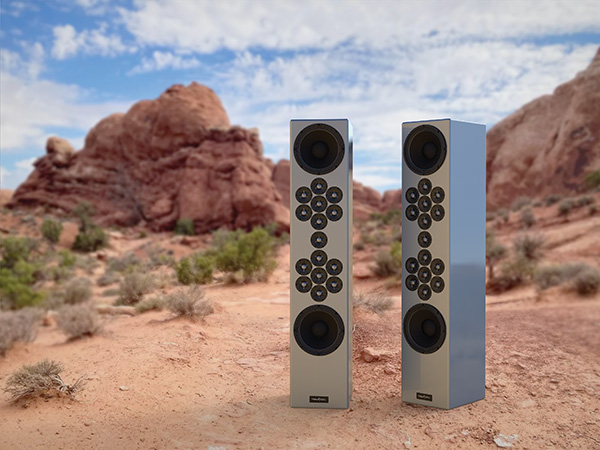
My musical appreciation—reverence at times—was due in part to the new Tekton Moab floorstanders that, over the summer, had arrived for review (footnote 1). For under five grand, factory-direct from the ever-scrappy Utah company, the man-sized towers lit up my living room. Practically from day one, they sounded exciting and true to life. Edging out the MartinLogan Odysseys that had been my conduit to musical joy for years, the Tektons became my new reference speakers.
 Eye-popping and ear-pleasing
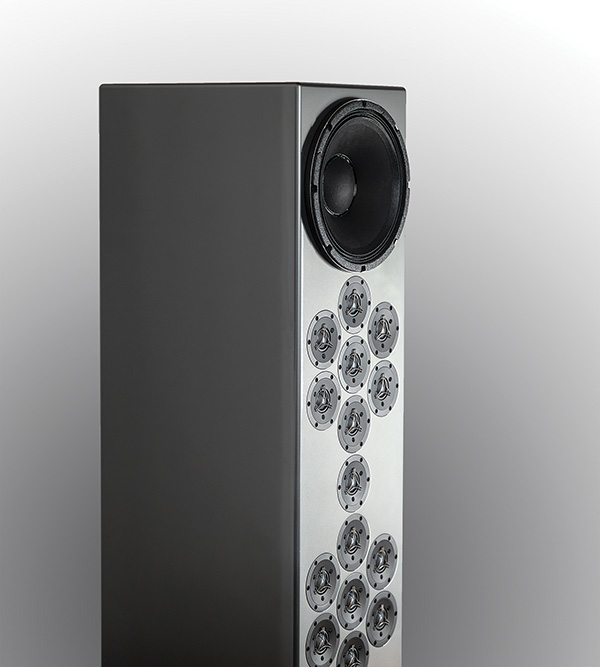
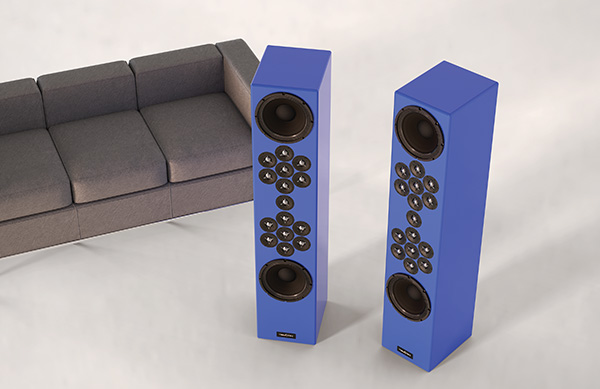
If you're thinking that building speakers with 30 tweeters is a sign of incipient madness, I'm happy to predict that once you listen to the Moabs, you'll change your mind. You see, years earlier, one of Alexander's most eye-popping and ear-pleasing ideas had been to cluster seven small high-frequency drivers in a tight circle and set the crossover to feed them midrange and low-treble only (in the case of the Moabs, between 772Hz and 3.41kHz). The cluster acts as a midrange driver with unusually low mass and thus exceptionally quick response. This helps especially with delicate overtones and harmonics, whose formation can be smothered by slower, traditional midrange cones. Tekton's patented circle array remains a defining characteristic of many of the company's models, from the $2780/pair Pendragons to the $9830/pair Ulfberhts (footnote 2). I didn't know this approach would be brilliant until I heard it with my own ears, after the original Moabs arrived. They sounded solid and engrossing. They pulsed and sashayed like live music does, with great midrange immediacy and terrific top-end sparkle but no tizziness. According to Alexander, the upgraded Moab has more going on that's new than those 15 beryllium "tweeters": This version has thicker baffles, better cabinet bracing, higher-quality crossover parts, and, optionally, an extra-high-quality gloss paint job. The price reflects these upgrades: Tekton charges $30,000 for a pair of the tricked-out Moabs, about six times the OG's cost.
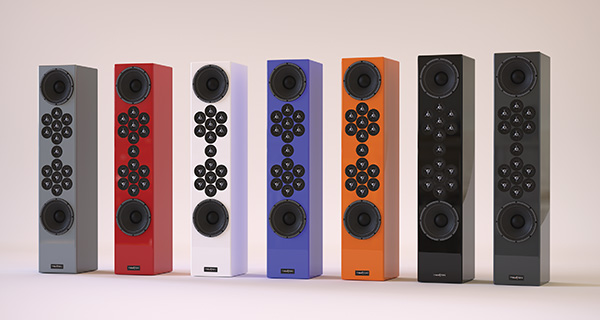 My new review pair arrived with the upgraded finish, in classy-looking Donington Gray, a BMW automotive color whose multiple coats shone like a mirror. They'd exited the spray booth just a week or so earlier and smelled like it—enough so that I guiltily banished them to my gear closet, where they stood next to a running air purifier. The paint odor dissipated slowly, and after a few weeks all was well.
At that point, I gave the Moabs Be a once-over in my listening room. Experience with visitors and online detractors has taught me that the appearance of these speakers is polarizing, much in the way that Wilson's Chronosonic speakers or Dan D'Agostino's amplifiers are. Not that the lumbering Moabs are blingy—far from it. The MDF boxes sport no swoops or curves to break up their straight lines, and they don't impersonate fine furniture, with delicate woodworking and fancy veneers. An online critic recently remarked of Tekton towers that he'd never turn his living room into "hifi Stonehenge," and I get his point, but I quite like the Moabs' look. They're not pretty, per se, but they have a brash, form-follows-function aesthetic, hold the frou-frou. My Moabs OG came with optional grilles that let users avoid trypophobia and hide the busyness of the front-baffle design. The new speakers arrived grille-less, and that's fine with me.
My new review pair arrived with the upgraded finish, in classy-looking Donington Gray, a BMW automotive color whose multiple coats shone like a mirror. They'd exited the spray booth just a week or so earlier and smelled like it—enough so that I guiltily banished them to my gear closet, where they stood next to a running air purifier. The paint odor dissipated slowly, and after a few weeks all was well.
At that point, I gave the Moabs Be a once-over in my listening room. Experience with visitors and online detractors has taught me that the appearance of these speakers is polarizing, much in the way that Wilson's Chronosonic speakers or Dan D'Agostino's amplifiers are. Not that the lumbering Moabs are blingy—far from it. The MDF boxes sport no swoops or curves to break up their straight lines, and they don't impersonate fine furniture, with delicate woodworking and fancy veneers. An online critic recently remarked of Tekton towers that he'd never turn his living room into "hifi Stonehenge," and I get his point, but I quite like the Moabs' look. They're not pretty, per se, but they have a brash, form-follows-function aesthetic, hold the frou-frou. My Moabs OG came with optional grilles that let users avoid trypophobia and hide the busyness of the front-baffle design. The new speakers arrived grille-less, and that's fine with me.
 Lost in Port-land
Placing them side by side with the OGs, I found the Be speakers about an inch shorter. That's because the beryllium drivers are slightly smaller in diameter than their fabric-dome predecessors, Alexander explained, allowing Tekton to take a little off the top, as my barber would say. Just as before, the dual 12" woofers, made by Eminence USA, are mounted near the baffles' top and bottom. They're 3.5' apart from center to center—an unusual arrangement that I reckon helps subdue room nulls.
Footnote 1: I wrote for a different publication then. Footnote 2: This polycell array, as the company calls it, also shows up in two recently introduced Tekton models: the $17,960/pair Signature Series Matrix LS, and a not-yet-in-production speaker that Alexander labels "Bespoke." He claims that Bespokes, which are expected to be much more expensive than current Tektons, will go toe to toe sonically with the likes of Wilson and Magico.