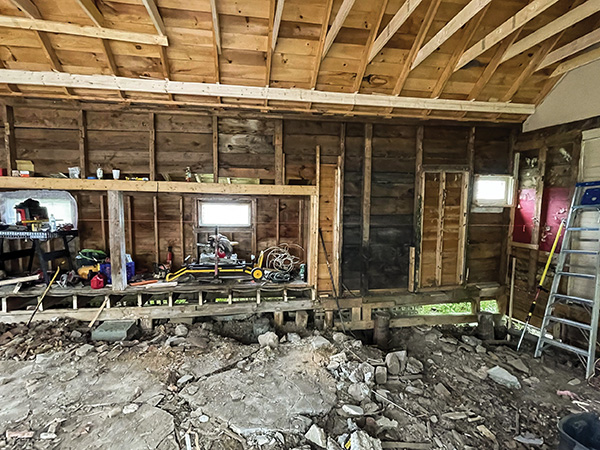
Changing his tune: Rogier van Bakel's listening room shortly after demolition began. The space had been an old two-car garage. (All photos by Rogier van Bakel.)
As happy moments in one's life go, this one was supposed to be up there: the time I first heard my stereo rig in the new, custom-built listening room in the back of my home. It had taken eight months to get to this point, starting with gutting the garage and rebuilding the floor and walls. (We kept the roof.) By the end, all-new doors and windows had been hung and treated with acoustical sealant. Extra-thick drywall and mass-loaded vinyl were installed for better sound insulation. A dedicated power line was brought in.
Credit where due: The new room was my wife's win-win suggestion. For a few years, I'd performed my reviewing duties in our living room, a good-sounding space that nonetheless had three problems. A variety of stereo gear had begun to occupy practically a third of the floor, making our digs less suitable for family use and entertaining. When my wife and kids went to bed, I couldn't really crank the volume anymore—and I love listening at night, at (I confess) elevated volumes. Lastly, the living room sits on top of a basement, suspended over joists. I had to be careful with the placement of speakers to keep the floor from acting as a tympanic resonator.
 A panel discussion
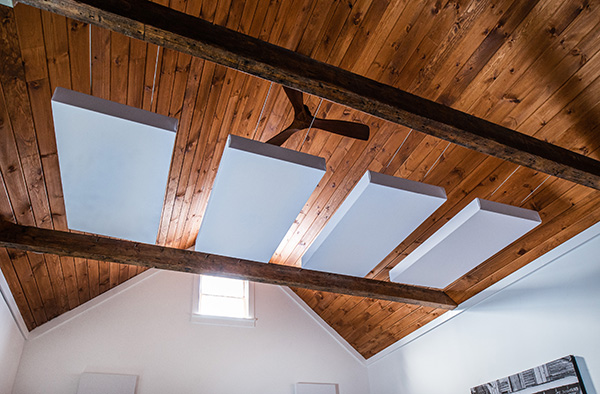
To be honest, the disappointment wasn't completely unexpected. In the fall of 2022, I'd absorbed much of the sixth edition of F. Alton Everest and Ken C. Pohlmann's Master Handbook of Acoustics and all of Jim Smith's Get Better Sound. It seemed inevitable that my medium-sized room (15' × 21', with a 16' gabled ceiling) would need a good number of acoustical panels. My friend Aaron, a math-minded audiophile with a solid knowledge of acoustics, agreed to help. We settled on more than 20 panels of various sizes, most 4" thick, including bass traps for the corners and a quartet of 2' × 4' clouds—overhead absorbers that tame reflections from the ceiling. We also ordered two skyline diffusers for the wall behind my listening chair.
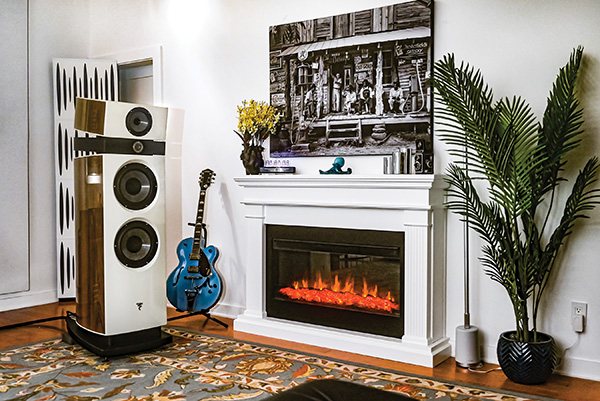 Despite our commitment to good acoustics, compromises were necessary. The goal was always to create a listening room that, big speakers notwithstanding, could just about pass for "regular" living quarters, preferably a combination of modern and rustic. So we had to find solutions that wouldn't make the space look like a control room. The skyline diffusers can pass for works of art (and most non-audiophile visitors assume that they are). The Dorothea Lange black-and-white canvas over the electric fireplace—her gorgeous 1939 photo of a Southern country store with Black men sitting on the porch—is an absorption panel at the same time. (It was custom printed to my size specifications by ATS Acoustics, with a file downloaded gratis from the Library of Congress (footnote 3).
About that fireplace: I chose it for heat and atmosphere, even though the 3' × 2' glass front is highly reflective. For critical listening, I often end up covering the pane with a 4"-thick panel—after turning off the heater element, mind you! When it's chilly out, a heat pump installed over the 18' × 4.5' gear closet to my right helps keep the place comfortable. (Hot tip: Running a couple of class-A amps can help, too.)
Despite our commitment to good acoustics, compromises were necessary. The goal was always to create a listening room that, big speakers notwithstanding, could just about pass for "regular" living quarters, preferably a combination of modern and rustic. So we had to find solutions that wouldn't make the space look like a control room. The skyline diffusers can pass for works of art (and most non-audiophile visitors assume that they are). The Dorothea Lange black-and-white canvas over the electric fireplace—her gorgeous 1939 photo of a Southern country store with Black men sitting on the porch—is an absorption panel at the same time. (It was custom printed to my size specifications by ATS Acoustics, with a file downloaded gratis from the Library of Congress (footnote 3).
About that fireplace: I chose it for heat and atmosphere, even though the 3' × 2' glass front is highly reflective. For critical listening, I often end up covering the pane with a 4"-thick panel—after turning off the heater element, mind you! When it's chilly out, a heat pump installed over the 18' × 4.5' gear closet to my right helps keep the place comfortable. (Hot tip: Running a couple of class-A amps can help, too.)
Footnote 1: For a Google-supplied Easter egg, search for "Pet Sematary" and watch the top of your browser window.