Sidebar 4: Measurements
I measured one of the Tekton Moab Be loudspeaker, serial number 0001L, in RvB's listening room, driving it with his Krell FPB 200c amplifier. I used DRA Labs' MLSSA system with a calibrated DPA 4006 microphone to examine the speaker's behavior in the farfield and an Earthworks QTC-40 mike for the nearfield responses. It wasn't possible to raise the 157lb loudspeaker off the floor for the measurements, so the first reflection from the ground occurs earlier than is usually the case with my testing. I therefore measured the response and dispersion with the microphone at 1m rather than my usual 50". RvB and I moved one of the speakers away from the sidewall so that it fired along his listening room's diagonal, but it wasn't possible to measure the off-axis response more than 45° to each side of the tweeter axis.
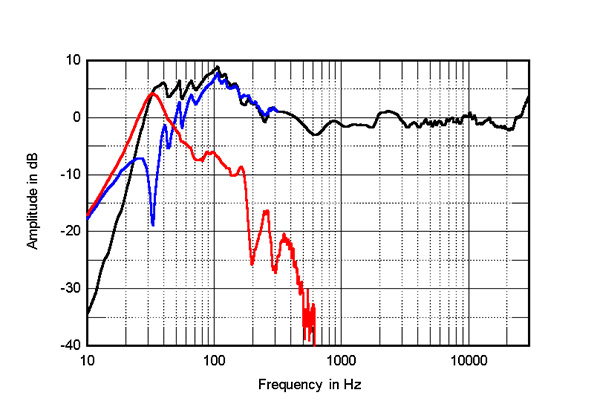
The impedance-magnitude plot has a saddle centered on 33Hz, which suggests that this is the tuning frequency of the twin ports on the enclosure's rear wall. The two woofers behaved identically; the blue trace below 300Hz in fig.3 shows the sum of their nearfield responses, which has its minimum-motion notch at 33Hz, as expected from fig.1. The ripples in the woofers' output are due to the fact that the two drive units are widely separated on the speaker's front baffle, leading to interference between their measured outputs. The nearfield response of the ports (red trace) peaks between 25Hz and 50Hz, and its upper-frequency rolloff is interrupted by peaks centered on 161Hz, 248Hz, and 352Hz. As the ports fire away from the listener, this behavior should not have audible consequences.
Footnote 1: EPDR is the resistive load that gives rise to the same peak dissipation in an amplifier's output devices as the loudspeaker. See "Audio Power Amplifiers for Loudspeaker Loads," JAES, Vol.42 No.9, September 1994, and stereophile.com/reference/707heavy/index.html.
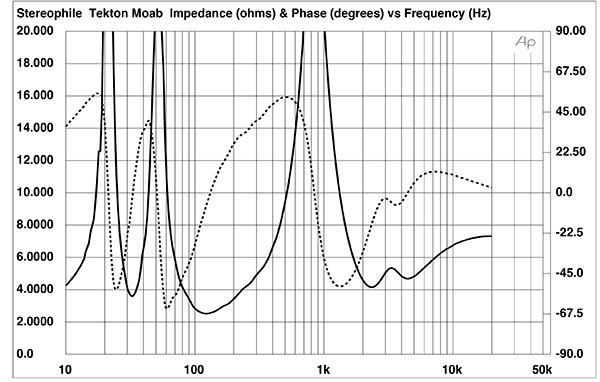
Fig.1 Tekton Moab Be, electrical impedance (solid) and phase (dashed) (2 ohms/vertical div.).
Tekton specifies the Moab Be's sensitivity as 93dB/2.83V/m. My estimate was similar, at 93.3dB(B)/2.83V/m, which is 6dB higher than the average of the loudspeakers I have measured. I used Dayton Audio's DATS V2 system to examine the loudspeaker's impedance. The Moab Be's impedance magnitude (fig.1, solid trace) lies above 4 ohms through the midrange and treble but drops below 4 ohms in the upper bass. The minimum value, 2.52 ohms, occurs at 121Hz. The electrical phase angle (fig.1, dashed trace) is often high, meaning that the EPDR (footnote 1), or effective impedance, is extremely low over much of the audioband. The EPDR was below 2 ohms between 27Hz and 31Hz, between 143Hz and 406Hz, and between 1625Hz and 2233Hz, with minimum values of 1.87 ohms at 28Hz, 1.17 ohms at 96Hz, 1.5 ohms at 197Hz, and 1.79 ohms at 1933Hz. The Moab has one of the most demanding impedances I have encountered, though this will be somewhat ameliorated by the high voltage sensitivity.
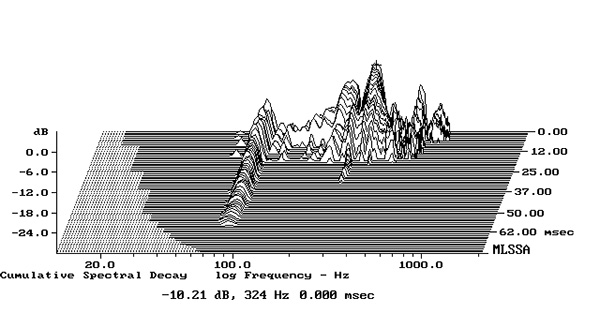
Fig.2 Tekton Moab Be, cumulative spectral-decay plot calculated from output of accelerometer fastened to the sidewall level with the bottom woofer (MLS driving voltage to speaker, 7.55V; measurement bandwidth, 2kHz).
The Moab Be's enclosure seemed lively when I rapped it with my knuckles. Investigating its vibrational behavior with a plastic-tape accelerometer, I found a resonant mode at 324Hz, which was strongest on the sidewall level with the lower woofer (fig.2). There were other strong modes at 200Hz and 535Hz on the bottom half of the rear panel.
Fig.3 Tekton Moab Be, anechoic response, averaged across 30° horizontal window on tweeter axis at 1m (black) and corrected for microphone response, with the nearfield woofer (blue) and port (red) responses and their complex sum respectively plotted below 300Hz, 600Hz, and 300Hz.
The black trace below 300Hz in fig.3 shows the sum of the nearfield midrange, woofer, and port outputs, taking into account acoustic phase and the different distance of each radiator from a nominal farfield microphone position. The rise in response in the upper bass will mainly be due to the nearfield measurement technique, but the Moab Be's low-frequency alignment does appear somewhat under-damped. The peak in the ports' output at 248Hz results in a small discontinuity at the same frequency in the woofers' response.
The black trace above 300Hz in fig.3 shows the Tekton's farfield response, averaged across a 30° horizontal window centered on the tweeter axis. The overall balance is impressively even from the middle of the midrange through to the top audio octave, though there is a slight excess of presence-region energy compared with the output above and below that region.
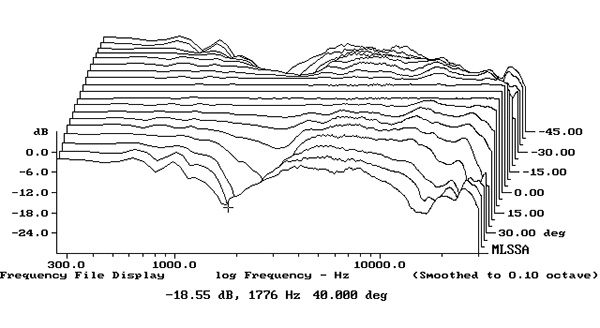
Fig.4 Tekton Moab Be, lateral response family at 1m, normalized to response on tweeter axis, from back to front: differences in response 45–5° off axis, reference response, differences in response 5–45° off axis.
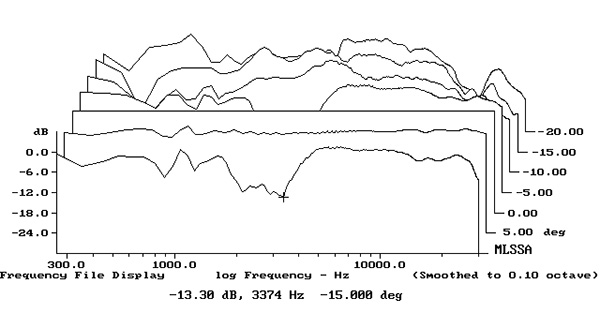
Fig.5 Tekton Moab Be, vertical response family at 1m, normalized to response on tweeter axis, from back to front: differences in response 20–5° above axis, reference response, differences in response 5–10° below axis.
The Moab Be's horizontal dispersion, normalized to the tweeter-axis response, is shown in fig.4. The contour lines in this graph are generally even, which implies stable stereo imaging, though a lack of energy develops between 1kHz and 4kHz at extreme off-axis angles. This will tend to compensate for the on-axis excess in the same region, which means that reducing the toe-in angle will give the most neutral treble balance. The tweeter is 40.5" from the floor, a few inches higher than what we have found to be a listener's typical ear height. In the vertical plane (fig.5), the traces normalized to the tweeter-axis response indicate a suckout at 3.4kHz, 5° above the tweeter axis and 10° below it.
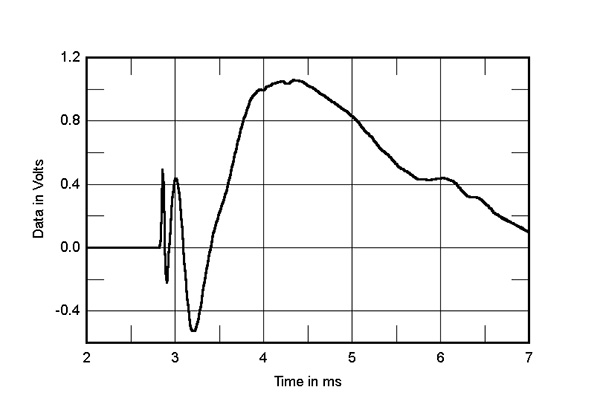
Fig.6 Tekton Moab Be, step response on tweeter axis at 1m (5ms time window, 30kHz bandwidth).
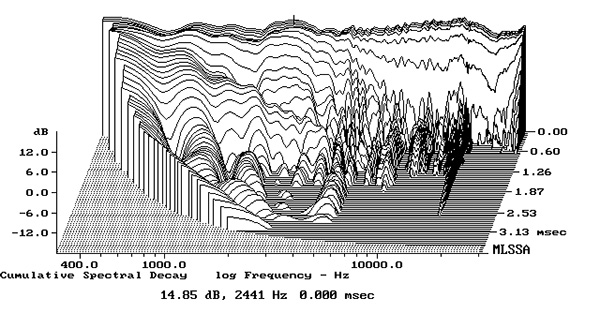
Fig.7 Tekton Moab Be, cumulative spectral-decay plot on tweeter axis at 1m (0.15ms risetime).
The Moab's step response (fig.6) indicates that all the drive units are connected in positive acoustic polarity. The tweeter's output arrives first at the microphone, and the decay of its step smoothly blends with the start of the step of the dual midrange array step. The decay of the midrange array's step then blends smoothly with the start of the woofers' step. This behavior implies an optimal crossover topology. The Tekton's cumulative spectral-decay plot (fig.7) is generally clean, though some low-level delayed energy is present in the low treble.
The Moab Be's measured performance suggests that with care in setup it will offer a neutral sonic balance. Its low-frequency alignment is best-suited to medium-to-large rooms.—John Atkinson
Footnote 1: EPDR is the resistive load that gives rise to the same peak dissipation in an amplifier's output devices as the loudspeaker. See "Audio Power Amplifiers for Loudspeaker Loads," JAES, Vol.42 No.9, September 1994, and stereophile.com/reference/707heavy/index.html.