Sidebar 3: Measurements
I used DRA Labs' MLSSA system and a calibrated DPA 4006 microphone to measure the Stenheim Alumine Three's frequency response in the farfield and an Earthworks QTC-40 mike for the nearfield responses. (I measured serial number 20030028.) Owing to the Alumine Three's weight—approximately 154lb—I wasn't able to lift the loudspeaker as high off the ground as I like to do for the farfield measurements. As this meant that the reflections of the speaker's output from the floor were closer in time to the direct sound, I had to window the impulse response data more aggressively than usual, which reduces the midrange resolution of the FFT-derived frequency responses.
The Alumine Three's sensitivity, measured in half-space and without any weighting, is specified as 93dB/2.83V/m. I examined the Stenheim's voltage sensitivity both with the speaker in the usual free-field condition and on its back close to the floor, which will approximate the half-space environment. (This had to be done with care, as the binding posts stand out from the rear panel.) The unweighted sensitivity in both conditions was 94.5dB/2.83V/m, which is a little higher than the specification. However, as I discussed in a paper that I presented to the Audio Engineering Society in 1997, I prefer to publish a loudspeaker's sensitivity calculated with a B-weighting filter (footnote 1), which gives a closer correlation with a loudspeaker's perceived loudness than an unweighted figure. The Alumine Three's B-weighted sensitivity was 91dB/2.83V/m, which is still significantly higher than average.
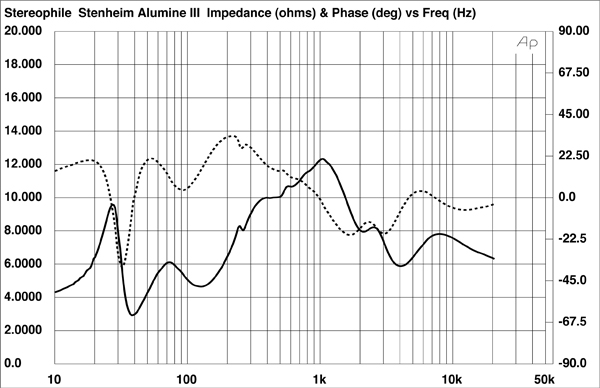
I used Dayton Audio's DATS V2 system to measure the impedance. Stenheim specifies the Alumine Three's nominal impedance as 8 ohms. I found that the impedance reaches a minimum value of 3 ohms between 38Hz and 41Hz, but the magnitude (fig.1, solid trace) lies above 6 ohms for most of the audioband. The electrical phase angle (dashed trace) is generally low, but the EPDR (footnote 2) drops to 1.5 ohms at 35Hz and to 2.3 ohms between 152Hz and 170Hz; otherwise, it remains between 4 ohms and 12 ohms in the midrange and above. Other than in the low bass and in that narrow region in the lower midrange, this speaker is a relatively easy load.
Footnote 1: See my discussion here and here. The original version of my paper can also be found in the AES E-Library here. Footnote 2: EPDR is the resistive load that gives rise to the same peak dissipation in an amplifier's output devices as the loudspeaker. See "Audio Power Amplifiers for Loudspeaker Loads," JAES, Vol.42 No.9, September 1994, and stereophile.com/reference/707heavy/index.html.
Footnote 3: See Table 1 here.
Fig.1 Stenheim Alumine Three, electrical impedance (solid) and phase (dashed) (2 ohms/vertical div.).
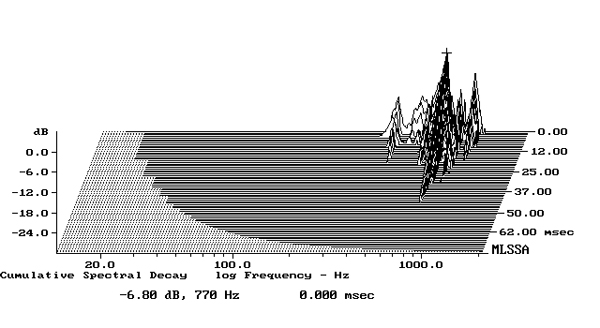
There is a strong discontinuity between 200Hz and 300Hz in the traces in fig.1 that suggests the presence of a resonance of some kind in that region. However, when I investigated the cabinet's vibrational behavior with a plastic-tape accelerometer, the panels were relatively inert, with the exception of a fairly strong resonant mode at 770Hz on the sidewalls level with the lower woofer (fig.2). The mode at 770Hz affects only a small area of the sidewalls, has a high Q (Quality Factor), and is sufficiently high in frequency that it should not give rise to any coloration.
Fig.2 Stenheim Alumine Three, cumulative spectral-decay plot calculated from output of accelerometer fastened to center of side panel level with the lower woofer (MLS driving voltage to speaker, 7.55V; measurement bandwidth, 2kHz).
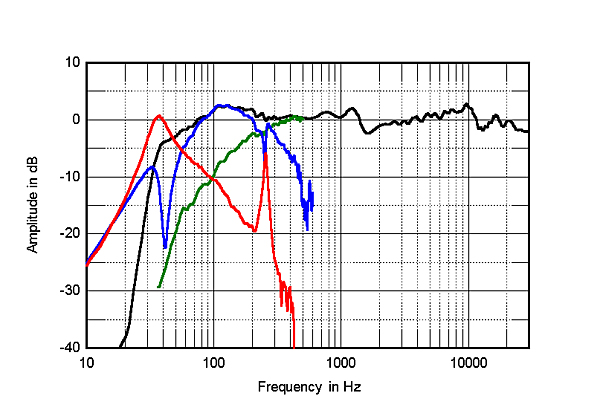
The two woofers behave identically below 100Hz but differently above that frequency. The lower woofer, which has a substantial roll surround, starts to roll off gently above 120Hz, while the upper woofer, which has a corrugated fabric surround, crosses over to the midrange unit (fig.3, green trace) close to the specified 300Hz. The blue trace in fig.3 is the summed nearfield output of the two woofers. It has a sharply defined minimum-motion notch at the port tuning frequency of 41Hz, but there is also a notch at 251Hz, the frequency of the discontinuity in the impedance traces. The red trace in fig.3 shows the nearfield output of the rectangular port at the base of the front baffle, which reflex-loads the two woofers. While the trace peaks in textbook manner at the port tuning frequency, a strong resonance is present at 251Hz, presumably due to an internal air-space issue. Although this resonance has a high Q, it is sufficiently high in level that I would expect it to have audible consequences. However, as the resonance lies between the frequencies of two musical notes, B at 247.2Hz and middle C at 261.6Hz (footnote 3), its audibility will depend on the music being played.
Fig.3 Stenheim Alumine Three, anechoic response on tweeter axis at 50", averaged across 30° horizontal window and corrected for microphone response, with the nearfield responses of the midrange unit (green), woofers (blue), port (red), and their complex sum (black), respectively plotted below 500Hz, 600Hz, 425Hz, and 300Hz.
The complex sum of the Alumine Three's nearfield responses is shown as the black trace below 300Hz in fig.3. It rolls off sharply below the port tuning frequency. The peak in the upper bass, which is due to the nearfield measurement technique, is smaller in amplitude than I usually see, suggesting that the woofer alignment is overdamped. Other than a small peak and dip between 1kHz and 2.5kHz and a slight rise in amplitude between 5kHz and 11kHz, the Stenheim's farfield response, averaged across a 30° horizontal window centered on the tweeter axis (fig.3, black trace above 300Hz), is even. The behavior just above 1kHz might be due to a surround issue with the midrange drive-unit, as is the case with the BBC LS3/5a. Like that classic design, it could be associated with a slightly nasal character, although Herb did not report hearing this.
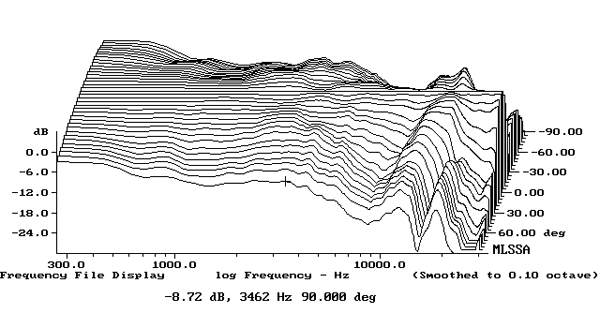
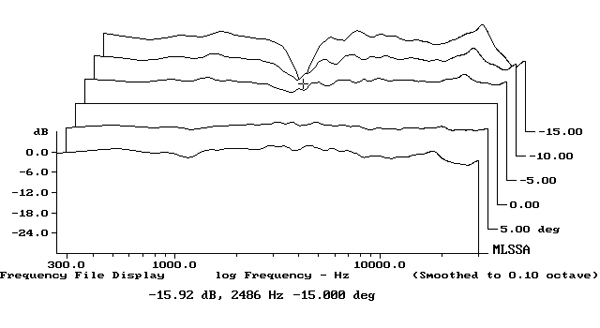
Fig.4 shows the Alumine Three's horizontal dispersion, normalized to the response on the tweeter axis, which therefore appears as a straight line. The tweeter and midrange unit are offset on the front baffle, and the changes on that side are shown at the front of the graph. The contour lines below the cursor position at 3.46kHz are smooth and evenly spaced, something that contributes to stable, well-defined stereo imaging. The apparent peak centered at 12kHz in the off-axis traces indicates that the lack of top-octave energy in the on-axis response tends to fill in to the speaker's sides. Similarly, the lack of energy off-axis just below that region suggests that the slight rise in the treble on-axis becomes smoother off-axis. Experimenting with toe-in will be useful in obtaining the optimal high-frequency balance. In the vertical plane (fig.5), the Stenheim's response doesn't change much over a +5°/–10° window centered on the tweeter axis, which is 38" from the floor. However, a suckout at the upper crossover frequency develops more than 10° above the tweeter axis. For optimal results, don't listen to this loudspeaker while standing.
Fig.4 Stenheim Alumine Three, lateral response family at 50", normalized to response on tweeter axis, from back to front: differences in response 90–5° off axis on other side of baffle, reference response, differences in response 5–90° off axis on tweeter side of baffle.
Fig.5 Stenheim Alumine Three, vertical response family at 50", normalized to response on tweeter axis, from back to front: differences in response 15–5° above axis, reference response, differences in response 5–10° below axis.
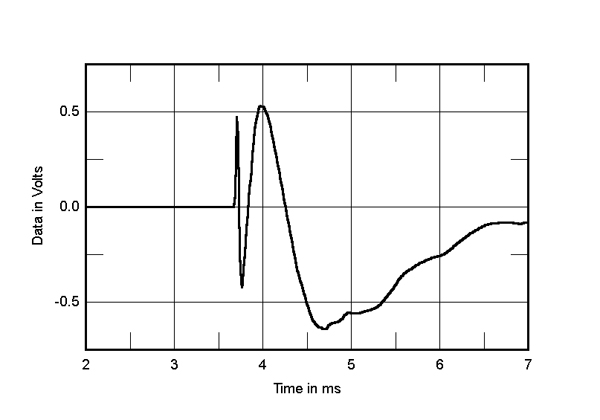
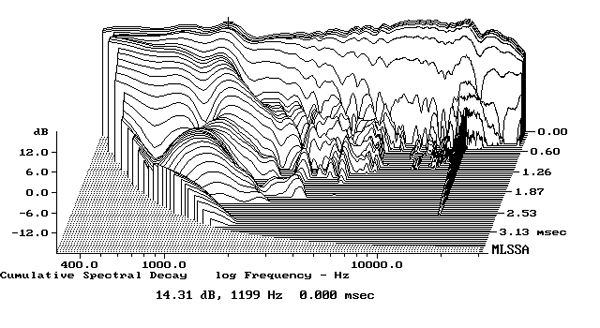
In the time domain, the Alumine Three's step response on the tweeter axis (fig.6) reveals that the tweeter and midrange unit are connected in positive acoustic polarity, the woofers in inverted polarity. (I confirmed this by looking at the step responses of the individual drive-units.) The decay of the tweeter's step smoothly blends with the positive-going start of the midrange unit's step, and the decay of that unit's step smoothly blends with the negative-going start of the woofers' step. This indicates optimal crossover implementation. The Stenheim's cumulative spectral-decay plot (fig.7) is superbly clean throughout the treble, though some low-level delayed energy is present at 1.2kHz, the center frequency of the small peak in the farfield response.
Fig.6 Stenheim Alumine Three, step response on tweeter axis at 50" (5ms time window, 30kHz bandwidth).
Fig.7 Stenheim Alumine Three, cumulative spectral-decay plot on tweeter axis at 50" (0.15ms risetime).
The Stenheim Alumine Three's measured performance indicates that this loudspeaker combines high sensitivity with a generally easy-to-drive impedance and mostly smooth, even behavior in the frequency domain. I was puzzled by the resonant peak in the port's output and by the small peak/dip just above 1kHz, but to be fair, any audible consequences of these resonances will depend on the music being played.—John Atkinson
Footnote 1: See my discussion here and here. The original version of my paper can also be found in the AES E-Library here. Footnote 2: EPDR is the resistive load that gives rise to the same peak dissipation in an amplifier's output devices as the loudspeaker. See "Audio Power Amplifiers for Loudspeaker Loads," JAES, Vol.42 No.9, September 1994, and stereophile.com/reference/707heavy/index.html.