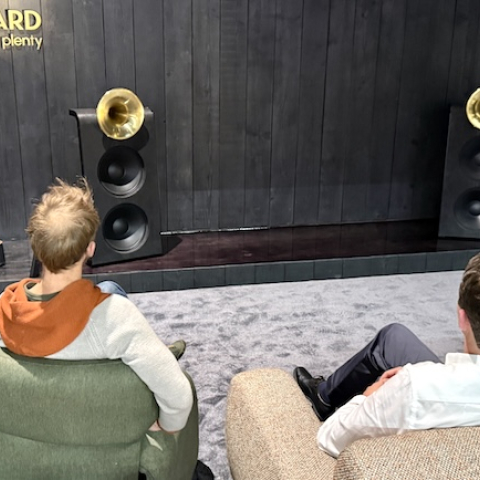
According to Panchard, "the listener should form an equilateral triangle with the speakers, or an isosceles triangle where the speakers are closer together than they are to the listener. This will likely result in the most faithful stereo image." He added, "The distance from the back wall should be between 18 and 60 inches."
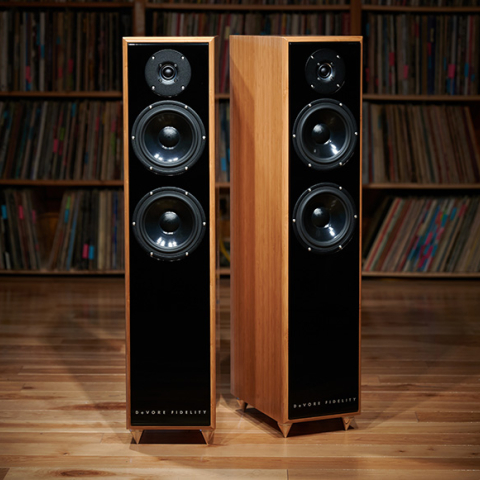
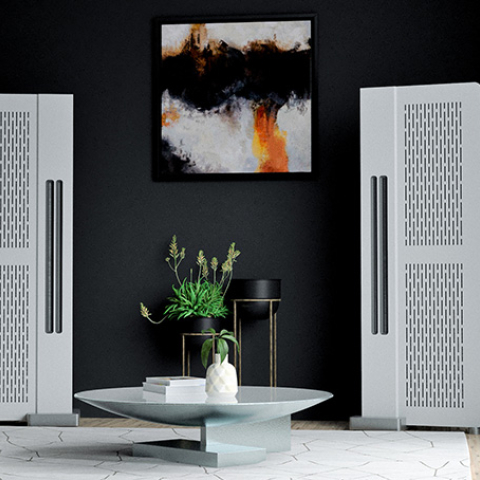
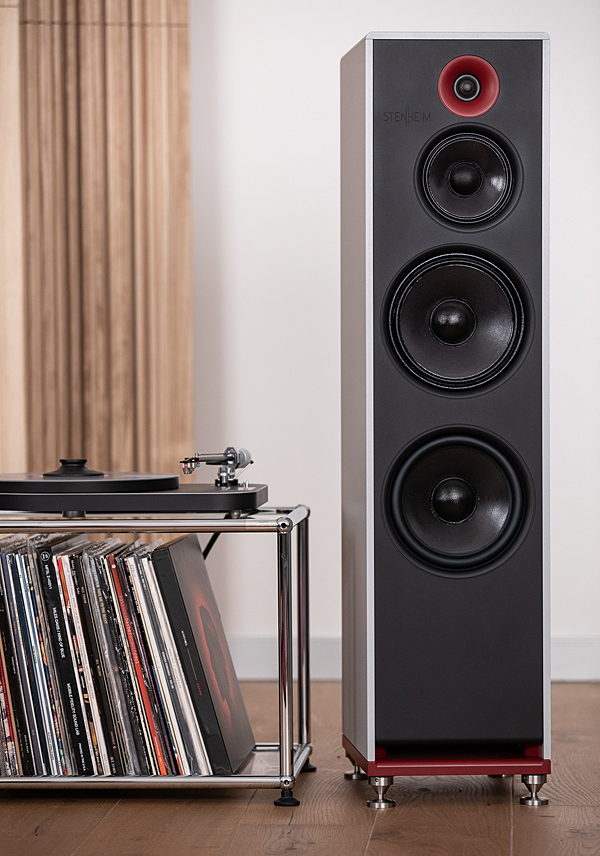
In my room, the Stenheim Alumine Threes appeared to take up less cubic space and felt smaller and less bulky than the Harbeth M30.2s (on stands) or my floorstanding DeVore Fidelity O/93s. My partner, "bb," said, "They make your room look bigger ... and nicer." I agreed.
Listening
Like the Imp, I had a hard time believing Stenheim's Alumine Threes were working properly on only 10 watts, so I let the RAAL HSA-1b amp drive hem for a couple more days of careful listening. What I observed was: 10Wpc was not enough for loud rock or dense symphonies. Heavy bass content blurred from clipping. Nevertheless, with my normal music at my normal listening levels, the Stenheim-RAAL combo exhibited a beautiful spectral balance and a controlled, well-focused presentation.
When I reinserted the Pass Labs XA25, I was pleased how those 25 watts (actually, 80 watts) of MOSFET power opened up and clarified the Alumine Three's sound. With the Pass Labs amp, the Alumine Three's bass extended precisely and descriptively to about 50Hz, subjectively. The taut-but-not-too-taut solidity of the Stenheim-Pass bass put a just-right rhythmic structure under the speakers' explicitly rendered midrange. With the RAAL amp, the midrange was flat-out gorgeous, but the bass and treble were November-dark and cloudy. With the XA25, all nine of the Stenheim's octaves were cloudless, blue-sky bright. With the RAAL, the silk-dome tweeter seemed to roll off early and lack detail. The XA25 seemed to add a full octave of clear sky at the top.
 One of my favorite repeat-play albums during this review cycle was Anna Von Hausswolff's Dead Magic (16/44.1 FLAC, City Slang/Qobuz). It presents evocative oceans of layered, heavily processed vocal and synthesizer tones, but, in some systems, these tones can sound hard and confused. The Alumine Threes were very good at sorting this type of recorded data. They put every compressed echo-soaked sound molecule in its proper place. Easy to comprehend. Beautiful and clear to my ear. Zero confusion.
What I noticed often during my days with the Stenheims was how quiet they were compared to the Falcons, DeVores, or Zu Soul Supremes. They were quiet in the same way Joseph Audio's Pulsar speakers are quiet. By "quiet" I mean that the Alumine Three's driver cones did not appear to be generating any hashy, low-level breakup sounds near the limits of their passbands.
The extraordinary transparency of the XA25 + Stenheims' reproduction was never more obvious or compelling than when it was playing Trio Mediaeval's Solacium (24/352.8 MQA 2L/Tidal). On Solacium, Trio Mediaeval sings sacred-sounding lullabies in a manner that merges ancient and contemporary modes of expression. The Alumine Threes excelled at reproducing the purity and lively everberant character of Trio Mediaeval's vocals. Acoustic bass notes were rendered in quick, taut, accurate tones. The Pass Labs–Stenheim combo presented Solacium as a beautiful work of human-scale art, radiant and reverent.
It took two weeks for my brain to adjust to the reality of a $32,900/pair speakers being majestically powered by a simple, $4900 25W class-A amplifier, but when it did finally adjust, I began wondering how the Stenheims might sound with single-ended triodes.
To find out, I let the 22Wpc, 845-tubed Line Magnetic LM-518IA drive the Stenheims while playing Charlie Parker's Encores – The Savoy Sessions (Savoy LP SJL 1107). Instrumental tone, especially Max Roach's drums and Miles Davis's trumpet, came across as correct and satisfying. Key changes and tempo changes were right there where I could notice and feel them. No shortness of breath or clipping distortion. Just right-on tone, tempo, and texture.
While the above albums played easily with low power, if I was into big symphonies and floor-pounding soundtracks, which I am, I would choose to match these Stenheims with an amplifier capable of more than the XA25's 80 watts—like Parasound's Halo A21+, a high-bias, class-AB, MOSFET amp specified to put 250Wpc into 8 ohms and 500Wpc into 4 ohms. As the A21+ pushed music through the Alumine Threes, it left no doubt that it is the most powerful amp, with the biggest heatsinks and the highest damping factor, of any in my herd.
At all times, I could feel the Parasound's grip on the Stenheims in the way it outlined and separated instruments on albums like Mirga Grazinyte-Tyla conducting the City of Birmingham Symphony Orchestra performing The British Project – Britten: Sinfonia da Requiem (24/96 FLAC, Deutsche Grammophon/Qobuz). With the A21+, the almost fullrange Alumine Threes made this type of music play bigger, more distinctly, more open, easier to follow, and more interesting than it did with my Falcons or DeVores. This music, this amp, and this speaker were made for each other.
One of my favorite repeat-play albums during this review cycle was Anna Von Hausswolff's Dead Magic (16/44.1 FLAC, City Slang/Qobuz). It presents evocative oceans of layered, heavily processed vocal and synthesizer tones, but, in some systems, these tones can sound hard and confused. The Alumine Threes were very good at sorting this type of recorded data. They put every compressed echo-soaked sound molecule in its proper place. Easy to comprehend. Beautiful and clear to my ear. Zero confusion.
What I noticed often during my days with the Stenheims was how quiet they were compared to the Falcons, DeVores, or Zu Soul Supremes. They were quiet in the same way Joseph Audio's Pulsar speakers are quiet. By "quiet" I mean that the Alumine Three's driver cones did not appear to be generating any hashy, low-level breakup sounds near the limits of their passbands.
The extraordinary transparency of the XA25 + Stenheims' reproduction was never more obvious or compelling than when it was playing Trio Mediaeval's Solacium (24/352.8 MQA 2L/Tidal). On Solacium, Trio Mediaeval sings sacred-sounding lullabies in a manner that merges ancient and contemporary modes of expression. The Alumine Threes excelled at reproducing the purity and lively everberant character of Trio Mediaeval's vocals. Acoustic bass notes were rendered in quick, taut, accurate tones. The Pass Labs–Stenheim combo presented Solacium as a beautiful work of human-scale art, radiant and reverent.
It took two weeks for my brain to adjust to the reality of a $32,900/pair speakers being majestically powered by a simple, $4900 25W class-A amplifier, but when it did finally adjust, I began wondering how the Stenheims might sound with single-ended triodes.
To find out, I let the 22Wpc, 845-tubed Line Magnetic LM-518IA drive the Stenheims while playing Charlie Parker's Encores – The Savoy Sessions (Savoy LP SJL 1107). Instrumental tone, especially Max Roach's drums and Miles Davis's trumpet, came across as correct and satisfying. Key changes and tempo changes were right there where I could notice and feel them. No shortness of breath or clipping distortion. Just right-on tone, tempo, and texture.
While the above albums played easily with low power, if I was into big symphonies and floor-pounding soundtracks, which I am, I would choose to match these Stenheims with an amplifier capable of more than the XA25's 80 watts—like Parasound's Halo A21+, a high-bias, class-AB, MOSFET amp specified to put 250Wpc into 8 ohms and 500Wpc into 4 ohms. As the A21+ pushed music through the Alumine Threes, it left no doubt that it is the most powerful amp, with the biggest heatsinks and the highest damping factor, of any in my herd.
At all times, I could feel the Parasound's grip on the Stenheims in the way it outlined and separated instruments on albums like Mirga Grazinyte-Tyla conducting the City of Birmingham Symphony Orchestra performing The British Project – Britten: Sinfonia da Requiem (24/96 FLAC, Deutsche Grammophon/Qobuz). With the A21+, the almost fullrange Alumine Threes made this type of music play bigger, more distinctly, more open, easier to follow, and more interesting than it did with my Falcons or DeVores. This music, this amp, and this speaker were made for each other.
 I believe Roon Radio sent me this version of Britten's Sinfonia da Requiem during my Stenheim review period to remind me how much some recorded music needs tall, fancy speakers and heavy, powerful amplifiers. I had forgotten how effectively big amps and speakers can dig into expansive wide-range recordings like this intense, dark-of-mood Benjam°n Britten composition from 1940.
Compared to the little Falcons and the humble DeVores, the Stenheim Alumine Threes delivered a bigger "sound" fueled by more undistorted volume, more unrestrained dynamics, more absolute clarity, and of course, more and deeper and less distorted bass.
You know
I believe Roon Radio sent me this version of Britten's Sinfonia da Requiem during my Stenheim review period to remind me how much some recorded music needs tall, fancy speakers and heavy, powerful amplifiers. I had forgotten how effectively big amps and speakers can dig into expansive wide-range recordings like this intense, dark-of-mood Benjam°n Britten composition from 1940.
Compared to the little Falcons and the humble DeVores, the Stenheim Alumine Threes delivered a bigger "sound" fueled by more undistorted volume, more unrestrained dynamics, more absolute clarity, and of course, more and deeper and less distorted bass.
You know
I used to sit on Fool's Hill mocking glossy, outsized, expensive speakers. To me, they were show horses, not workhorses. In private I called them "dude-ranch trucks." And then Walter Swanbon showed up with his pro-grade handtruck carrying the svelte, matte-finished Alumine Three. Before I played them, I was inclined to maybe like them, but only a little, and never as much as my much-less-expensive Falcons or DeVores. However! I never imagined how much previously undelivered recorded information the Stenheim Alumine Threes would bring into my room. Or how powerful and compelling this newly discovered information would be. So now I must ask myself: Are the Alumine Threes 10 times better than the Falcon Gold Badges? Yes, I believe they are.
Besides their smooth, coherent response between 50Hz and 250Hz (which the LS3/5a lacks), the Stenheim Alumine Threes showcased a radically uncolored midband that was quieter, better focused, and more clean-lens transparent than the LS3/5a. Overall, what makes the Stenheims 10 times better than the Falcons is their greater bass power and extension—and their extraordinary midband lucidity.
It's my way
When reviewing audio equipment, I always attempt to elucidate what the reviewed component does different than, or better than, or worse than similar components in its price-performance category. This can be difficult if I'm not in-home familiar with the review component's competition. But it was easy with the Stenheim Alumine Threes. What separates the Threes from most other top-tier luxury-class speakers is twofold: First, the Stenheims' look is living-room, partner, and family-friendly, not audiophile weird. Second, and more importantly, the Alumine Threes are not dreadful-to-drive, low-EPDR speakers that will only work with massive crazy-money monoliths that are capable of driving 2 ohms. While the Stenheims responded extremely well to large amounts of high-quality amplifier power, they were equally exciting when powered by a 25W class-A solid state amp and a 22W single-ended triode. I regard this as proof that a well-engineered speaker need not be difficult to drive.
Remember Chaim Topol singing in Fiddler on the Roof?
If I were a rich man,
Ya ha deedle deedle, bubba bubba deedle deedle dum.
All day long I'd biddy biddy bum.
Like the Imp, I had a hard time believing Stenheim's Alumine Threes were working properly on only 10 watts, so I let the RAAL HSA-1b amp drive hem for a couple more days of careful listening. What I observed was: 10Wpc was not enough for loud rock or dense symphonies. Heavy bass content blurred from clipping. Nevertheless, with my normal music at my normal listening levels, the Stenheim-RAAL combo exhibited a beautiful spectral balance and a controlled, well-focused presentation.
One of my favorite repeat-play albums during this review cycle was Anna Von Hausswolff's Dead Magic (16/44.1 FLAC, City Slang/Qobuz). It presents evocative oceans of layered, heavily processed vocal and synthesizer tones, but, in some systems, these tones can sound hard and confused. The Alumine Threes were very good at sorting this type of recorded data. They put every compressed echo-soaked sound molecule in its proper place. Easy to comprehend. Beautiful and clear to my ear. Zero confusion.
What I noticed often during my days with the Stenheims was how quiet they were compared to the Falcons, DeVores, or Zu Soul Supremes. They were quiet in the same way Joseph Audio's Pulsar speakers are quiet. By "quiet" I mean that the Alumine Three's driver cones did not appear to be generating any hashy, low-level breakup sounds near the limits of their passbands.
I believe Roon Radio sent me this version of Britten's Sinfonia da Requiem during my Stenheim review period to remind me how much some recorded music needs tall, fancy speakers and heavy, powerful amplifiers. I had forgotten how effectively big amps and speakers can dig into expansive wide-range recordings like this intense, dark-of-mood Benjam°n Britten composition from 1940.
I used to sit on Fool's Hill mocking glossy, outsized, expensive speakers. To me, they were show horses, not workhorses. In private I called them "dude-ranch trucks." And then Walter Swanbon showed up with his pro-grade handtruck carrying the svelte, matte-finished Alumine Three. Before I played them, I was inclined to maybe like them, but only a little, and never as much as my much-less-expensive Falcons or DeVores. However! I never imagined how much previously undelivered recorded information the Stenheim Alumine Threes would bring into my room. Or how powerful and compelling this newly discovered information would be. So now I must ask myself: Are the Alumine Threes 10 times better than the Falcon Gold Badges? Yes, I believe they are.
When reviewing audio equipment, I always attempt to elucidate what the reviewed component does different than, or better than, or worse than similar components in its price-performance category. This can be difficult if I'm not in-home familiar with the review component's competition. But it was easy with the Stenheim Alumine Threes. What separates the Threes from most other top-tier luxury-class speakers is twofold: First, the Stenheims' look is living-room, partner, and family-friendly, not audiophile weird. Second, and more importantly, the Alumine Threes are not dreadful-to-drive, low-EPDR speakers that will only work with massive crazy-money monoliths that are capable of driving 2 ohms. While the Stenheims responded extremely well to large amounts of high-quality amplifier power, they were equally exciting when powered by a 25W class-A solid state amp and a 22W single-ended triode. I regard this as proof that a well-engineered speaker need not be difficult to drive.
Ya ha deedle deedle, bubba bubba deedle deedle dum.
All day long I'd biddy biddy bum.