Sidebar 3: Measurements
When a loudspeaker is measured, the underlying assumption is that the distance from the speaker to the microphone is significantly greater than the largest dimension of the speaker's drive-unit array. With conventional moving-coil loudspeakers, this assumption is almost always correct: The microphone is in the speaker's farfield, where any differences in the path lengths from all the drive-units are negligible. However, with a panel loudspeaker such as the Magnepan LRS, this becomes difficult to arrange. The LRS's Magneplanar panel is 38" tall by 10" wide, which means that, at my usual microphone distance of 50", the farfield assumption is incorrect. The resulting proximity effect will tilt up the response at low frequencies—as it will when the loudspeaker is listened to at the same distance.
So with that caveat, I used DRA Labs' MLSSA system and a calibrated DPA 4006 microphone to measure the Magnepan LRS's frequency response in the farfield and an Earthworks QTC-40 mike for the nearfield response.
Magnepan specifies the LRS's sensitivity as 86dB at 500Hz with 2.83V. I don't like specifying a sensitivity at just one frequency, as this could be misleading with a speaker having a nonflat response (as they all do). I prefer to use a wideband noise signal and a B-weighting filter; this filter reduces the effect on the measured value with speakers having extended highs or lows. Taken in this manner, my estimate of the Magnepan's sensitivity was almost 6dB lower than specified, at 80.1dB(B)/2.83V/m. Because a panel speaker has a dipolar radiation pattern, this sensitivity can't be directly compared with that of a conventional box speaker—the dipole emits as much sound to its rear as it does to the front. Even so, the LRS will not go very loud with low-powered amplifiers.
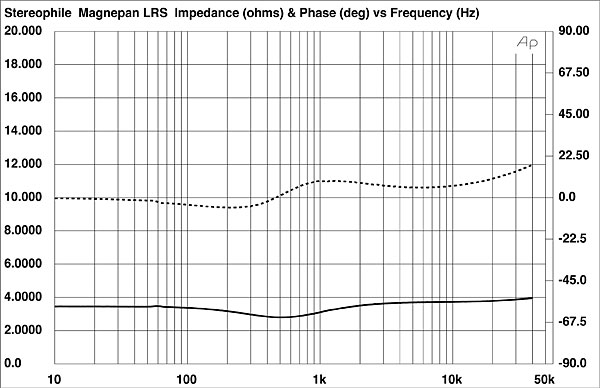
Magnepan specifies the LRS's nominal impedance as 4 ohms. My measurement of the speaker's impedance magnitude (fig.1, solid trace) revealed that the LRS behaves more like a 3.33-ohm load, with a minimum value of 2.8 ohms between 400 and 600Hz. However, the electrical phase angle (dotted trace) is very low; the LRS behaves almost like a pure resistance. This loudspeaker will work well with amplifiers that have no problem driving 4-ohm loads.
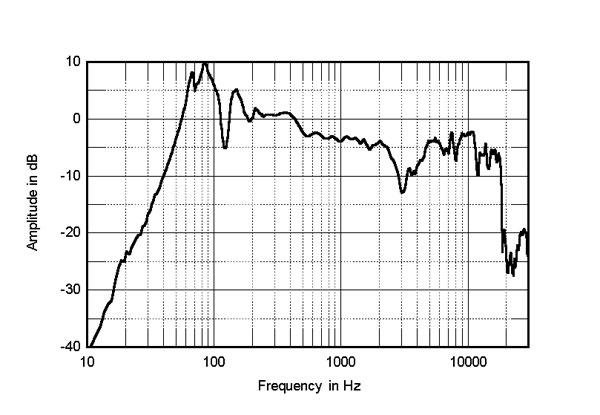 Higher in frequency in fig.2, the black trace shows the Magnepan's farfield response, averaged across a 30° horizontal window centered on the middle of the panel in front of the tweeter section. (With the backward tilt of the panel when supported by its stand, this would be the listening axis.) While the speaker basically offers an even frequency balance from 500Hz to 19kHz, an octave-wide, 7dB-deep suckout in the presence region will both affect the measured sensitivity and make the LRS sound "polite."
However, after I picked up the Maggies from Herb Reichert's Bed-Stuy bunker, he suggested in an email that "When you do your LRS frequency-response measurements—try having the tweeter ribbons 1" farther from the microphone (at 50") than the bass-mid cluster." His cryptic recommendation implied that the presence-region suckout fills in to the side of the tweeter section of the panel—and if you look at the LRS's horizontal dispersion (fig.3), that does appear to be the case. The cursor in this graph is positioned at 3.1kHz, the center frequency of the suckout, and as the individual traces are normalized to the tweeter-axis response, you can see that Herb was correct.
Higher in frequency in fig.2, the black trace shows the Magnepan's farfield response, averaged across a 30° horizontal window centered on the middle of the panel in front of the tweeter section. (With the backward tilt of the panel when supported by its stand, this would be the listening axis.) While the speaker basically offers an even frequency balance from 500Hz to 19kHz, an octave-wide, 7dB-deep suckout in the presence region will both affect the measured sensitivity and make the LRS sound "polite."
However, after I picked up the Maggies from Herb Reichert's Bed-Stuy bunker, he suggested in an email that "When you do your LRS frequency-response measurements—try having the tweeter ribbons 1" farther from the microphone (at 50") than the bass-mid cluster." His cryptic recommendation implied that the presence-region suckout fills in to the side of the tweeter section of the panel—and if you look at the LRS's horizontal dispersion (fig.3), that does appear to be the case. The cursor in this graph is positioned at 3.1kHz, the center frequency of the suckout, and as the individual traces are normalized to the tweeter-axis response, you can see that Herb was correct.
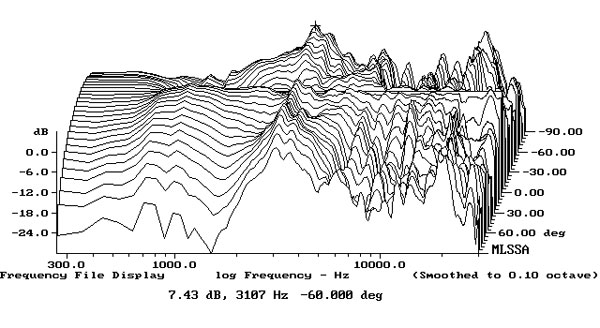 The changes in response on the woofer side of the panel, shown at the front of fig.3, suggest that the listener will get more midrange energy if the speakers are positioned with their tweeter sections on the outside edges. The dipolar behavior in the midrange is evident, though the dispersion in the treble is more complicated. In the vertical plane (fig.4), the suckout at 3.1kHz tends to fill in above and below the midpanel axis.
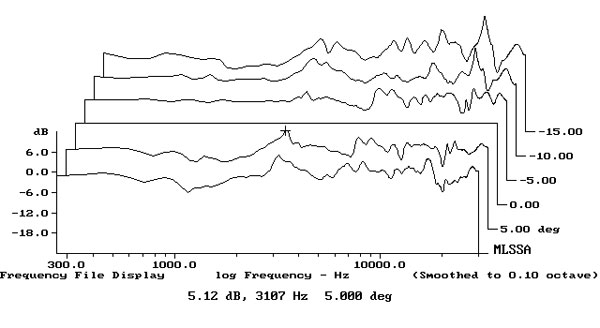
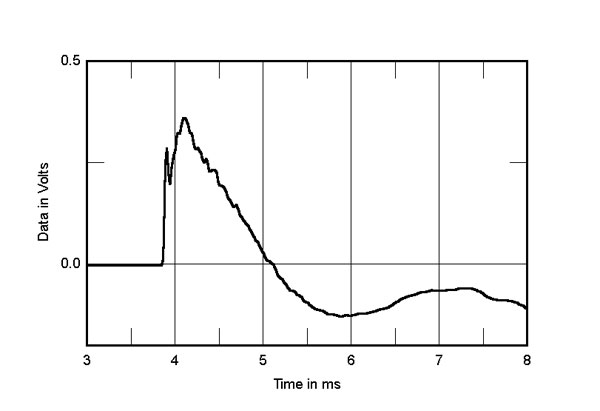
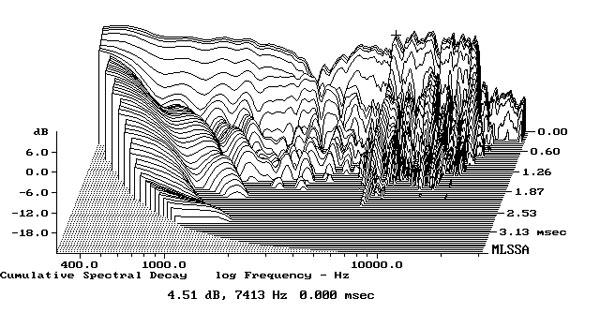
Fig.1 Magnepan LRS, electrical impedance (solid) and phase (dashed) (2 ohms/vertical div.).
Turning to the LRS's measured frequency response (fig.2), the proximity effect mentioned earlier can be seen. The speaker's farfield output rises as the frequency drops from 500 to 300Hz, while below 300Hz, the response measured in the nearfield rises precipitously. In part, this rise in the midbass will be due to the nearfield measurement technique, which assumes that the drive-units are mounted in a true infinite baffle. But it is also due to the panel's fundamental "drum-skin" resonance, which tends to compensate for the fact that with a dipole speaker the reflections of the speaker's backward-firing sound from the wall behind it will cancel the front-firing sound below a frequency that depends on the panel's size.
Fig.2 Magnepan LRS, anechoic response on mid-panel tweeter axis at 50", averaged across 30° horizontal window and corrected for microphone response, with the nearfield panel response plotted below 300Hz.
Fig.3 Magnepan LRS, lateral response family at 50", normalized to response on mid-panel tweeter axis, from back to front: differences in response 90–5° off axis on tweeter side, reference response, differences in response 5–90° off axis on woofer side.
Fig.4 Magnepan LRS, vertical response family at 50", normalized to response on mid-panel tweeter axis, from back to front: differences in response 15–5° above axis, reference response, differences in response 5–10° below axis.
In the time domain, the LRS's step response on the midpanel tweeter axis (fig.5) reveals that the panel's high- and low-frequency sections are connected in positive acoustic polarity. The tweeter step slightly leads that of the woofer on this axis, which suggests that the best blend of the two sections—one that gives a perfect, right-triangle-shaped, time-coincident step—occurs on the woofer side of the measurement axis. Again, Herb's suggestion was correct. Some small high-frequency ripples overlaying the decay of the Magnepan's step give rise to some top-octave hash in the speaker's cumulative spectral-decay plot (fig.6)—but see the link to my measurements of Magnepan's MG2.6/R for an explanation of why this behavior might not matter.
Fig.5 Magnepan LRS, step response on mid-panel tweeter axis at 50" (5ms time window, 30kHz bandwidth).
Fig.6 Magnepan LRS, cumulative spectral-decay plot on mid-panel tweeter axis at 50" (0.15ms risetime).
Interpreting the measured performance of a panel loudspeaker such as the Magnepan LRS is far from straightforward. Overall, however, the LRS appears to be capable of well-balanced sound, provided its owner takes care in optimizing such matters as placement and toe-in.—John Atkinson