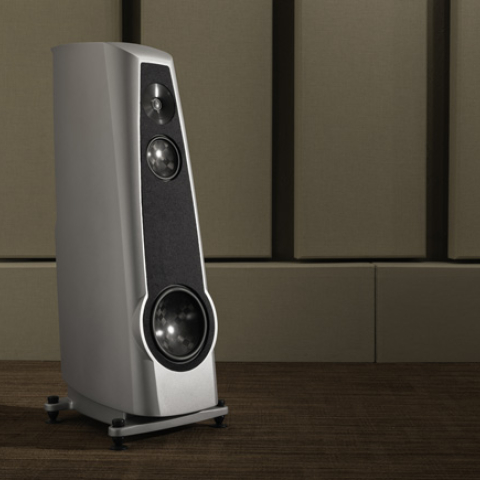
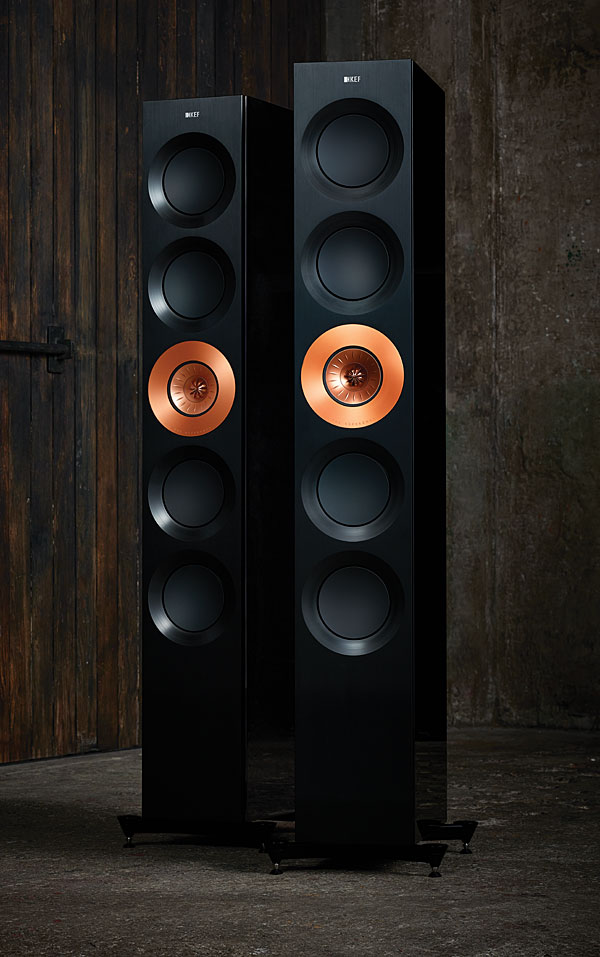
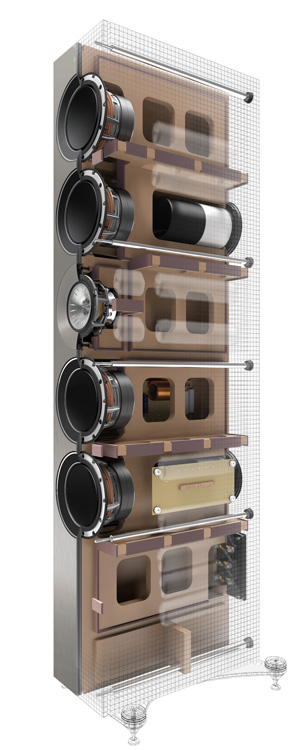
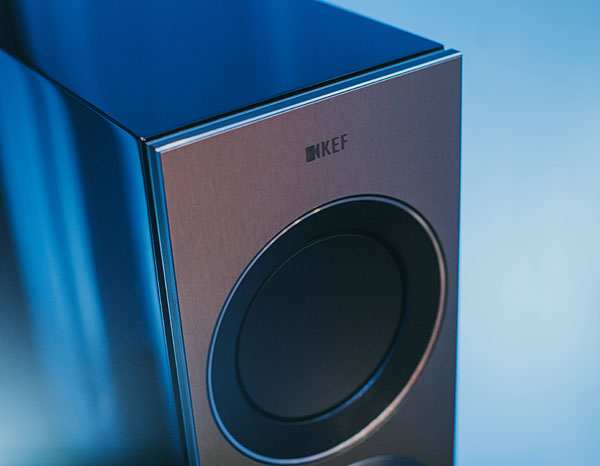
The Reference 5's massive cabinet is heavily braced, and the aluminum baffle is connected to it with a lossy damping material. Outriggers fitted with spiked feet provide stability for the tall, narrow enclosure, and heavy-duty chromed terminals provide for single and biwiring. My review samples came in the visually stunning, white "Kent Engineering and Foundry Edition" finish.
 Sound Quality
After experimenting with positioning the Reference 5s in my room, Jack Oclee-Brown eventually decided on using the long port for the two top woofers and the short port for the two bottom woofers of each speaker. The short ports give a maximally flat low-frequency response that will be optimal for American-style, light-construction rooms; the long ports give an overdamped alignment to suit British-style rooms, which have more solid walls. The walls of my basement room are solid up to 4', and above that are drywall on studs. Using all short ports gave rich low frequencies but somewhat compromised clarity; all long ports gave superb low-frequency clarity but not enough bass weight. After Oclee-Brown had left, I experimented with both positions and ports, but ended up with his choices: that way, the 1/3-octave warble tones on my Editor's Choice CD (Stereophile STPH016-2) extended cleanly and evenly through the 40Hz band, with the 32Hz tone boosted by the lowest-frequency mode in my room. The 25Hz tone was audible at my normal listening level, but the 20Hz tone was not. The half-step–spaced tonebursts on Editor's Choice played evenly and with good control, and the balance didn't change significantly over a relatively wide vertical window.
The Reference 5s' enclosures were not quite as inert as I was expecting. Listening to the cabinets' sidewalls with a stethoscope, I could hear a metallic ringing at around 825Hz when I rapped the panels with my knuckles. This ringing was very faint, however; I could hear no associated coloration with solo-piano recordings. And as with the Blade Two and LS50, the Reference 5's midrange reproduction was superbly natural. Well-recorded voices, such as the late Lorraine Hunt Lieberson's mezzo in Brahms's song "Unbewegte laue Luft" (ALAC file ripped from CD, Wigmore Hall Live 0013), or that of the still-with-us Diana Krall in "All of Nothing at All," from her Love Scenes (DSD64 file, Impulse!/Acoustic Sounds IMP12342), simply hung in space between the speakers.
 The Reference 5's treble balance was sweet, but after a while I felt it was a touch too sweet. Even so, the Ayre Acoustics QX-5 Twenty DAC, which I'd found sounded a bit too upfront when used with its own digital volume control and without a preamplifier, proved to be a synergistic match with the Reference 5s when it drove the MBL power amplifiers directly. With Giuliano Carmignola and Mayumi Hirasaki's brisk performance of J.S. Bach's Double Violin Concerto, BWV 1043, accompanied by Concerto Köln (ALAC file ripped from CD, Archiv 0289 479 2695 5), for example, the Ayre-MBL-KEF combination coped well with this recording's rather aggressive treble balance, and allowed me to relish the glorious bloom of the cellos and double bass. The combination of bass drum and bass guitar underlying the flanged piano that kicks off "Unforgiven," from Beck's Morning Phase (24-bit/96kHz ALAC file, Capitol/HDtracks), was similarly glorious, if a little too ripe in absolute terms with the combination of short and long ports and at the level at which I like to listen.
With the dual-mono pink-noise track on Editor's Choice (ALAC file ripped from CD, Stereophile STPH016-2), the central image was very narrow and stable. In fact, the KEF Reference 5s were soundstaging champs. Elsewhere in this issue you can find Robert Levine's review of an album of choral works by Eriks Eenvalds, with the Portland State Chamber Choir conducted by Ethan Sperry (24/88.2 AIFF master files for CD, Naxos 8.579008). I had recorded the first three works on this album with my usual array of six microphones: a fairly close ORTF pair of Neumann cardioids, to define the soundstage; a fairly close spaced pair of high-voltage DPA omnis, to add the bloom and low-frequency weight; and a more distantly spaced pair of DPA omnis, to capture more of the church ambience. When the outputs of the three pairs of mikes are brought into time alignment, the aim of the mix is to get the best of all worlds: a tonally correct recording with a stable soundstage that is true to the original event. The recording's producer, Erick Lichte, was responsible for the mix; at the start of the first track, "The First Tears," three women bounce the words "It was Raven" to each other. As they do so, the KEFs unambiguously positioned the narrow image of each singer at the correct position in terms of both soundstage width and depth.
The Reference 5's treble balance was sweet, but after a while I felt it was a touch too sweet. Even so, the Ayre Acoustics QX-5 Twenty DAC, which I'd found sounded a bit too upfront when used with its own digital volume control and without a preamplifier, proved to be a synergistic match with the Reference 5s when it drove the MBL power amplifiers directly. With Giuliano Carmignola and Mayumi Hirasaki's brisk performance of J.S. Bach's Double Violin Concerto, BWV 1043, accompanied by Concerto Köln (ALAC file ripped from CD, Archiv 0289 479 2695 5), for example, the Ayre-MBL-KEF combination coped well with this recording's rather aggressive treble balance, and allowed me to relish the glorious bloom of the cellos and double bass. The combination of bass drum and bass guitar underlying the flanged piano that kicks off "Unforgiven," from Beck's Morning Phase (24-bit/96kHz ALAC file, Capitol/HDtracks), was similarly glorious, if a little too ripe in absolute terms with the combination of short and long ports and at the level at which I like to listen.
With the dual-mono pink-noise track on Editor's Choice (ALAC file ripped from CD, Stereophile STPH016-2), the central image was very narrow and stable. In fact, the KEF Reference 5s were soundstaging champs. Elsewhere in this issue you can find Robert Levine's review of an album of choral works by Eriks Eenvalds, with the Portland State Chamber Choir conducted by Ethan Sperry (24/88.2 AIFF master files for CD, Naxos 8.579008). I had recorded the first three works on this album with my usual array of six microphones: a fairly close ORTF pair of Neumann cardioids, to define the soundstage; a fairly close spaced pair of high-voltage DPA omnis, to add the bloom and low-frequency weight; and a more distantly spaced pair of DPA omnis, to capture more of the church ambience. When the outputs of the three pairs of mikes are brought into time alignment, the aim of the mix is to get the best of all worlds: a tonally correct recording with a stable soundstage that is true to the original event. The recording's producer, Erick Lichte, was responsible for the mix; at the start of the first track, "The First Tears," three women bounce the words "It was Raven" to each other. As they do so, the KEFs unambiguously positioned the narrow image of each singer at the correct position in terms of both soundstage width and depth.
 Peculiarly, this recording sounded slightly more reverberant than it had through either the Bowers & Wilkins 805 D3 or Dynaudio Contour 20 speakers, which were in my system when I mastered this recording. I don't know what speakers Erick used to finalize the mix (his longtime references are Revel Performa F208s), but I'm sure that if he'd been using the KEF Reference 5s he'd have reduced the level of the distant omnis a little—less a criticism than an observation. And the KEFs' ability to resolve image depth was even apparent with mono recordings. I recently purchased the reissue of Dennis Brain's recording of the four Mozart horn concertos, from 1954, with the Philharmonia Orchestra conduct by Herbert von Karajan (ALAC file ripped from CD, EMI References 761013). The KEFs clearly presented the image of Brain's horn as behind the strings, even though the dual-mono image of the ensemble was narrow, and didn't splash out to the sides at any frequencies.
Stereophile's founder, the late J. Gordon Holt, used to argue with me that if a component made recorded ambience more apparent, it must be doing something wrong that emphasized the reverberation (footnote 1). That's possible, but I think it more likely that such a component allows the brain to more easily decode the aural cues already encoded in the recording. And throughout the review period I was impressed by the KEFs' ability to let me hear deep into a recording. Bravo!, the very last recording I made at the Santa Fe Chamber Music Festival, features Edward Elgar's wonderfully passionate Piano Quintet in a, with the Kalichstein-Laredo-Robinson Trio reinforced by violinist Daniel Phillips (of the Orion String Quartet) and violist Robert Rinehart (CD, Stereophile STPH014-2). (Elgar wrote great parts for the inner voices in his works, and at 2:25 in the Quintet's slow movement, Adagio, Rinehart's viola is allowed to bring the first section to a close rather than the usually dominant first violin and cello.)
Peculiarly, this recording sounded slightly more reverberant than it had through either the Bowers & Wilkins 805 D3 or Dynaudio Contour 20 speakers, which were in my system when I mastered this recording. I don't know what speakers Erick used to finalize the mix (his longtime references are Revel Performa F208s), but I'm sure that if he'd been using the KEF Reference 5s he'd have reduced the level of the distant omnis a little—less a criticism than an observation. And the KEFs' ability to resolve image depth was even apparent with mono recordings. I recently purchased the reissue of Dennis Brain's recording of the four Mozart horn concertos, from 1954, with the Philharmonia Orchestra conduct by Herbert von Karajan (ALAC file ripped from CD, EMI References 761013). The KEFs clearly presented the image of Brain's horn as behind the strings, even though the dual-mono image of the ensemble was narrow, and didn't splash out to the sides at any frequencies.
Stereophile's founder, the late J. Gordon Holt, used to argue with me that if a component made recorded ambience more apparent, it must be doing something wrong that emphasized the reverberation (footnote 1). That's possible, but I think it more likely that such a component allows the brain to more easily decode the aural cues already encoded in the recording. And throughout the review period I was impressed by the KEFs' ability to let me hear deep into a recording. Bravo!, the very last recording I made at the Santa Fe Chamber Music Festival, features Edward Elgar's wonderfully passionate Piano Quintet in a, with the Kalichstein-Laredo-Robinson Trio reinforced by violinist Daniel Phillips (of the Orion String Quartet) and violist Robert Rinehart (CD, Stereophile STPH014-2). (Elgar wrote great parts for the inner voices in his works, and at 2:25 in the Quintet's slow movement, Adagio, Rinehart's viola is allowed to bring the first section to a close rather than the usually dominant first violin and cello.)
 As I wrote in the liner note for this CD, when I mixed the recording I couldn't use the preferred purist technique of distant microphones that I'd used for my three previous recordings of the Festival, because of noise from the venue's then-new climate-control system. Instead, I augmented a distant pair of microphones with an individual mike on each instrument, and also used a judicious amount of artificial reverberation generated by a Lexicon digital processor, which I'd programmed to match the real acoustic as closely as possible. Since the CD's release, I've always felt I should have used a touch more of the Lexicon-derived ambience. Not with the Reference 5s—the perceived reality created by the recording plunged me back in time, to Santa Fe's St. Francis Auditorium in the summer of 1998.
I've written before about the role of an audio system as a time machine. As I finish writing this review I'm listening to one of my 2013 "Records 2 Die 4," Jacqueline du Pré's unrivaled 1965 performance of Elgar's Cello Concerto, with the LSO conducted by Sir John Barbirolli (24/96 FLAC files, EMI/HDtracks). The Reference 5's clarity revealed some analog tape saturation in the orchestral climaxes, and its tonal balance made this vintage recording sound sweeter than expected. But again I am transported back to the Golden Age of classical music recording, with the 20-year-old virtuoso performing just for me.
As I wrote in the liner note for this CD, when I mixed the recording I couldn't use the preferred purist technique of distant microphones that I'd used for my three previous recordings of the Festival, because of noise from the venue's then-new climate-control system. Instead, I augmented a distant pair of microphones with an individual mike on each instrument, and also used a judicious amount of artificial reverberation generated by a Lexicon digital processor, which I'd programmed to match the real acoustic as closely as possible. Since the CD's release, I've always felt I should have used a touch more of the Lexicon-derived ambience. Not with the Reference 5s—the perceived reality created by the recording plunged me back in time, to Santa Fe's St. Francis Auditorium in the summer of 1998.
I've written before about the role of an audio system as a time machine. As I finish writing this review I'm listening to one of my 2013 "Records 2 Die 4," Jacqueline du Pré's unrivaled 1965 performance of Elgar's Cello Concerto, with the LSO conducted by Sir John Barbirolli (24/96 FLAC files, EMI/HDtracks). The Reference 5's clarity revealed some analog tape saturation in the orchestral climaxes, and its tonal balance made this vintage recording sound sweeter than expected. But again I am transported back to the Golden Age of classical music recording, with the 20-year-old virtuoso performing just for me.
 Summing Up
I very much enjoyed my time with the KEF Reference 5. It may not be a more affordable, less visually idiosyncratic Blade Two—that speaker stands alone in KEF's line—but it offers its own balance of strengths: a neutral, uncolored midrange; weighty but well-defined lows; sweet, smooth highs; and superbly secure, stable soundstaging. The Reference 5s might sound too mellow in a large, overdamped space, but in my somewhat irregularly shaped room (18.5' long by 14' wide by 8' high), the immaculately finished KEFs gave me all I need for musical and sonic satisfaction.
Footnote 1: For example: In 1988, Gordon wrote that "even the 'best' tube preamps were obviously inaccurate. . . . But their imperfections were of a kind which tended to glorify the sound of music—to make it . . . more spacious than the signals fed into them."
Sound QualityAfter experimenting with positioning the Reference 5s in my room, Jack Oclee-Brown eventually decided on using the long port for the two top woofers and the short port for the two bottom woofers of each speaker. The short ports give a maximally flat low-frequency response that will be optimal for American-style, light-construction rooms; the long ports give an overdamped alignment to suit British-style rooms, which have more solid walls. The walls of my basement room are solid up to 4', and above that are drywall on studs. Using all short ports gave rich low frequencies but somewhat compromised clarity; all long ports gave superb low-frequency clarity but not enough bass weight. After Oclee-Brown had left, I experimented with both positions and ports, but ended up with his choices: that way, the 1/3-octave warble tones on my Editor's Choice CD (Stereophile STPH016-2) extended cleanly and evenly through the 40Hz band, with the 32Hz tone boosted by the lowest-frequency mode in my room. The 25Hz tone was audible at my normal listening level, but the 20Hz tone was not. The half-step–spaced tonebursts on Editor's Choice played evenly and with good control, and the balance didn't change significantly over a relatively wide vertical window.
The Reference 5's treble balance was sweet, but after a while I felt it was a touch too sweet. Even so, the Ayre Acoustics QX-5 Twenty DAC, which I'd found sounded a bit too upfront when used with its own digital volume control and without a preamplifier, proved to be a synergistic match with the Reference 5s when it drove the MBL power amplifiers directly. With Giuliano Carmignola and Mayumi Hirasaki's brisk performance of J.S. Bach's Double Violin Concerto, BWV 1043, accompanied by Concerto Köln (ALAC file ripped from CD, Archiv 0289 479 2695 5), for example, the Ayre-MBL-KEF combination coped well with this recording's rather aggressive treble balance, and allowed me to relish the glorious bloom of the cellos and double bass. The combination of bass drum and bass guitar underlying the flanged piano that kicks off "Unforgiven," from Beck's Morning Phase (24-bit/96kHz ALAC file, Capitol/HDtracks), was similarly glorious, if a little too ripe in absolute terms with the combination of short and long ports and at the level at which I like to listen.
With the dual-mono pink-noise track on Editor's Choice (ALAC file ripped from CD, Stereophile STPH016-2), the central image was very narrow and stable. In fact, the KEF Reference 5s were soundstaging champs. Elsewhere in this issue you can find Robert Levine's review of an album of choral works by Eriks Eenvalds, with the Portland State Chamber Choir conducted by Ethan Sperry (24/88.2 AIFF master files for CD, Naxos 8.579008). I had recorded the first three works on this album with my usual array of six microphones: a fairly close ORTF pair of Neumann cardioids, to define the soundstage; a fairly close spaced pair of high-voltage DPA omnis, to add the bloom and low-frequency weight; and a more distantly spaced pair of DPA omnis, to capture more of the church ambience. When the outputs of the three pairs of mikes are brought into time alignment, the aim of the mix is to get the best of all worlds: a tonally correct recording with a stable soundstage that is true to the original event. The recording's producer, Erick Lichte, was responsible for the mix; at the start of the first track, "The First Tears," three women bounce the words "It was Raven" to each other. As they do so, the KEFs unambiguously positioned the narrow image of each singer at the correct position in terms of both soundstage width and depth.
Peculiarly, this recording sounded slightly more reverberant than it had through either the Bowers & Wilkins 805 D3 or Dynaudio Contour 20 speakers, which were in my system when I mastered this recording. I don't know what speakers Erick used to finalize the mix (his longtime references are Revel Performa F208s), but I'm sure that if he'd been using the KEF Reference 5s he'd have reduced the level of the distant omnis a little—less a criticism than an observation. And the KEFs' ability to resolve image depth was even apparent with mono recordings. I recently purchased the reissue of Dennis Brain's recording of the four Mozart horn concertos, from 1954, with the Philharmonia Orchestra conduct by Herbert von Karajan (ALAC file ripped from CD, EMI References 761013). The KEFs clearly presented the image of Brain's horn as behind the strings, even though the dual-mono image of the ensemble was narrow, and didn't splash out to the sides at any frequencies.
Stereophile's founder, the late J. Gordon Holt, used to argue with me that if a component made recorded ambience more apparent, it must be doing something wrong that emphasized the reverberation (footnote 1). That's possible, but I think it more likely that such a component allows the brain to more easily decode the aural cues already encoded in the recording. And throughout the review period I was impressed by the KEFs' ability to let me hear deep into a recording. Bravo!, the very last recording I made at the Santa Fe Chamber Music Festival, features Edward Elgar's wonderfully passionate Piano Quintet in a, with the Kalichstein-Laredo-Robinson Trio reinforced by violinist Daniel Phillips (of the Orion String Quartet) and violist Robert Rinehart (CD, Stereophile STPH014-2). (Elgar wrote great parts for the inner voices in his works, and at 2:25 in the Quintet's slow movement, Adagio, Rinehart's viola is allowed to bring the first section to a close rather than the usually dominant first violin and cello.)
As I wrote in the liner note for this CD, when I mixed the recording I couldn't use the preferred purist technique of distant microphones that I'd used for my three previous recordings of the Festival, because of noise from the venue's then-new climate-control system. Instead, I augmented a distant pair of microphones with an individual mike on each instrument, and also used a judicious amount of artificial reverberation generated by a Lexicon digital processor, which I'd programmed to match the real acoustic as closely as possible. Since the CD's release, I've always felt I should have used a touch more of the Lexicon-derived ambience. Not with the Reference 5s—the perceived reality created by the recording plunged me back in time, to Santa Fe's St. Francis Auditorium in the summer of 1998.
Summing UpI very much enjoyed my time with the KEF Reference 5. It may not be a more affordable, less visually idiosyncratic Blade Two—that speaker stands alone in KEF's line—but it offers its own balance of strengths: a neutral, uncolored midrange; weighty but well-defined lows; sweet, smooth highs; and superbly secure, stable soundstaging. The Reference 5s might sound too mellow in a large, overdamped space, but in my somewhat irregularly shaped room (18.5' long by 14' wide by 8' high), the immaculately finished KEFs gave me all I need for musical and sonic satisfaction.
Footnote 1: For example: In 1988, Gordon wrote that "even the 'best' tube preamps were obviously inaccurate. . . . But their imperfections were of a kind which tended to glorify the sound of music—to make it . . . more spacious than the signals fed into them."