Sidebar 3: Measurements
I used DRA Labs' MLSSA system and a calibrated DPA 4006 microphone to measure the EgglestonWorks Viginti's frequency response in the farfield, and an Earthworks QTC-40 for the nearfield and in-room responses. Because of the Viginti's bulk and weight, I took my measurement gear to Michael Fremer's place in New Jersey, where I performed the quasi-anechoic measurements on the speaker in his driveway. (It was one of the few days in March that was not cold, the sun was shining, and there was no wind!) Mikey and I lacked the strength to lift the 255-lb speaker off the ground, so the reflections of the drive-units' outputs from the ground between the speaker and the microphone occurred earlier than is usually the case with my measurements. The frequency resolution of the response graphs in the midrange is therefore reduced.
My estimate of the Viginti's sensitivity was a high 89dB(B)/2.83V/m, 2dB higher than the specified 87dB. The impedance is specified as 6 ohms, with a minimum value of 3.5 ohms at 29Hz. My measurement of the impedance magnitude (fig.1, solid trace) reveals that while the impedance lies above 8 ohms from the upper midrange up, there are minimum values of 4 ohms at 32Hz and 3.75 ohms at 76Hz. However, the electrical phase angle remains usefully low.
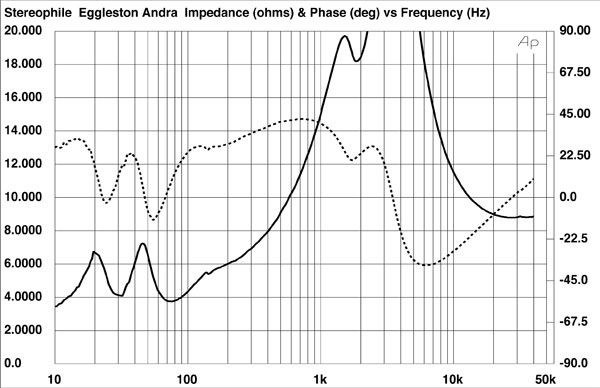 The saddle at 30Hz in the impedance-magnitude trace implies that the large, rectangular port at the base of the rear panel is tuned to this frequency. The two woofers behave identically, and their combined output (fig.2, blue trace) has the expected minimum-motion notch at 30Hz. The woofers are crossed over to the midrange unit (green trace) at the specified 110Hz with low-order slopes, and their upper-frequency output rolls off relatively gently, with peaks visible between 500 and 600Hz, and others at 1.5 and 3kHz. When I was measuring the woofers' farfield output, I could hear these peaks as formants superimposed on the sound of the pseudo-random noise signal. I would have thought that this behavior would be masked by the output of the midrange units. However, it is possible that it correlates with MF occasionally hearing some upper-midrange coloration. The output from the vents on the rear of the midrange enclosure was clean and typical of a transmission line, mirroring the frontal radiation at a reduced level but out of phase with it. (Note that the nearfield output of the midrange units in fig.2 doesn't have the minimum-motion notch that would indicate reflex loading.)
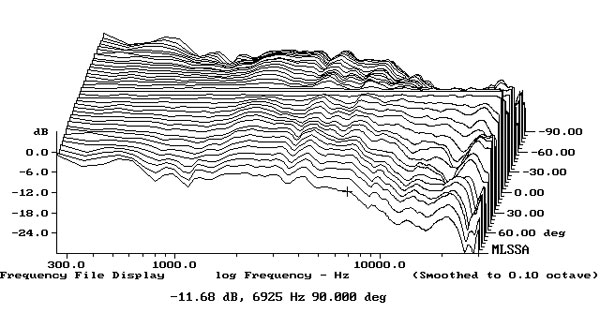
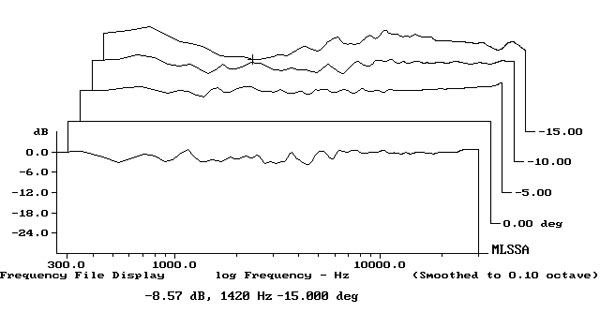
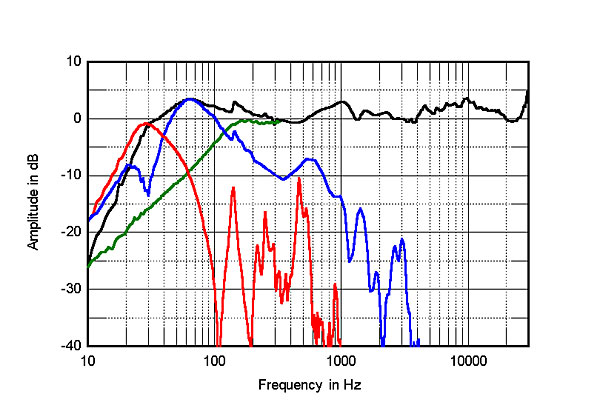 The farfield response in fig.2 (black trace above 300Hz) was taken on the tweeter axis, averaged across a 30° horizontal window. Other than slight excesses of energy between 700Hz and 1.4kHz and in the upper treble, the speaker offers a respectably uniform output. Fig.3 shows the Viginti's lateral radiation pattern normalized to the tweeter-axis response, which therefore appears as a straight line. The speaker's horizontal dispersion is commendably even and well controlled, though the 1" dome does become relatively directional above 7kHz. In the vertical plane (fig.4), the response on the tweeter axis, which is 36" above the floor, again appears as a straight line, and changes little over a window of –5°/+10°.
 The red trace in fig.5 shows the spatially averaged response in Mikey's listening room, while the blue trace shows the in-room response of the Wilson Alexx speakers he reviewed in May 2017, measured under identical conditions. (Using SMUGSoftware's FuzzMeasure 3.0 program and a 96kHz sample rate, I average 20 1/6-octave–smoothed spectra, individually taken for the left and right speakers, in a rectangular grid 36" wide by 18" high and centered on the positions of Mikey's ears.) The EgglestonWorks speaker's in-room response is remarkably smooth and even from the middle of the midrange through to the 30kHz upper limit of this graph. The Wilson speaker's response is not quite as smooth, and has more presence-region energy. The traces in this graph below 350Hz are disturbed by room modes that have not been evened out by the spatial averaging. However, while the room-corner placement of both speakers results in elevated low frequencies, the Vigintis produce more energy just below 200Hz and between 30 and 70Hz; the Wilsons offer slightly greater low-bass extension.
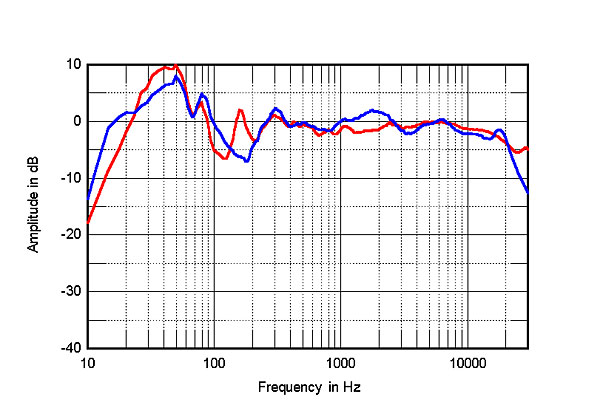
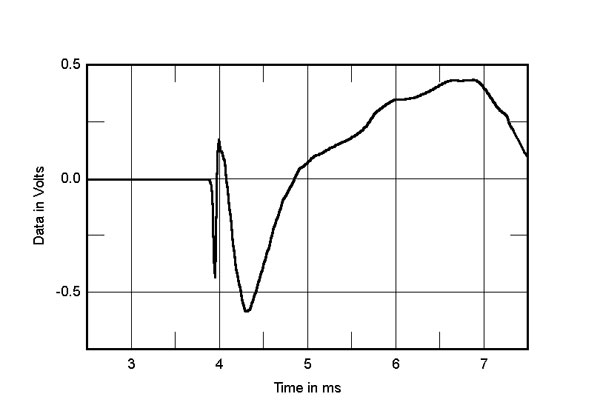
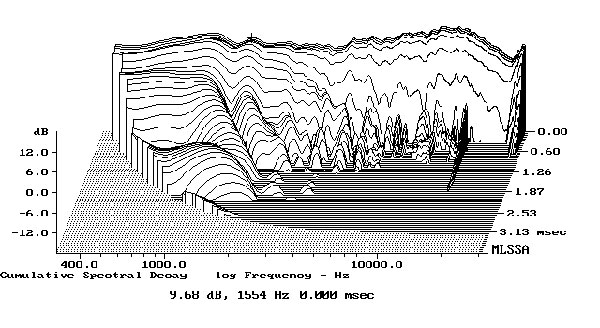
Fig.1 EgglestonWorks Viginti, electrical impedance (solid) and phase (dashed) (2 ohms/vertical div.).
A discontinuity is visible at 142Hz in the impedance traces; when I listened to the enclosure with a stethoscope, I did hear some resonant modes in the rear panel, and in the carbon-fiber inserts in the side panels.
Fig.2 EgglestonWorks Viginti, anechoic response on tweeter axis at 50" (black) averaged across 30° horizontal window and corrected for microphone response, with farfield response of woofers (blue above 355Hz) and nearfield responses of midrange unit (green), woofers (blue), port (red), and their complex sum (black), respectively plotted below 300Hz, 355Hz, 1kHz, and 300Hz.
The port's output, again measured in the nearfield (red trace), peaks between 20 and 50Hz, but its upper-frequency rolloff is marred by several peaks, the second strongest of which coincides with the discontinuity in the impedance traces. This behavior might correlate with Mikey finding there to be some midbass emphasis in the Viginti's balance. The sum of the nearfield outputs of the midrange, woofers, and port is shown as the black trace below 300Hz in fig.2; the apparent peak in the midbass is entirely an artifact of the nearfield measurement technique, which assumes that the radiators are mounted in a true infinite baffle—ie, one that extends to infinity in both planes.
Fig.3 EgglestonWorks Viginti, lateral response family at 50", normalized to response on tweeter axis, from back to front: differences in response 90–5° off axis, reference response, differences in response 5–90° off axis.
Fig.4 EgglestonWorks Viginti, vertical response family at 50", normalized to response on tweeter axis, from back to front: differences in response 15–5° above tweeter axis, reference response, difference in response 5° below tweeter axis.
Fig.5 EgglestonWorks Viginti, spatially averaged, 1?/6-octave response in MF's listening room (red); and of Wilson Alexx (blue).
In the time domain, the step response on the tweeter axis (fig.6) indicates that the tweeter and midrange units are connected in inverted acoustic polarity, the woofers in positive polarity. The integration of the drive-unit outputs is well arranged, however. The cumulative spectral-decay plot on the tweeter axis (fig.7) is superbly clean in the treble.
Fig.6 EgglestonWorks Viginti, step response on tweeter axis at 50" (5ms time window, 30kHz bandwidth).
Fig.7 EgglestonWorks Viginti, cumulative spectral-decay plot on tweeter axis at 50" (0.15ms risetime).
Other than those peaks in the woofer and port outputs, EgglestonWorks' Viginti offers respectable measured performance.—John Atkinson