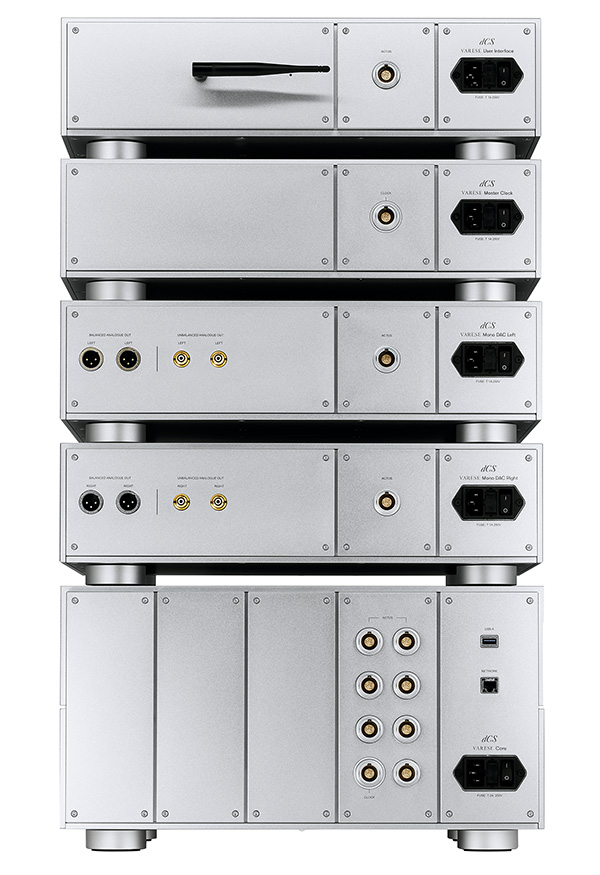
So much tidier than the Vivaldi stack! The User Interface (top) connects via BT to the remote and via an ACTUS umbilical to the Master Clock (below). The Core (bottom) hosts USB-A and wired Ethernet inputs (there's no Wi-Fi), with ACTUS outputs to the two Mono DACs above. The Mono DACs each have two analog outputs, on XLRs and RCAs. (Photo: Paul Miller.)
The ACTUS cable
During my factory tour, I had the opportunity to chat for 51 minutes with one of dCS's younger engineers, Ben Ashcroft. In his almost 11 years with the company, he has risen from apprentice in the production department to managing the design of the dCS ACTUS cable. Originally drawn to dCS due to his interest in music—he loves electronic music—he was able to attend university part-time for seven years funded by dCS while building his technological knowledge base and skills. In 2022, he joined dCS's R&D team. Shortly thereafter, he was given free rein to expand upon and develop the single-cable-carries-all ACTUS system.
"I soon realized that there was nothing off-the-shelf that would act as a solution," Ashcroft told me. "For one, we needed six twisted, braided pairs of copper cabling: four to send and control the audio and the carefully isolated Tomix pair for our new clock technology. Each of these six twisted pairs has its own foil shield. Our testing is very strict on the amount of crosstalk between pairs, and the design passed with some margin. Performance is consistent at lengths up to 30 meters, and you can put 1m and 30m lengths on the same Varèse system with no timing errors, loss of sound quality, or added jitter. It is quite possible that ACTUS cables can achieve far more than they're currently required to do.
"We worked with the UK branch of our partner LEMO of Switzerland to carefully position the pins in a way that enabled us to reach the high speed specifications and levels of performance we wished for. Given that LEMO hadn't undertaken anything like this before, it was quite an accomplishment."
Inserting an ACTUS cable with LEMO's purpose-designed push/ pull connector is simple; there's only one way it can go in. As for break-in, just leave the system on with no music playing, as clock data is constantly traveling through the cables.
Ashcroft and others repeatedly stressed that dCS is
not a cable company. It is always possible that, while meeting or even exceeding dCS's tight measurement specifications, dedicated cable companies can put their own sonic spin on dCS's achievement. With the understanding that all ACTUS cable must be certified by dCS, several well-known companies are already exploring what they can achieve and perhaps advance.
Conception and casework
During my visit to dCS UK, I also spent time with mechanical engineer Ross Bowman. Currently commercial director, who ensures that every aspect of Varèse manufacture remains in synch and on schedule, Bowman headed the design team for Varèse and the far-lower-priced Lina.
After working with others to conceive the number of boxes and what each might do, Bowman had to ensure that board and chassis fit and software and hardware would mesh. It took two years to develop dCS's rigid-flex foldable PCBs. The main board has nine foldable sections and 12 layers—some plastic, others copper or fiberglass—that enable it to isolate functions.
All boards are designed to fit within Varèse's single billet machined aluminum chassis that effectively manages heat via air movement within the casing. "The properties of our material effectively turn movement and vibration into heat," Bowman said. "That heat is then trapped between layers and successfully dissipated without harming the boards. It is a completely cohesive design, all the way around, that allows us to control heat, EMI, and RFI."
Simplification
According to Cook, "All the analog output circuitry is essentially identical between an APEX version of Vivaldi and the Varèse Mono DACs. But the Mono DACs take Varèse performance quite a bit higher by virtue of the many improvements in the power supply and the mechanical design. For example, each chassis better isolates sensitive components from vibrations, and the ACTUS interface enables us to offload processes to the Core." As David Steven noted during one of several exchanges, "The sum of our advances is so great that a Varèse system [without the] Varèse Master Clock is less susceptible to jitter than a Vivaldi Apex system with Master Clock."
"Everything about the system, including a huge amount of underlying technology, is designed to let us perform digital-to-analog conversion with the highest level of accuracy. Crucially, only a single ACTUS cable runs from a given component to the Core. The whole system is addressed as one; you don't have to worry about individual displays, menus, and settings on multiple components. So, in terms of setup and usage, despite being internally the most complex from a user perspective, I think it's the easiest to operate multibox system that we've ever made." Cook was but one of many dCS folks who stressed how much they've done to simplify setup and operation. Connection is a snap. The only ACTUS port on the Core that is assigned to and labeled for a specific component is the one on the bottom left, which goes to the Clock.
"Any of the other ports can go to any of the units, and they'll just sort themselves out as to what's connected to what," Cook said. "There's no need for RS-232 or any other kind of auxiliary cabling to synchronize units."
The standby/power procedure for Varèse is equally simple. Each unit has a main power toggle switch on the back of each unit and a small standby/on button on the bottom center. A short press puts the system in standby, and a long press fully shuts the system down. It's advisable to turn the Core on first and give it at least 15–20 seconds, or even a couple of minutes, to stabilize before turning on the other components. One person told me to turn on the User Interface/display last, but another didn't consider that essential. Before I knew any of this, I turned on units randomly, and everything worked fine. (I won't ignore the recommended turn-on sequence again, I promise!)
The current online user guide (footnote 9) occupies a mere 21 pages; even the large-print setup guide (footnote 10) is only 33 pages, far shorter than for the Vivaldi equivalent. I had only five ACTUS cables to separate from power cables. As intimidating as five boxes may seem, setup and operation are simple. Operating a Blu-ray player, TV, and multichannel music system is a far more complex affair.
Setup/review strategy
Despite the simplicity of Varèse setup, managing to fit a threepiece
D'Agostino Relentless preamp, five separate Varèse boxes, three separate Vivaldi boxes, and the
Innuos Statement NG music server/PhoenixNet switch on the nine shelves of my
Grand Prix Monza dual rack was no simple task. Figuring out the power cable connection scheme presented challenges.
My gratitude to Emron Mangelson for his patience, long arms, and flexible knees, which allowed him to reach into the back pillars of my rack, remove and replace lots of screws and bolts, and change the distance between shelves. Ultimately, we kept the Relentless preamp on the top left shelf and placed the Varèse User Interface/ Display atop the Core on the right top shelf. Miraculously, all other Varèse components fit onto the only shelves I could give them, with the Mono DACs situated on the bottom shelves. Vivaldi and Innuos components remained where they were. All components rested on Wilson Audio Pedestals. The Mighty
Stromtank S-4000 MKII XT supplied all front-end power, and my wall power/grounding scheme, recently upgraded by Audio Ultra, handled the amps.
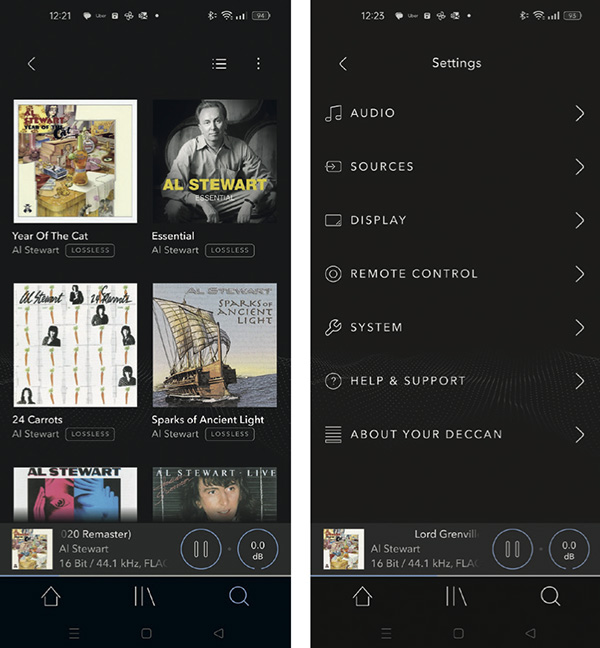
By the second week of the review period, Mosaic ACTUS allowed me to view folders on my USB stick in alphabetical order. Folder and track titles were accessible but not album covers or booklets. I could also view and play files on my NAS, which only displayed in alphabetical order without album art or booklets. By the time you read this, Mosaic ACTUS's feature set will have likely expanded.
To use Innuos with its Sense App, it was necessary to manually connect the Nordost Valhalla 2 USB cable that extended from the Statement. When the Statement served as music and streaming source, I focused on the Sense App and ignored the Varèse display.
Previous experience with Rossini, Vivaldi, and their APEX upgrades has convinced me that as good as their volume controls are, a high-quality analog preamp can enhance the system's sound. Since dCS made no changes to Vivaldi APEX's analog output when it created Varèse, I eliminated the Varèse volume control from the chain by turning volume all the way up to unity gain and listened through the D'Agostino Relentless preamp I normally use. I wish I could have enlisted a few willing hands to help me switch between the Relentless and
Soulution 727 preamplifiers, but everyone I felt comfortable asking was healing a sore back.
Because changing power cables was a major hassle, I relegated most comparison listening between Vivaldi and Varèse to the dCS listening room in Cambridge. There, others shifted cables for me while I could remain relaxed and in prime listening form.
Most of the recordings I auditioned in Port Townsend were hi-rez By the second week of the review period, Mosaic ACTUS allowed me to view folders on my USB stick in alphabetical order. Folder and track titles were accessible but not album covers or booklets. I could also view and play files on my NAS, which only displayed in alphabetical order without album art or booklets. By the time you read this, Mosaic ACTUS's feature set will have likely expanded.
To use Innuos with its Sense App, it was necessary to manually connect the Nordost Valhalla 2 USB cable that extended from the Statement. When the Statement served as music and streaming source, I focused on the Sense App and ignored the Varèse display.
Previous experience with Rossini, Vivaldi, and their APEX upgrades has convinced me that as good as their volume controls are, a high-quality analog preamp can enhance the system's sound. Since dCS made no changes to Vivaldi APEX's analog output when it created Varèse, I eliminated the Varèse volume control from the chain by turning volume all the way up to unity gain and listened through the D'Agostino Relentless preamp I normally use. I wish I could have enlisted a few willing hands to help me switch between the Relentless and Soulution 727 preamplifiers, but everyone I felt comfortable asking was healing a sore back.
Because changing power cables was a major hassle, I relegated most comparison listening between Vivaldi and Varèse to the dCS listening room in Cambridge. There, others shifted cables for me while I could remain relaxed and in prime listening form.
Most of the recordings I auditioned in Port Townsend were hi-rez PCM. Because MQA decoding was not yet available in Varèse, I avoided the MQA files I often play through the Vivaldi APEX music system. Nonetheless, when Peter McGrath requested that I play the MQA version of his recent, private live 24/192 recording of a piano recital by Stephen Hough through the Vivaldi APEX system and compare its sound to the non-MQA version played through the Varèse system, I found myself unable to resist what I feared would be an arduous process. It was. When all was said and done, what was done in was me. The stress of pulling, tugging, unraveling, and repositioning six thick power cables plus a set of XLR interconnects left me unable to draw any conclusion other than that I eagerly await the arrival of full MQA unfolding and rendering to Varèse.
One comparison I eagerly performed was between the sound of the
Innuos Statement NG player/streamer (footnote 11) using InnuOS/Sense to the Varèse player/streamer using Mosaic ACTUS. In many cases, I listened to the same resolution files on Qobuz, the Statement's internal SSD, and a USB 3 SSD inserted into the Varèse. At the time of the review, only the Statement enabled me to view album covers and booklets, regardless of source. That may have changed by the time you read this.
Footnote 9: See dcsaudio.zendesk.com/hc/en-gb/articles/17479741049500-User-Guide-Varèse.
Footnote 10: See dcsaudio.zendesk.com/hc/en-gb/article_attachments/17728278685212.
Footnote 11: My Statement NG took advantage of Innuos's recently released upgrade umbilical cables, whose enhancement of resolution, detail, and air is notable.