Sidebar 1: dCS Managing Director David Steven on Varèse and its Mono DACs
There were lots of different projects going on over the last five or six years. We studied how people actually use our kit in the real world, what they want from interfaces and apps, how they search for music, how they want to control the system, how they unbox it and install it, and so on. While all that was going on, we had Chris Hales and his team looking at the Ring DAC and Andy McHarg and his team pondering software and system architecture. Their research led to APEX.
We continued on from there. If we have Mono DACs, how do we keep them in perfect sync? That was where the idea for the Tomix clocking system came from. Then we said, okay, if you've got these five boxes, how do they talk to each other by sending audio, command, and clock signals? We were aware of one common frustration with Vivaldi was all the AES, BNC, and other cables—all the spaghetti. How do we simplify that?
So, we had different research projects asking how we could improve our technologies and exploring how someone might listen to music 10 years into the future. As we tried to keep all the different projects on track, we finally got to where Varèse was becoming a real thing.
If you think about it in computing terms, it was almost like we had designed a new chip, like Apple with its M chips, but we also needed to rewrite the operating system and come up with new computer interfaces. The team and I weren't sure if we could actually realize a new product, but we knew we could bring APEX to existing dCS products. Once we did that, we could try to focus on this crazy, long-term research project and try to get the most out of everything we were developing.
Inevitably, Varèse started with the DACs. We had APEX, which sounded great, and we realized that we could improve it further if we went to dual differential DACs. Once that came together, everything else got layered on top of or built around it. Between Chris's team designing the hardware and Andy's team writing the software, we made the system work. That's been the last five or six years of intense development at dCS.
One of our big challenges was synchronizing the two separate Mono DACs in a way that didn't compromise clocking. Introducing the Varèse Master Clock improved things further, but our way of synchronizing the DACs while simultaneously improving jitter performance and lowering the noisefloor is quite unique.
We ended up creating a single folded flex-rigid circuit board for the Core (footnote 1). It has nine points of flex, which enables us to wrap it around our single-billet aluminum chassis. (That chassis also acts as a heatsink.) By fitting all the electronics on a single circuit board, we isolate sensitive components from the noisier components on the board. This improves signal integrity and reliability and reduces crosstalk.
The Varèse Mono DACs locate all their D/A circuitry on a single nonfoldable board. This, too, makes a big difference. Plus, we're now running differential Ring DACs inside each of the Varèse Mono DACs. That provides an inherent balance in how the Ring DAC draws from the power supply. It's not signal-dependent anymore, which means it's perfectly predictable. For a D/A converter, that is a very, very nice thing. Ultimately, all these elements together result in a system whose measured performance is at the highest level we've ever created.
Andy's first projects were A to Ds. We were there in the beginning of 24-bit and then hi-rez recording and playback. Andy and the team next worked on DSD and SACD as a format, developed DoP, and got everyone involved to make DoP an open format. We've been through FireWire and then dual AES as an interface. When Andy, Chris, and I were conceptualizing Vivaldi, even though it was really built around silver discs as the format, we were also thinking about computer audio and where it could go.
It feels like Varèse was 35-plus years in the making. Varèse is everything that we've ever learned and all the mistakes we've ever made overcome. Undoubtedly, some new challenges have been introduced. But we have been trying to make something that technically measures and performs better than anything we've ever done—something that is way, way simpler to use and more accessible to everyone, not just the audiophile. That's why I think Varèse was so many years in development and had so many different strands. Once we all got excited by what we were hearing from the prototype DACs, it was about building on top of that and trying to do the music and artistry justice. There was something special happening and we had to keep pushing it, keep going.
Our goal was to take away all the visual noise—the lights and flashing things—and simplify the entire experience to make music and emotion more accessible. How do we connect to the music, and how do we enrich that experience for other people? Ultimately, Varèse is about the musical experience. It is about creating a system that is as transparent as a piece of glass and does no harm to the recording.—David Steven
Footnote 1: The folded PCB design, first released in the dCS Lina range of products, enables the company to fit a huge number of components into smaller caseworks. What dCS did not reveal at the time of Lina's release was that the folded PCB design was developed with the Varèse Core in mind and repurposed for Lina, which was released first.
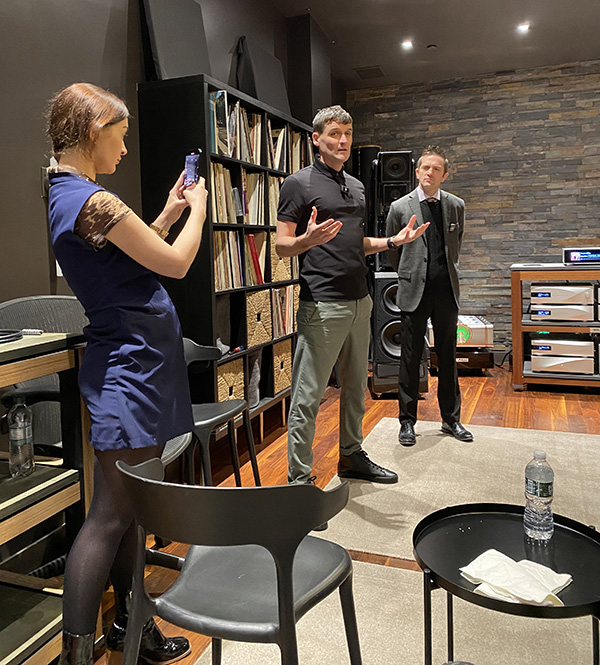
David Steven (center) discusses the design and features of the dCS Varèse at New York's Innovative Audio in January. (Photo: John Atkinson).
Varèse really started with us as a team saying, "If there were no constraints and we had infinite time and infinite budget, what could we do? Where could we go? How can we make a system that is simple to use, easy to set up, and super reliable? How can we support higher sample rates? How can we support streaming services? How can we make it easier to control functions over Bluetooth as opposed to IR?"
Looking at the user experience, reliability, and capability led us to the question: "How does it sound?" Ultimately, everything we do is about what happens between the speakers, acting in service to the music. How do we unravel ones and zeroes into music more accurately, more faithfully than anything we've ever done before?
We don't really look at what other people are doing. It's always about how we can better what we did previously.
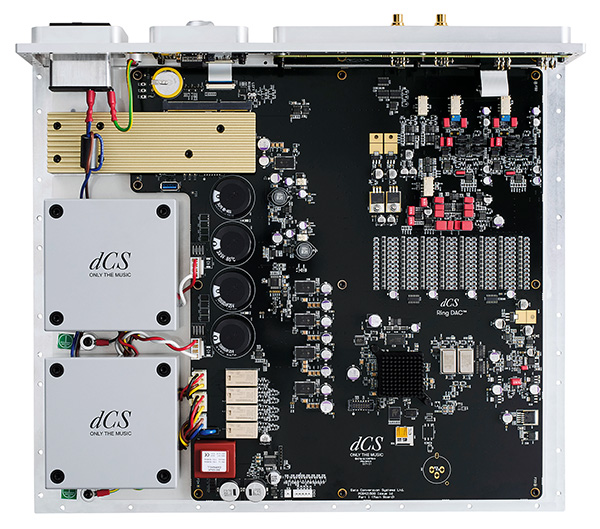
Inside the Varèse Mono DAC: Dual power supplies (left), which power the Xilinx DSP (under the heatsink, top left); the Ring DAC's differential matrix of 2×48 resistor current sources (center right); and the mixed op-amp–based analog output stage (top right). (Photo: Paul Miller.)
The Mono DACs were our biggest accomplishment. They have no crosstalk between them, and they have the lowest level of intrinsic jitter in any dCS front-end. There are separate power supplies in each DAC, each focusing on one channel of audio and optimized for digital and analog stages. That in and of itself had some profound effects on sound quality. Having the processing somewhere else, in the Core, is also handy, but the big thing is the Mono DACs. It's fair to say those DACs can, in theory, do more processing if they need to. If we come up with some stupid idea, we can do it in the future. But currently the DACs don't do any filtering or multiplying or anything like that. That's all in the Core.
Footnote 1: The folded PCB design, first released in the dCS Lina range of products, enables the company to fit a huge number of components into smaller caseworks. What dCS did not reveal at the time of Lina's release was that the folded PCB design was developed with the Varèse Core in mind and repurposed for Lina, which was released first.