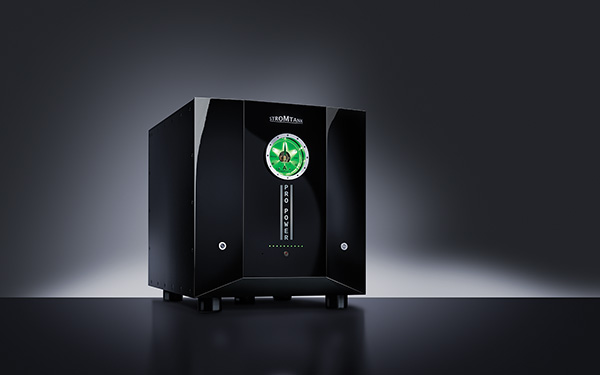
In my enthusiastic 2022 review of the Stromtank S-1000 ($16,900), I described the Stromtank as a computer-controlled lithium iron phosphate (LiFePO4) battery array that, coupled with its AC inverters and all the trimmings, supplies clean, constant, stable off-grid AC power to hi-fi components. By softly depressing a single button on the front panel, Stromtank owners can easily switch from wall-connected mode (when the Stromtank's dimmable front-panel meter is blue) to a disconnected, battery-only state (when the meter is green). At the end of a listening session, users can return to blue mode to recharge the battery array.
When a Stromtank is fully charged, the needle on the meter rests at zero (footnote 1), and a horizontal array of small green LEDs below the meter is fully illuminated. As battery charge dissipates, the number of illuminated LEDs decreases; the power meter's needle continues to rest at zero until the voltage starts to sag. If the Stromtank discharges fully during playback, the Stromtank automatically shifts from green to blue and begins to recharge. As it recharges, you can still play music, but the AC is no longer completely isolated from the vagaries of wall power.
After I spent many months with the Stromtank S-1000, Stromtank company founder/CEO/chief technical engineer Wolfgang Meletzky (footnote 2) sent me an S-2500 Quantum MK-II ($29,000), which has enough capacity to enable longer green mode sessions. The S-2500 MK-II remained in my system through the spring of 2024, when it began to buzz while in green mode. Simultaneously, the power supply of my reference Dan D'Agostino Momentum HD preamplifier also started to buzz, but at a maddeningly different frequency. Not even Arnold Schönberg would have been happy.
Like an increasing number of today's companies, Stromtank can diagnose and repair many problems remotely, without leaving its office in Berlin. First, though, they had to supply a remote diagnostics and repair box. I connected it as directed, phoned the Stromtank mothership in Berlin, and awaited the results. Alas, for his S-2500, remote repair proved impossible. Rather than replace the unit, Meletzky suggested I upgrade to the just-released Stromtank S-4000 ProPower MK-II.
 What it is
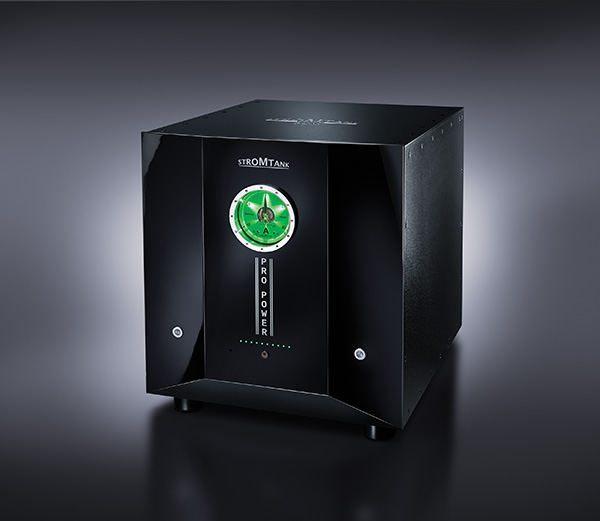
The Stromtank S-4000 MK-II contains 16 LiFePO4 batteries and two high-performance inverters that, working in parallel, output 120V AC at 60Hz. Stromtank claims the S-4000 MK-II can supply an entire large system, including powerful power amplifiers, with battery power. The upgrade to MK-II status came about two years after the release of the original S-4000. In improving the S-4000, Stromtank paid special attention to its internal copper cabling, determining what length and diameter works best. The S-4000 MK-II comes in two versions: basic ($44,000) and XT ($51,000). Stromtank believes that the basic MK-II's stored energy capacity of 2650Wh should enable users to power a 600VA load with off-grid battery power—green mode—for about four hours. The XT version's stored energy capacity of up to 5300Wh should provide the same load battery power for approximately eight hours. At the urging of Stromtank US's Alex Wilde, Meletzky supplied the S-4000 MK-II XT for review.
Stromtank's website proposes a best-of-all-possible-worlds scenario to address power problems, in which an S-4000 ProPower "supplies all analog devices of your stereo system, while an S1000-SourcePower in combination with the SEQ-5 power strip or an S2500-Quantum exclusively takes care of the needs of digital sources." The company notes that the two Stromtank units can be stacked—one placed on top of the other—and operated simultaneously.
Not every scenario is ideal. Beyond the total price of these units, I trembled at the thought of a double Stromtank tower in front of my equipment rack, blocking components as heavy power cables snaked around and through my rack. As "A Mighty Fortress is our God" played on repeat at top volume in my head, I banished all consideration of two stacked Stromtanks in my music room.
 To set me at ease, Meletzky assured me that a single S-4000 MK-II XT, in combination with a Stromtank SEQ-5 power strip (in which each duplex operates independently from the other), could power my whole system. The big Stromtank, he said, would supply both my front-end components and amplifiers with clean, regulated battery power that would enable me to enjoy my system to its full potential.
I informed Meletzky that previous experimentation had convinced me that the Stromtank's dedicated outlets for digital equipment, which are designed to filter out digital noise, were not an asset with my low-noise dCS and other digital gear. In response, he supplied an S-4000 MK-II XT with no filtered "digital" outlets.
During a Zoom chat, Meletzky explained the advantage of the S-4000 MK-II's double-converter system: Two converters "work together in parallel and split the energy. They give you much more power than the S-2500 Quantum MK-II and can handle the big pull of amplifiers because the second internal converter can help the first one supply output current faster.
"If you have too big an engine, for example, it is always difficult to handle lower power in combination with high power pulses. But if you split the output power between two DC/AC converters, you can handle the low energy as well as the high peak energy. The MK-II's 48V system means we divide the internal battery current by half so that less current runs in a single wire. We now have higher voltage and lower current flow in the whole unit. Our new battery-management system keeps all 16 batteries at the same, absolutely flat level. The energy does not spike because no single cell outputs more or less current than the other."
To set me at ease, Meletzky assured me that a single S-4000 MK-II XT, in combination with a Stromtank SEQ-5 power strip (in which each duplex operates independently from the other), could power my whole system. The big Stromtank, he said, would supply both my front-end components and amplifiers with clean, regulated battery power that would enable me to enjoy my system to its full potential.
I informed Meletzky that previous experimentation had convinced me that the Stromtank's dedicated outlets for digital equipment, which are designed to filter out digital noise, were not an asset with my low-noise dCS and other digital gear. In response, he supplied an S-4000 MK-II XT with no filtered "digital" outlets.
During a Zoom chat, Meletzky explained the advantage of the S-4000 MK-II's double-converter system: Two converters "work together in parallel and split the energy. They give you much more power than the S-2500 Quantum MK-II and can handle the big pull of amplifiers because the second internal converter can help the first one supply output current faster.
"If you have too big an engine, for example, it is always difficult to handle lower power in combination with high power pulses. But if you split the output power between two DC/AC converters, you can handle the low energy as well as the high peak energy. The MK-II's 48V system means we divide the internal battery current by half so that less current runs in a single wire. We now have higher voltage and lower current flow in the whole unit. Our new battery-management system keeps all 16 batteries at the same, absolutely flat level. The energy does not spike because no single cell outputs more or less current than the other."
 Round one
The Stromtank S-4000 ProPower MK-II XT arrived in a large, sturdily designed custom case attached to a wooden pallet. When power expert and Stromtank dealer Edward DeVito of Audio-Ultra paid a visit to help install it, we easily removed the screws that held the case's front and top panels in place, slid the unit onto a dolly, and wheeled it into the music room. Using inflatable sliders, we—mostly Ed—removed the S-2500 Quantum MK-II and replaced it with the S-4000 MK-II XT. But first we listened to my system with the S-2500 Quantum MK-II in place. Given how many power cables my system requires, the number of available outlets, and the capacity of backs to break, sliding two 176lb Stromtanks back and forth and changing all those cables for repeated A/B comparisons was out of the question. A single A/B was all any sane person could hope to accomplish. With the S-2500 supplying battery power to all my front-end components, we picked some revealing tracks. Given Ed's tight schedule, we stuck to one track each. Ed chose "In the Wee Hours" from Hoodoo Man Blues by Junior Wells's Chicago Blues Band with Buddy Guy (16/44.1 FLAC, Delmark/Tidal). I went for the maximal impact, multi-octave span, wide dynamic contrasts, and deep bass of the first movement of Mahler Symphony No.5 performed by Orchestre Symphonique du Montréal, conducted by Rafael Payare (24/96 download, Pentatone). With those two tracks, we had most items on the audiophile checklist covered.
After listening with the S-2500 Quantum MK-II, taking notes, and discussing, we did the big switch and powered all my front-end components with the Stromtank S-4000 MK-II XT.
Footnote 1: It is tempting to think of a meter on a hi-fi component as either a power meter or a level meter; this is, in fact, a current meter. It stays at zero when the unit is fully charged. While it's charging, the needle points to the right, indicating the charging current. When it is in use, the needle points to the left, indicating the discharge rate in amperes. Footnote 2: Meletzky founded MBL in 1979, then sold the company in 2009 because it had grown to such an extent that he had no time left to design new products. After starting a new company whose products would store solar and wind power in batteries, he returned to his love of music and envisioned what battery power could do for audio systems.
What it isThe Stromtank S-4000 MK-II contains 16 LiFePO4 batteries and two high-performance inverters that, working in parallel, output 120V AC at 60Hz. Stromtank claims the S-4000 MK-II can supply an entire large system, including powerful power amplifiers, with battery power. The upgrade to MK-II status came about two years after the release of the original S-4000. In improving the S-4000, Stromtank paid special attention to its internal copper cabling, determining what length and diameter works best. The S-4000 MK-II comes in two versions: basic ($44,000) and XT ($51,000). Stromtank believes that the basic MK-II's stored energy capacity of 2650Wh should enable users to power a 600VA load with off-grid battery power—green mode—for about four hours. The XT version's stored energy capacity of up to 5300Wh should provide the same load battery power for approximately eight hours. At the urging of Stromtank US's Alex Wilde, Meletzky supplied the S-4000 MK-II XT for review.
To set me at ease, Meletzky assured me that a single S-4000 MK-II XT, in combination with a Stromtank SEQ-5 power strip (in which each duplex operates independently from the other), could power my whole system. The big Stromtank, he said, would supply both my front-end components and amplifiers with clean, regulated battery power that would enable me to enjoy my system to its full potential.
Round oneThe Stromtank S-4000 ProPower MK-II XT arrived in a large, sturdily designed custom case attached to a wooden pallet. When power expert and Stromtank dealer Edward DeVito of Audio-Ultra paid a visit to help install it, we easily removed the screws that held the case's front and top panels in place, slid the unit onto a dolly, and wheeled it into the music room. Using inflatable sliders, we—mostly Ed—removed the S-2500 Quantum MK-II and replaced it with the S-4000 MK-II XT. But first we listened to my system with the S-2500 Quantum MK-II in place. Given how many power cables my system requires, the number of available outlets, and the capacity of backs to break, sliding two 176lb Stromtanks back and forth and changing all those cables for repeated A/B comparisons was out of the question. A single A/B was all any sane person could hope to accomplish. With the S-2500 supplying battery power to all my front-end components, we picked some revealing tracks. Given Ed's tight schedule, we stuck to one track each. Ed chose "In the Wee Hours" from Hoodoo Man Blues by Junior Wells's Chicago Blues Band with Buddy Guy (16/44.1 FLAC, Delmark/Tidal). I went for the maximal impact, multi-octave span, wide dynamic contrasts, and deep bass of the first movement of Mahler Symphony No.5 performed by Orchestre Symphonique du Montréal, conducted by Rafael Payare (24/96 download, Pentatone). With those two tracks, we had most items on the audiophile checklist covered.
Footnote 1: It is tempting to think of a meter on a hi-fi component as either a power meter or a level meter; this is, in fact, a current meter. It stays at zero when the unit is fully charged. While it's charging, the needle points to the right, indicating the charging current. When it is in use, the needle points to the left, indicating the discharge rate in amperes. Footnote 2: Meletzky founded MBL in 1979, then sold the company in 2009 because it had grown to such an extent that he had no time left to design new products. After starting a new company whose products would store solar and wind power in batteries, he returned to his love of music and envisioned what battery power could do for audio systems.