But first, the blowback I expected following my February 2014 column on Synergistic Research's Uniform Energy Field Technology room treatments never arrived—in fact, quite the opposite. My own positive experience of the UEF devices was confirmed by e-mails from readers who'd already used them, and from those who'd taken up Synergistic's offer of a money-back guarantee. Skeptics will charge that what I and these readers heard is evidence of confirmation bias, but people say this about any positive remarks made about audio components priced above $500.
 The other day, I received an e-mail from Art Noxon, who invented the TubeTrap room treatment, manufactured by Acoustic Sciences Corp. TubeTraps have been a staple of studios, home theaters, and audiophile listening rooms for more than a quarter century now, and no one disputes their efficacy or the science behind them. I've had TubeTraps in my listening room for most of those years; without them, I'm not sure bass behemoths like Wilson Audio Specialties' Alexandria XLFs could work in my moderately sized room.
So it was with a great deal of amusement that I read Noxon's e-mail:
The other day, I received an e-mail from Art Noxon, who invented the TubeTrap room treatment, manufactured by Acoustic Sciences Corp. TubeTraps have been a staple of studios, home theaters, and audiophile listening rooms for more than a quarter century now, and no one disputes their efficacy or the science behind them. I've had TubeTraps in my listening room for most of those years; without them, I'm not sure bass behemoths like Wilson Audio Specialties' Alexandria XLFs could work in my moderately sized room.
So it was with a great deal of amusement that I read Noxon's e-mail:
With so many young people getting involved, these are vinyl playback's salad days—but they wouldn't be possible without the input and expertise of the oldsters. Beginning in the 1960s, Fidelity Research, of Japan, produced tonearms and cartridges that were then considered to be among the world's best. The costly FR-24 tonearm and FR-1 moving-coil cartridge were objects of analog desire. The tonearm still is, though Fidelity Research folded during the digital onslaught of the 1980s.
Fidelity Research products were the creations of Isamu Ikeda, who founded Ikeda Sound Labs shortly after FR closed its doors. He began with a round-bodied, cantileverless cartridge that quickly found devotees, though it was almost impossible to accurately align. In 2011, IT Industry Company Limited assumed control of Ikeda Sound Labs (footnote 1). IT claims that, in doing so, it bought the "spirit, technology and craftsmanship of Mr. I. Ikeda." I sought clarification.
Bill Demars of Beauty of Sound, an authorized Ikeda dealer in East Greenbush, a suburb of Albany, New York, told me in an e-mail that "Mr. Ikeda has taken a step away from the day to day activities of building cartridges. He trained the members of IT Industries and they are carrying the torch and building the product. He is still alive and around 89 years old."
To learn that Ikeda is alive, well, and still here to enjoy the vinyl resurgence is gratifying, but Demars and his fellow dealers need to update their websites. As I write this, his still claims that "These superlative phono cartridges are hand-made by Isamu Ikeda of Ikeda Sound Labs."
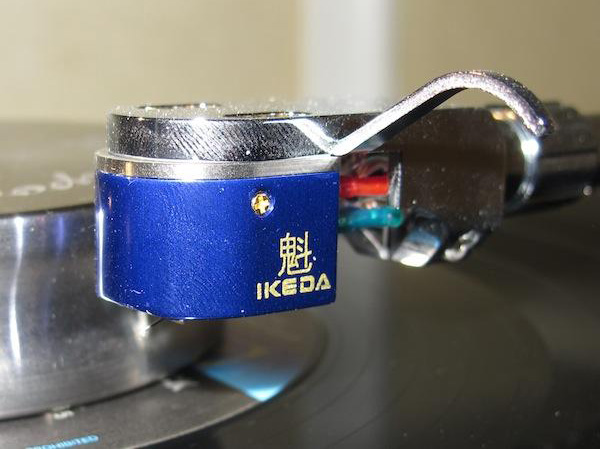
The current importer of Ikeda cartridges is Aaudio Imports, whose site does not make that claim. The top model in Ikeda's line of five moving-coil cartridges, the Kai ($8500), launched in 2012, outputs a very low 0.19mV and has an ultralow internal impedance of 2.5 ohms, which indicates few turns of coil wire and thus ultralow moving mass. Attached to the Kai's boron cantilever is a familiar-looking, MicroRidge stylus of solid diamond. The recommended vertical tracking force (VTF) is 1.8gm, ±0.2gm. The claimed frequency range is 10Hz–45kHz, the channel separation "over 27dB (1kHz)," and the channel balance within 1dB at 1kHz. The Kai is relatively heavy at 11.5gm. Its body is made of alumite, an alloy of aluminum, iron, and obsidian, with a top plate of titanium. The generator system features a core of high-efficiency Permalloy (a nickel-iron alloy) and samarium-cobalt magnets. Given the Kai's high mass, its compliance is appropriately low at 7×10⁻⁶cm/dyne.
In other words, the Ikeda Kai must be used with a tonearm of relatively high mass and a phono preamplifier capable of high gain with low noise. With a tonearm's 14gm effective mass added to the cartridge's mass of 11.5gm, the system's total effective mass is 25.5gm, which should result in a fundamental resonant frequency of about 12Hz—the uppermost acceptable resonant frequency. In short: only high-mass tonearms need apply for this job.
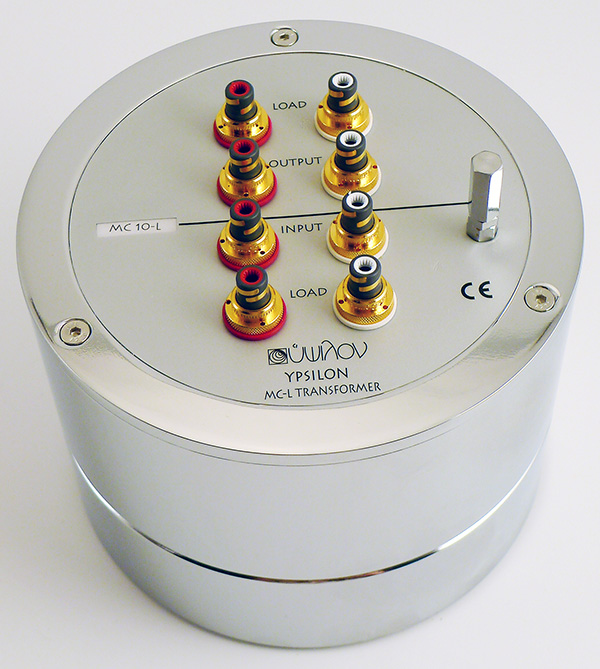 Ypsilon MC26-L step-up transformer
Were I a gear slut, I'd have on hand at least one, and preferably two, current-amplification phono preamplifiers—say, the B.M.C. Phono MCCI and the MR Labs VERA 20, both specifically designed for ultralow-impedance cartridges. But I'm not and I don't, so Aaudio Imports' Brian Ackerman sent, along with the Ikeda Kai, a sample of Ypsilon Electronics' new MC26-L step-up transformer for use with Ypsilon's VPS-100 moving-magnet phono stage, which I'd bought and which is still my favorite phono preamp.
The MC26-L, designed for use with very-low-impedance cartridges, has a 26× turns ratio that produces 28.3dB of gain. Without additional plugs, the cartridge "sees" a load of 70 ohms. Ypsilon's recent L-model transformers are far larger than their standard models, and so is the MC26-L's cost: $6200. The pure-silver-wire option (not auditioned) sends the price into the stratosphere. But the reactions of those who've opted for the silver upgrade have been equally stratospheric. They send me e-mails.
Listening
When you spend $8500 on a phono cartridge that's been built, tuned, and tested all by hand, you're entitled to something that meets or exceeds its claimed specifications—and whose stylus-and-cantilever assembly, when the tonearm is parallel to the record surface, produces a stylus rake angle (SRA) of close to 92°. With azimuth electronically set and measured, the Ikeda Kai produced 30dB of channel separation and channel balance within 1dB. The optimized setting was achieved with only an infinitesimal deviation from perpendicularity of the cantilever's position relative the record surface. Likewise, an SRA of 92° was obtained with the tonearm close to parallel to the record surface. In short, the Kai is superbly constructed. Clearly, the IT Industry team that Isamu Ikeda trained to build his cartridges learned well.
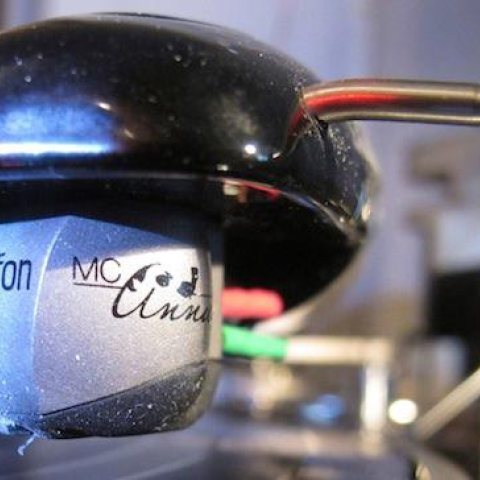
$8500 is a considerable—some would say obscene—amount of cash for a phono cartridge. From your first listening session, you'd better know you're hearing something that sounds at least different from, and hopefully a lot more impressive than, your "average" $3000 or even $6000 cartridge. That was true of my experience of the Lyra Atlas ($9500), the Ortofon Anna ($8924), and the Clearaudio Goldfinger Statement ($15,000), and it was true of what I heard from the Kai. To paraphrase what US Supreme Court Justice Potter Stewart said about obscenity in 1964, you'll know a good $10,000 or an $8500 cartridge when you hear it.
The Ikeda Kai must have arrived already broken in. Its sound didn't change over time, nor would I have wanted it to—although, as with the Lyra Atlas, whose sound in some ways it resembles, it won't be everyone's ideal.
Like the Lyra Atlas, the Goldfinger Statement, and the Transfiguration Proteus, the Kai could produce explosive dynamic swings that called into question statements about vinyl's supposedly limited dynamic range. And, like the other cartridges mentioned, the Kai produced an unmistakably deep, wide, and tall soundstage.
Footnote 1: Ikeda Sound Labs, IT Industry Company Limited, 4387, Yaho, Kunitachi-shi, Tokyo 186-0011, Japan. Tel: (81) 42-576-2276, (81) 42-312-0528. Fax: (81) 42-574-2267. Web: www.soleberry.net/cartridge.html. US distributor: Aaudio Imports, 4871 Raintree Drive, Parker, CO 80134. Tel: (720) 851-2525. Fax: (720) 851-7575. Web: www.aaudioimports.com.
The other day, I received an e-mail from Art Noxon, who invented the TubeTrap room treatment, manufactured by Acoustic Sciences Corp. TubeTraps have been a staple of studios, home theaters, and audiophile listening rooms for more than a quarter century now, and no one disputes their efficacy or the science behind them. I've had TubeTraps in my listening room for most of those years; without them, I'm not sure bass behemoths like Wilson Audio Specialties' Alexandria XLFs could work in my moderately sized room.
So it was with a great deal of amusement that I read Noxon's e-mail:
Michael, you mentioned Rayleigh Waves, ice picks, and TubeTraps all being part of an odyssey-packed evolution of your old listening room.Noxon went on to ask if I'd like to try the latest version of TubeTraps, and of course I said I would. My point is this: If you're still skeptical about sticking Synergistic's tiny horn resonators on your walls or stabbing your walls and floors with an ice pick, please reconsider—though the stabbing is best left to the Rayleigh Wave experts. Ikeda Sound Labs Kai moving-coil cartridgeBecause I invented the TubeTrap, I have been able to work continuously on room acoustics for 30 some years, which is a long time to do one thing. One of my friends at the time of the actual invention of the TubeTrap was a trained aeronautical engineer who would later go back to grad school for his master's degree in architecture and become a teacher in [the] architecture school at the University of Oregon. He eventually opened up his office and called me in to do the acoustics. He said "no way" to every traditional way of doing acoustics I could come up with.During these hands-on design sessions I kept explaining the basics to him to no avail, and then he came up with something. We tried it and it worked. Your ice-pick routine is just about what we did. We put sound-absorbing materials into the wall cavities and developed ways to vent bass-buildup pressure in the corners of the room into the air cavities inside the walls of the room. We made a leaky baseboard that looked solid and could handle mopping, foot impact, cleaning, and painting, and, in addition to all that, it had long slits of open space that actually vented air pressure in the room into the wall-cavity air spaces. I'm sure all the rooms he designed after that one had his tricky dick invisible acoustic design built in.His focus on good room acoustics was for speech-range sound in small and sparsely furnished rooms. It was not for high-power audio systems in small rooms. But still, it worked for what it was intended [to do]. Thought you'd like to know that the maniac with the ice pick wasn't just crazy.
With so many young people getting involved, these are vinyl playback's salad days—but they wouldn't be possible without the input and expertise of the oldsters. Beginning in the 1960s, Fidelity Research, of Japan, produced tonearms and cartridges that were then considered to be among the world's best. The costly FR-24 tonearm and FR-1 moving-coil cartridge were objects of analog desire. The tonearm still is, though Fidelity Research folded during the digital onslaught of the 1980s.
Ypsilon MC26-L step-up transformerWere I a gear slut, I'd have on hand at least one, and preferably two, current-amplification phono preamplifiers—say, the B.M.C. Phono MCCI and the MR Labs VERA 20, both specifically designed for ultralow-impedance cartridges. But I'm not and I don't, so Aaudio Imports' Brian Ackerman sent, along with the Ikeda Kai, a sample of Ypsilon Electronics' new MC26-L step-up transformer for use with Ypsilon's VPS-100 moving-magnet phono stage, which I'd bought and which is still my favorite phono preamp.
When you spend $8500 on a phono cartridge that's been built, tuned, and tested all by hand, you're entitled to something that meets or exceeds its claimed specifications—and whose stylus-and-cantilever assembly, when the tonearm is parallel to the record surface, produces a stylus rake angle (SRA) of close to 92°. With azimuth electronically set and measured, the Ikeda Kai produced 30dB of channel separation and channel balance within 1dB. The optimized setting was achieved with only an infinitesimal deviation from perpendicularity of the cantilever's position relative the record surface. Likewise, an SRA of 92° was obtained with the tonearm close to parallel to the record surface. In short, the Kai is superbly constructed. Clearly, the IT Industry team that Isamu Ikeda trained to build his cartridges learned well.
Footnote 1: Ikeda Sound Labs, IT Industry Company Limited, 4387, Yaho, Kunitachi-shi, Tokyo 186-0011, Japan. Tel: (81) 42-576-2276, (81) 42-312-0528. Fax: (81) 42-574-2267. Web: www.soleberry.net/cartridge.html. US distributor: Aaudio Imports, 4871 Raintree Drive, Parker, CO 80134. Tel: (720) 851-2525. Fax: (720) 851-7575. Web: www.aaudioimports.com.