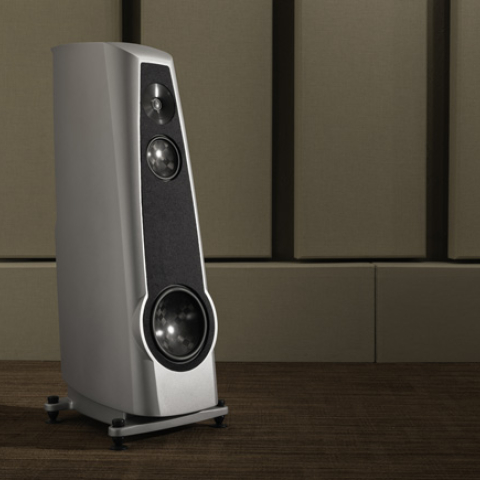
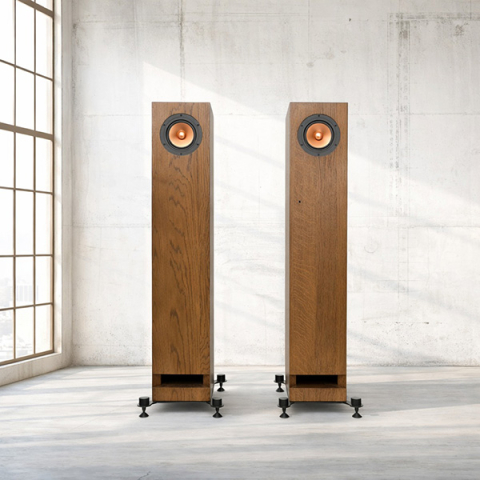
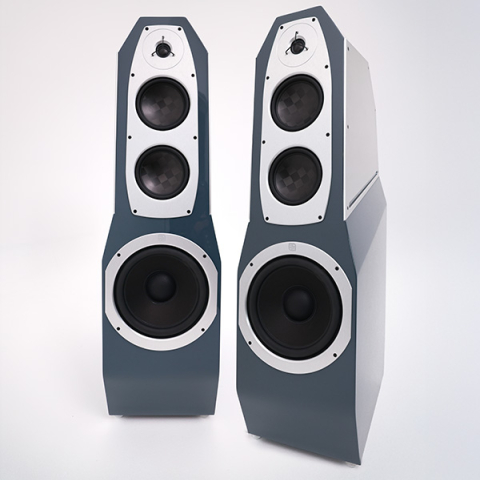
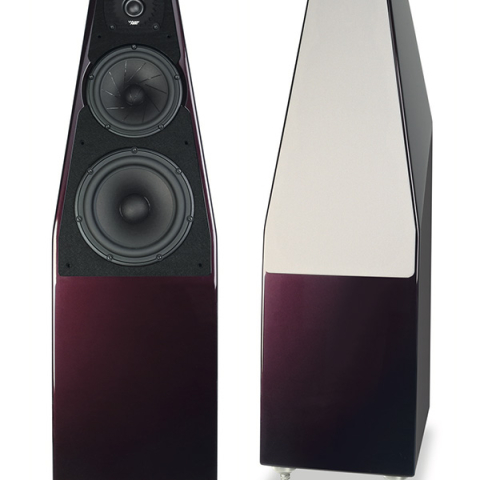
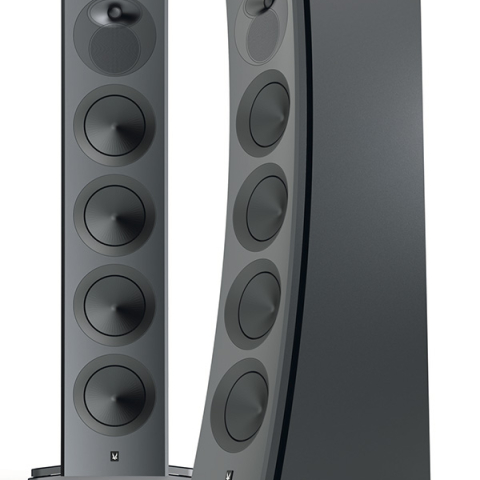
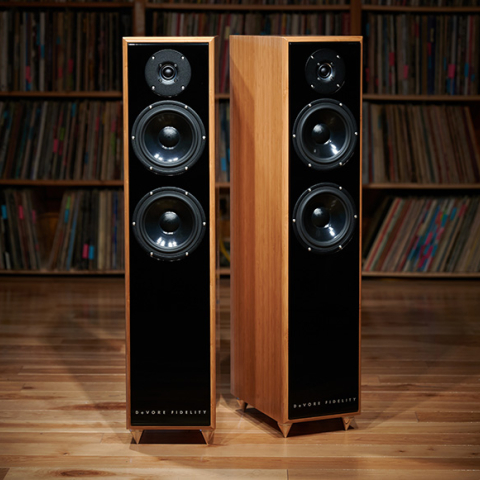
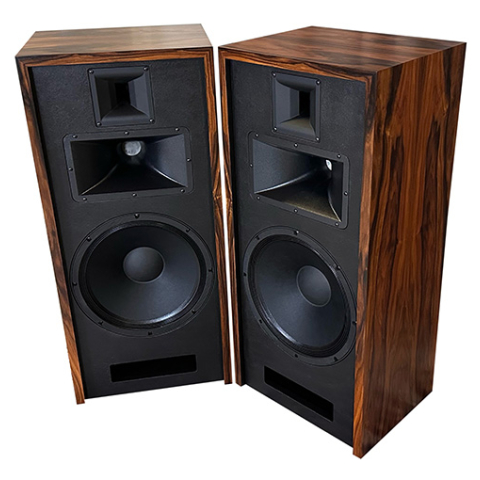
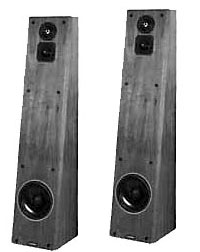
 New England Audio Resource's NEAR-50M is a cyborg: metal innards in a wooden body. It represents NEAR's top statement in the firm's Metal Diaphragm Technology speaker line, which features the "NEAR-Perfect" driver cone. Metal—in this case an anodized aluminum alloy—is much more rigid than paper or plastic. Hence, a driver with a metal cone acts more nearly as a true piston. When it comes to loudspeaker cones, breaking up is not hard to do. When that happens, the cone flexes in a complex pattern, generating harmonic distortion. A typical plastic or paper 8" woofer may experience its first breakup mode at a frequency as low as 500Hz. The NEAR 8" metal-cone woofer's first breakup mode is said to be well above 2kHz, and their 4" metal-cone midrange does much better than that (footnote 1).
I've said it before: Much of the coloration introduced by dynamic drivers is due to in-band resonances and their associated harmonic distortions. The frequency-response curve may look reasonably flat, with only a few wiggles here and there, but that in itself does not tell the whole story. When a cone breaks up, its various sections may move out of phase relative to one another so that their output cancels out and produces little sound radiation at the fundamental frequency. However, it does not follow that significant cancellation of the harmonics takes place. While the frequency-response wiggles may look benign, the audibility of the dissonant breakup harmonics may be significant.
Metal diaphragms have other advantages. Sensitivity to environmental effects is virtually eliminated. Because aluminum is non-hygroscopic, a metal cone cannot absorb moisture. Unless completely waterproofed, a paper cone's performance is affected as the cone is softened by moisture absorption; and the impact of many wet/dry cycles weakens the diaphragm. The promise of metal is repeatable sonic performance for many years. And, because metal is a good conductor of heat, the diaphragm can heatsink the voice-coil, thereby improving the thermal rating and, very likely, the driver's reliability.
On the debit side, metal cones tend to be much heavier than paper or plastic and thus typically result in less sensitive drivers. Metal also has very little internal damping: when metal cones break up, they do so screaming with a high-Q resonance. It's important, therefore, to use metal drivers well within their comfort zones. NEAR uses a fourth-order linear-phase network to roll off the woofer just below 300Hz. Such a network offers a slower descent into the stopband around the crossover point, thereby improving transient response at the cost of sacrificing some selectivity. A mix of first- and fourth-order networks (footnote 2) is used to blend the midrange and tweeter—this the well-known Vifa 1" metal-dome unit—at about 4kHz (footnote 3).
New England Audio Resource's NEAR-50M is a cyborg: metal innards in a wooden body. It represents NEAR's top statement in the firm's Metal Diaphragm Technology speaker line, which features the "NEAR-Perfect" driver cone. Metal—in this case an anodized aluminum alloy—is much more rigid than paper or plastic. Hence, a driver with a metal cone acts more nearly as a true piston. When it comes to loudspeaker cones, breaking up is not hard to do. When that happens, the cone flexes in a complex pattern, generating harmonic distortion. A typical plastic or paper 8" woofer may experience its first breakup mode at a frequency as low as 500Hz. The NEAR 8" metal-cone woofer's first breakup mode is said to be well above 2kHz, and their 4" metal-cone midrange does much better than that (footnote 1).
I've said it before: Much of the coloration introduced by dynamic drivers is due to in-band resonances and their associated harmonic distortions. The frequency-response curve may look reasonably flat, with only a few wiggles here and there, but that in itself does not tell the whole story. When a cone breaks up, its various sections may move out of phase relative to one another so that their output cancels out and produces little sound radiation at the fundamental frequency. However, it does not follow that significant cancellation of the harmonics takes place. While the frequency-response wiggles may look benign, the audibility of the dissonant breakup harmonics may be significant.
Metal diaphragms have other advantages. Sensitivity to environmental effects is virtually eliminated. Because aluminum is non-hygroscopic, a metal cone cannot absorb moisture. Unless completely waterproofed, a paper cone's performance is affected as the cone is softened by moisture absorption; and the impact of many wet/dry cycles weakens the diaphragm. The promise of metal is repeatable sonic performance for many years. And, because metal is a good conductor of heat, the diaphragm can heatsink the voice-coil, thereby improving the thermal rating and, very likely, the driver's reliability.
On the debit side, metal cones tend to be much heavier than paper or plastic and thus typically result in less sensitive drivers. Metal also has very little internal damping: when metal cones break up, they do so screaming with a high-Q resonance. It's important, therefore, to use metal drivers well within their comfort zones. NEAR uses a fourth-order linear-phase network to roll off the woofer just below 300Hz. Such a network offers a slower descent into the stopband around the crossover point, thereby improving transient response at the cost of sacrificing some selectivity. A mix of first- and fourth-order networks (footnote 2) is used to blend the midrange and tweeter—this the well-known Vifa 1" metal-dome unit—at about 4kHz (footnote 3).
Equipment reports occasionally undergo exceptionally long periods of gestation. Such was the case with the '50M. The review process unfolded in several chapters, and since all of these episodes are germane to this story, you shall be told about them. It is Stereophile's policy to describe all experiences with a particular product. For example, the fact that the first sample of a particular product blew up should be of great interest to you, reflecting as it does the product's reliability. You, of all people, have a right to know about it. In this case, it's important for you to know that this product continued to evolve during the review process, and that manufacturing mistakes were made. After all, you could have ended up with any of the three samples of the '50M that I auditioned. The first samples arrived nearly two years ago, shortly after the 1991 Winter CES. A brief audition revealed serious problems with driver integration. Small changes in toe-in angle produced major alterations in tonal balance. I put the speakers aside for several months, and, as is often the case in the high-end business, NEAR called in May 1991 to say that the '50M had been upgraded to include new crossover parts, wire, and a generally more refined tuning of the system. The second set of samples (SNs 014021 & 22), arriving in June 1991, caught me in the midst of moving out of Stereophile's dedicated listening room and setting up a whole new listening environment. I thus didn't commence my audition of them until fall 1991. By December I'd reached a set of final impressions, the gist of which could be titled "A Tale of Three Drivers."
Yet another surprise. The first thing I did was to measure the '50M's frequency response to determine just how the "correct" crossover network integrated the drivers. To my surprise, both the old and new samples measured essentially alike at 1m. All of my measurements so far had been conducted with my Neutrik System 3300, but those measurements agreed with those performed with a recently acquired ATI Loudspeaker Measurement System (LMS). While I don't pretend to claim that it's possible to fully characterize loudspeaker performance with a simple figure of merit or a few response measurements, it has been demonstrated that the nearfield on-axis response correlates well with listening impressions—at least in well-treated rooms and in a listening configuration optimized for imaging precision.
Based on the above, I can only conclude that NEAR is guilty of suboptimal system engineering. That the NEAR metal drivers are capable of excellent sonic performance is quite evident. I hereby raise my glass in salute to NEAR's contribution to the art. Unfortunately, drivers alone do not an excellent loudspeaker make. Although they're essential ingredients by definition, sound engineering to assure proper driver integration is also part of the recipe for success.
As this review went to press, NEAR informed us that the NEAR-50M had been revised yet again, with now a front baffle made from 1" rather than ¾" MDF, a more compliant midrange surround, a slightly different crossover, and higher-quality 5-way binding posts. Although we requested samples of this latest version of the '50 for a "Follow-Up" be sent, this never happened.—John Atkinson
Footnote 1: Both drive-units are manufactured using machinery and molds that NEAR inherited from the original Bozak company.—Dick Olsher