

 Empire 108
Empire Scientific's 108 Stereo–Mono moving magnet cartridge puts out 8mV, and with it in my system, Julie London's Julie Is Her Name (Liberty LRP 3006) sounded super-vivid and perfectly period correct: Julie sounded like she did coming out of my parents' Columbia console in 1958. When I played E. Power Biggs's Greatest Hits (Columbia MS 7269), the same thing happened. When I played Patsy Cline singing "Heartaches" (Decca 45 31429), it sounded like Patsy sounded coming out of a juke box. Feeding the Linear Tube Audio Z10e integrated amplifier, the Empire 108 made my Falcon LS3/5a's sound like the Altec 604Es that I gave to Art Dudley. A simple cartridge change, from a sleek modern Dynavector XX2A moving coil with a line contact stylus to a midcentury Empire 108 with a 0.7mil conical stylus, triggered tidal waves of memories and associations. The experience made me wonder, what exactly is accuracy? Seeking answers, I played Stravinsky's L'Oiseau de feu from the La Voix de son maiître LP (2 C069-02070). I've known this 1970 recording for decades, and the Dynavector XX2A played it with "I could hear every violin" string textures. My Sonic Labs' Ultra Eminent Ex and EMT's JSD6 moving coils played this dead-quiet French pressing with "I could hear the insides of the cellos" clarity. Don't laugh: The Empire 108 moving magnet delivered more immediacy and more life-like instrumental tones. It played this music bigger and bolder, though with less empty space than a modern moving coil.
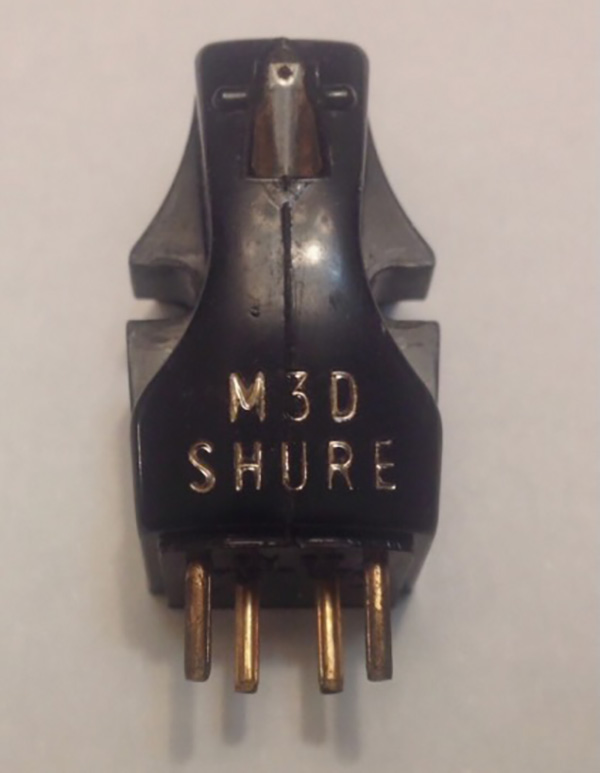 Shure M3D
Next, I pulled out a vintage cartridge I own. In 1958, the Shure Radio Company introduced "the M3D Stereo Dynetic cartridge," which Shure's ads described as "the world's first moving magnet stereo cartridge" (footnote 5). The M3D weighs 8.5gm and puts out 7.8mV. It uses a conical stylus and has a specified VTF of 3–6gm. Designwise, its curvy, black Bakelite body reads as midcentury modern. Its bold gold lettering makes it look expensive. At $45, it was the flagship of the Shure lineup, followed by the $24 M7D. Despite the hefty price, it was a popular stereo cartridge when it came out. My M3D arrived attached to the tonearm on the Lenco L75 turntable I bought from a friend of Michael Trei who lives in Brooklyn. Right out of the original Lenco box, I was awestruck by the M3D's midrange clarity, which felt more sharp-focused than I imagined any 1960s record player could muster. I knew Michael had done a tune-up on this lightly used deck and that during that tune-up he had installed a "replacement" stylus he bought from LP Gear. I remember he said it cost $106. I put the M3D on a Jelco headshell attached to a Sorane SL-1.2 tonearm mounted on a Dr. Feickert Blackbird turntable. Using the Feickert protractor, I set it to a Stevenson alignment. I set VTF at a low 1.5gm then absentmindedly played a record at that setting. To my surprise, it sounded detailed, airy, and transparent, and it tracked flawlessly (footnote 6). I do not normally associate "airy and transparent" with 1960s moving magnets. Curiosity and disbelief forced me to up the tracking force to 2gm and play the same massed-string music I had played with the 108: Stravinsky's L'Oiseau de feu. Now it sounded clear and explicit like a fancy moving coil. I could not figure out why.
 I started riddling Trei with dumb questions. "So, Michael, how can this $106 Jico stylus make the M3D sound so detailed and detailed and transparent?" His answer: "It's not a Jico stylus, it's a Pfanstieh." I asked if he was sure. "It came in a Pfanstiehl box," he said. I had never heard of Pfanstiehl, so I asked Michael to send me a link (footnote 7). I clicked on it, scrolled down, and saw this: "Finest quality N3D stylus specified for Shure M3D cartridge Special Vivid Line Contact diamond tip for exceptional fidelity."
Turns out my M3D "replacement stylus" was not a standard Jico; it was a "Special Vivid Line Contact diamond." I laughed out loud when I discovered this because it explained everything. You see, if you buy a used moving magnet on eBay, chances are you will need a new stylus. Fortunately, there is a wide range of choices, from Jico, LP Gear, and others. I recommend trying several different ones.
With Pfanstiehl's N3D line contact stylus, the M3D's bass was less forward and forceful than it was with the 108,but it blended smoothly with the Shure's hyperdetailed midrange. This 1958 moving magnet came across as supertransparent, fast, and superbly balanced, but maybe a touch rolled off in the treble. Its midrange felt naturally transparent and maximally resolved, almost electrostatic.
I started riddling Trei with dumb questions. "So, Michael, how can this $106 Jico stylus make the M3D sound so detailed and detailed and transparent?" His answer: "It's not a Jico stylus, it's a Pfanstieh." I asked if he was sure. "It came in a Pfanstiehl box," he said. I had never heard of Pfanstiehl, so I asked Michael to send me a link (footnote 7). I clicked on it, scrolled down, and saw this: "Finest quality N3D stylus specified for Shure M3D cartridge Special Vivid Line Contact diamond tip for exceptional fidelity."
Turns out my M3D "replacement stylus" was not a standard Jico; it was a "Special Vivid Line Contact diamond." I laughed out loud when I discovered this because it explained everything. You see, if you buy a used moving magnet on eBay, chances are you will need a new stylus. Fortunately, there is a wide range of choices, from Jico, LP Gear, and others. I recommend trying several different ones.
With Pfanstiehl's N3D line contact stylus, the M3D's bass was less forward and forceful than it was with the 108,but it blended smoothly with the Shure's hyperdetailed midrange. This 1958 moving magnet came across as supertransparent, fast, and superbly balanced, but maybe a touch rolled off in the treble. Its midrange felt naturally transparent and maximally resolved, almost electrostatic.
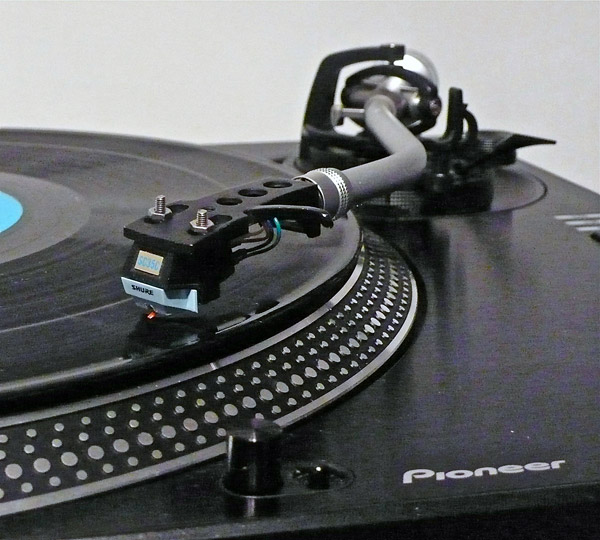 Shure SC35C
Shure's M3D with the Pfanstiehl stylus played discs with audiophile-level finesse and transparency. This made me wonder how it might compare to the Shure SC35C I reviewed in Gramophone Dreams #3. The SC35 was introduced in 1973 and stayed in production until 2018. Originally sold as a "broadcast" cartridge to radio stations, the SC35C is now marketed as a deejay cartridge "that won't skip." Its spherical stylus tracks at 3–5gm, and its last list price was $75. I bought mine new in 2014 for $35. Today, LP Gear sells new old stock SC35Cs for $157. If you just bought your first turntable, I recommend you try this cartridge. It's rugged, easy to install, and supermusical. It tracks like a hound and presents recordings with four-star authority and drive. It plays all genres of music in a satisfying manner. Like the M3D, the SC35C specifies channel separation as >20dB. You get that channel blending that makes early stereo better than tolerable. You do not get Empire 108 tone or my M3D's line-contact transparency. I like this cartridge because it's a solid performer. But compared to that retipped M3D, the SC35C sounds bright, thick, and a little blunt.
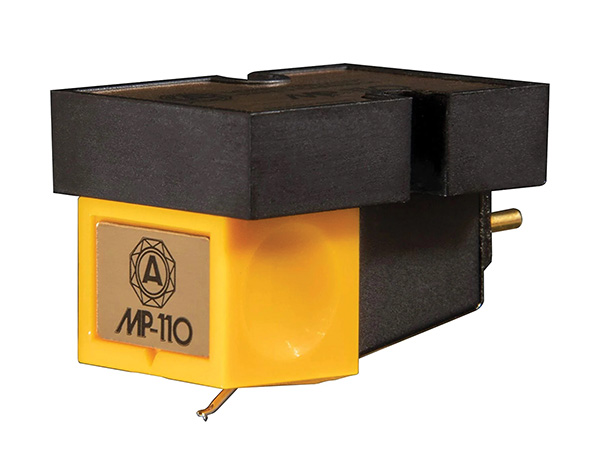 Nagaoka MP-200
I wanted to compare the Empire 108 and Shure M3D to a modern moving magnet, so I played the abovementioned antique records with the "homebrew" new-production Nagaoka MP-200 I reviewed in Gramophone Dreams #87 The MP-200 is a moving magnet that uses a nude "superfine elliptical diamond," and it sounded not at all like the Empire 108. But! When I played the new Nagaoka through the Kitsuné KTE LCR-1 phono stage, it sounded a lot like the retipped Shure M3D through the same LCR pre. The MP-200 was less vivid and tactile than the M3D but smoother and more extended in the top octaves. I'm glad I own both. In sum
What I'm describing here are audio adventures for anybody with more imagination than cash. This is not nostalgia. It has nothing to do with any form of yearning or low-level sentiment. It is an empirical, intellectual, and philosophical searching for authentic human culture. It's about hearing our records as their producers heard them.
Footnote 5: See service.shure.com/s/article/brief-history-of-shure-phonograph-cartridges. Remarkably, Shure also maintains a link to a pdf of the owner's guide for the M3D, downloadable at pubs.shure.com/guide/m3d/en-us.















