Two circuits would feed a 4-gang AC receptacle box located behind the amplifiers; each amplifier would have its own dedicated 20A circuit. The other two would feed another 4-gang box located behind the equipment rack.
This should have been done 20 years ago when I moved into this house! According to Hungerford's synopsis, the now-corroded electrical infrastructure was assembled in the 1970s and included all-aluminum wire. The subpanel used a decade ago to create the then-new dedicated circuit for the audio system featured 3-wire, metal-clad cabling that does not allow for an isolated ground wire and ties together the receptacle ground clamp and the metal box ground. These are things I never considered or understood before.
Hungerford's synopsis also concluded that multiple connection points, especially of dissimilar metals, increased impedance and created "inductive vertices" that inhibit proper draining of RF noise. Powell amplified this point. The mechanical connection points may not make full positive contact (clearly the ones in the old meter box did not), a situation that could produce arcing, which, among other sins, increases transient intermodulation distortion.
The plan was to disconnect the main ground wire, which connects to the distant cold water line, from the original indoor main electrical panel and connect it to the outside main panel, and tie it to a new 10' long, ¾" copper-clad steel ground rod about 5' from the service drop. All the old ground rods would be disconnected and removed. The electrical code requires a maximum ground impedance of 25 ohms, but the goal was to do much better than that. If this wasn't achieved, a second grounding rod would be installed 20' away from the first one, which is what happened.
 Finally, Hungerford related in his synopsis, "'scopes and meters were used to select the cleanest phase on which to place the audio equipment." Two 10' copper-clad steel ground rods wired in series were drilled into the lawn, and the cold water pipe was reconnected (footnote 6), after which the final impedance to ground read 0.49 ohm. As Hungerford put it, "Excellent result."
The cost
Finally, Hungerford related in his synopsis, "'scopes and meters were used to select the cleanest phase on which to place the audio equipment." Two 10' copper-clad steel ground rods wired in series were drilled into the lawn, and the cold water pipe was reconnected (footnote 6), after which the final impedance to ground read 0.49 ohm. As Hungerford put it, "Excellent result."
The cost
The cost for parts and labor for a job like this should be around $15,000 including consultation and project planning by either Hungerford or DeVito (or whomever you choose, but a heating and air conditioning contractor is not the person for the job), electrician-supplied parts, and installation costs. I paid my electrician his going rate, and I paid for the parts. Powell's, Hungerford's, and DeVito's consulting services were provided pro bono. The sonic improvement
Hungerford and DeVito encouraged me to use the AudioQuest Niagara 7000 in the "front end" to isolate the digital gear but to plug the amps directly into the wall, each into its own 20A circuit. The before/after difference was beyond anything I had imagined. All the 60Hz hum had been eliminated. Finally!
 Everything positive you may have read about the spectacular Tone Poet reissue Katanga! (Pacific Jazz ST-70) is true. The title track has intense visceral energy, and the tune's composer, Dupree Bolton, produces a mind-blowing trumpet performance, coming from nowhere and disappearing after this record (footnote 7). If you're a fan of Gil Evans's album Out of the Cool, you'll immediately recognize guitarist Ray Crawford. The title tune will leave you exhausted, exhilarated, and maybe overwhelmed and gasping for air.
I bought this album after the transfer switch disaster and after I'd installed the PS Audio Regenerators, so I only knew the sound in that context. To me, the sax and trumpet sounded nicely present and well-focused, but also pinched and thin. After the electricity upgrade, they became full-bodied: solid yet transparent. The louder I played this album, the better and fuller it sounded. "This is insane!" I repeatedly exclaimed out loud with no one in the room—until my wife appeared, saying, "That sounds amazing from upstairs!" I know I've overused her as a foil in my reviews, but hey, it did happen.
Everything positive you may have read about the spectacular Tone Poet reissue Katanga! (Pacific Jazz ST-70) is true. The title track has intense visceral energy, and the tune's composer, Dupree Bolton, produces a mind-blowing trumpet performance, coming from nowhere and disappearing after this record (footnote 7). If you're a fan of Gil Evans's album Out of the Cool, you'll immediately recognize guitarist Ray Crawford. The title tune will leave you exhausted, exhilarated, and maybe overwhelmed and gasping for air.
I bought this album after the transfer switch disaster and after I'd installed the PS Audio Regenerators, so I only knew the sound in that context. To me, the sax and trumpet sounded nicely present and well-focused, but also pinched and thin. After the electricity upgrade, they became full-bodied: solid yet transparent. The louder I played this album, the better and fuller it sounded. "This is insane!" I repeatedly exclaimed out loud with no one in the room—until my wife appeared, saying, "That sounds amazing from upstairs!" I know I've overused her as a foil in my reviews, but hey, it did happen.
 The home theater results were in some ways even more spectacular: I have a Marantz AV8801U preamp/processor and Parasound Halo A 51 five-channel amp driving Sonics by Joachim Gerhard speakers, which have always sounded thick and veiled, with limited dynamics. The intelligibility of center-channel dialog has been poor from the beginning. I tried everything, from increasing center-channel volume to carefully aiming the speaker at the listening position, but nothing improved it. Moving the home theater circuit to the new subpanel produced a profound improvement; even my hearing-impaired, 92-year-old mother-in-law heard it. We could even turn off the subtitles while watching The Crown, so much had dialog intelligibility improved. Voices now floated on a cushion of air, projecting forward into the room. The Parasound Halo A 51 turned silky and transparent. It was like a complete system swap.
Finally, I tried plugging the amps into both the big PS Audio P20 Regenerator and into a second AudioQuest Niagara 7000. In both cases, there was a clear loss of the spectacular newfound transparency and silkiness.
Before the transfer switch, the Niagara 7000 produced noticeable sonic improvement. After it, I couldn't have kept writing and reviewing without the PS Audio regenerators. Garth Powell has asked me to unbox the 7000 and "just plug it into the wall, with nothing connected to it." Since each channel is on its own circuit, compare the two channels. If I hear an improvement, he'll explain why. If I don't, I'll send it back. That's for next time!
The home theater results were in some ways even more spectacular: I have a Marantz AV8801U preamp/processor and Parasound Halo A 51 five-channel amp driving Sonics by Joachim Gerhard speakers, which have always sounded thick and veiled, with limited dynamics. The intelligibility of center-channel dialog has been poor from the beginning. I tried everything, from increasing center-channel volume to carefully aiming the speaker at the listening position, but nothing improved it. Moving the home theater circuit to the new subpanel produced a profound improvement; even my hearing-impaired, 92-year-old mother-in-law heard it. We could even turn off the subtitles while watching The Crown, so much had dialog intelligibility improved. Voices now floated on a cushion of air, projecting forward into the room. The Parasound Halo A 51 turned silky and transparent. It was like a complete system swap.
Finally, I tried plugging the amps into both the big PS Audio P20 Regenerator and into a second AudioQuest Niagara 7000. In both cases, there was a clear loss of the spectacular newfound transparency and silkiness.
Before the transfer switch, the Niagara 7000 produced noticeable sonic improvement. After it, I couldn't have kept writing and reviewing without the PS Audio regenerators. Garth Powell has asked me to unbox the 7000 and "just plug it into the wall, with nothing connected to it." Since each channel is on its own circuit, compare the two channels. If I hear an improvement, he'll explain why. If I don't, I'll send it back. That's for next time!
Footnote 6: The US National Electrical Code calls for grounding to both the cold water pipe, "if available on the premises," and a "secondary electrode."
Footnote 7: Most of what's known about Dupree is thanks to jazz scholar Ted Gioia, who tracked Dupree down and interviewed him in the late 1980s. Dupree appeared on one previous album: Harold Land's The Fox, from 1960. He had a heroin habit and was in jail most of the time between the two albums, and soon after Katanga!, he went back to jail and spent most of the next 25 years there.—Jim Austin
Footnote 8: You can watch a YouTube video showing the whole process here.
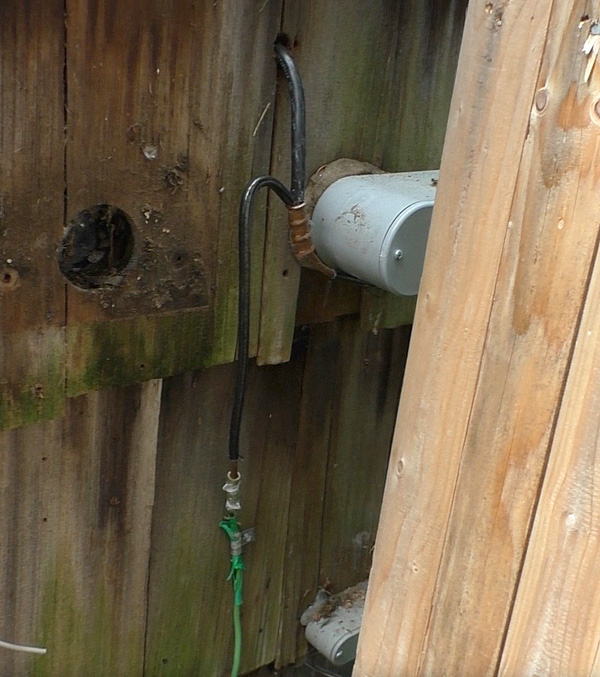
Multiple ground wire splices from the former indoor main panel ground wire.
In this and other ways, the plan would totally rebuild the house's grounding system, even though what was already there met code. It's no wonder that the first contractor balked.
Bradley and his assistant meticulously executed the plan, and I had them pull the upstairs home theater circuit out from the now-secondary former main panel and route it to the new utility room subpanel. I'm glad I did, as you'll read.
The cost for parts and labor for a job like this should be around $15,000 including consultation and project planning by either Hungerford or DeVito (or whomever you choose, but a heating and air conditioning contractor is not the person for the job), electrician-supplied parts, and installation costs. I paid my electrician his going rate, and I paid for the parts. Powell's, Hungerford's, and DeVito's consulting services were provided pro bono. The sonic improvement
Hungerford and DeVito encouraged me to use the AudioQuest Niagara 7000 in the "front end" to isolate the digital gear but to plug the amps directly into the wall, each into its own 20A circuit. The before/after difference was beyond anything I had imagined. All the 60Hz hum had been eliminated. Finally!
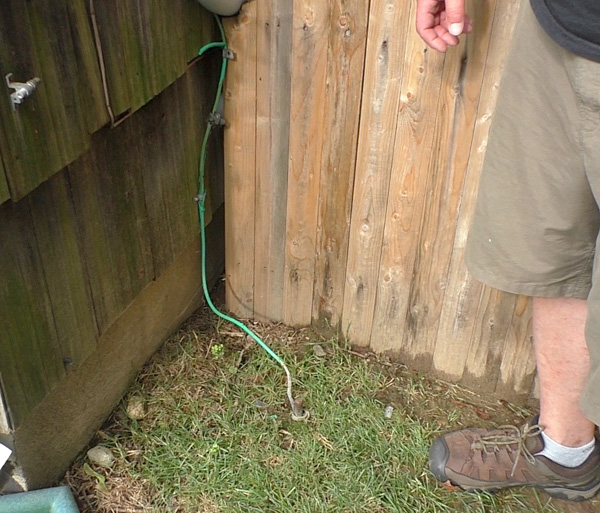
Ground wire running into one of a few small ground rods.
The result was top-to-bottom background blackness even with an ear pressed to the tweeter (other than the slight, ever-present hiss that comes from the darTZeel NHB-18NS preamp). When the noisefloor fell away, dynamics greatly improved, and the musical presentation seemed to explode from the speakers with unusual ease, leaving in its wake just plain black.
I could now play familiar records, streams, and files at far lower SPLs because I could hear farther into the sonic picture. Yet, when I cranked the music up, it was easier on the ears because there wasn't a hint of congestion, hardening, or harshness.
The improvement in transparency was immediately obvious, as was new transient delicacy and purity. On the Direct-to-Disc recording of Bruckner's 7th Symphony, with Haitink conducting the BPO, spectacular and transparent as the sound was upon first listen, massed strings always had a slight touch of congestion. Now it was gone, replaced by the kind of transparency that lets you hear farther into the soundstage and a silky smoothness.
Everything positive you may have read about the spectacular Tone Poet reissue Katanga! (Pacific Jazz ST-70) is true. The title track has intense visceral energy, and the tune's composer, Dupree Bolton, produces a mind-blowing trumpet performance, coming from nowhere and disappearing after this record (footnote 7). If you're a fan of Gil Evans's album Out of the Cool, you'll immediately recognize guitarist Ray Crawford. The title tune will leave you exhausted, exhilarated, and maybe overwhelmed and gasping for air.
I bought this album after the transfer switch disaster and after I'd installed the PS Audio Regenerators, so I only knew the sound in that context. To me, the sax and trumpet sounded nicely present and well-focused, but also pinched and thin. After the electricity upgrade, they became full-bodied: solid yet transparent. The louder I played this album, the better and fuller it sounded. "This is insane!" I repeatedly exclaimed out loud with no one in the room—until my wife appeared, saying, "That sounds amazing from upstairs!" I know I've overused her as a foil in my reviews, but hey, it did happen.
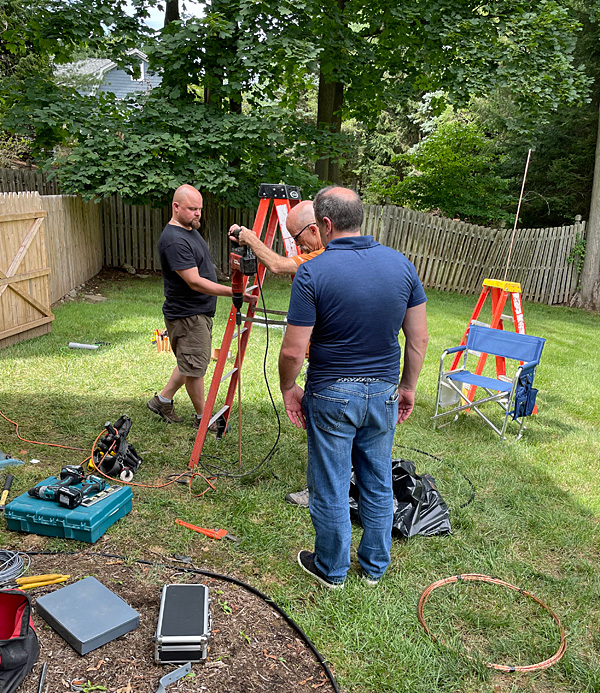
Drilling one of two 10' copper-clad ground rods into the soil.
This was a remarkable, global improvement in every listening parameter. The system's performance now is clearly superior to what it was before the transfer switch installation. The upgrade healed the camel's broken back—and then some.
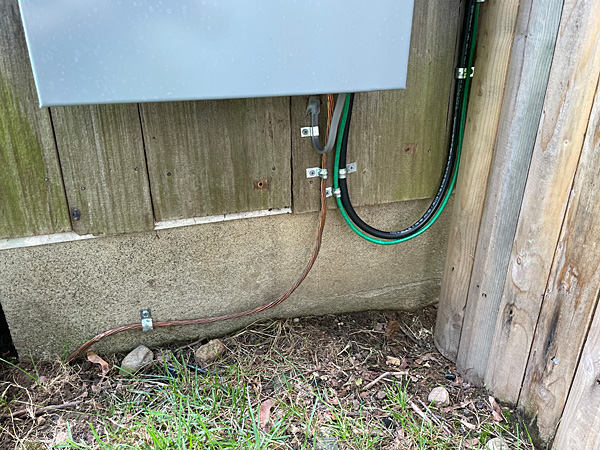
The new ground wires running into the new main outdoor box, then exiting toward the two new grounding rods.
I'll conclude this column by urging you, if you live in your own home and especially if the infrastructure is old and the wiring aluminum, to consider a project like this (footnote 8). You won't regret it!
Footnote 6: The US National Electrical Code calls for grounding to both the cold water pipe, "if available on the premises," and a "secondary electrode."