Brand-fan excitement ran high among consumers and reviewers alike when Wilson Audio Specialties announced that it would roll out a nonfunctioning prototype of the Chronosonic XVX at the 2019 Rocky Mountain Audio Fest (RMAF). The Chronosonic XVX was rumored to be a replacement for the $210,000/pair Alexandria XLF, offering performance similar to that of the $850,000 WAMM Master Chronosonic system (including two Master Subsonics and a controller) at a less breathtaking price. (You won't catch me writing "affordable" here.) The static unveiling at RMAF intensified anticipation.
XVX rumors, like most rumors, proved to be not quite accurate. When the XVX was introduced, the XLF remained in the Wilson lineup. (It was retired mid-2020.) Nor was the XVX intended as the company's second-tier loudspeaker, as some had speculated—or not precisely.
The WAMM was always positioned as a limited-edition product. The XVX, then—like the Alexandria XLF before it—was meant to be the statement product in Wilson's regular lineup, a no-compromise loudspeaker, a cost-no-object design.
Cost was something of an object, though: Daryl Wilson said in that static-unveiling video (footnote 1) that he'd hoped to bring the project in under $300,000/pair. By the time he and his design team were finished, that price had risen to $329,000. (To head off online price whiners at the pass, I'll note that the February 11, 2021 New York Times carried a story about a $76,000/pair, limited-edition Birkenstock sandal made from ripped-up Hermès Birkin bags. The shoes are expected to sell out, and they don't play Beethoven, Miles, or the Clash.)
Thus, while the XVX incorporates much of the WAMM's groundbreaking technology—including its precise time-alignment technology (in somewhat simplified form)—and more than a few new innovations, it costs roughly half what the WAMM costs. Yet it is priced well above the XLF, leaving a $130,000 hole in Wilson's impressive lineup. Wilson says this hole will not be filled.
From the ground up
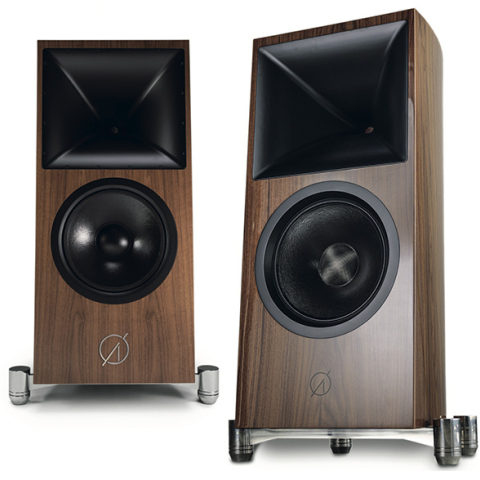
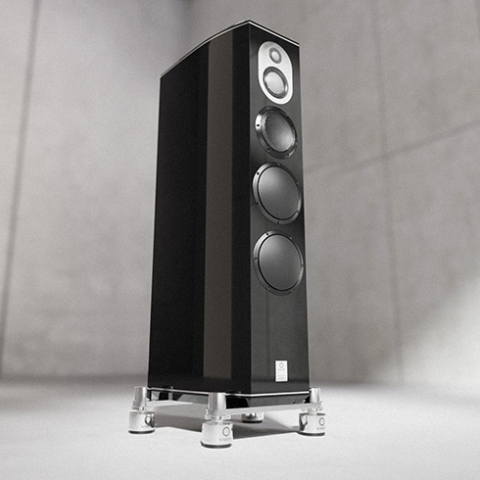
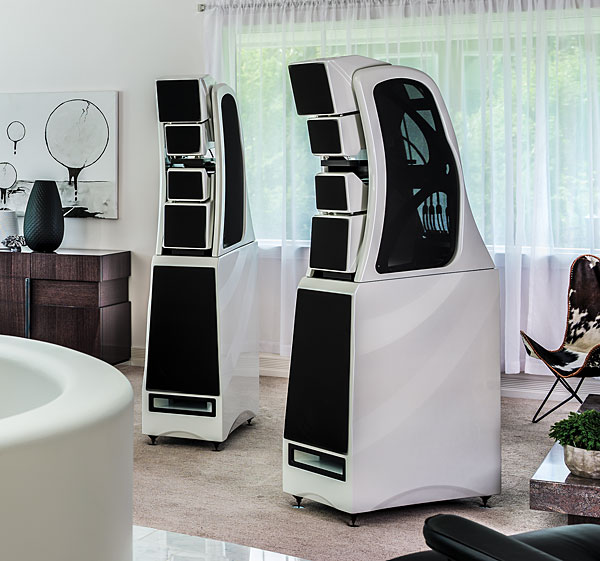
Standing about 6' 4" inches tall in spiked heels and weighing 685lb, the XVX incorporates the same 10½" and 12½" hard-paper-pulp woofers developed for the WAMM and later "pilfered" for the Alexx. In the XVX, the woofer pair is housed in a massive enclosure nearly 3' deep and tall. The enclosure features the selectable (rear- or front-firing) "Cross-Load" port system introduced with the XLF. The woofer cabinet is constructed using Wilson's superhard, nonresonant "X" material.
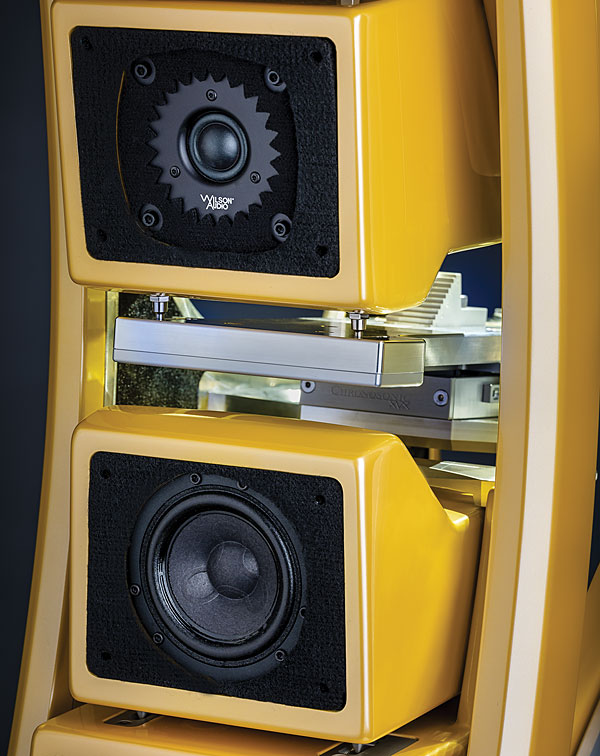 The speaker's upper section holds four speaker modules: upper and lower rear-vented midrange modules sandwich a sealed tweeter and a bottom-vented upper-midrange module. The tweeter is the same Convergent Synergy Mk5 doped-silk fabric dome used in the WAMM. A second Mk5 tweeter is mounted atop the upper-midrange enclosure. The upper midrange driver is a variant of the 4" paper-pulp cone driver, two of which are used in the WAMM's MTM (d'Appolito) array.
Brand-new here is the QuadraMag midrange driver, Dave Wilson's final driver project, developed in collaboration with his team over five years but not finished in time for inclusion in the WAMM Chronosonic. It features a 7" paper-pulp–composite cone driven by a motor featuring four Alnico magnet "slugs" that, relative to the original iteration's three, increase efficiency, speed, resolution, and "sweetness," Daryl Wilson says.
The heart of the speaker, though, is a version of the micrometer-based aluminum-and–stainless steel gantry system developed for the WAMM, which allows precise time alignment of the mid- and upper-frequency drivers relative to each other and the drivers below. In a conversation with Jason Victor Serinus, the late Dave Wilson described the goal of the system as achieving "synchronicity of the alignment of the leading edge of the transient."
The speaker's upper section holds four speaker modules: upper and lower rear-vented midrange modules sandwich a sealed tweeter and a bottom-vented upper-midrange module. The tweeter is the same Convergent Synergy Mk5 doped-silk fabric dome used in the WAMM. A second Mk5 tweeter is mounted atop the upper-midrange enclosure. The upper midrange driver is a variant of the 4" paper-pulp cone driver, two of which are used in the WAMM's MTM (d'Appolito) array.
Brand-new here is the QuadraMag midrange driver, Dave Wilson's final driver project, developed in collaboration with his team over five years but not finished in time for inclusion in the WAMM Chronosonic. It features a 7" paper-pulp–composite cone driven by a motor featuring four Alnico magnet "slugs" that, relative to the original iteration's three, increase efficiency, speed, resolution, and "sweetness," Daryl Wilson says.
The heart of the speaker, though, is a version of the micrometer-based aluminum-and–stainless steel gantry system developed for the WAMM, which allows precise time alignment of the mid- and upper-frequency drivers relative to each other and the drivers below. In a conversation with Jason Victor Serinus, the late Dave Wilson described the goal of the system as achieving "synchronicity of the alignment of the leading edge of the transient."
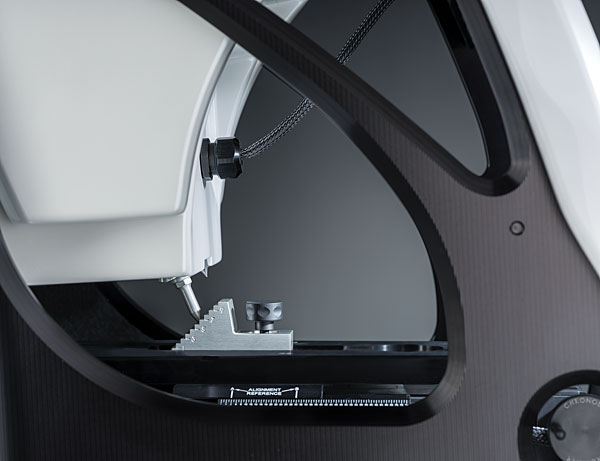 While flat–front-baffle speakers fixed at 90° from vertical can have an error of hundreds of microseconds, Wilson explained to young Jason, the WAMM's micrometer/gantry system allows for adjustments down to about 2µs. "It's nice if you have phase coherence, but it is not necessary," Wilson said in his chat with JVS. "What I'm interested in is the synchronicity of the leading edge of each note."
The topmost midrange driver and tweeter share one micrometer "sled," while the two lower drivers ride on the second. The 4" upper-midrange driver can be further adjusted, fore and aft and for rake angle, independent of the 7" midrange driver upon which its spikes rest. Wilson says the "resolution" of this system on the XVX is comparable to that on the WAMM. Other Wilson loudspeakers—including my reference Alexx—have similar adjustability, but by comparison to the XVX, it's relatively coarse.
The system by which the time alignment is achieved is an ingenious and remarkably rigid mechanical wonder, made easier to appreciate and adjust by a built-in, two-tiered, rechargeable-battery–powered lighting system and embedded bubble levels. Modules are aligned fore and aft via the two ultrafine-pitched, micrometer-controlled, "V-material"– damped sleds, and proper rake angles are achieved using Wilson's tried-and-true stepped block-and-spike system.
Wilson has been criticized for sticking to paper-pulp cones and soft-dome tweeters instead of utilizing more exotic materials like beryllium, titanium, ceramic, or diamond. "In the final analysis," Dave Wilson told Jason, "it's what you like."
While flat–front-baffle speakers fixed at 90° from vertical can have an error of hundreds of microseconds, Wilson explained to young Jason, the WAMM's micrometer/gantry system allows for adjustments down to about 2µs. "It's nice if you have phase coherence, but it is not necessary," Wilson said in his chat with JVS. "What I'm interested in is the synchronicity of the leading edge of each note."
The topmost midrange driver and tweeter share one micrometer "sled," while the two lower drivers ride on the second. The 4" upper-midrange driver can be further adjusted, fore and aft and for rake angle, independent of the 7" midrange driver upon which its spikes rest. Wilson says the "resolution" of this system on the XVX is comparable to that on the WAMM. Other Wilson loudspeakers—including my reference Alexx—have similar adjustability, but by comparison to the XVX, it's relatively coarse.
The system by which the time alignment is achieved is an ingenious and remarkably rigid mechanical wonder, made easier to appreciate and adjust by a built-in, two-tiered, rechargeable-battery–powered lighting system and embedded bubble levels. Modules are aligned fore and aft via the two ultrafine-pitched, micrometer-controlled, "V-material"– damped sleds, and proper rake angles are achieved using Wilson's tried-and-true stepped block-and-spike system.
Wilson has been criticized for sticking to paper-pulp cones and soft-dome tweeters instead of utilizing more exotic materials like beryllium, titanium, ceramic, or diamond. "In the final analysis," Dave Wilson told Jason, "it's what you like."
 A few more details
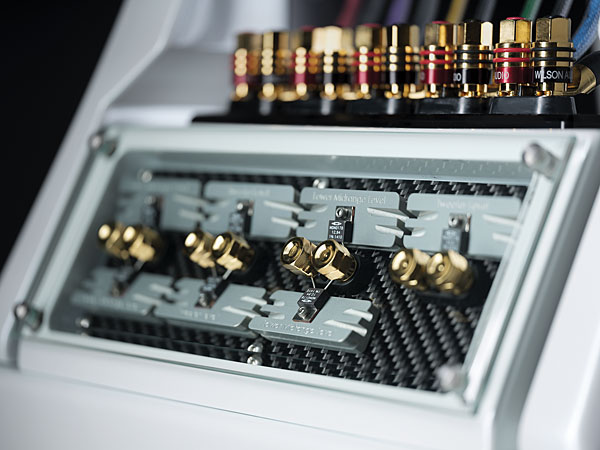
A few years ago, Wilson purchased Reliable Capacitor (RelCap) and brought cap manufacturing in-house, giving the design team control over cap consistency and quality and the ability to make capacitors of any desired value. Anyone who's played the capacitor-substitution game has heard the big sonic differences capacitors can make. I started capacitor-rolling in 1980, guided by the groundbreaking Jung and Marsh Audio magazine articles published in February and March of that year. Capacitors are most critical in crossover networks, especially in multidriver speaker designs like Wilson's WAMMs and XVXs, but in 1980 they transformed my Hafler DH-101 preamplifier from a physical and sonic lightweight into something special. The crossover networks (one for the woofers and a separate one for the higher frequency drivers) are potted to control vibration (and to prevent snooping?) and encased in stiff carbon fiber housings located in the lower-rear portion of the woofer cabinet.
Wilson hand-twists cables for each application with wire sourced from Transparent (except for the Magnum Opus cables used in the woofer section, which are bought premade). Wilson manufactures in-house connectors and binding posts as well as grille frames and side panels.
Setup
COVID-19 delayed delivery and setup. The review pair remained at the factory for months until Wilson's Bill Peugh and Tyler Hall felt it safe to travel and I felt it was safe to have masked visitors. During the considerable waiting period, I wondered if and how these large speakers would work in my room. Wilson's Peter McGrath, who has set up WATT Puppy 7's, MAXX2's and MAXX3's, XLFs, and Alexxes in my room (all of which I ended up purchasing), was 100% confident that they would work. However, the optional $37,500 (each) Subsonic Woofers with $4500 ActivXO crossover were not an option here. There's absolutely no room for them. Wilson has a speaker placement technique it calls "WASP" (Wilson Audio Setup Procedure) based on listening to the room and determining the location where it (the room) least influences the sound. (Wilson calls it the "zone of neutrality.") Peugh made use of it as best he could, but in my room there's little flexibility in the placement of speakers this big. They ended up very close to where the XLFs, Alexxes, Marten Coltrane 3's, and the enormous Sonus Faber Aida IIs sounded best.
Footnote 1, just after the 12-minute mark at youtube.com/watch?v=A_jslqJ4TkE.
Standing about 6' 4" inches tall in spiked heels and weighing 685lb, the XVX incorporates the same 10½" and 12½" hard-paper-pulp woofers developed for the WAMM and later "pilfered" for the Alexx. In the XVX, the woofer pair is housed in a massive enclosure nearly 3' deep and tall. The enclosure features the selectable (rear- or front-firing) "Cross-Load" port system introduced with the XLF. The woofer cabinet is constructed using Wilson's superhard, nonresonant "X" material.
The speaker's upper section holds four speaker modules: upper and lower rear-vented midrange modules sandwich a sealed tweeter and a bottom-vented upper-midrange module. The tweeter is the same Convergent Synergy Mk5 doped-silk fabric dome used in the WAMM. A second Mk5 tweeter is mounted atop the upper-midrange enclosure. The upper midrange driver is a variant of the 4" paper-pulp cone driver, two of which are used in the WAMM's MTM (d'Appolito) array.
Brand-new here is the QuadraMag midrange driver, Dave Wilson's final driver project, developed in collaboration with his team over five years but not finished in time for inclusion in the WAMM Chronosonic. It features a 7" paper-pulp–composite cone driven by a motor featuring four Alnico magnet "slugs" that, relative to the original iteration's three, increase efficiency, speed, resolution, and "sweetness," Daryl Wilson says.
The heart of the speaker, though, is a version of the micrometer-based aluminum-and–stainless steel gantry system developed for the WAMM, which allows precise time alignment of the mid- and upper-frequency drivers relative to each other and the drivers below. In a conversation with Jason Victor Serinus, the late Dave Wilson described the goal of the system as achieving "synchronicity of the alignment of the leading edge of the transient."
While flat–front-baffle speakers fixed at 90° from vertical can have an error of hundreds of microseconds, Wilson explained to young Jason, the WAMM's micrometer/gantry system allows for adjustments down to about 2µs. "It's nice if you have phase coherence, but it is not necessary," Wilson said in his chat with JVS. "What I'm interested in is the synchronicity of the leading edge of each note."
The topmost midrange driver and tweeter share one micrometer "sled," while the two lower drivers ride on the second. The 4" upper-midrange driver can be further adjusted, fore and aft and for rake angle, independent of the 7" midrange driver upon which its spikes rest. Wilson says the "resolution" of this system on the XVX is comparable to that on the WAMM. Other Wilson loudspeakers—including my reference Alexx—have similar adjustability, but by comparison to the XVX, it's relatively coarse.
The system by which the time alignment is achieved is an ingenious and remarkably rigid mechanical wonder, made easier to appreciate and adjust by a built-in, two-tiered, rechargeable-battery–powered lighting system and embedded bubble levels. Modules are aligned fore and aft via the two ultrafine-pitched, micrometer-controlled, "V-material"– damped sleds, and proper rake angles are achieved using Wilson's tried-and-true stepped block-and-spike system.
A few more detailsA few years ago, Wilson purchased Reliable Capacitor (RelCap) and brought cap manufacturing in-house, giving the design team control over cap consistency and quality and the ability to make capacitors of any desired value. Anyone who's played the capacitor-substitution game has heard the big sonic differences capacitors can make. I started capacitor-rolling in 1980, guided by the groundbreaking Jung and Marsh Audio magazine articles published in February and March of that year. Capacitors are most critical in crossover networks, especially in multidriver speaker designs like Wilson's WAMMs and XVXs, but in 1980 they transformed my Hafler DH-101 preamplifier from a physical and sonic lightweight into something special. The crossover networks (one for the woofers and a separate one for the higher frequency drivers) are potted to control vibration (and to prevent snooping?) and encased in stiff carbon fiber housings located in the lower-rear portion of the woofer cabinet.
COVID-19 delayed delivery and setup. The review pair remained at the factory for months until Wilson's Bill Peugh and Tyler Hall felt it safe to travel and I felt it was safe to have masked visitors. During the considerable waiting period, I wondered if and how these large speakers would work in my room. Wilson's Peter McGrath, who has set up WATT Puppy 7's, MAXX2's and MAXX3's, XLFs, and Alexxes in my room (all of which I ended up purchasing), was 100% confident that they would work. However, the optional $37,500 (each) Subsonic Woofers with $4500 ActivXO crossover were not an option here. There's absolutely no room for them. Wilson has a speaker placement technique it calls "WASP" (Wilson Audio Setup Procedure) based on listening to the room and determining the location where it (the room) least influences the sound. (Wilson calls it the "zone of neutrality.") Peugh made use of it as best he could, but in my room there's little flexibility in the placement of speakers this big. They ended up very close to where the XLFs, Alexxes, Marten Coltrane 3's, and the enormous Sonus Faber Aida IIs sounded best.
Footnote 1, just after the 12-minute mark at youtube.com/watch?v=A_jslqJ4TkE.