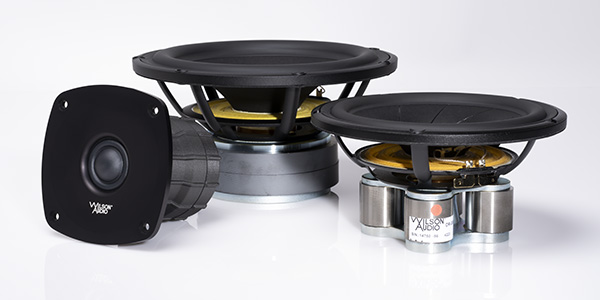
 The technical evolution of the Sabrina V over its forebear, the SabrinaX, can be gleaned by comparing a few key performance indicators. For example, the newcomer still achieves a higher sensitivity than the 87dB specification at 88.9dB despite being slightly less sensitive than the 'X (89.6dB, all ref. 1kHz/2.83V/1m). Also, the V's response is slightly less uniform than its predecessor's (see fig.2) with errors of ±3.80dB/±3.90dB (L/R) versus ±2.85dB/±2.90dB for the 'X (both 200Hz– 20kHz), and it's also a little tougher to drive. However, all this is traded for lower distortion and significantly improved bass extension. I'll dive into the detail a little further into this report, but the background to this shift in subjective 'tone'—and the deeper bass in particular — all stems from Wilson's repurposing of its core range of drivers, pictured below.
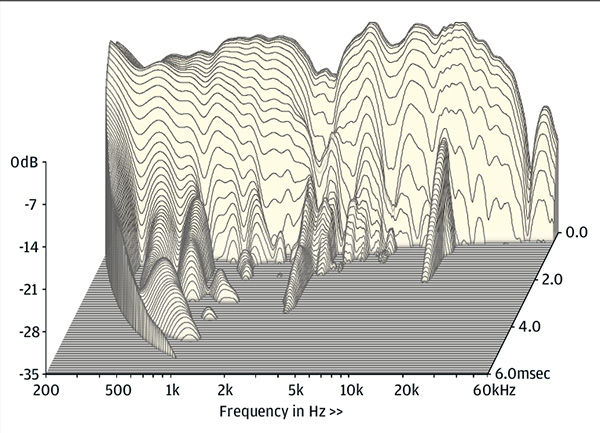
Fig.1 CSD waterfall plot over 6ms and across a 60kHz bandwidth. Cabinet resonances are well suppressed, leaving mild driver modes at 2.3kHz and 15kHz, the former also seen in the WATT/Puppy.
Starting at the top of the cabinet, Wilson's Convergent Synergy Carbon (CSC) tweeter, developed for the Alexx V, is already deployed in the Alexia V, Sasha V, The WATT/Puppy, Mezzo CSC and Alida CSC. It is now added to the Sabrina V. The Sabrina V's 200mm woofer is used in the Sasha V, the WATT/Puppy, and Mezzo CSC, but it differs from the Alexx V's 200mm woofer, which was designed to complement a partnering 255mm woofer. Both Alexx V bass drivers were first deployed in the flagship WAMM Master Chronosonic.
The driver with the most extensive reach across the Wilson ecosystem is the 178mm QuadraMag midrange, developed for the Chronosonic XVX and now trickled down to the Alexx V, Alexia V, Sasha V, WATT/Puppy, Mezzo CSC as well as the Sabrina V.
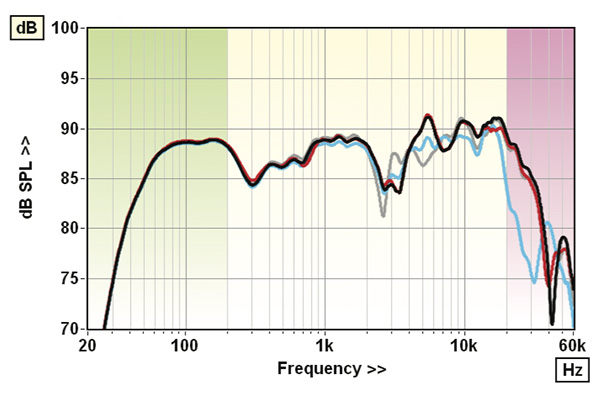
Fig.2 Frequency response including nearfield, summed bass driver and port (green shaded area), freefield corrected to 1m at 2.83V (yellow shade), and ultrasonic (pink shade). Left, black; right, red; ±15°, blue; with grille, gray.
Otherwise, the V's forward response (fig.2) inherits the dips in upper bass, midrange, and presence regions seen with the X, though slightly shifted in frequency. The associated driver resonances are milder, as is the 15kHz dome mode (see the CSD waterfall, fig.1).
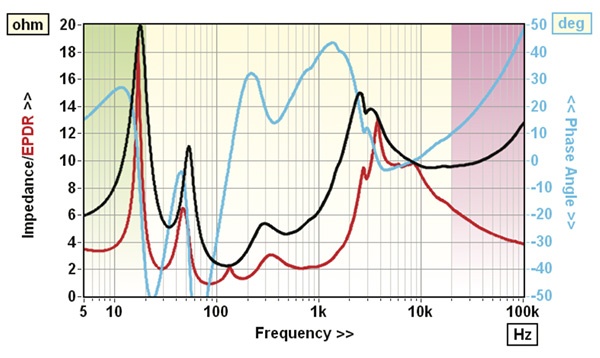
Fig.3 Impedance modulus (black) and phase (blue) and EPDR (equivalent peak dissipation resistance, red), 5Hz–100kHz. Audio range, yellow shade; infrasonic, green shade; ultrasonic, pink shade.
Finally, as I mentioned at the beginning of this report, the Sabrina V's amplifier loading has got a little tougher. While the nominal impedance is quoted as 4 ohms, with an accurately specified 2.2 ohms/121Hz minimum (fig.3, black trace), the accompanying swings in impedance phase from –65°/65Hz to +43°/1.4kHz (blue trace) result in a reasonably tough 0.95 ohm EPDR at 84Hz (red trace). Capable amplifiers only need apply!—Paul Miller