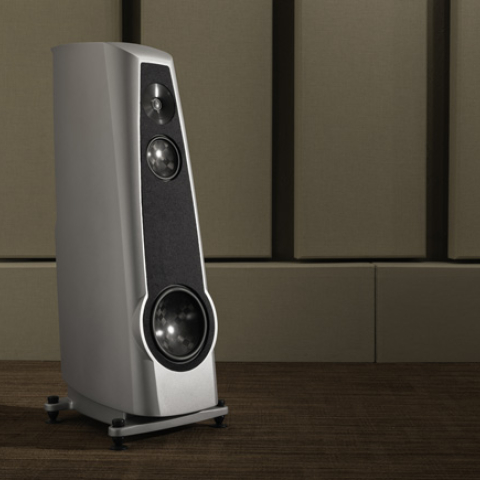
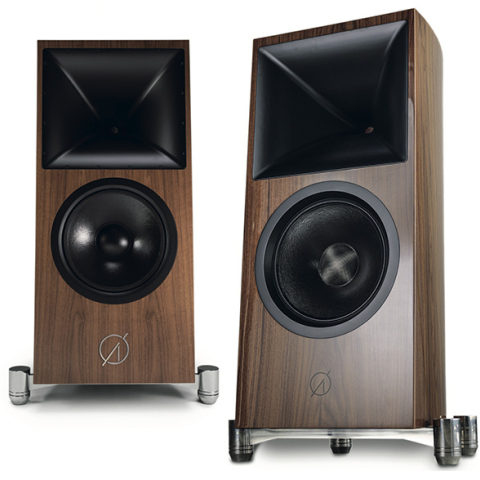
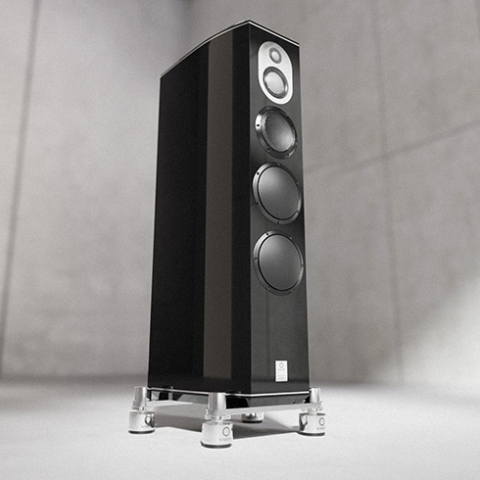
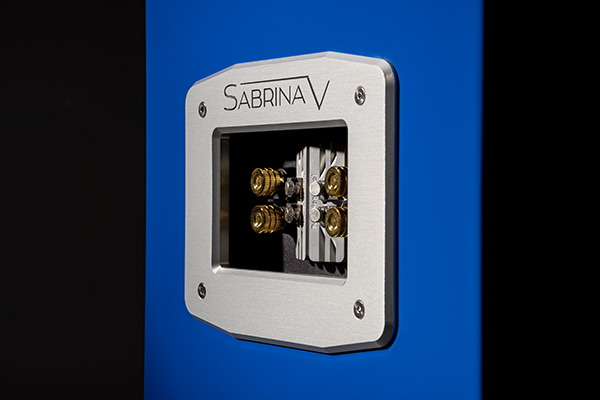
 The obvious starting point for positioning the Sabrinas was the spot usually occupied by the WATT/Puppies, which is also the spot where the Sasha Vs had worked well previously. But when we first fired the Sabrinas up, Peter commented that they "felt a bit closed in." He was correct. This wasn't a placement issue: After a week and a half or so, they began to open up. I can't explain this, though the very close tolerances in many high-performance dynamic loudspeakers make it plausible that things need to loosen up before they start to sound their best. I let the Sabrinas run in for quite a few days with internet radio before trying any positioning experiments or making any listening notes.
When I began to focus, I moved the Sabrinas slightly farther away from my listening chair and placed them slightly closer together. Their final position formed a triangle that was a little more isosceles, no longer equilateral. The sonic result was good frequency balance and a soundstage that was a bit more coherent, especially with the speakers toed in a little.
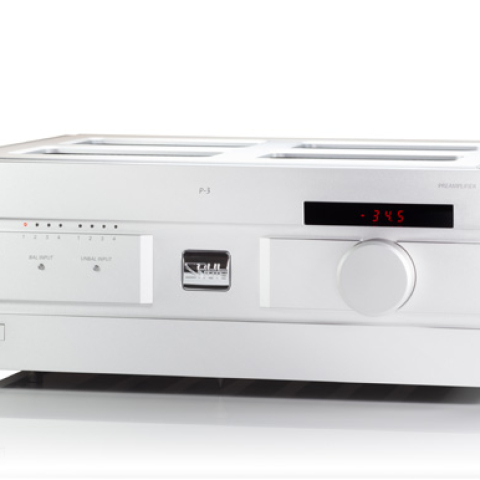
Pleased with their positions, I started to experiment with the electronics. My McIntosh C12000 preamplifier allows me to choose solid state or tubed outputs. At first I felt that the Sabrina Vs benefitted from the Mac pre's solid state circuits, gaining clarity and detail. However, I later found that I preferred the tubed outputs, as I usually do with my WATT/Puppies. Maybe this too was a consequence of the need to wait for the Sabrina Vs to break in. Amplification in my reference rig is the solid state McIntosh MC462, which is specified to deliver 450W into any load.
The obvious starting point for positioning the Sabrinas was the spot usually occupied by the WATT/Puppies, which is also the spot where the Sasha Vs had worked well previously. But when we first fired the Sabrinas up, Peter commented that they "felt a bit closed in." He was correct. This wasn't a placement issue: After a week and a half or so, they began to open up. I can't explain this, though the very close tolerances in many high-performance dynamic loudspeakers make it plausible that things need to loosen up before they start to sound their best. I let the Sabrinas run in for quite a few days with internet radio before trying any positioning experiments or making any listening notes.
When I began to focus, I moved the Sabrinas slightly farther away from my listening chair and placed them slightly closer together. Their final position formed a triangle that was a little more isosceles, no longer equilateral. The sonic result was good frequency balance and a soundstage that was a bit more coherent, especially with the speakers toed in a little.
Pleased with their positions, I started to experiment with the electronics. My McIntosh C12000 preamplifier allows me to choose solid state or tubed outputs. At first I felt that the Sabrina Vs benefitted from the Mac pre's solid state circuits, gaining clarity and detail. However, I later found that I preferred the tubed outputs, as I usually do with my WATT/Puppies. Maybe this too was a consequence of the need to wait for the Sabrina Vs to break in. Amplification in my reference rig is the solid state McIntosh MC462, which is specified to deliver 450W into any load.
I first heard the new Wilson Sabrina V at its product launch at Innovative Audio in midtown Manhattan. Longtime owner Elliot Fishkin presides over one of the longest-surviving brick-and-mortar audiophile dealerships in the metro New York region, and I have enjoyed several listening events in his underground bunker showrooms just south of Central Park. McGrath was on hand to introduce the Sabrina V, which at this session was powered by the Dan D'Agostino Pendulum integrated amplifier. Innovative Audio has three showrooms; the session was held in their medium-sized room, which has a fairly high ceiling. McGrath often plays demos from recordings he has made over the years (footnote 3). Along with a few large-scale tracks that made the oomph capability of the Sabrinas abundantly clear, a real standout piece was a piano/vocal reduction of the last movement of Mahler's Das Lied von der Erde. A solo female vocal and a piano was all it took to make clear that the Sabrina V was a first-class music maker, capable of delivering the emotional goods.
 Back upstate in my own listening room, the new pair of Sabrina Vs broken in, one of the first pieces I took notes on was from Edvard Grieg's Lyric Suite, Op.54, from the set Edvard Grieg: Complete Symphonic Works, Vol.3 from the WDR Symphony Orchestra Köln, Eivind Aadland, conductor (24/48 FLAC, Audite/Qobuz). I heard a piece I don't ever recall hearing before: "Klokkeklang," or "Bell Ringing" (footnote 4). Grieg himself described this brief piece as "absolutely crazy." A friend of Grieg's labeled it "a veritable apotheosis of fifths." Delicate and impressionistic, some measures sound note for-note like the opening of Billy the Kid. Aaron Copland would have seen this score on the piano rack of his teacher, Boulanger; Grieg was big in Paris at the top of the 20th century. Now I know where Copland came from.
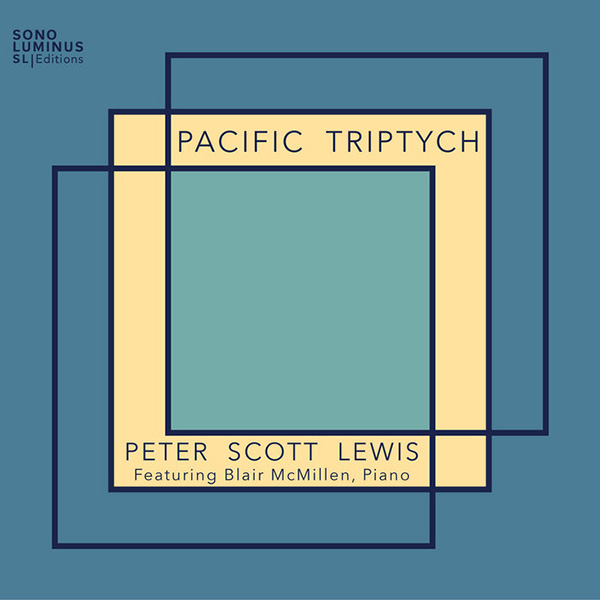 Lewis's music is tight and concise, with active, forward-driving rhythms to the front; it is not spacey trance music. Pacific Triptych was originally scored for orchestra; a solo piano version was completed later. Pianist Blair McMillen performs with strength and conviction on a Hamburg Steinway D, from 1987, at Oktaven Audio in Mount Vernon, New York. Owned by engineer Ryan Streber, Oktaven has one of the larger studio spaces in the New York metro region. The studio has two Steinway Ds, a New York version and the Hamburg. Variation exists from one instrument to the next, but in general the Hamburg-built pianos are known for a more burnished, less forward-sounding tone than their New York cousins—perfect for solo or chamber music recordings.
 Before he started manufacturing audiophile speakers, David Wilson was engineering audiophile recordings. Browsing, I was pleased to find that Chad Kassem's Analogue Productions had reissued Sonatas for Violin and Piano (LP, Wilson Audiophile/Analogue Productions APC-8722, footnote 5), pressed on nice new 180gm vinyl a Quality Record Pressings. This excellent program is performed by violinist David Abel and pianist Julie Steinberg, recorded to tape in the Mills College Concert Hall with a spaced pair of Schoeps microphones. Steinberg plays another fine Hamburg Steinway D; Abel's violin was made by Guarneri in 1719. This is a premier example of fine chamber music sound.
When I mentioned to Daryl Wilson that I had picked this album to listen to, he told me that the album is still in use in Wilson R&D and for demos: "Rumanian Folk Dances is still used as a reference for high-frequency evaluation."
Before he started manufacturing audiophile speakers, David Wilson was engineering audiophile recordings. Browsing, I was pleased to find that Chad Kassem's Analogue Productions had reissued Sonatas for Violin and Piano (LP, Wilson Audiophile/Analogue Productions APC-8722, footnote 5), pressed on nice new 180gm vinyl a Quality Record Pressings. This excellent program is performed by violinist David Abel and pianist Julie Steinberg, recorded to tape in the Mills College Concert Hall with a spaced pair of Schoeps microphones. Steinberg plays another fine Hamburg Steinway D; Abel's violin was made by Guarneri in 1719. This is a premier example of fine chamber music sound.
When I mentioned to Daryl Wilson that I had picked this album to listen to, he told me that the album is still in use in Wilson R&D and for demos: "Rumanian Folk Dances is still used as a reference for high-frequency evaluation."
Is the Wilson Audio Specialties Sabrina V the equal of the larger, costlier loudspeakers in the Wilson lineup? No—but nor are they its equal. It's horses for courses. What best fits your preferences, lifestyle, space, and budget? Though granted, two woofers, or three, can make more sound than a single woofer can. I asked Daryl Wilson how much of the performance of its larger siblings he would ascribe to the Sabrina V at average listening levels (because bigger speakers can play louder). "I would say a Sabrina V owner is getting about 80%–85% of the performance of the WATT/Puppy in the smaller package afforded by the Sabrina V." That sounds about right.
Footnote 3: For those who don't know, McGrath is an accomplished recording engineer. For years he was the lead engineer for Harmonia Mundi, which is known for its excellent sonics. His recording with the Florida Philharmonic under James Judd is my favorite Mahler 1. In the '80s, with Julian Kreeger, McGrath had his own label, Audiofon.—Jim Austin Footnote 4: The Lyric Suite has a complicated history. It is based on the six-part Lyric Pieces, which Grieg composed for piano. In 1894, Anton Seidl, who at the time was the conductor of the New York Philharmonic, orchestrated four of the pieces, including "Klokkeklang." A decade later, Grieg himself revised Seidl's orchestration. He dropped "Klokkeklang" and added another piece, "Shepherd Boy," for strings only. These days, "Klokkeklang" isn't considered part of the Lyric Suite. On the album from WDR Symphony Orchestra Köln, "Klokkeklang" follows the Lyric Suite proper.