A large, thick, unpadded rug covers most of the hardwood floor in the listening space, and the wall behind my chair is covered in shelves filled with books and discs of various types. I've installed acoustic panels and additional rugs in the adjoining areas to further tame the acoustic.
While the listening space, so treated—an ongoing project!—is far from dead, music played there has, for me, a pleasingly spacious quality, without obvious reverb or flutter echo. Bass support is good, if less dramatic than in my prior, fully enclosed 25' by 15.5' by 8' room with its lath-and-plaster walls. But it's also less even than I'd ideally prefer for two-channel sound unassisted by a subwoofer and/or room equalization. (With these speakers and others—welcome to the real world!)
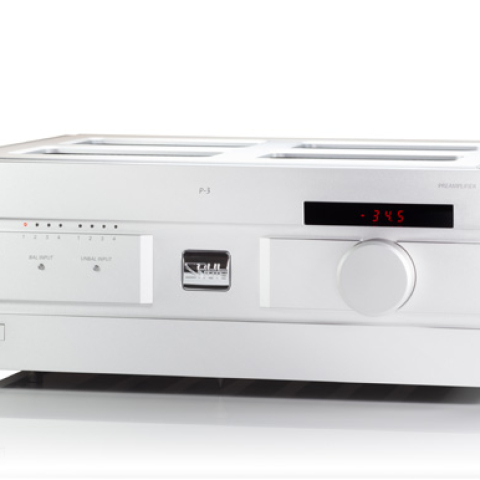
Except where noted, I drove the Thiel TT1s full-range with two-channel sources, using an Integra DTC-9.8 7.1-channel preamplifier-processor primarily as a 2.0-channel preamp in its Direct mode. While a Jeff Rowland Design Group Consummate analog preamplifier was also available, the slightly more open top and tighter bass of the newer Integra (both models were discontinued long ago) better suits the system and room as a whole, and that's what I used for most of my time with the Thiels. A new high-end pre-pro is due to be installed soon, but I stayed with the Integra for this review because I'm fully familiar with its setup, operation, and sound.
 The power amp was a Proceed AMP5. I used only two of its five channels of amplification, each of which is driven by a completely separate power supply and transformer. The Proceed originated, in 1998, from the House of Mark Levinson in its early years under Harman International—I like to think of it as a Levinson Lite. While its specified output of 125Wpc into 8 ohms is modest by today's standards (the AMP5 was discontinued in 2003), it easily enough drove the Thiels as loudly as I desired—and the music required—in my room. The source was a Marantz UD7007 Smart 3D universal Blu-ray player, connected to the Integra with a coaxial digital cable. I mostly listened to CDs, but for the occasional two-channel SACD I used the Rowland preamp connected to the UD7007's analog output (the Integra's main weakness is its analog sound).
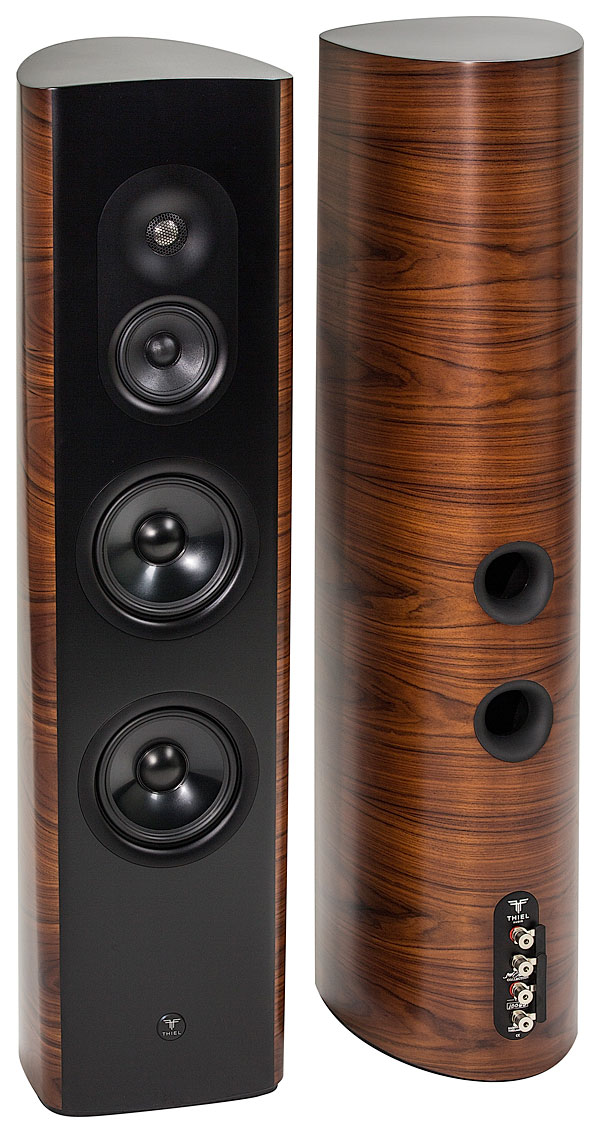
Before doing any listening, serious or otherwise, I broke in the Thiel TT1s for about 100 hours with pink noise.
Listening
The power amp was a Proceed AMP5. I used only two of its five channels of amplification, each of which is driven by a completely separate power supply and transformer. The Proceed originated, in 1998, from the House of Mark Levinson in its early years under Harman International—I like to think of it as a Levinson Lite. While its specified output of 125Wpc into 8 ohms is modest by today's standards (the AMP5 was discontinued in 2003), it easily enough drove the Thiels as loudly as I desired—and the music required—in my room. The source was a Marantz UD7007 Smart 3D universal Blu-ray player, connected to the Integra with a coaxial digital cable. I mostly listened to CDs, but for the occasional two-channel SACD I used the Rowland preamp connected to the UD7007's analog output (the Integra's main weakness is its analog sound).
Before doing any listening, serious or otherwise, I broke in the Thiel TT1s for about 100 hours with pink noise.
Listening
My current area, large overall and slightly livelier than the norm, doesn't allow quite as precise a soundstage as did my previous space, which was smaller, more enclosed, and heavily damped. But despite that and some of my above comments about design philosophy, the Thiel TT1s produced wide, deep, and convincingly detailed images.
For example, the sound of the chorus in John Rutter's Requiem, in the recording by Timothy Seelig and the Turtle Creek Chorale (CD, Reference RR-57CD), came off exceptionally well, the group realistically spread out between the speakers (but not beyond them—a quality I feel is more often an artifact of the speakers and room than something in a recording just waiting to be reproduced). In some passages, the Thiels also resolved individual voices within the chorus. This recording can also provide a compelling sense of depth, and at this the TT1s were equally impressive.
Arne Domnérus and Gustaf Sjökvist's Antiphone Blues (CD, Proprius PRCD 7744) is a superb recording of saxophone and pipe organ in the highly ambient SpÜnga Church, a 12th-century sanctuary in Tensta, Sweden. The odd pairing of instruments works in a program that encompasses everything from hymns, blues, spirituals, and jazz to Schumann and Vivaldi. The Thiels did an outstanding job of fully capturing the church's deep, rich acoustic. While Domnérus's alto saxophone does sound unrealistically huge, that's certainly down to the mix and the acoustic. The only thing the Thiels didn't fully capture was the weight in the lowest reaches of the organ (more on this later)—but they did a good job of concealing this deficiency.
On their I Couldn't Hear Nobody Pray (CD, Warner Bros. 46698-2), the five (yes, five) singers of the Fairfield Four were spread out convincingly from left to right, though image spread was a bit enlarged and less precise in the songs in which the singers are most closely miked. But again, that appears to be a recording choice. And if those closely recorded solo voices (mostly bass-baritone, particularly on "These Bones") were a bit too prominent, the Thiels properly conveyed each singer's unique style and vocal texture. Overall, on this and other good recordings, I had no reservations about the TT1's ability to put forth natural-sounding reproductions of male and female voices without coloration.
The TT1 also produced a wealth of unexaggerated detail. Dean Peer's Travelogue (CD, Fahrenheit FR2451) sounded fast and crisp, but with a natural overall balance. Everything here—from the transients of Dean's electric bass and its rich warmth, the percussion, and the "Hello, pretty girl" from a "parrot" that begins the final track—was convincingly rendered.
One thing about the TT1 that struck me was that it didn't seem to reproduce all recordings with the same sonic signature, as do some speakers—and rooms. Fortunately, the better ones don't; they do their best to re-recreate what's on the recordings. And while no speakers do this perfectly, the closer they come, the better. I can't think of many words to ascribe a "characteristic sound" to the TT1: bright, dull, nasal, boxy, bloated, overly dynamic, showy—none fit. I have to limit myself to smooth yet detailed, uncolored (particularly with well-recorded voices), and tight, somewhat lean bass.
It was the TT1's bass that was my main concern. Not its tightness—audiophiles pine for that—but the leanness. Remember, no reviewer can tell you exactly what a speaker will sound like in your room, only what it sounds like in his or hers—and my listening area is very large. But all of us have to deal with room modes. The upside of that is that, in my space, the inevitable modes weren't as intrusive with the Thiels as they can be with speakers having a more extended bottom end. The TT1's true frequency response might be inherently flat and fairly extended—I'll await John Atkinson's measurements to settle this—but in my room, bass boom was never a problem with these speakers.
Some listeners prefer that sort of well-defined, unaggressive bass. Bass was never obviously lacking in my room, but I could hear when it wasn't quite up to the best I've enjoyed here. Perhaps this was a result of the TT1's small internal volume—or of a deliberate design choice to minimize the inevitable negative impact of most listening-room modes.
This won't trouble all of you. For those it does, and for those whose large rooms offer no cure, there's always the option of adding a subwoofer (or, better yet, two). I did try the TT1s with Revel's long-discontinued Performa B15 subwoofer. For this I used the B15's three channels of built-in parametric equalization, but none of the EQ offered by the Integra preamp-processor (graphic EQ, tone controls, Audyssey MultEQ XT) except for its high/low-pass filter, here set to 100Hz. Indeed, one of the reasons I used the Integra was its ability to switch between its Direct (subwoofer and all extraneous circuitry switched off) and Stereo (subwoofer and high/low-pass filter in circuit) modes with the push of a single button on the remote. This made possible direct A/B comparisons from the listening seat.
Without going into extensive detail (subwoofered TT1s are not the subject of this review): A good subwoofer did improve the TT1's top-to-bottom balance. But with most music it was hard to hear any differences in the bass when I switched in the sub—which was as it should be. There was a subtle and sometimes meaningful loss of top-end air with the subwoofer and the pre-pro's filter engaged. One workaround for this when listening to music would be to drive the Thiels full-range and use a sub's internal low-pass filter. But that approach can make it trickier in some situations to optimally blend a subwoofer with the main channels.
Comparisons
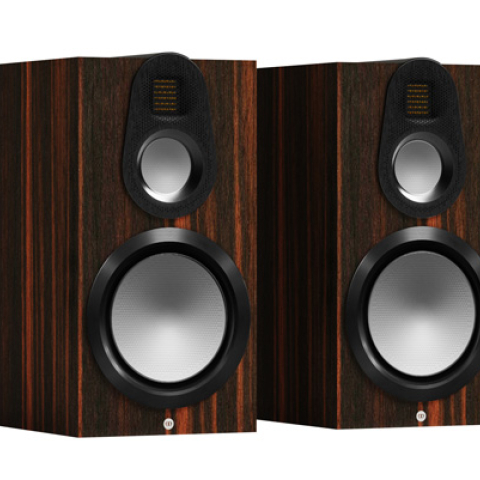
My comparisons were limited to the only current speaker model I had on hand: Monitor Audio's Silver 10 (footnote 2). The Monitor Silver 10 offers a bit more air on top than the Thiel TT1—perhaps this was a simple matter of a slightly elevated mid- and top-treble response. The Thiel was a bit more forward in the lower treble and midrange, but these differences, too, were subtle. The two pairs of speakers produced soundstages equally impressive in width and depth, though the Monitor's extra bit of top-end air subtly enhanced depth with low-level music, such as the quieter passages in Rutter's Requiem. An obvious difference between the two designs was at the bottom end. While the TT1 underperformed a bit down low, the Silver 10 was occasionally a little too eager to chomp into a deep-bass riff. I didn't dislike this; with a good recording of pipe organ or drums, and without a sub, I often heard more at the bottom end from the Monitors than from the Thiels. The Silver 10s captured more of the organ underpinning the chorus in at least a few passages of the Rutter Requiem and some of his other works on that disc. The Monitors were also better than the Thiels at reproducing the big Japanese drums on recordings by the taiko drumming troupe Kodo, both in the drums' initial transient impact and the way in which the sound from the body of the instrument reverberated back into the recording space. But in some ways, the Thiel TT1s chalked up points for not overdoing it. They also seemed less prone to a subtle smearing that may originate in the Monitors' more lively cabinets, though this happened rarely and never troubled me. Though neither speaker is a shy wallflower, some listeners might find the Silver 10s a bit more eager to please overall—perhaps too eager.
Conclusions
In the above comparison, the unmentioned elephant in the room is cost. The Monitor Audio Silver 10 retails for $2498/pair—considerably less than half the price of the Thiel TT1. This is at least partially due to the fact that the Silver 10 is made entirely in China; Thiel uses more expensive US labor to assemble the TT1, and drivers from Scandinavia; only the TT1's cabinet is made in Asia. Beyond that, however, the TT1 faces formidable competition in the $5000–$7000 range from the likes of GoldenEar Technology (Triton One), KEF (R Series), Revel (Performa 3), Sonus Faber (Venere), and more than a few others. But the TT1 makes its case without apologies. It won't dominate a small space, and its honest sound can satisfy even in a very large space over long listening sessions. It deserves a very careful audition.
Footnote 2: Thomas J. Norton reviewed the see Monitor Audio Silver 10 for our sister magazine Sound&Vision. Stereophile hasn't reviewed the Silver 10, but we did review the similar, if slightly smaller, Silver 8 in January 2015.—John Atkinson
The power amp was a Proceed AMP5. I used only two of its five channels of amplification, each of which is driven by a completely separate power supply and transformer. The Proceed originated, in 1998, from the House of Mark Levinson in its early years under Harman International—I like to think of it as a Levinson Lite. While its specified output of 125Wpc into 8 ohms is modest by today's standards (the AMP5 was discontinued in 2003), it easily enough drove the Thiels as loudly as I desired—and the music required—in my room. The source was a Marantz UD7007 Smart 3D universal Blu-ray player, connected to the Integra with a coaxial digital cable. I mostly listened to CDs, but for the occasional two-channel SACD I used the Rowland preamp connected to the UD7007's analog output (the Integra's main weakness is its analog sound).
Before doing any listening, serious or otherwise, I broke in the Thiel TT1s for about 100 hours with pink noise.
ListeningMy current area, large overall and slightly livelier than the norm, doesn't allow quite as precise a soundstage as did my previous space, which was smaller, more enclosed, and heavily damped. But despite that and some of my above comments about design philosophy, the Thiel TT1s produced wide, deep, and convincingly detailed images.
My comparisons were limited to the only current speaker model I had on hand: Monitor Audio's Silver 10 (footnote 2). The Monitor Silver 10 offers a bit more air on top than the Thiel TT1—perhaps this was a simple matter of a slightly elevated mid- and top-treble response. The Thiel was a bit more forward in the lower treble and midrange, but these differences, too, were subtle. The two pairs of speakers produced soundstages equally impressive in width and depth, though the Monitor's extra bit of top-end air subtly enhanced depth with low-level music, such as the quieter passages in Rutter's Requiem. An obvious difference between the two designs was at the bottom end. While the TT1 underperformed a bit down low, the Silver 10 was occasionally a little too eager to chomp into a deep-bass riff. I didn't dislike this; with a good recording of pipe organ or drums, and without a sub, I often heard more at the bottom end from the Monitors than from the Thiels. The Silver 10s captured more of the organ underpinning the chorus in at least a few passages of the Rutter Requiem and some of his other works on that disc. The Monitors were also better than the Thiels at reproducing the big Japanese drums on recordings by the taiko drumming troupe Kodo, both in the drums' initial transient impact and the way in which the sound from the body of the instrument reverberated back into the recording space. But in some ways, the Thiel TT1s chalked up points for not overdoing it. They also seemed less prone to a subtle smearing that may originate in the Monitors' more lively cabinets, though this happened rarely and never troubled me. Though neither speaker is a shy wallflower, some listeners might find the Silver 10s a bit more eager to please overall—perhaps too eager.
In the above comparison, the unmentioned elephant in the room is cost. The Monitor Audio Silver 10 retails for $2498/pair—considerably less than half the price of the Thiel TT1. This is at least partially due to the fact that the Silver 10 is made entirely in China; Thiel uses more expensive US labor to assemble the TT1, and drivers from Scandinavia; only the TT1's cabinet is made in Asia. Beyond that, however, the TT1 faces formidable competition in the $5000–$7000 range from the likes of GoldenEar Technology (Triton One), KEF (R Series), Revel (Performa 3), Sonus Faber (Venere), and more than a few others. But the TT1 makes its case without apologies. It won't dominate a small space, and its honest sound can satisfy even in a very large space over long listening sessions. It deserves a very careful audition.
Footnote 2: Thomas J. Norton reviewed the see Monitor Audio Silver 10 for our sister magazine Sound&Vision. Stereophile hasn't reviewed the Silver 10, but we did review the similar, if slightly smaller, Silver 8 in January 2015.—John Atkinson