Sidebar 5: Measurements
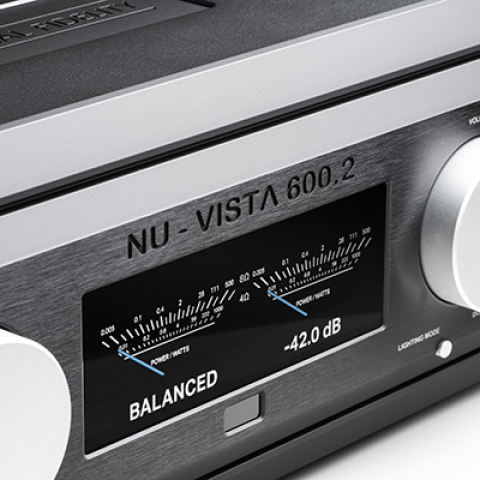
In practice, the core design and performance metrics of the 600.2 integrated amplifier show closer parallels with Musical Fidelity's four-box Nu-Vista PRE/PAS pre/power combination, itself inspired by the legacy Titan amplifier, than it does with its larger sibling, the Nu-Vista 800.2 integrated.
The 600.2 may be the lower-powered model, but, with power ratings of 160W into 8 ohms and 300W into 4 ohms and in practice delivering 200Wpc and 325Wpc into those loads, respectively (ref. 1kHz at 1% THD), it could never be described correctly as low-powered.
Tested via its balanced inputs, the 600.2's 36.8dB gain is some 6dB higher than that of the 800.2 and also of the PRE/PAS combination. At full volume, this equates to an input sensitivity of 41mV (ref. 0dBW) and 517mV to raise the rated 160W into 8 ohms, suggesting that the top 11–12dB of the volume control will not be used with standard 2V line-level sources. Balanced 6V sources will utilize proportionally less of the volume control's range.
The 600.2's 88.9dB A-weighted S/N ratio falls between the 800.2's 86.3dB and the PAS power amp's 94.1dB (all ref. 0dBW). To a greater or lesser degree, all these figures remain better than 85dB, the average A-weighted S/N ratio achieved by all amplifiers tested in the last 40 years. Figures in the mid-90s (dB) are not uncommon these days. The subjective impact of opening the window further remains a topic of debate.
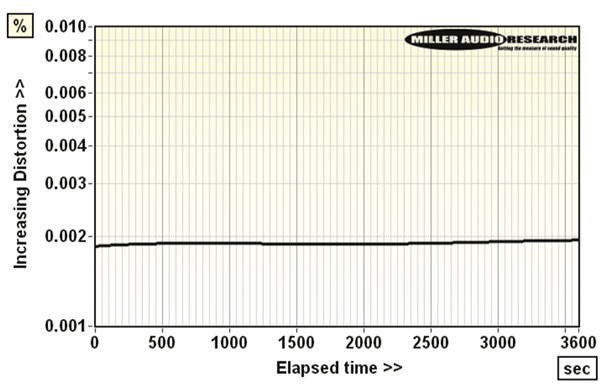
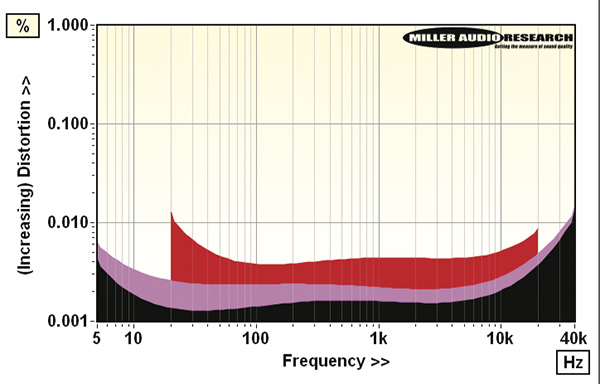
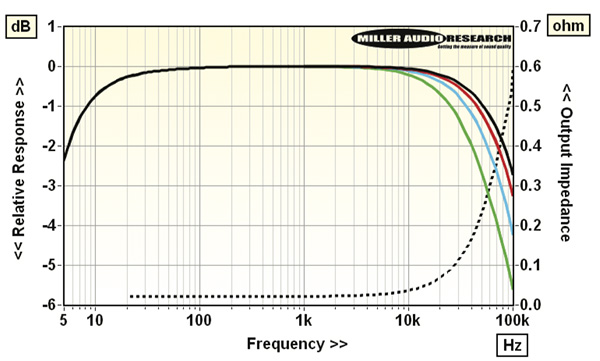
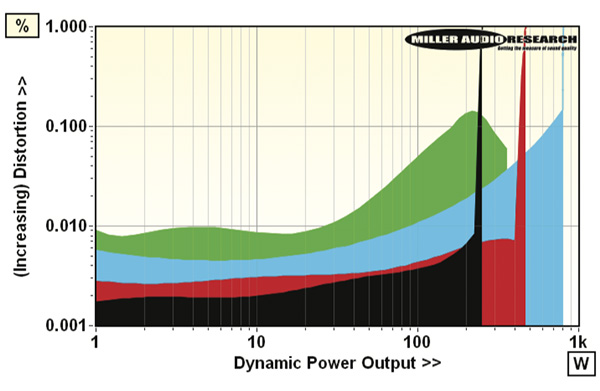
Fig.1 Musical Fidelity Nu-Vista 600.2, Dynamic power output (ref. 1kHz/10ms) versus distortion into 8 ohms (black), 4 ohms (red), 2 ohms (blue), and 1 ohm (green). Note protection into 1 ohm.
Aside from scale, a key difference between the 600.2 and the 800.2 lies in the margin allowed by MF's protection regime. The 800.2 supports 325Wpc into 8 ohms and 575Wpc into 4 ohms with a dynamic capacity of 365W, 705W, 1.3kW, and a full 2.2kW (47A) into 8, 4, 2, and 1 ohm loads, respectively (all ref. 1kHz, 10ms at 1% THD). In common with the PAS power amp, the 600.2 is more conservatively specified into lower-impedance loads. It will deliver 255Wpc, 465Wpc, 800Wpc (20A), and 360Wpc into 8, 4, 2, and 1 ohm loads under dynamic conditions (see fig.1); the PAS is similarly limited to 575W into 2 ohms (17A) and 198W into 1 ohm.
Fig.2 Musical Fidelity Nu-Vista 600.2, Distortion ref. 1kHz/10W/8 ohms output over one hour (3600 seconds), from cold to 45°C max heatsink temperature.
As we have seen with the earlier Nu-Vista amplifiers, distortion is low and very stable with respect to both temperature and frequency. From switch on (cold), distortion increases marginally from 0.00185% to 0.00195% after 1 hour of conditioning at 1kHz, 10W, 8 ohms (see fig.2), at which time the 600.2 registered spot temperatures of ~45°C across its casework.
Fig.3 Musical Fidelity Nu-Vista 600.2, Distortion versus frequency 5Hz–40kHz at 1W/8 ohms (black) and 10W/8 ohms (pink), and 20Hz–20kHz at 100W/8 ohms (red).
Relative to level, distortion shows a very gentle increase from 0.0014% at 1W to 0.002% at 10W, 0.004% at 100W, and 0.005% at the rated 160W (all ref. 1kHz, 8 ohms), while versus frequency, there's a relatively small increase at the low bass/high treble extremes to 0.001% at 20Hz and 0.0035% at 20kHz at 1W and 0.013% at 20Hz and 0.0088% at 20kHz at 100W (fig.3, black and red traces, respectively).
Fig.4 Musical Fidelity Nu-Vista 600.2, Frequency response 5Hz–100kHz into 8 ohms (black), 4 ohms (red), 2 ohms (blue), and 1 ohm (green), all versus output impedance (dashed trace, right-hand Y axis).
The frequency response, meanwhile, is almost identical to that of the PRE/PAS amplifier combination (see fig.4). Within ±1dB limits, the output is flat to 8Hz–52kHz before falling gently to –2.8dB at 100kHz (all ref. 8 ohms). The output impedance is also almost identical to that of the PAS power amp, holding to 0.021–0.07 ohms (20Hz–20kHz) before increasing to 0.59 ohms at 100kHz. This has some small impact on response vs. load impedance, with the maximum deviation of –0.7dB at 20kHz and –5.6dB at 100kHz occurring into nonreactive 1 ohm loads.—Paul Miller