Sidebar 2: What's a Nuvistor?
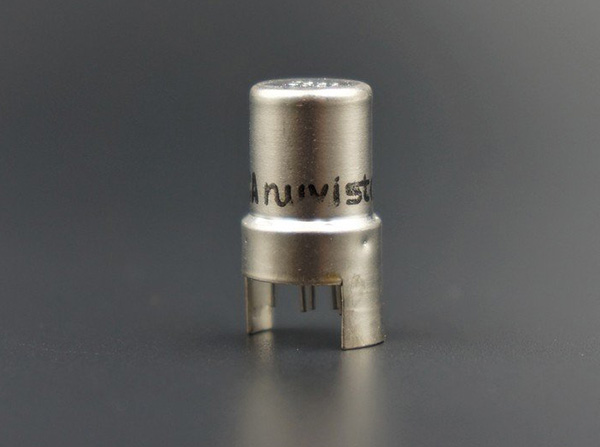 In his introduction to this review, Martin Colloms describes nuvistors as "small, metal-clad vacuum tubes introduced in 1959 to compete with bipolar-junction transistors." Martin's description is perfectly accurate, but there is more to be said. The nuvistor was created to overcome the shortcomings inherent in run-of-the-mill vacuum tubes: size, reliability, microphony, and so on. If you've heard of vacuum tubes on fighter jets, they were probably nuvistors. The Russian MiG-25, which was famously flown to Japan by a defecting pilot in 1976, used nuvistors.
In hi-fi, the first use of a nuvistor was probably 1988's Premier Seven preamplifier. After that it was all Musical Fidelity. Anthony Michaelson, the company's original owner, deployed nuvistors in the first Nu-Vista component, Nu-Vista Preamplifier, in 1998.
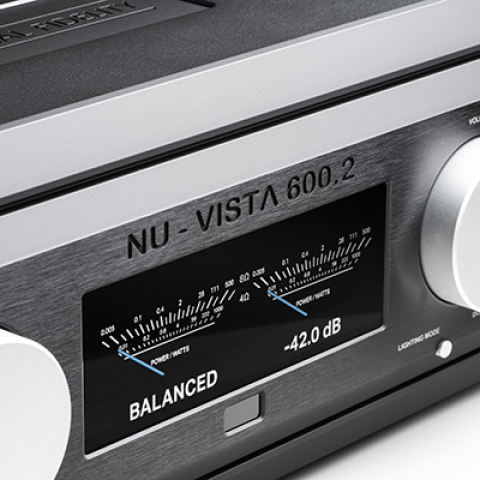
The 7586, the nuvistor used in the 600.2, was the very first one produced. It is a medium-gain triode with an amplification factor in the low 30s. It has 12 pins, though seven of the pins are very short; the five long pins provide the primary connections: to the heater, cathode, grid, and anode. The short pins appear to be structural. Nuvistors are in input or driver stages of power amplifiers or in the preamplification stages of integrated amplifiers.
In the early days, nuvistors were mainly used in televisions, but they have some major advantages in hi-fi. They are highly reliable and have a very long lifetime; they rarely need replacing. They have a wide bandwidth and low noise, and they are energy efficient.
Martin mentioned that an earlier Nu-Vista model was the first power amplifier to use nuvistors, but they have been used before for audio applications. Nuvistors—specifically the 6CW4—were used in '60s-era radio tuners including the Kenwood KW-1100U and the Lafayette HA-55A receiver.
There have also been pro/studio applications. The 7586—the same nuvistor used in the 600.2—was used in the Ampex MR-70 reel-to-reel tape machine from the mid-1960s. The 7586 was also used in microphones, notably the AKG C12a. Originally, the celebrated Neumann U 47—beloved by Frank Sinatra (see this month's Recording of the Month), Ella Fitzgerald, Bing Crosby, Louis Armstrong, Michael Jackson, and the Beatles—used a Telefunken VF14, a different metal-clad vacuum tube. But only 27,000 of those were ever made, and when the supply of suitably high-quality samples ran out, a replacement was needed. Neumann turned to a nuvistor, the 6CW4.—Jim Austin
In his introduction to this review, Martin Colloms describes nuvistors as "small, metal-clad vacuum tubes introduced in 1959 to compete with bipolar-junction transistors." Martin's description is perfectly accurate, but there is more to be said. The nuvistor was created to overcome the shortcomings inherent in run-of-the-mill vacuum tubes: size, reliability, microphony, and so on. If you've heard of vacuum tubes on fighter jets, they were probably nuvistors. The Russian MiG-25, which was famously flown to Japan by a defecting pilot in 1976, used nuvistors.
In hi-fi, the first use of a nuvistor was probably 1988's Premier Seven preamplifier. After that it was all Musical Fidelity. Anthony Michaelson, the company's original owner, deployed nuvistors in the first Nu-Vista component, Nu-Vista Preamplifier, in 1998.
The 7586, the nuvistor used in the 600.2, was the very first one produced. It is a medium-gain triode with an amplification factor in the low 30s. It has 12 pins, though seven of the pins are very short; the five long pins provide the primary connections: to the heater, cathode, grid, and anode. The short pins appear to be structural. Nuvistors are in input or driver stages of power amplifiers or in the preamplification stages of integrated amplifiers.
In the early days, nuvistors were mainly used in televisions, but they have some major advantages in hi-fi. They are highly reliable and have a very long lifetime; they rarely need replacing. They have a wide bandwidth and low noise, and they are energy efficient.
Martin mentioned that an earlier Nu-Vista model was the first power amplifier to use nuvistors, but they have been used before for audio applications. Nuvistors—specifically the 6CW4—were used in '60s-era radio tuners including the Kenwood KW-1100U and the Lafayette HA-55A receiver.
There have also been pro/studio applications. The 7586—the same nuvistor used in the 600.2—was used in the Ampex MR-70 reel-to-reel tape machine from the mid-1960s. The 7586 was also used in microphones, notably the AKG C12a. Originally, the celebrated Neumann U 47—beloved by Frank Sinatra (see this month's Recording of the Month), Ella Fitzgerald, Bing Crosby, Louis Armstrong, Michael Jackson, and the Beatles—used a Telefunken VF14, a different metal-clad vacuum tube. But only 27,000 of those were ever made, and when the supply of suitably high-quality samples ran out, a replacement was needed. Neumann turned to a nuvistor, the 6CW4.—Jim Austin
In his introduction to this review, Martin Colloms describes nuvistors as "small, metal-clad vacuum tubes introduced in 1959 to compete with bipolar-junction transistors." Martin's description is perfectly accurate, but there is more to be said. The nuvistor was created to overcome the shortcomings inherent in run-of-the-mill vacuum tubes: size, reliability, microphony, and so on. If you've heard of vacuum tubes on fighter jets, they were probably nuvistors. The Russian MiG-25, which was famously flown to Japan by a defecting pilot in 1976, used nuvistors.
In hi-fi, the first use of a nuvistor was probably 1988's Premier Seven preamplifier. After that it was all Musical Fidelity. Anthony Michaelson, the company's original owner, deployed nuvistors in the first Nu-Vista component, Nu-Vista Preamplifier, in 1998.
The 7586, the nuvistor used in the 600.2, was the very first one produced. It is a medium-gain triode with an amplification factor in the low 30s. It has 12 pins, though seven of the pins are very short; the five long pins provide the primary connections: to the heater, cathode, grid, and anode. The short pins appear to be structural. Nuvistors are in input or driver stages of power amplifiers or in the preamplification stages of integrated amplifiers.