I began with Muddy Waters's "Good Morning Little Schoolgirl" from his 1964 album Folk Singer (24/192 MQA, Chess/Tidal). Timbres were virtually neutral with just a touch of inviting warmth, dimensionality was impressive, and the guitar's cleanly articulated dynamic nuances drew me in. The Krell K-300i sounded great.
I was equally enamored of the reproduction of mezzo-soprano Marianne Crebassa's rendition, with pianist Fazil Say, of Debussy's "La mer est plus belle ques les cathedrals," from their album Secrets (24/96 WAV/Erato 564483). The sound was smooth and inviting—I loved the warm highs—the illusion of depth quite good if not breath-seizing, and timbres were spot on. To evaluate the bass, I turned to Mahler's Symphony No.3 by Iván Fischer and the Budapest Festival Orchestra (DSD64, Channel Classics CCSA 38817/ NativeDSD) and King Creosote and Jon Hopkins's "John Taylor's Month Away" from Diamond Mine (16/44.1 FLAC, Deep Six/Tidal/Qobuz), where low bass was impressively tight and clear, with forceful slam. Thumbs up all the way. In short order, it had become clear that listening would be a pleasurable and involving experience and not a mere review assignment.
Out of the blue, award-winning keyboard master Robert Silverman emailed to say he was coming to Port Townsend to give a house concert and wanted to hear my system. When he arrived, we used the Rossini DAC and K-300i to listen to tracks from two of his Chopin recordings: Stereophile's February 2018 "Recording of the Month," Chopin's Last Waltz (DSD128, IsoMike 5606, NativeDSD), which was engineered by Ray Kimber, and Chopin: Polonaise-Fantasie and Four Scherzi (24/96 FLAC, Marquis B07GJ2J9BC, Qobuz). Bob was impressed enough to ask if I thought the Krell might be a good match for his home system.
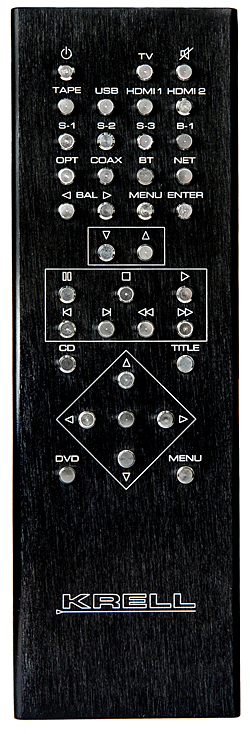 Then we bypassed the $31,498 Rossini DAC/Clock combo and auditioned the Krell's $1000 DAC option. We inserted a USB stick loaded with Silverman's tracks and others into the K-300i's front USB-A port, selected the correct input (Network), and easily controlled playback using the mConnect app I'd previously downloaded to my iPad Pro. Because the Krell's USB-A port can't accept DSD128, we struck out with Silverman's IsoMike recording. Instead, we chose tracks from two other superbly engineered recordings, Crebassa and Say's Secrets and our September 2019 "Recording of the Month," Patricia Barber's Higher (16/44.1 FLAC, ArtistShare AS0171).
Having reviewed both recordings with my reference Rossini DAC, I knew them well enough to note that the K-300i's DAC conveyed less air, transparency, and color contrasts than my reference. The soundstage was smaller and a dearth of harmonics impacted the piano's radiance and vibrancy on the Crebassa, and flattened the sound of double bass on the Barber. But the overall beauty of the music, and its creators' sublime artistry, touched me nonetheless. I hadn't listened to the Barber since writing my review several months before and was delighted anew by the exquisite musicianship of all involved. When we returned to the Rossini, I could hear details such as fingers moving across bass strings that were obscured by the K-300i's DAC.
Days later, I used the Roon app on my iPad to send music from the NUC to the K-300i's DAC via its Ethernet port. On Barber's first two songs, "Muse" and "Surrender," colors were a bit muted, and bass a mite fuzzy. I attempted to hear if those two tracks sounded any different when I used mConnect to play them back from a USB stick inserted into the Krell's USB-A port; if they did, I couldn't hear it. Switching to the first movement of Mahler Symphony No.3 confirmed that, with the Krell's DAC, left/right elements on the soundstage seemed less connected, and the vividness, three-dimensionality, and strong bass that I find so thrilling was diminished. Timbres were still spot on and inviting, but listening was less involving.
Since many audiophiles play their digital files from a computer rather than a dedicated music server, I dragged in a 2017 MacBook Pro, hooked it up to the Rossini via USB, and sent the signal to the K-300i's balanced inputs. With Roon as playback software, the sound on Barber's songs surprised me. While I had expected something noticeably less transparent than through the NUC, the sound was gorgeous, with ideally smooth and correct timbres. Yes, when I ditched the computer and used the NUC instead, highs were clearer, and air and natural sibilance more pronounced and image size increased. The natural radiance and complex overtones of the piano's highs emerged, and I could sense the texture of each note plucked on the bass. But either via computer or dedicated music server (NUC), the sound of the Krell integrated/Rossini DAC combo was wonderful.
Everybody: Look what's going down!
Then we bypassed the $31,498 Rossini DAC/Clock combo and auditioned the Krell's $1000 DAC option. We inserted a USB stick loaded with Silverman's tracks and others into the K-300i's front USB-A port, selected the correct input (Network), and easily controlled playback using the mConnect app I'd previously downloaded to my iPad Pro. Because the Krell's USB-A port can't accept DSD128, we struck out with Silverman's IsoMike recording. Instead, we chose tracks from two other superbly engineered recordings, Crebassa and Say's Secrets and our September 2019 "Recording of the Month," Patricia Barber's Higher (16/44.1 FLAC, ArtistShare AS0171).
Having reviewed both recordings with my reference Rossini DAC, I knew them well enough to note that the K-300i's DAC conveyed less air, transparency, and color contrasts than my reference. The soundstage was smaller and a dearth of harmonics impacted the piano's radiance and vibrancy on the Crebassa, and flattened the sound of double bass on the Barber. But the overall beauty of the music, and its creators' sublime artistry, touched me nonetheless. I hadn't listened to the Barber since writing my review several months before and was delighted anew by the exquisite musicianship of all involved. When we returned to the Rossini, I could hear details such as fingers moving across bass strings that were obscured by the K-300i's DAC.
Days later, I used the Roon app on my iPad to send music from the NUC to the K-300i's DAC via its Ethernet port. On Barber's first two songs, "Muse" and "Surrender," colors were a bit muted, and bass a mite fuzzy. I attempted to hear if those two tracks sounded any different when I used mConnect to play them back from a USB stick inserted into the Krell's USB-A port; if they did, I couldn't hear it. Switching to the first movement of Mahler Symphony No.3 confirmed that, with the Krell's DAC, left/right elements on the soundstage seemed less connected, and the vividness, three-dimensionality, and strong bass that I find so thrilling was diminished. Timbres were still spot on and inviting, but listening was less involving.
Since many audiophiles play their digital files from a computer rather than a dedicated music server, I dragged in a 2017 MacBook Pro, hooked it up to the Rossini via USB, and sent the signal to the K-300i's balanced inputs. With Roon as playback software, the sound on Barber's songs surprised me. While I had expected something noticeably less transparent than through the NUC, the sound was gorgeous, with ideally smooth and correct timbres. Yes, when I ditched the computer and used the NUC instead, highs were clearer, and air and natural sibilance more pronounced and image size increased. The natural radiance and complex overtones of the piano's highs emerged, and I could sense the texture of each note plucked on the bass. But either via computer or dedicated music server (NUC), the sound of the Krell integrated/Rossini DAC combo was wonderful.
Everybody: Look what's going down!
It doesn't take a weatherman with a PhD to know that the wind blows foul when comparing a $1000 DAC to a setup costing 30.5 times more. In the interest of fairness, I enlisted the excellent Mytek Brooklyn DAC+ ($2195), which has balanced analog outputs but lacks a network connection. It was easy to connect the Mytek to the K-300i and compare its sound to the more-than-14-times-more-expensive Rossini's—the Mytek's highs were a little bright, bass was a mite muffled and diminished, and transparency, depth of color and soundstage, and air were all "less than." However, due to the complexity of my reference system's elaborate noise-isolation scheme—a complexity that compelled Jim Austin to don his starched collar and preach the values of simplicity—directly comparing the sounds of the Mytek and Krell DACs involved more finagling than you would ever want to read about. Ultimately, each had its sonic strong points, but the Krell, which required no additional power cable or space and could accept network signals, triumphed in the cost/practicality department.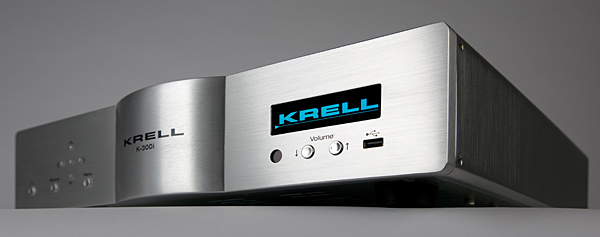 Right before it was time to return from the K-300i to my 6.33-times-more-expensive Progression monoblocks, friend Peter Schwartzman and his audiophile buddy David came by for last listens. Our tracks included the Barber and Mahler, soul vet Bettye LaVette's "Crazy" from Thankful N' Thoughtful "Deluxe Edition" (24/96 Flac/Qobuz), Yello's "Electrified II" from Toy (24/48 WAV, Polydor 4782160/HDtracks), Will.i.am's title track from #thatPower, featuring Justin Bieber (16/44.1 FLAC, Interscope Records UICS-9136/7), and, for that last little bit of pounding bass and blaring brass, Eiji Oue and the Minnesota Orchestra's Keith Johnson-recorded version of Copland's Fanfare for the Common Man from Copland 100 (16/44.1 WAV, Reference Recordings RR-93). David was wowed, and I loved every second of everything I heard. As for Peter, his comment that the K-300i might be the perfect integrated for our doctor/musician friend, Gary Forbes, led me to say that compared to all the other integrated amps I'd ever brought to Gary's for a listen, the Krell's sound was the most neutral, transparent, and satisfying on every level.
Yes, the D'Agostino Progression monos sounded even more neutral than the Krell K-300i. Images were larger, and the soundstage bigger. I heard more depth to voice and bass, and more harmonics on the piano. Barber's hushed singing seemed even more intimate and refined. That recording sounded so exquisite that I wanted to cry. (To those who may doubt these words I say: You don't know me.)
Also with my reference D'Agostino monoblocks, when I turned to one of the recordings I'd reviewed with the Krell integrated, Yannick Nézet-Séguin's version of Mozart's Die Zauberflöte (24/96 WAV, Deutsche Grammophon B003069702), I heard more resonance in the marvelous voice of bass Franz-Josef Selig, which also sounded larger. On Fischer's Mahler Third, it was easy to hear that, at the symphony's beginning, some of the drums were positioned offstage, behind the right side of the orchestra. And to turn from the sublime to the soulful (not that they're mutually exclusive), the guitar on LaVette's "Crazy" sounded even nastier (as it should) with the Krell.
I'm hardly the final authority on integrated amplifiers, having reviewed exactly four. But of all of them, the one whose sound stands out most in my mind is the Krell K-300i. It has the smoothest, most listenable, and most all-of-one-piece sonics of the lot; it isn't a supreme challenge to move around; and it offers an optional DAC that is surprisingly musical and satisfying for the price. The Krell is also Roon-ready, does well by DSD and MQA, and offers streaming options that some much-higher-priced components lack. There's a round edge to its images that some might equate with the gentlest sprinkling of warmth, but others would describe as listener-friendly. It certainly leaves me smiling. If the Krell K-300i doesn't end up with a Class A $$$ (for high value) rating in Stereophile's next Recommended Components, the man might as well come and take me away. Hey, since that could happen regardless, take a listen soon, so I can find out what you think before it's too late...
Right before it was time to return from the K-300i to my 6.33-times-more-expensive Progression monoblocks, friend Peter Schwartzman and his audiophile buddy David came by for last listens. Our tracks included the Barber and Mahler, soul vet Bettye LaVette's "Crazy" from Thankful N' Thoughtful "Deluxe Edition" (24/96 Flac/Qobuz), Yello's "Electrified II" from Toy (24/48 WAV, Polydor 4782160/HDtracks), Will.i.am's title track from #thatPower, featuring Justin Bieber (16/44.1 FLAC, Interscope Records UICS-9136/7), and, for that last little bit of pounding bass and blaring brass, Eiji Oue and the Minnesota Orchestra's Keith Johnson-recorded version of Copland's Fanfare for the Common Man from Copland 100 (16/44.1 WAV, Reference Recordings RR-93). David was wowed, and I loved every second of everything I heard. As for Peter, his comment that the K-300i might be the perfect integrated for our doctor/musician friend, Gary Forbes, led me to say that compared to all the other integrated amps I'd ever brought to Gary's for a listen, the Krell's sound was the most neutral, transparent, and satisfying on every level.
Yes, the D'Agostino Progression monos sounded even more neutral than the Krell K-300i. Images were larger, and the soundstage bigger. I heard more depth to voice and bass, and more harmonics on the piano. Barber's hushed singing seemed even more intimate and refined. That recording sounded so exquisite that I wanted to cry. (To those who may doubt these words I say: You don't know me.)
Also with my reference D'Agostino monoblocks, when I turned to one of the recordings I'd reviewed with the Krell integrated, Yannick Nézet-Séguin's version of Mozart's Die Zauberflöte (24/96 WAV, Deutsche Grammophon B003069702), I heard more resonance in the marvelous voice of bass Franz-Josef Selig, which also sounded larger. On Fischer's Mahler Third, it was easy to hear that, at the symphony's beginning, some of the drums were positioned offstage, behind the right side of the orchestra. And to turn from the sublime to the soulful (not that they're mutually exclusive), the guitar on LaVette's "Crazy" sounded even nastier (as it should) with the Krell.
I'm hardly the final authority on integrated amplifiers, having reviewed exactly four. But of all of them, the one whose sound stands out most in my mind is the Krell K-300i. It has the smoothest, most listenable, and most all-of-one-piece sonics of the lot; it isn't a supreme challenge to move around; and it offers an optional DAC that is surprisingly musical and satisfying for the price. The Krell is also Roon-ready, does well by DSD and MQA, and offers streaming options that some much-higher-priced components lack. There's a round edge to its images that some might equate with the gentlest sprinkling of warmth, but others would describe as listener-friendly. It certainly leaves me smiling. If the Krell K-300i doesn't end up with a Class A $$$ (for high value) rating in Stereophile's next Recommended Components, the man might as well come and take me away. Hey, since that could happen regardless, take a listen soon, so I can find out what you think before it's too late...
Then we bypassed the $31,498 Rossini DAC/Clock combo and auditioned the Krell's $1000 DAC option. We inserted a USB stick loaded with Silverman's tracks and others into the K-300i's front USB-A port, selected the correct input (Network), and easily controlled playback using the mConnect app I'd previously downloaded to my iPad Pro. Because the Krell's USB-A port can't accept DSD128, we struck out with Silverman's IsoMike recording. Instead, we chose tracks from two other superbly engineered recordings, Crebassa and Say's Secrets and our September 2019 "Recording of the Month," Patricia Barber's Higher (16/44.1 FLAC, ArtistShare AS0171).
Having reviewed both recordings with my reference Rossini DAC, I knew them well enough to note that the K-300i's DAC conveyed less air, transparency, and color contrasts than my reference. The soundstage was smaller and a dearth of harmonics impacted the piano's radiance and vibrancy on the Crebassa, and flattened the sound of double bass on the Barber. But the overall beauty of the music, and its creators' sublime artistry, touched me nonetheless. I hadn't listened to the Barber since writing my review several months before and was delighted anew by the exquisite musicianship of all involved. When we returned to the Rossini, I could hear details such as fingers moving across bass strings that were obscured by the K-300i's DAC.
Days later, I used the Roon app on my iPad to send music from the NUC to the K-300i's DAC via its Ethernet port. On Barber's first two songs, "Muse" and "Surrender," colors were a bit muted, and bass a mite fuzzy. I attempted to hear if those two tracks sounded any different when I used mConnect to play them back from a USB stick inserted into the Krell's USB-A port; if they did, I couldn't hear it. Switching to the first movement of Mahler Symphony No.3 confirmed that, with the Krell's DAC, left/right elements on the soundstage seemed less connected, and the vividness, three-dimensionality, and strong bass that I find so thrilling was diminished. Timbres were still spot on and inviting, but listening was less involving.
Since many audiophiles play their digital files from a computer rather than a dedicated music server, I dragged in a 2017 MacBook Pro, hooked it up to the Rossini via USB, and sent the signal to the K-300i's balanced inputs. With Roon as playback software, the sound on Barber's songs surprised me. While I had expected something noticeably less transparent than through the NUC, the sound was gorgeous, with ideally smooth and correct timbres. Yes, when I ditched the computer and used the NUC instead, highs were clearer, and air and natural sibilance more pronounced and image size increased. The natural radiance and complex overtones of the piano's highs emerged, and I could sense the texture of each note plucked on the bass. But either via computer or dedicated music server (NUC), the sound of the Krell integrated/Rossini DAC combo was wonderful.
It doesn't take a weatherman with a PhD to know that the wind blows foul when comparing a $1000 DAC to a setup costing 30.5 times more. In the interest of fairness, I enlisted the excellent Mytek Brooklyn DAC+ ($2195), which has balanced analog outputs but lacks a network connection. It was easy to connect the Mytek to the K-300i and compare its sound to the more-than-14-times-more-expensive Rossini's—the Mytek's highs were a little bright, bass was a mite muffled and diminished, and transparency, depth of color and soundstage, and air were all "less than." However, due to the complexity of my reference system's elaborate noise-isolation scheme—a complexity that compelled Jim Austin to don his starched collar and preach the values of simplicity—directly comparing the sounds of the Mytek and Krell DACs involved more finagling than you would ever want to read about. Ultimately, each had its sonic strong points, but the Krell, which required no additional power cable or space and could accept network signals, triumphed in the cost/practicality department.
Right before it was time to return from the K-300i to my 6.33-times-more-expensive Progression monoblocks, friend Peter Schwartzman and his audiophile buddy David came by for last listens. Our tracks included the Barber and Mahler, soul vet Bettye LaVette's "Crazy" from Thankful N' Thoughtful "Deluxe Edition" (24/96 Flac/Qobuz), Yello's "Electrified II" from Toy (24/48 WAV, Polydor 4782160/HDtracks), Will.i.am's title track from #thatPower, featuring Justin Bieber (16/44.1 FLAC, Interscope Records UICS-9136/7), and, for that last little bit of pounding bass and blaring brass, Eiji Oue and the Minnesota Orchestra's Keith Johnson-recorded version of Copland's Fanfare for the Common Man from Copland 100 (16/44.1 WAV, Reference Recordings RR-93). David was wowed, and I loved every second of everything I heard. As for Peter, his comment that the K-300i might be the perfect integrated for our doctor/musician friend, Gary Forbes, led me to say that compared to all the other integrated amps I'd ever brought to Gary's for a listen, the Krell's sound was the most neutral, transparent, and satisfying on every level.
Yes, the D'Agostino Progression monos sounded even more neutral than the Krell K-300i. Images were larger, and the soundstage bigger. I heard more depth to voice and bass, and more harmonics on the piano. Barber's hushed singing seemed even more intimate and refined. That recording sounded so exquisite that I wanted to cry. (To those who may doubt these words I say: You don't know me.)