Sidebar 3: Measurements
I used my Audio Precision SYS2722 system to measure the HiFi Rose RA280. While the manufacturer describes the RA280 as a "class-AD" design, it appears to have a class-D output stage for its two channels. Because class-D amplifiers emit relatively high levels of ultrasonic noise that would drive my analyzer's input into slew-rate limiting—the RA280 emitted enough RF noise to interfere with reception on the portable FM radio I keep in my test lab—I inserted an Audio Precision AUX-0025 passive low-pass filter between the test load and the analyzer. This filter mitigates noise above 80kHz and eliminates noise above 200kHz. Without the filter, 79mV of ultrasonic noise was present in the amplifier's output, with a center frequency of 574kHz. I used the Audio Precision filter for all tests other than the frequency and tone control responses. As the HiFi Rose is a class-D design, there was no need to precondition it before testing. Nevertheless, I operated it for 30 minutes at a moderate power into 8 ohms before starting the testing; after that period, the top panel's temperature measured 101.1°F/38.4°C.
Looking first at the behavior of the line-level inputs, the HiFi Rose amplifier preserved absolute polarity at the loudspeaker and subwoofer outputs with both input types. The balanced input was wired with pin 2 hot, the AES standard. The maximum voltage gain at 1kHz into 8 ohms was 37.5dB at the speaker outputs for the balanced input and 6dB higher for the single-ended inputs. The maximum gain at the single subwoofer output was 4.6dB for the balanced input, 10.6dB for the single-ended inputs. This was with both the left and right input channels driven. With just one channel driven, the gain at the subwoofer output dropped by 6dB, implying that this output sums the left and right input channels.
The HiFi Rose RA280 offers high power with very low distortion into resistive loads, and its MM-compatible phono input also featured very low distortion with accurate RIAA equalization. The rise in output impedance at the top of the audioband isn't in itself a cause for concern, but it might lead to the amplifier's treble character being dependent on the speakers with which it is used.—John Atkinson
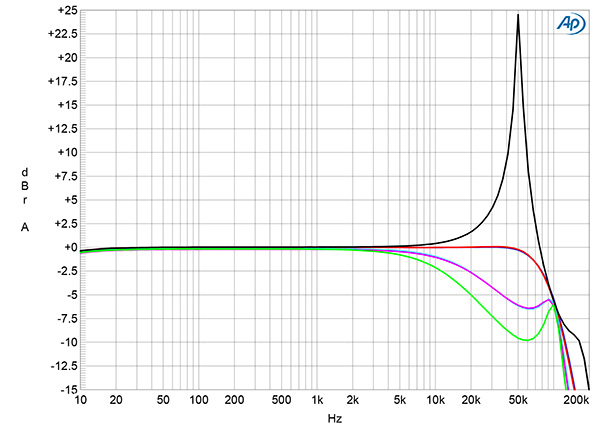
Fig.1 HiFi Rose RA280, frequency response in bypass mode at 2.83V into: simulated loudspeaker load (gray), 8 ohms (left channel blue, right red), 4 ohms (left cyan, right magenta), and 2 ohms (green) (5dB/vertical div.).
The balanced input impedance was 90k ohms at 20Hz and 1kHz, dropping inconsequentially to 82k ohms at 20kHz. The single-ended input impedance was 4.7k ohms at 20Hz and 1kHz, 4.4k ohms at 20kHz. The subwoofer output impedance was 590 ohms across the audioband. The loudspeaker output impedance was very low, at 20Hz and 1kHz, at 0.03 ohms, though it rose significantly at 20kHz, to 1.65 ohms. The variation in the amplifier's frequency response with our standard simulated loudspeaker (fig.1, gray trace) was negligible in the audioband, but there was a 25dB-high peak at 50kHz, presumably due to a significant increase in the output impedance above the audioband interacting with the dummy load's increasingly inductive phase angle. The response into a resistive 8 ohm load (blue and red traces) was flat in the audioband but rolled off at ultrasonic frequencies, reaching –3dB at 90kHz. The response into 4 ohms (cyan, magenta traces) and 2 ohms (green trace) rolled off above 10kHz, respectively reac ing –3dB at 22kHz and 12kHz; a small peak developed at 100kHz.
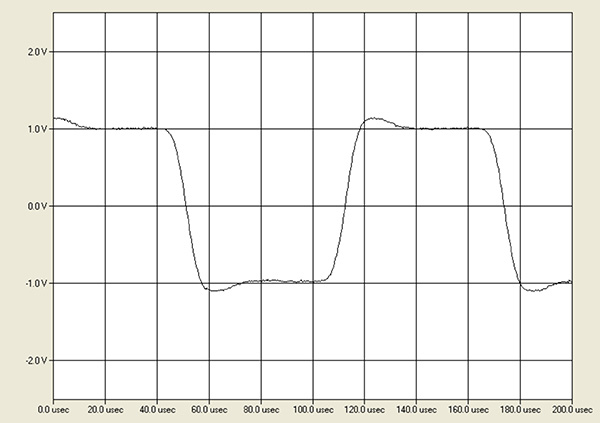
Fig.2 HiFi Rose RA280, small-signal 10kHz squarewave into 8 ohms.
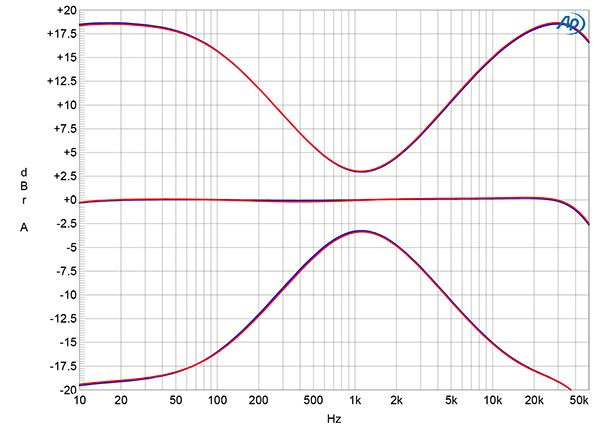
Fig.3 HiFi Rose RA280, frequency response at 2.83V into 8 ohms with bass and treble controls set to the minimum, central, and maximum positions (left channel blue, right red; 5dB/vertical div.).
Fig.1 was taken with the volume control set to the maximum; the channels are well-matched, but when I repeated the 8 ohm measurement with the control set to –12dB, I observed a 0.5dB imbalance in favor of the left channel. The response at the subwoofer output was full-range, reaching –2dB at 200kHz. The HiFi Rose's reproduction of a 10kHz squarewave into 8 ohms, taken with the Audio Precision ultrasonic filter, featured relatively short risetimes (fig.2), with a small, critically damped overshoot. Fig.3 shows the response into 8 ohms with the bass and treble controls activated and set to their minimum, central, and maximum positions. The maximum boost and cut is almost 20dB, which is more than is practically useful.
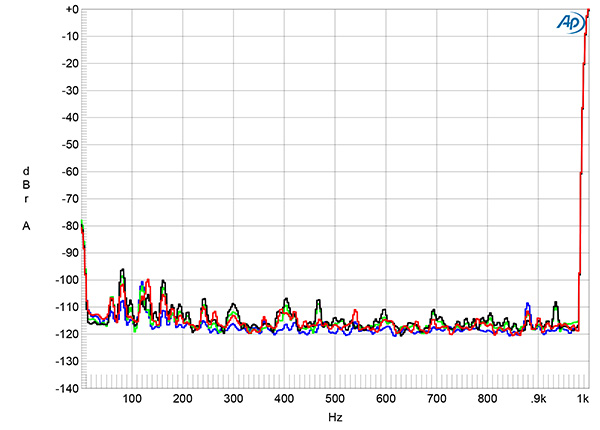
Fig.4 HiFi Rose RA280, spectrum of 1kHz sinewave, DC–1kHz, at 1W into 8 ohms with volume control set to the maximum (left channel blue, right red) and to –12dB ((left channel green, right gray) (linear frequency scale).
The channel separation was good in both directions below 3kHz, at 70dB, and still 60dB at 20kHz. The amplifier's unweighted, wideband signal/noise ratio, taken with the single-ended inputs shorted to ground and with the Audio Precision low-pass filter, was a good 72.4dB ref. 1W into 8 ohms. This ratio improved to 79.9dB when the measurement bandwidth was restricted to the audioband, and to 82dB when A-weighted. Spectral analysis of the low-frequency noisefloor as the HiFi Rose drove a 1kHz tone at 1W into 8 ohms with the volume control set to the maximum revealed that the random noisefloor was low in level (fig.4, blue and red traces). Repeating the analysis with the volume control set to –12dB and the input signal 12dB larger, so that the output remained at 1W into 8 ohms, gave a very similar result (green, gray traces). The noise must therefore be introduced after the control.
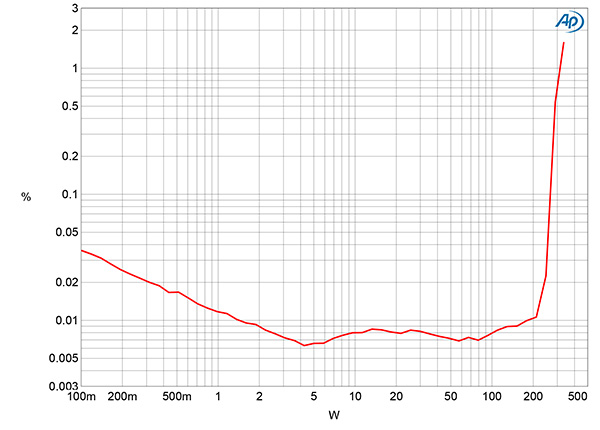
Fig.5 HiFi Rose RA280, distortion (%) vs 1kHz continuous output power into 8 ohms.
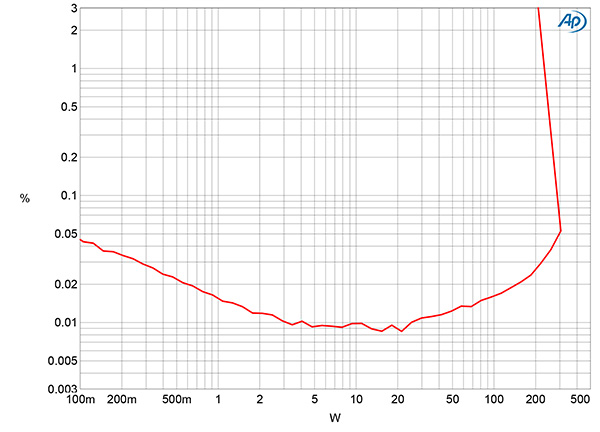
Fig.6 HiFi Rose RA280, distortion (%) vs 1kHz continuous output power into 4 ohms.
HiFi Rose specifies the RA280's maximum power as 250W into both 8 ohms and 4 ohms; these powers are equivalent to 24.15dBW and 21.15dBW. We define clipping as the point at which the THD+noise reaches 1%. The HiFi Rose amplifier exceeded the specified power into 8 ohms with a 1kHz signal, clipping with both channels driven at 300Wpc into 8 ohms (24.8dBW, fig.5). Fig.6 shows how the THD+N varied with power into 4 ohms, again with both channels driven. The amplifier delivers 305W at 0.053% THD+N but appeared to go into protection mode above that power. The FTC's updated "Amplifier Rule" states that maximum power should also be assessed at frequencies other than 1kHz. I therefore repeated the clipping test with a 20kHz signal. The THD+N reached 1% at just above the specified 250W into 8 ohms with this frequency.
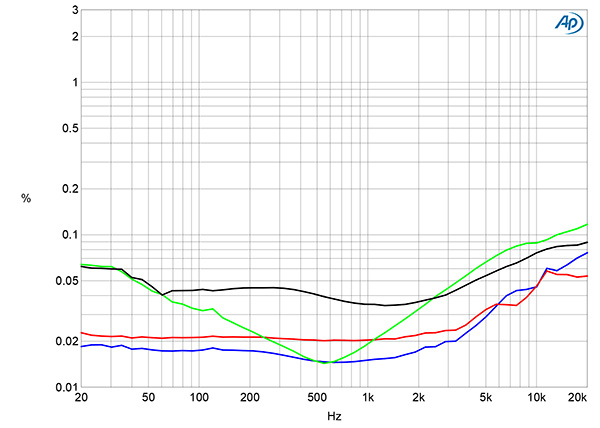
Fig.7 HiFi Rose RA280, THD+N (%) vs frequency at 20V into: 8 ohms (left channel blue, right red) and 4 ohms (left green, right gray).
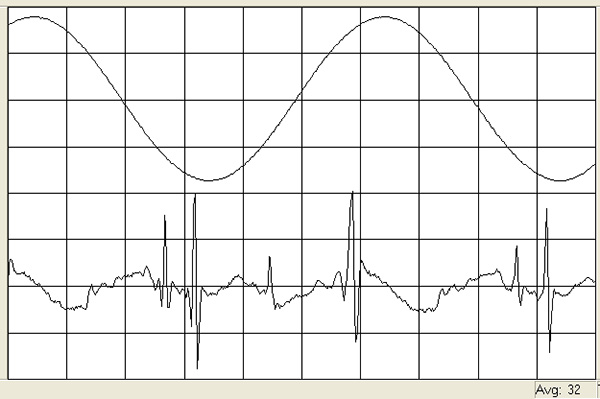
Fig.8 HiFi Rose RA280, 1kHz waveform at 50W into 8 ohms, 0.012% THD+N (top); distortion and noise waveform with fundamental notched out (bottom, not to scale).
I examined how the THD+N percentage varied with frequency at 20V, which is equivalent to 50W into 8 ohms and 100W into 4 ohms (fig.7). Overall, the THD+N was very low into both loads; it did rise above 3kHz, which will be due to the circuit's limited open-loop bandwidth. The bottom trace in fig.8 shows the distortion waveform at 50W into 8 ohms. Even though this graph was taken with the Audio Precision ultrasonic filter, bursts of HF noise are present just before each waveform peak.
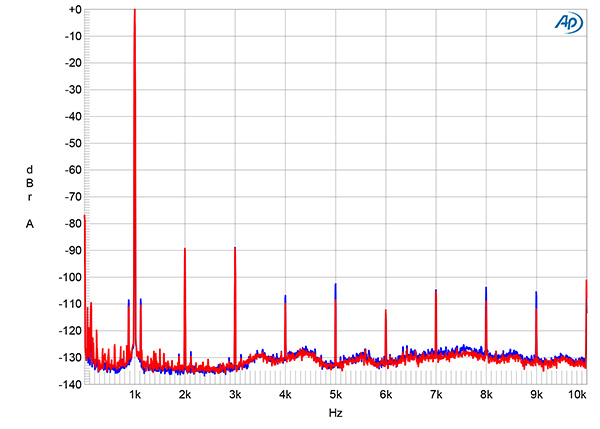
Fig.9 HiFi Rose RA280, spectrum of 1kHz sinewave, DC–1kHz, at 50W into 8 ohms (linear frequency scale).
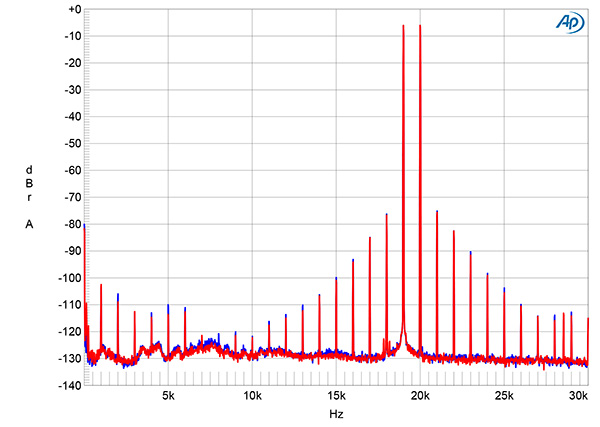
Fig.10 HiFi Rose RA280, HF intermodulation spectrum, DC–30kHz, 19+20kHz at 50W peak into 8 ohms (linear frequency scale).
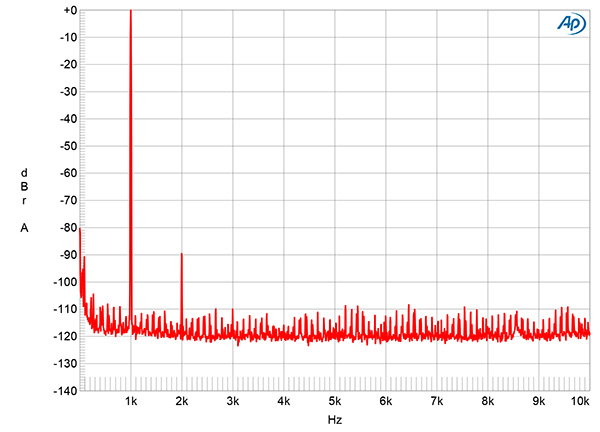
Spectral analysis (fig.9) reveals that the second and third harmonics were highest in level, but these lay at a very low –90dB (0.003%). While higher-order harmonics are present, these all lie below –100dB (0.001%). The 1kHz difference product with an equal mix of 19kHz and 20kHz tones at 50W peak into 8 ohms lay below –100dB (fig.10), but the higher-order, higher-frequency intermodulation products were much higher in level.
To examine the performance of the R280's MM-compatible phono input, I connected a wire from the grounding terminal on the amplifier's rear panel to the analyzer's chassis ground to minimize noise. To avoid overdriving the output stage, I mostly did this testing by looking at the subwoofer output, with the volume control set to –20dB, except where noted.
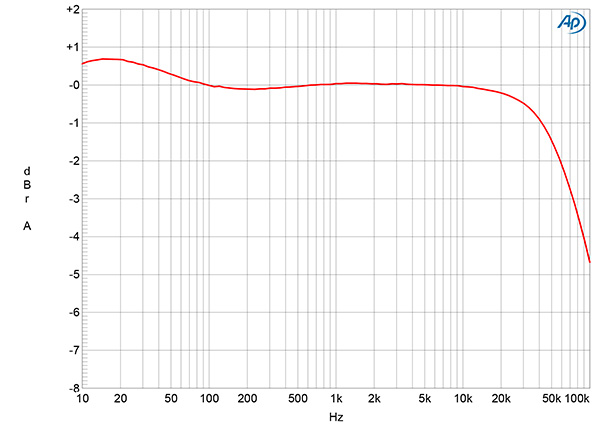
Fig.11 HiFi Rose RA280, phono input, response with RIAA correction (left channel blue, right red; 1dB/vertical div.).
The phono input preserved absolute polarity at both the loudspeaker and subwoofer outputs. The maximum gain with one channel driven was 78.9dB from the loudspeaker output into 8 ohms and 40.1dB from the subwoofer output. The input impedance was the specified 47k ohms at 1kHz, rising to 100k ohms at the bottom and top of the audioband. The RA280's RIAA equalization, measured at the wide-bandwidth subwoofer output, was extremely accurate, other than a small boost in the low bass (fig.11).
With the phono inputs shorted to ground and the volume control set to the maximum, the HiFi Rose's phono input's unweighted, wideband S/N ratio, measured at the subwoofer output and ref. 1kHz at 5mV, was a good 63dB. Restricting the measurement bandwidth to 22Hz– 22kHz increased this ratio to an excellent 86dB, while inserting an A-weighting filter improved it further to 92.3dB.
Fig.12 HiFi Rose RA280, phono input, spectrum of 1kHz sinewave, DC–1kHz, at 10mV input (left channel blue, right red; 20dB/vertical div.).
To examine the RA280 phono input's overload margins, I reduced the volume control setting to –30dB, to ensure I was looking at true input overload rather than clipping at the subwoofer output. The margin ref. 1kHz at the standard moving magnet level of 5mV was a good 17.4dB at 20Hz and 1kHz. However, I wasn't able to get consistent readings at 20kHz. The phono input offered very low distortion. With a 1kHz input signal at 10mV, the only distortion harmonic that could be seen above the noisefloor was the second, at –90dB (0.003%, fig.12). Intermodulation distortion was similarly low (not shown).