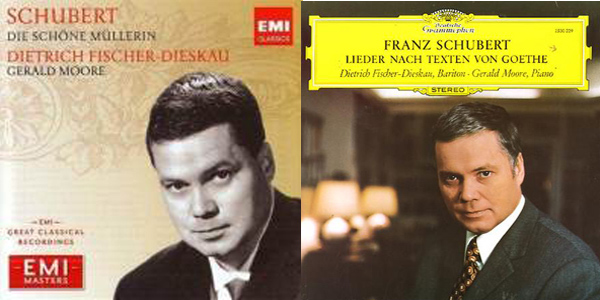
If any single voice was synonymous with the flowering of the LP era, it was that of German baritone Dietrich Fischer-Dieskau. The great artist's death at his home in Bavaria on Friday, May 18, 10 days short of his 87th birthday, sets the final seal on an age in which art song, oratorio, and opera received equal respect from record companies and the listening public.
Equally adept at all three disciplines, Fischer-Dieskau became perhaps the most recorded baritone in history. There was a period in which nary a month went by without another LP from Fischer-Dieskau on which he sang either solo or in ensemble. Even today, when so many recordings have gone out of print, and large number of LPs have never been remastered for CD, arkivmusic.com lists no less than 490 titles that include Fischer-Dieskau's voice. The most recent release, a four-SACD remastered compilation of some of the monaural Schubert lieder (art song) recordings he made with pianists Gerald Moore and Karl Engel early in his career, became available on the website on May 8. Its 39 performances are but a fraction of the Schubert recordings he made in his five decades before the microphone.
Fischer-Dieskau recorded many of Schubert's songs multiple times. Beyond the three volumes of Schubert lieder that he recorded in stereo with Moore in the late 1960s and early '70s, when his voice was at its peak—a project that embraced virtually every song by Schubert suitable to the male voice, including the "three" song cycles (to the extent that one can consider Schwanengesang a cycle)—he recorded the Winterreise (Winter's Journey) cycle so many times, in every phase of his career, as to hold a world record of sorts.
Even after he officially retired in 1992, Fischer-Dieskau continued to make recordings. In 1994, after plans fell through to record a volume of Schubert songs for Graham Johnson's complete series on Hyperion, he augmented tenor Ian Bostridge's first youthful recording of the cycle, Die Schöne Müllerin (The Miller Lad), with readings of poems by Wilhelm Müller that Schubert never set. As late as 2005, when he turned 80, Fischer-Dieskau joined pianist Burkhard Kehring to record a 2-CD set of melodrama by Schumann, Liszt, Strauss, and Ullmann. And when he wasn't recording or painting or giving master classes or inspiring from a distance, he was coaching the likes of Matthias Goerne, one of the few contemporary baritones to equal his predecessor's profundity of interpretation, in the art of reaching out from the stage to communicate intimately with an audience.
When I first heard a recording of Fischer-Dieskau singing lieder, sometime in my early 20s, I was stunned. The voice was so warm, so velvety, and so filled with beauty that I could focus on neither melody nor words; it was all I could do to bask in the glow of his rare instrument without gasping in amazement. Later, I confess, I sometimes found the baritone's hyper-attention to detail as distracting as the rare beauty of his voice. "If only he and (his sometimes recording partner, soprano) Elisabeth Schwarzkopf would stop self-consciously fussing over every possible meaning and nuance in every single syllable and just sing with sincerity," I would think. But just when I'd be ready to throw in the towel, Fischer-Dieskau would sing a passage that would resonate so deeply within my soul that I would be stopped in my tracks, and capitulate once again to his artistry.
In no way did Fischer-Dieskau limit himself to Schubert. Bach, Beethoven, Brahms, Mahler, Mozart, Strauss, Wagner, Wolf, and, in 20th century repertoire, Bartók, Berg, Orff, Pfitzner, Reimann, Rihm, Schoenberg, and Shostakovich are but a few of the composers whose works he illumined with his artistry. Nor did his mastery desert him in his later years. When I was preparing to review Matthias Goerne's recent recital of songs from Shostakovich's late Suite on Verses of Michelangelo Buonarroti, I turned to Fischer-Dieskau's equally late document of the songs with Vladimir Ashkenazy and the Radio-Symphonie-Orchester Berlin (copyright 1993, no recording date supplied) to find him singing with surprising authority and great eloquence.
Please refer to Daniel Lewis' excellent obituary in The New York Times for an account of the early events in Fischer-Dieskau's life that contributed to his profoundly compassionate treatment of fundamental issues of life and death. This approach distinguishes Fischer-Dieskau's 10-CD set on Orfeo, Die Salzburger Liederabende 1956–1965, that documents a decade of live, prime voice lieder recitals with Moore.
Equally unforgettable are the recording of Mahler's Lieder Eines Fahrenden Gesellen (Songs of a Wayfarer) with Wilhelm Furtwängler and the Philharmonia Orchestra, and the 1960 film of the cycle with Paul Kletzki and the NHK Symphony Orchestra. For a very different side of Fischer-Dieskau's artistry, check out his Count Almaviva in Jean-Pierre Ponnelle's 1976 film of Mozart's Le Nozze di Figaro with Karl Böhm conducting the Vienna Philharmonic.
This You-Tube clip captures Fischer-Dieskau at his finest, performing one of the songs from Mahler's Lieder eines fahrenden Gesellen.