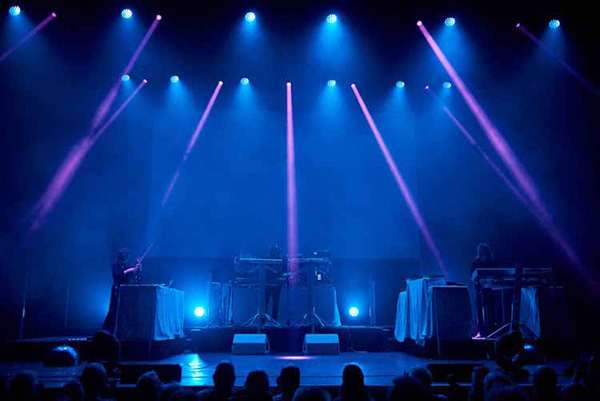
If you are at all familiar with the Netflix sci-fi/horror phenomenon known as Stranger Things, you've heard its foreboding, pulsating theme music dozens of times. The familiarity of that signature Stranger synth bed should in turn lead your ingrained sound-sense memory to conjure the music of Tangerine Dream, the pioneering German electronic band whose aural fingerprints are all over the show's ethereal, period-apropos soundscapes.
The familiarity of that signature Stranger synth bed should in turn lead your ingrained sound-sense memory to conjure the music of Tangerine Dream, the pioneering German electronic band whose aural fingerprints are all over the show's ethereal, period-apropos soundscapes. Not only have all five seasons of Stranger Things exposed younger generations to scores of wonderful '80s-bred tracks; the show's creators also opened the door for both new and re-attuned appreciation of TD's tirelessly inventive instrumental works (footnote 1).
"The younger audiences we see coming to our shows definitely learned about us from Stranger Things—and they also found out who we are from the five hours of music we composed for GTA 5" (footnote 2), TD keyboardist and music director Thorsten Quaeschning told me in a recent Zoom interview. "That's why younger people are attending our concerts and buying our vinyl. Some even ask for tapes—but we don't have any of those."
Before Tangerine Dream founder Edgar Froese passed away in 2015, he charged German-born Quaeschning—who joined TD in 2005 after briefly serving as the band's recording engineer—to carry on. The current three-piece lineup comprises Quaeschning, violinist Hoshiko Yamane, and synth player/keyboardist Paul Frick.
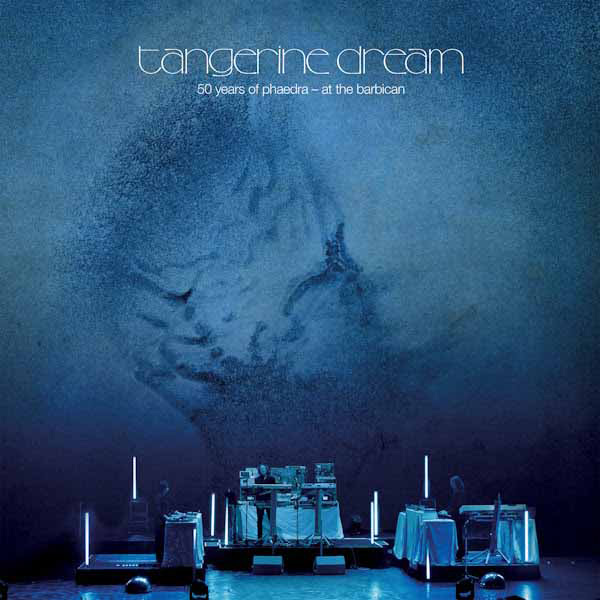
In recent years, the trio has challenged itself by revisiting vintage recordings to see if they could be updated for live performance with current technology and modern equipment. The latest result of that aural quest is 50 Years of Phaedra: At the Barbican (Kscope), a three-LP, two-CD live revamping of the groundbreaking 1974 LP on Virgin, the first the band composed mainly on a modular Moog. Label impresario Richard Branson, who had just signed TD to his Virgin imprint for a five-year deal, had given them carte blanche to do as they pleased at The Manor Studio in Oxfordshire, England—and so they did. Since no presets or memory banks were available, tuning the Moog took several painstaking hours every day—and even then it was near-impossible to ensure that the timing of the sequences they came up with would be precisely quantized.
 "At that time, using tapes and other non-stable things added to the main character and sparkle of the original recording," Quaeschning said. "Maybe for the '70s that was just part of the DNA and magic of those tracks. At first, I tried to do it in a very hard, quantized way, but it sounded cold. It didn't work at all, to be honest." He tried using professional sync boxes instead of a sequencer, then used some very slow oscillators for slight detuning. "Paul, the other synth player, started sequencer loops by triggering the '1' manually to make it a little bit shaky, and then it was all fine. It was quite interesting that you could just play it into the [workstation] and then press Q."
In other words, both Quaeschning and Frick found it worked better to flaunt imperfections and leave the humanity intact rather than quantizing things to digital precision. All told, TD performed the Phaedra 50th anniversary show seven times in Europe in 2024–'25. The band's favorite performance was the Barbican in London on October 7, 2024. The trio found it had to adapt each performance to the room at hand, Quaeschning explained. "Every concert on the Phaedra 50th anniversary tour was different. For the first half of each show, there would be a range of 1 to 20BPM difference, depending on the venue and how the melodies worked. In Lyon, we had to play it in 132BPM because of the early reflections we were getting back from the wall, and with all the delays it was just a mess. The Barbican was the easiest place to play. It was built to be a classical venue, and it sounded fantastic in there." The Barbican gig got the nod for official release.
Tangerine Dream remain busy in 2026. They're recording material for a new studio album. They have tasked themselves with tackling the inherent complexities of 1976's Stratosfear for a handful of live anniversary shows. And they're continuing a series of gigs under the "Continuum Tour" umbrella.
"I hope people want to continue sharing the experience of hearing songs together," Quaeschning concluded. "Rather than having algorithms tell you what music to listen to when you're happy or when you're sad, you can come hear a real-time score for your life instead." Stranger things have happened.
"At that time, using tapes and other non-stable things added to the main character and sparkle of the original recording," Quaeschning said. "Maybe for the '70s that was just part of the DNA and magic of those tracks. At first, I tried to do it in a very hard, quantized way, but it sounded cold. It didn't work at all, to be honest." He tried using professional sync boxes instead of a sequencer, then used some very slow oscillators for slight detuning. "Paul, the other synth player, started sequencer loops by triggering the '1' manually to make it a little bit shaky, and then it was all fine. It was quite interesting that you could just play it into the [workstation] and then press Q."
In other words, both Quaeschning and Frick found it worked better to flaunt imperfections and leave the humanity intact rather than quantizing things to digital precision. All told, TD performed the Phaedra 50th anniversary show seven times in Europe in 2024–'25. The band's favorite performance was the Barbican in London on October 7, 2024. The trio found it had to adapt each performance to the room at hand, Quaeschning explained. "Every concert on the Phaedra 50th anniversary tour was different. For the first half of each show, there would be a range of 1 to 20BPM difference, depending on the venue and how the melodies worked. In Lyon, we had to play it in 132BPM because of the early reflections we were getting back from the wall, and with all the delays it was just a mess. The Barbican was the easiest place to play. It was built to be a classical venue, and it sounded fantastic in there." The Barbican gig got the nod for official release.
Tangerine Dream remain busy in 2026. They're recording material for a new studio album. They have tasked themselves with tackling the inherent complexities of 1976's Stratosfear for a handful of live anniversary shows. And they're continuing a series of gigs under the "Continuum Tour" umbrella.
"I hope people want to continue sharing the experience of hearing songs together," Quaeschning concluded. "Rather than having algorithms tell you what music to listen to when you're happy or when you're sad, you can come hear a real-time score for your life instead." Stranger things have happened.
Footnote 1: To return the favor, TD cut a 6-minute version of "Stranger Things Theme," which can be found on their 2016 two-CD/two-LP set, Particles (Eastgate/Invisible Hands). Among the '80s songs that have garnered new/renewed popularity thanks to their Stranger Things inclusions are Kate Bush's "Running Up That Hill" (1985), Limahl's "The NeverEnding Story" (1984), and the Clash's "Should I Stay or Should I Go" (1982). Footnote 2: GTA 5 is shorthand for Grand Theft Auto V, the 2013 iteration of the uber-popular action/adventure videogame series from Rockstar Games.
"At that time, using tapes and other non-stable things added to the main character and sparkle of the original recording," Quaeschning said. "Maybe for the '70s that was just part of the DNA and magic of those tracks. At first, I tried to do it in a very hard, quantized way, but it sounded cold. It didn't work at all, to be honest." He tried using professional sync boxes instead of a sequencer, then used some very slow oscillators for slight detuning. "Paul, the other synth player, started sequencer loops by triggering the '1' manually to make it a little bit shaky, and then it was all fine. It was quite interesting that you could just play it into the [workstation] and then press Q."
Footnote 1: To return the favor, TD cut a 6-minute version of "Stranger Things Theme," which can be found on their 2016 two-CD/two-LP set, Particles (Eastgate/Invisible Hands). Among the '80s songs that have garnered new/renewed popularity thanks to their Stranger Things inclusions are Kate Bush's "Running Up That Hill" (1985), Limahl's "The NeverEnding Story" (1984), and the Clash's "Should I Stay or Should I Go" (1982). Footnote 2: GTA 5 is shorthand for Grand Theft Auto V, the 2013 iteration of the uber-popular action/adventure videogame series from Rockstar Games.