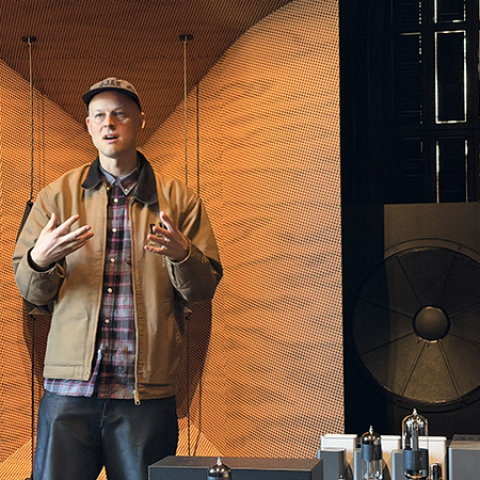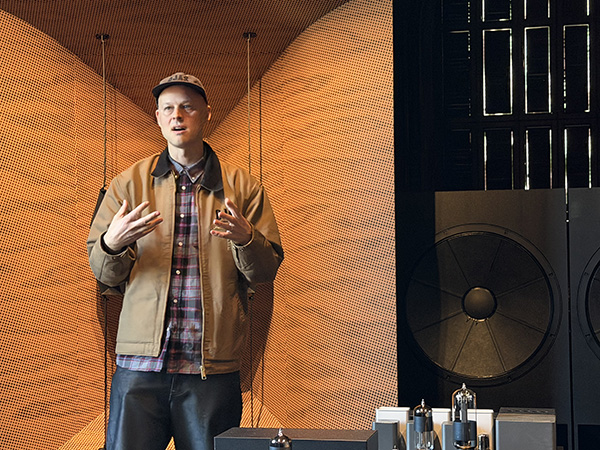
Since founding Ojas in the 1990s and applying the name to his audio components, Devon Turnbull has mined a young audience that the traditional hi-fi industry has struggled to reach. Those who know about him receive his speakers, amplifiers, and turntables as if they were gifts delivered from on high.
Turnbull has many devotees in the high-end community, and a handful of detractors, as anyone has when they're doing something fresh and new. No matter: When you meet him, it quickly becomes apparent that he isn't driven by praise. Rather, he's driven by a desire to introduce a receptive young public to an approach to music reproduction that in the most basic ways is familiar to mainstream audiophiles: conscious, attentive, even spiritual, framed by objects that are themselves works of art.
Devon Turnbull approaches his brand—Ojas—as an artist approaches his art, focusing on message as mantra. In Sanskrit, Ojas is the body's vital life force. The word has other shades, depending on the context: immunity. Strength. Radiance.
Ojas systems can be found at galleries, museums, hip hotels, listening bars, retail stores, dance clubs. He sells DIY parts and kits. He has a column in a legendary Japanese audio magazine. He collaborates with fashion and hi-fi brands, including Klipsch and Denon. He is a classically trained pianist.
Turnbull is a quiet ambassador of listening culture. He gently proselytizes the experience of attentive listening and his distinctive components: custom turntables, low-power tube amplifiers, and—especially—high-sensitivity, horn-loaded loudspeakers of his own creation. At Ojas events, he's more spiritual guide than brazen salesman.
It is widely accepted among mainstream audiophiles that what we do daily has little appeal to the young, yet young people line up around city blocks, from New York to Paris to Tokyo, to spend a few minutes listening—really listening—to music played back on his systems on display in prominent museums and galleries.
Ojas birth and ascent
Turnbull dropped out of high school and earned his GED at age 17. He enrolled at the Art Institute of Seattle, an odd, interesting, for-profit institution that operated more like a trade school than an art school, issuing two-year degrees intended to lead directly to employment. One of the fields AIS embraced was audio engineering, which fed graduates into Seattle's successful 1990s music scene and its burgeoning video-game industry. AIS offered students experience in recording suites designed by the firm of John Storyk, which has worked with the Berklee School of Music and designed NYU's Steinhardt's famed Dolan Recording Studio. Storyk's first commission, in 1969, was Electric Lady Studios. At AIS, Turnbull learned about audio engineering in the "pro" sense: how to record musicians and make records. In interviews, he has talked about how he learned about acoustics, and he would have been exposed to the concepts and language surrounding recorded music and sound. He learned to record using both digital and analog tools. Yet the approach he was taught to making music—a modern, efficient, sensible approach—is arguably one he would later turn on its head. In the late 1990s, Turnbull began using "Ojas" as a brand and a signature across all his projects: graffiti, music, clothing. An early, tangible manifestation was a T-shirt line. Then in 2003, he cofounded, with three others, Nom de Guerre, an "underground" menswear label based in a basement boutique off Broadway in Manhattan that blended military influences with high-fashion tailoring with influences from graffiti and art. Nom de Guerre was a huge success in the fashion world, though Turnbull insists that it never made much money (footnote 1). Still, it became one of the classic streetwear brands. Japan was a major inspiration for Nom de Guerre, and the brand's development studio was in Tokyo. Turnbull found himself there frequently. He encountered jazz kissa and that unique Japanese passion for hi-fi, including for classic US brands like Altec and JBL deployed with old-school turntables and low-power tube amplifiers (footnote 2). Given his background in pro audio, it was hardly a surprise when he started building loudspeakers on the side.
Turnbull's hi-fi breakthrough came via his fashion focus: He was invited to install sound systems in Supreme stores. Supreme is a retail chain, but it isn't mainstream like, say, UNIQLO. Supreme sells street-culture fashion: skate, punk, hip-hop (footnote 3). The chain started in New York City before expanding globally; there are still only 18 stores internationally.
Supreme stores are like galleries, selling merchandise that is at once countercultural and high fashion. They're perhaps best known for their gallery-like spaces and for selling very limited editions—only a few of each item—which keeps demand strong by refusing to satiate it fully. Supreme has collaborated with major figures in the art and fashion worlds, including such figures as Jeff Koons. The Koons collaboration was a series of three skateboard decks to be mounted on the wall as art, featuring imagery from Koons's "Monkey Train" works. Only 500 sets were made; today you can find them on resale sites for thousands of dollars a set. The Koons collaboration led to others, including with Damien Hirst: another skate-deck set, and the limited-edition "Us and Them" T-shirt.
You can sense resonance with Turnbull's approach to hi-fi: functional objects as art, on the basis not just of beauty and cultural resonance but also scarcity and desire, carefully curated.
Supreme's collaboration with Louis Vuitton is an interesting variation on the theme. Around 2000, Supreme started releasing products featuring a bastardized version of the LV monogram logo: It was a (relatively) lowbrow appropriation of a high-end fashion symbol. Louis Vuitton sent a cease-and-desist letter, demanding that Supreme burn its unsold stock. It got a lot of attention—and it took nearly two decades for the LV-Supreme relationship to mature: In 2017, Kim Jones, art director at Louis Vuitton, consummated it with an official LV-Supreme collaboration, at that year's fall/winter show in Paris.
Turnbull was not involved in any of that—but he was in that orbit via his friend Virgil Abloh. Abloh was also a streetwear designer, the brains behind the Pyrex Vision and Off-White labels. In 2018, Abloh was appointed Men's Artistic Director at Louis Vuitton.
Abloh brought Turnbull in to make loudspeakers for his 2019 solo exhibition at the Museum of Contemporary Art Chicago, Figures of Speech, and for various Louis Vuitton events. Those events gave Ojas speakers cred as high fashion, as works of art. When Abloh offered Turnbull speakers for sale on his website, Canary Yellow, they sold out within days. (Sadly, Abloh died in 2021 at age 41, from a rare cancer.)
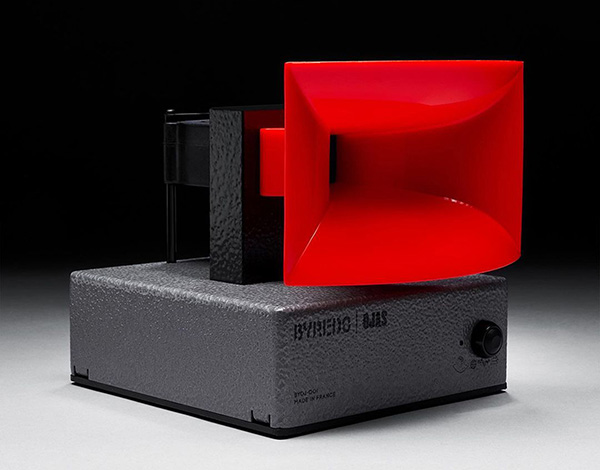
Today, Ojas speakers feature at Prada events and anchor iconic listening spaces, including Public Records in New York City (footnote 4). Ojas has outfitted rooms in at least two hotels: Nine Orchard (footnote 5) in Manhattan and Patina Osaka in Japan (footnote 6). He collaborated with fragrance brand Byredo to create the BYOJ-01 Olfactive Stéréophonique—a scent diffuser (below) that distributes perfume from a device inspired by the aesthetics of a horn loudspeaker; it cost about $1000, and despite the name, was mono only.
 In 2020, Turnbull debuted his Ojas Artbook Shelf Speaker, which is still available, when it's not out of stock, for $6000/pair. Each speaker features a single 8" JBL 328C coaxial driver and an Ojas multicell horn in a neat, Baltic Birch–plywood box with a front-facing elongated vent. An "Artbook" collaboration with Supreme was launched in early 2025; it's the usual Artbook Shelf in a special colorway, sold with an Ojas Tripath class-D amplifier. An Artbook 2.0 update is slated for 2026.
If there's a theme to Turnbull's work—fashion, the museum collaborations, the loudspeakers—it's this continuum between art and commercial products. An artful T-shirt, skateboard deck, or horn loudspeaker made in numbers that fall short of demand can become an object of desire much as a work of art does. (It's not all hype. It's axiomatic that the object must first be innately desirable.)
Turnbull's world is a world of desirable, tangible things that exist in limited supply (footnote 7). Contrast that with digital, where the stuff of music is ephemeral, not physical, and can be reproduced in unlimited quantity essentially without cost.
Turnbull's place in hi-fi culture
In 2020, Turnbull debuted his Ojas Artbook Shelf Speaker, which is still available, when it's not out of stock, for $6000/pair. Each speaker features a single 8" JBL 328C coaxial driver and an Ojas multicell horn in a neat, Baltic Birch–plywood box with a front-facing elongated vent. An "Artbook" collaboration with Supreme was launched in early 2025; it's the usual Artbook Shelf in a special colorway, sold with an Ojas Tripath class-D amplifier. An Artbook 2.0 update is slated for 2026.
If there's a theme to Turnbull's work—fashion, the museum collaborations, the loudspeakers—it's this continuum between art and commercial products. An artful T-shirt, skateboard deck, or horn loudspeaker made in numbers that fall short of demand can become an object of desire much as a work of art does. (It's not all hype. It's axiomatic that the object must first be innately desirable.)
Turnbull's world is a world of desirable, tangible things that exist in limited supply (footnote 7). Contrast that with digital, where the stuff of music is ephemeral, not physical, and can be reproduced in unlimited quantity essentially without cost.
Turnbull's place in hi-fi culture
You cannot separate the Ojas brand from Turnbull himself. To a large extent, they're one and the same. In his own, texted words, Turnbull's role in hi-fi has been "popularization of the concept of a practice of thoughtfully creating a unique system and LISTENING. This is intuitive to a Stereophile reader, but my particular style seems to resonate with a new market." At his Brooklyn Navy Yard factory, he makes amplifier and speaker kits. He distributes those kits, amplifier kits by Sun Audio, books, magazines, records, T-shirts, and DIY loudspeaker components through both his website, his BNY location, and his Greene Street Soho shop. At any given moment, most of them are "Sold Out."
Beyond hardware, Turnbull holds the distinction of being the first non-Japanese contributor to MJ, the venerable 101-year-old journal of audio technology.
Furthermore, his reach has penetrated the professional scene: In collaboration with Norwegian pro audio manufacturer NNNN, his ON PA speaker systems have been installed in at least 20 nightclubs across the world.
How is what he is doing different from what more mainstream brands have tried?
"Most people in audio," Turnbull wrote in an email, "see a small market and try to figure out how to capture as much of it as possible. I am more interested in just turning people on to hi-fi in general. I always tell them to educate themselves before they form an opinion that my product is the thing they want."
Turnbull's installations at museums and galleries—including his current installation at the Cooper Hewitt Museum in New York City, which is part of the Smithsonian Institution—are must-see, must-hear events for his large and growing public. These environments cultivate an intense listening culture resembling that in a Japanese jazz kissa. Attendees don't talk or check their phones. Instead, they commit to the experience, reading liner notes and focusing completely on the music and the sound.
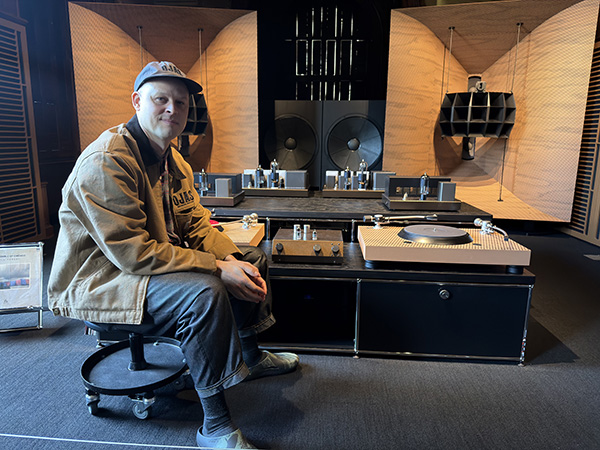 Ojas art spaces
In 2021, Turnbull installed a complete Ojas system at the Lisson Gallery in New York City titled "Hi-Fi Listening Room Dream No.1." When the London Lisson Gallery duplicated the event in 2023, more than 7000 visitors showed up for "a free, drop-in experience for all to surrender to the act of listening, with rare intention, to recorded and live music." The Ojas Listening Room at USM Modular Furniture NYC—this is the closest thing Ojas has to a proper store—opened in 2023. "HiFi Pursuit Listening Room Dream No.2" opened in 2024 at the San Francisco MoMA. "That's where we had a massive line and five to six thousand people showed up in a day," Turnbull recalled.
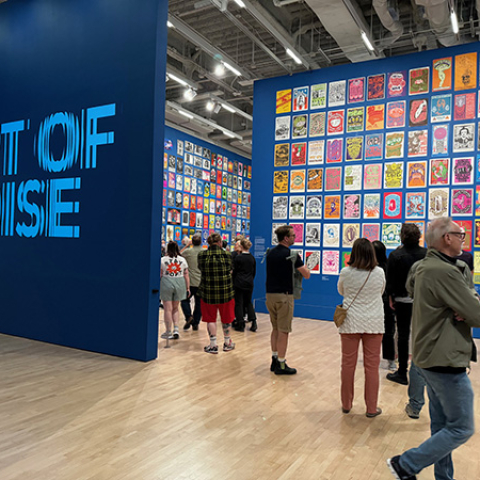
"HiFi Pursuit Listening Room Dream No. 3" opened at the Cooper Hewitt Smithsonian Design Museum in New York City on December 12, 2025, as part of the "Art of Noise" exhibition. Scheduled through mid-June, live music sessions and special events will include high-profile recording artists: WNPR's John Schaefer, possibly Mark Ronson and Questlove. The exhibit invites visitors to "experience music in a space designed to slow down and reflect, bringing back the joy of experiencing and sharing music together." (The words are Turnbull's, written for the exhibit.)
T-shirts are available for $60 each.
Footnote 1; "We had basically every account we wanted in the world, but high end menswear wasn't a big enough market at the time," Turnbull wrote in an email, but "We never made enough money that I didn't have to have a full-time job to pay the bills." Footnote 2: Over time, Turnbull's connection to Japan deepened. He now has a second home in Japan and spends several months a year there. He speaks some Japanese; he is, he says, "a lower intermediate level Japanese language student. I study it every day and love the mental exercise." As mentioned elsewhere in this article, he contributes to MJ Audio Technology—the print magazine, published in Japanese—but his monthly MJ articles are translated from English.
Footnote 3: Ever seen the movie Kids, from 1995? It's an important film. It featured the screen debuts of Chloë Sevigny and Rosario Dawson and a couple of other young actors who became well-known. In the New York Times, Ben Detrick called it "Lord of the Flies with skateboards, nitrous oxide, and hip-hop." Well, several of the cast members, including Harold Hunter and Justin Pierce, were original or early employees of the original NYC Supreme store.
Footnote 4: See nnnn.no/public-records/.
Footnote 5: See nineorchard.com/rooms.
Footnote 6: See patinahotels.com/osaka/drink-and-dine/listening-room.
Footnote 7: Though Turnbull says he isn't a fan of this culture. "I actually hate this, and it's why I left fashion, for the most part. I don't want to make things that are so fleeting. I want to make timeless things," he wrote in an email.
Turnbull dropped out of high school and earned his GED at age 17. He enrolled at the Art Institute of Seattle, an odd, interesting, for-profit institution that operated more like a trade school than an art school, issuing two-year degrees intended to lead directly to employment. One of the fields AIS embraced was audio engineering, which fed graduates into Seattle's successful 1990s music scene and its burgeoning video-game industry. AIS offered students experience in recording suites designed by the firm of John Storyk, which has worked with the Berklee School of Music and designed NYU's Steinhardt's famed Dolan Recording Studio. Storyk's first commission, in 1969, was Electric Lady Studios. At AIS, Turnbull learned about audio engineering in the "pro" sense: how to record musicians and make records. In interviews, he has talked about how he learned about acoustics, and he would have been exposed to the concepts and language surrounding recorded music and sound. He learned to record using both digital and analog tools. Yet the approach he was taught to making music—a modern, efficient, sensible approach—is arguably one he would later turn on its head. In the late 1990s, Turnbull began using "Ojas" as a brand and a signature across all his projects: graffiti, music, clothing. An early, tangible manifestation was a T-shirt line. Then in 2003, he cofounded, with three others, Nom de Guerre, an "underground" menswear label based in a basement boutique off Broadway in Manhattan that blended military influences with high-fashion tailoring with influences from graffiti and art. Nom de Guerre was a huge success in the fashion world, though Turnbull insists that it never made much money (footnote 1). Still, it became one of the classic streetwear brands. Japan was a major inspiration for Nom de Guerre, and the brand's development studio was in Tokyo. Turnbull found himself there frequently. He encountered jazz kissa and that unique Japanese passion for hi-fi, including for classic US brands like Altec and JBL deployed with old-school turntables and low-power tube amplifiers (footnote 2). Given his background in pro audio, it was hardly a surprise when he started building loudspeakers on the side.
In 2020, Turnbull debuted his Ojas Artbook Shelf Speaker, which is still available, when it's not out of stock, for $6000/pair. Each speaker features a single 8" JBL 328C coaxial driver and an Ojas multicell horn in a neat, Baltic Birch–plywood box with a front-facing elongated vent. An "Artbook" collaboration with Supreme was launched in early 2025; it's the usual Artbook Shelf in a special colorway, sold with an Ojas Tripath class-D amplifier. An Artbook 2.0 update is slated for 2026.
If there's a theme to Turnbull's work—fashion, the museum collaborations, the loudspeakers—it's this continuum between art and commercial products. An artful T-shirt, skateboard deck, or horn loudspeaker made in numbers that fall short of demand can become an object of desire much as a work of art does. (It's not all hype. It's axiomatic that the object must first be innately desirable.)
You cannot separate the Ojas brand from Turnbull himself. To a large extent, they're one and the same. In his own, texted words, Turnbull's role in hi-fi has been "popularization of the concept of a practice of thoughtfully creating a unique system and LISTENING. This is intuitive to a Stereophile reader, but my particular style seems to resonate with a new market." At his Brooklyn Navy Yard factory, he makes amplifier and speaker kits. He distributes those kits, amplifier kits by Sun Audio, books, magazines, records, T-shirts, and DIY loudspeaker components through both his website, his BNY location, and his Greene Street Soho shop. At any given moment, most of them are "Sold Out."
Ojas art spacesIn 2021, Turnbull installed a complete Ojas system at the Lisson Gallery in New York City titled "Hi-Fi Listening Room Dream No.1." When the London Lisson Gallery duplicated the event in 2023, more than 7000 visitors showed up for "a free, drop-in experience for all to surrender to the act of listening, with rare intention, to recorded and live music." The Ojas Listening Room at USM Modular Furniture NYC—this is the closest thing Ojas has to a proper store—opened in 2023. "HiFi Pursuit Listening Room Dream No.2" opened in 2024 at the San Francisco MoMA. "That's where we had a massive line and five to six thousand people showed up in a day," Turnbull recalled.
Footnote 1; "We had basically every account we wanted in the world, but high end menswear wasn't a big enough market at the time," Turnbull wrote in an email, but "We never made enough money that I didn't have to have a full-time job to pay the bills." Footnote 2: Over time, Turnbull's connection to Japan deepened. He now has a second home in Japan and spends several months a year there. He speaks some Japanese; he is, he says, "a lower intermediate level Japanese language student. I study it every day and love the mental exercise." As mentioned elsewhere in this article, he contributes to MJ Audio Technology—the print magazine, published in Japanese—but his monthly MJ articles are translated from English.