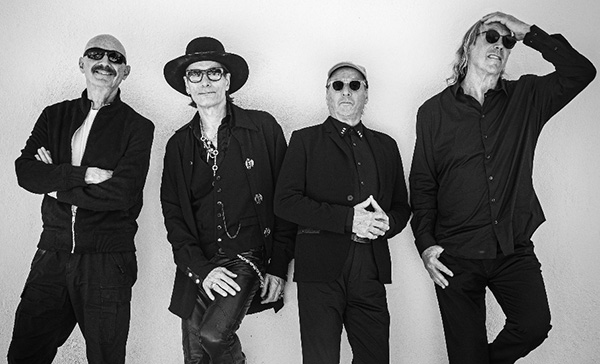
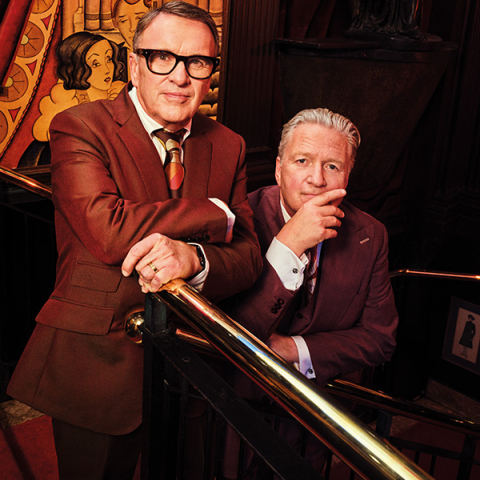
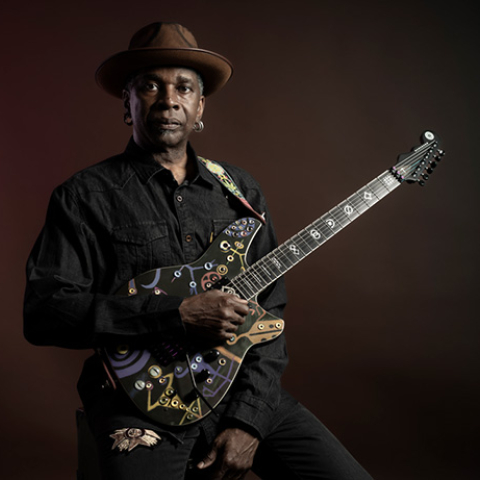
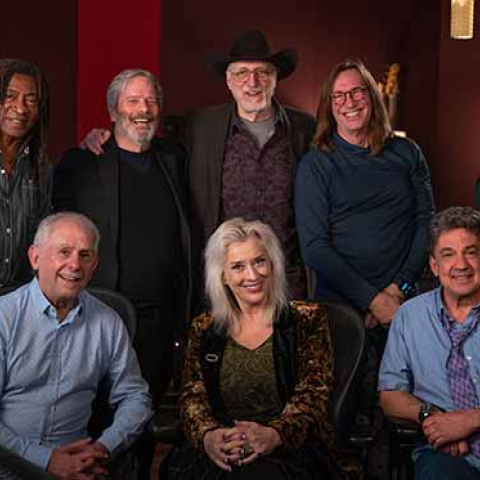
BEAT BAND (L–R): Tony Levin, Steve Vai, Adrian Belew, Danny Carey. (Photo by Alison Dyer)
Adrian Belew had an itch that needed some serious scratching. The iconoclastist/vocalist had a hankering to perform material from the three King Crimson albums he fronted during the proto-prog band's 1980s revival—October 1981's
Discipline, June 1982's
Beat, and March 1984's
Three of a Perfect Pair—but how could he go about it in a way that pays respect to and expands upon their original intent, all at once?
First order of business: Make sure King Crimson founder and guitar visionary Robert Fripp approved, even though he would not be participating.
Check. Next: Confirm that bassist Tony Levin is onboard.
Check. Finally: Knowing that Fripp and drummer Bill Bruford wouldn't participate (footnote 1), find perfect replacement bandmembers for these sure-to-be-challenging gigs. Belew and Levin enlisted two acknowledged virtuosos: guitarist Steve Vai (Frank Zappa, solo, G3) and drummer Danny Carey (Tool), and the all-caps BEAT was born (footnote 2).
Check.
BEAT played 65 shows in North America in 2024 followed by briefer runs in Mexico and South America in early 2025. One of the tour's best outings, in Los Angeles on November 14, 2024, was captured and released in September 2025 as
BEAT LIVE on InsideOut Music/Sony.
BEAT LIVE is available in multiple configurations: a three-LP set, a two-CD/one Blu-ray package including concert footage, and a limited-edition run of the Blu-ray package that adds a third, bonus CD including additional live tracks captured elsewhere on the North America tour and a 36-page artbook.
I saw BEAT a few weeks after that L.A. gig, in Buffalo in December 2024, and I can attest to how bleeping
adroit they are.
Considering the complex nature of prime King Crimson material—the polymetric street dustup of "Thela Hun Ginjeet," the electronic drum showcase "Larks' Tongues in Aspic (Part III)," several songs the '80s band
never played live, like the metallic robotics of "Dig Me" and the pleading tones on "Model Man"—the fledgling BEAT collective had some steep musical hills to climb. The newest members—call them two of a perfect pair—more than held their own. Vai stepped up to add his signature fretboard textures to 14-minute take on "The Sheltering Sky," while Carey's fierce drum solo sequence leading into "Indiscipline," and his electronic drum clinic opening "Waiting Man," show he belongs in an elite skinsman league alongside the more modern likes of Gavin Harrison of Porcupine Tree and Pineapple Thief. "I'm a drummer myself, and I admire what the greatest drummers I've played with get out of the snare by the way they hit it," Belew noted. "Drummers like Bill Bruford and Danny Carey just have this 'thing,' and they've mastered it." (footnote 3)
Belew breathed new life into linchpin songs like the slide ballad "Matte Kudasai" and the aforementioned art narrative "Indiscipline" ("I like it!"), while Levin's funk-flexed fingers handled the low-end slap-attack on tracks like the relentless "Sleepless" and the synth-laden instrumental "Industry" without losing a beat—pun intended. The only non-'80s offering on the three-LP set—a blistering, encore-opening take on the punishing instrumental "Red" (the title track to KC's November 1974 LP on Atlantic)—evinces all the sinew and muscle of the original piece, which was blueprinted by Fripp, Bruford, and bassist John Wetton.
How did Belew and Co. see their fever-BEAT dream realized? Once the four-man band convened and started to flesh out the arrangements, the mission became simple. "We had to figure out the places where we could take what was already there and make it our own, because I certainly didn't want any of it to be like someone was trying to sound like the original records," Belew explained during a recent phone interview, speaking from his home base in Tennessee. "I didn't want to stifle what Steve Vai or Danny Carey could do, so we gave them some outlines as to what we hoped this would become—and they did it, times 10."
The ever-meticulous Vai (known for his "impossible guitar parts") dug deeper than deep. "Steve took over five months to learn all this music, because he's really dedicated," Belew continued. "There is a lot of interlocking guitar stuff Robert [Fripp] and I did, and that had to be the way it was. But then there were other places where you'd say, 'Right here, I can see you doing something else more your style that will fit with this music.' We did that song by song, part by part."
Belew and Levin developed their own synergy and musical shorthand long ago, having played together on and off for several decades. "It's much more exciting to revisit this music in a different way," Levin told me in a separate Zoom interview, from Albuquerque, New Mexico, during BEAT's late-2024 tour run. "And because we have Danny Carey and Steve Vai giving us their interpretations of that same music, it became a valid and exciting musical experience to go out and do this long a tour.
"Steve did have a lot of homework to do, to study and practice how to play Robert Fripp's parts, and Danny's amazing too. The solo he does ahead of 'Indiscipline' is different each night, and it goes on for as long as he wants. Just covering the music the way it was in the '80s wouldn't be as worthwhile. Mind you, in the '80s, we
did change quite a bit in the live shows, and you can hear it (footnote 4). To me, frankly, the exciting part for BEAT was letting the music grow and be vibrant and different each night. There's room and latitude in these pieces to do that."
"Three of a Perfect Pair" is just one example of BEAT's nightly permutations. In the original 1984 studio recording, Levin vocally echoes the words "complicated" and "aggravated" after Belew sings them, but he doesn't do so on
every chorus. "It's an answer," Levin clarified. "Adrian has the main theme, and then I answer him—or not. Playing with BEAT, it depends on a whole lot of things. Nobody's going to miss it if I don't do it every time. Sometimes, my voice gets tired because I'm a normal human being—unlike Adrian." Levin paused to punctuate that previous point with a laugh before continuing. "Sometimes, I'm resting my voice. Other times, musically, I don't feel like it calls for it that night."
Belew added, "There is a sensibility to it that's on the original record—and that's an instinctual thing that's down to Tony. It's there on the first and second chorus, and then it isn't on the third chorus, but it returns on the fourth. It was me and Tony shouting things out to make it not really be a perfect part, so it's up to him for when he feels like he should do it or not. Sometimes he feels more comfortable with singing, and other times not. Some nights, the audience sings the part for him—and when that happens, it's better to let them do it. We get excited knowing that they know the songs that well."
Another hallmark of '80s Crim music is the wordplay in so many of Belew's lyrics, none more cleverly executed than "Elephant Talk," the opening track from
Discipline. "It relates to all the levels of communication people have as human beings," he explained. "Back in the early '80s, when I was doing a lot of songwriting, I carried with me a pocket-size
Merriam-Webster Dictionary. When I decided I was going to do that with the words, I just went through the dictionary with a yellow highlighter and highlighted every one of them I could think of that might work. Then I went back and started filtering them out by saying, 'No, I think this is better,' and I put them in that order. I still have that dictionary. If there's ever a Crimson Museum, that dictionary should be put right in there."
Does this mean Belew has lyrics covering the letters F to Z? Unfortunately, no. "By the time I got to E, I was looking at the list of all the words I had, and I thought, 'Geez, this is plenty right here, but what am I gonna end with?' Well, I'm also doing this elephant sound with my guitar, so how about ending with 'Elephant Talk'? And that was that."
That titular phrase has an interesting etymology. "There was a song called 'Baby Elephant Walk,' a cute instrumental piece I liked when I was younger," Belew said (footnote 5). "That gave me the impetus to say, 'What about talk? It's only talk.'" That elephant bond also inspired the official BEAT logo.
Speaking of F–Z: Both Belew and Vai spent formative years as members of Frank Zappa's band, tough they never overlapped. "We were three years apart, so we never played together," Belew confirmed, "but I think there's a school of Zappa that you graduate from—if you're lucky. It's a certain mindset more than anything, that you do stuff a certain way. You've gotta be highly professional, show up, and do all the right things. You can't be in a haze of any sort. Consistency and correctness were the rules for playing Frank's music—and when you apply that to something as complex as the music of King Crimson, it works perfectly well, because you have to be the same way for that music, too."
Belew is confident
BEAT LIVE will connect with the Crimson cognoscenti and those who saw the tour. He hopes it gets through to younger listeners. "It's so unique and timeless," he observed. "When you stumble along and find this music out there somewhere—whether a friend tells you or your dad tells you or someone else—it's going to be
shocking. They'll go, 'What is this?' There are people who have taken things from King Crimson and used it in their music—and I have no problem with that at all, because that is how you grow. I think if young people find this music, it's gonna knock them out of their seats, because there's just nothing else out there like it."
Footnote 1: These days, Fripp is content to make goofy/charming YouTube videos with his wife/muse Toyah Willcox for their regular "Sunday Lunch" series. (Seek out their colorful cover of Judas Priest's "Breaking the Law" to see what I mean.) In 2022, Bruford came out of retirement to resume regularly performing in England as a member of the Pete Roth Trio, a jazz collective.
Footnote 2: Most likely, BEAT went the all-caps route so as not to compete and/or be confused with the Beat, the still-touring '80s British ska/reggae new wavers fronted by Dave Wakeling, alternately known as the English Beat in the States.
Footnote 3: Harrison also got behind the kit with King Crimson. He overlapped with Belew in 2007–08, and was also part of the band's featured three-drummer lineup from 2013–21.
Footnote 4: For proof, cue up
Sheltering Skies (Live in Fréjus, August 27th 1982), which was released in two-LP and one-CD options by Discipline Global Mobile/Panegyric in 2024.
Footnote 5: "Baby Elephant Walk" was composed by Henry Mancini in 1961 for the 1962 film
Hatari!