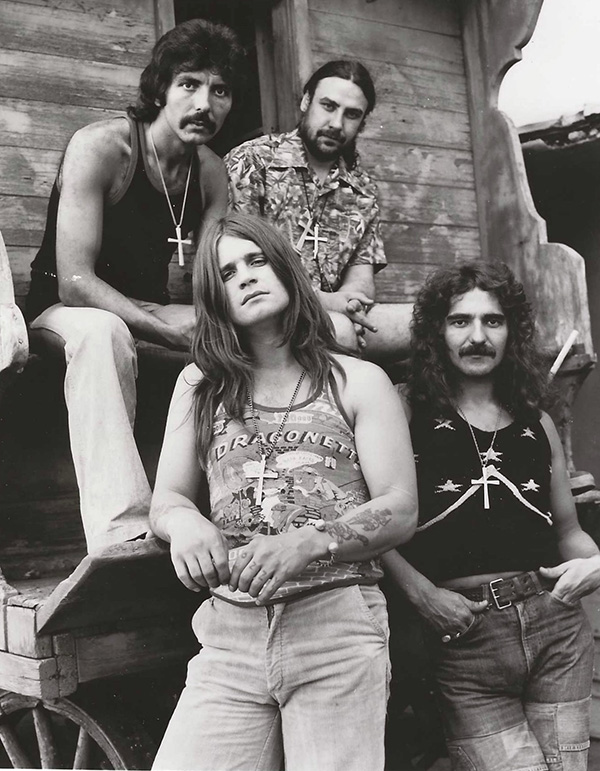
John Michael Osbourne was obsessed with the Beatles. Better known by the sobriquet "Ozzy," the cofounding lead singer of Black Sabbath who later turned uber-successful solo artist and still later became a reality TV star was deeply in love with the Fab Four. Osbourne passed away on July 22, 2025, at age 76.
A working-class lad from Birmingham, England, Osbourne saw music as his way out. Those Beatles records were the gateway. "I have such great respect for the Beatles," he told me when we sat down together for an interview at Sony's New York City headquarters on May 20, 2010. "I can remember walking around the streets of Birmingham, proud, with a Beatles record sleeve under my arm. I bought those Beatles boots, too, and one of those cheap wigs. It wasn't even hair—it was a plastic f---ing cap! I had it all, man." Picture if you will a longhaired teenage Osbourne ambling through Birmingham's rough-and-tumble streets in a faux Beatles wig. "Electric Funeral" indeed.
"The Beatles did give me the gift of melody, you know," Ozzy continued. "In fact, you'll hear the Beatles in a lot of things of mine."
Cue up "Get Back" at the end of side 2 of the Beatles' Let It Be from May 1970, then follow that with the title track to September 1970's Paranoid. Listen to how Ozzy's improvised vocals mirror Sabbath guitarist Tony Iommi's muscular, power-chord guitar line. Now substitute Paul McCartney's "Jojo was a man who thought he was a loner / But he knew it couldn't last" for "Finished with my woman / 'Cause she couldn't help me with my mind," but at a slightly faster clip to get the staccato enunciation parallel.
During our interview, I mentioned these similarities to Ozzy. "That's very interesting to hear," he replied. "The Beatles had great harmonies, great melodies."
Though Osbourne has long been called the "Prince of Darkness," that foreboding label could be revised to read "Prince of Dark Melody." The key to his and Black Sabbath's music was not in melding musical muck with punishing noise but rather in marrying down-tuned guitars to tuneful lyrics. Combination is key. Togetherness is key. The blueprint is the self-titled debut Black Sabbath, which was recorded at Regent Sound Studios on Denmark Street in London in a whirlwind 12-hour session on October 16, 1969, and released on Vertigo in February 1970. "I preferred playing those songs live, together, and capturing the moment," Tony Iommi told me about those formative sessions, during an earlier NYC interview, this one on April 27, 2005. "Ozzy sang, and we played right along with him—and we tried to replicate that feel with him, directly onstage. Later, whenever we'd go too far over the top with too many takes, we had to remember to get back to how we first did it. That was the secret—go in, write the songs, and then go out and play them."
During that 2010 interview, I handed Ozzy my somewhat worn Black Sabbath LP. He opened the gatefold and ran his hand across the mostly black interior, tracing over and down the inverted cross on the right side with the track listings and credits in reverse order (footnote 1). "Back then, when you got an album in your hands, it was f---ing awesome. We were blown away. Even to be allowed to do a gatefold cover was an amazing thing," Ozzy said, still holding the gate open.
"I remember taking a copy home to my mom and saying, 'Look, mom, I've made a record!' My father thought we'd be a bit more musical of course. [He grins.] When we first heard the playback, with the bells, the thunder, and all the effects, we were like, "F---ing hell!" (footnote 2)
Capturing that light-and-dark magic in the moment and trusting collective instincts are at the core of those early Black Sabbath records, which influenced generations of musicians who followed in their wicked wake. "The touchstone record of my life is Master of Reality," Smashing Pumpkins vocalist/guitarist Billy Corgan told me. Master was Sabbath's third studio album, released by Vertigo in August 1971. "I'm just forever in awe of it. Whatever happened on that record imprinted on my brain. It's a sound that I've forever chased, whether it was the way they treated Ozzy's vocals, Tony's guitar, [or] the way [Geezer Butler's] bass sat. Most people think Sabbath's bass is really sludgy. It actually isn't. It sits in this interesting, clear kind of low midrange with those roomy but not overly open drums [by Bill Ward]. That is the blueprint of all successful rock'n'roll—at least my version of it. There's just something about the cosmic warmth of that album's analog sound that denotes something very akin to nature and the stars."
Just don't forget the melody. Kevin Churko, who co-produced a pair of Osbourne solo albums on Epic—May 2007's Black Rain and June 2010's Scream—said, "The thing that's kept Ozzy relevant for all these years is that he is all about the actual song. He's not a monotone singer; he wants lines to have those ups and downs. When you think about some of his biggest hits, even 'Crazy Train' (footnote 3) is in a pretty major key, and it's happening [over top of ] a pretty heavyriff."
Trends come and go, but the Ozzman abideth. "You could say I've survived a lot of fads and fashions," Ozzy told me. "New music for me is not new music unless it does something I haven't heard or played before." After headlining the Back to the Beginning final concert that took place at Villa Park in Sabbath's Birmingham hometown on July 5, 2025, Ozzy sailed off into the endless skies, and he did it on his own terms
Footnote 1: Early pressings of Black Sabbath have Ozzy's first and last names both misspelled in those credits, as "Ossie Osborne."
Footnote 2: Those awesome/chilling effects occur in the 6-minute song "Black Sabbath," which opens the album.
Footnote 3: "Crazy Train" is Ozzy's signature solo song, from September 1980's Blizzard of Ozz (Jet).