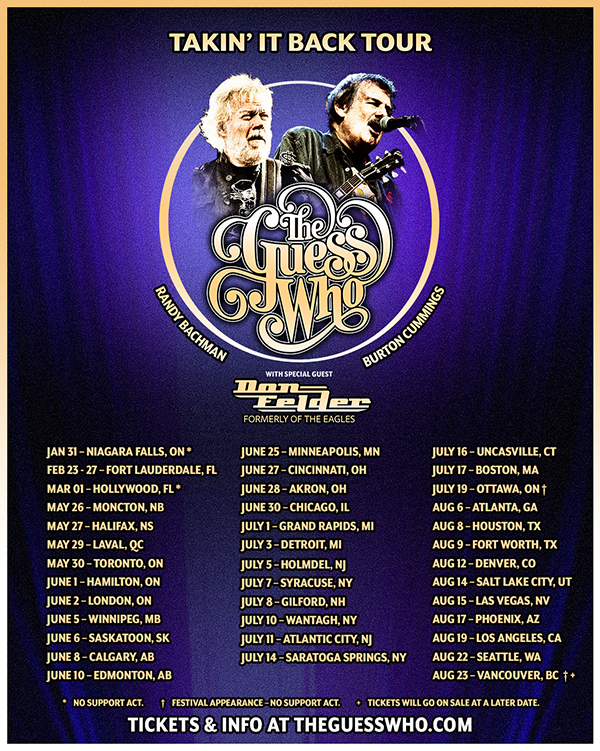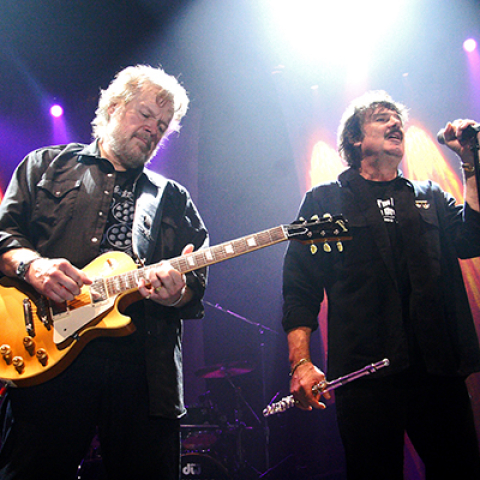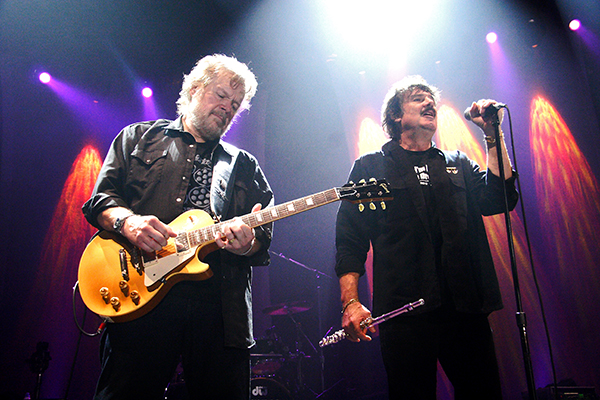
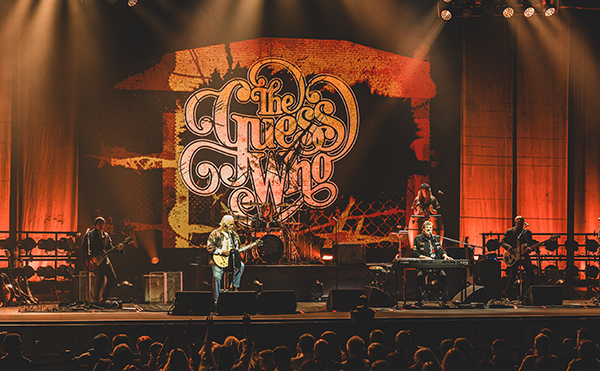
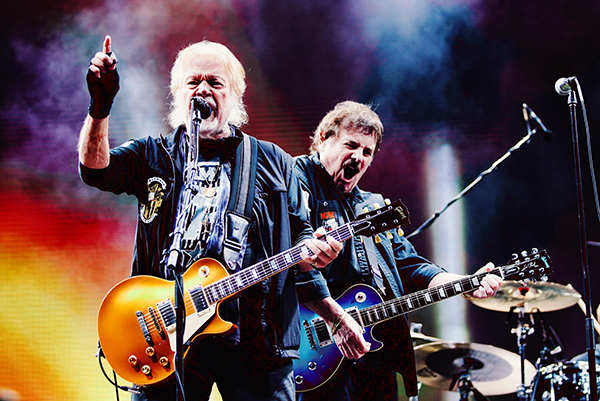
No More Guessing: Bachman (left) and Cummings are back with a vengeance. All Guess Who live in 2026 photos by Corey Kelly.
Guess Who is back on tour this summer?
Third base.
Sorry, I couldn't resist.
After traveling a long, hard road, keyboardist/vocalist Burton Cummings and guitarist/vocalist Randy Bachman—the two main beating hearts of Winnipeg's finest rock progenitors, The Guess Who—have indeed reclaimed their name and come back together for the Takin' It Back Tour, their first time touring together as The Guess Who in 23 years. The tour commences tonight, May 26, 2026, in Moncton, New Brunswick. If you want to catch a show yourself, go here for all the whens, wheres, and ticket-obtainment information.
During a recent Zoom interview, Cummings, Bachman, and I discussed why The Guess Who were early proponents of releasing stereo singles, which one of them loves vinyl and which one prefers CD and digital, and how the eternal hit that is "American Woman" was born out of an improvised riff during a live show.
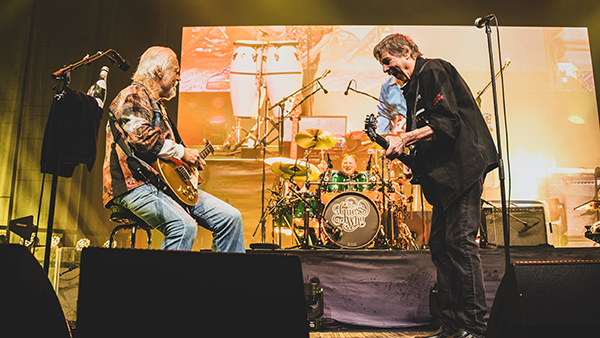 Mike Mettler: Welcome back, you two! Is it fair to say that playing live together as The Guess Who is kind of like getting back on a bike again? You guys have a performing shorthand already, and you've played a bunch of shows together before this upcoming run. Do you feel like you're on point?
Randy Bachman: Well, when we rehearsed, it was not really about learning the songs—it was just getting the vibe of being together, joking around, making the odd mistake, and goofing around about it. We can play these songs all blindfolded with our hands tied up in the middle of the night, you know what I mean? It was more about getting the brotherhood and the fellowship back together. And we got the vibe really fast, with a really great band (footnote 1). I sat in with them many times—two or three times a year, over the last 10 years anyway. So, just sliding back in there is—it's really been fun. Mettler: The current set list has about 19 songs on it including some Bachman-Turner Overdrive songs and one of Burton's solo tracks. I'm really happy to see the Guess Who deep cut "Albert Flasher" on there, which is something people may not be expecting. (footnote 2)
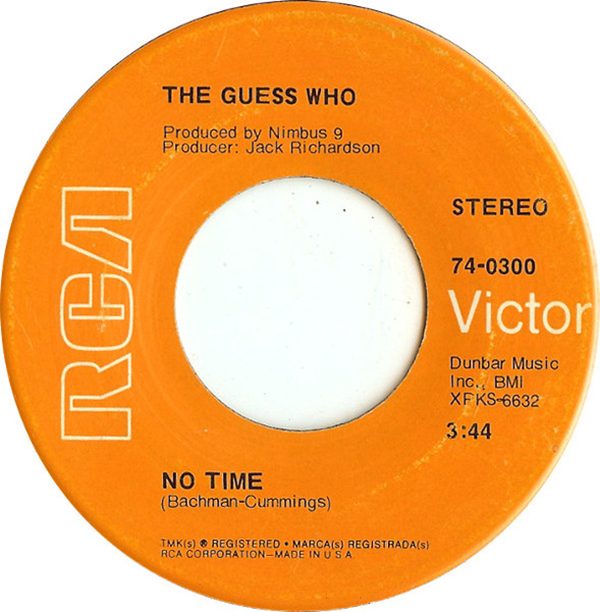
Burton Cummings: For the real Guess Who fans, we're doing some stuff that we never did before. We do a song called "Proper Stranger," which was the flip side of [the 1969 single] "No Time." See, Randy played about six tracks of guitar on that record—and in the old days we could never do it because he couldn't play all the parts. Now that we have three lead guitar players, we can do "Proper Stranger." We also never used to do "A Wednesday in Your Garden," from [March 1969’s] Wheatfield Soul. We're doing that now, too, and I love singing it. I always loved the song.
Cummings: Yeah, that's correct.
 Mettler: There's a very interesting stereo mix of that song, which is the first track on Wheatfield Soul, because in the intro, the keyboard part that Burton is playing on the Hohner Pianet is over on the right, and then Randy's guitar counter is on the left before Burton's lead vocal comes in the middle. Did you guys consciously think, "We wanna play with the stereo soundfield this early in our career"?
Cummings: I think Jack Richardson, our producer, and Brian Christian, the engineer, they were well aware of how stereo mixes were opening up, so they were very conscious of the positioning of everything. And I think some of our stuff sounds pretty good because they were really at the cusp of real stereo.
 Mettler: Once you got more vocal about those kinds of things, did you guys have a sense of things like, "We want to sound like this. My voice has to be out a little bit more. The guitar has to support it, and then we can come forward with the keyboards"? Were you guys that technical about it, or was it just a "feel" thing?
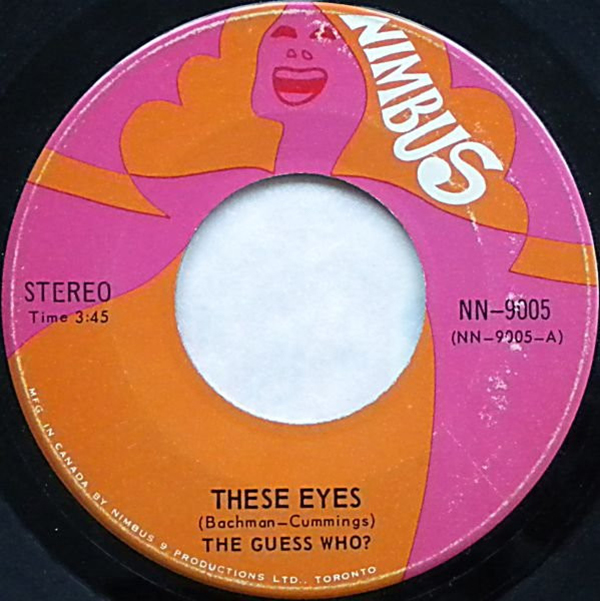
Bachman: We had several years of training, doing a weekly television show on CBC right across Canada. (footnote 3) Every Thursday, we were on for two solid years, and we had to play the hit parade. So, we would be playing Beach Boys, Vanilla Fudge, Motown, Beatles, Stones, Moody Blues—everything. One day, the producer said, "The hits are lasting too long"—hits back then lasted six to eight or nine months—"and you guys are repeating yourselves. If you can write something good enough to fit in between [The Rolling Stones'] 'Ruby Tuesday' and [The Beach Boys'] 'I Get Around,' we'll put it in the show." So, we started writing. And then Jack Richardson heard "These Eyes" on one of these shows and said, "That's a hit song." It was kind of magical how all that happened—but we were seasoned at recording because we went in every Tuesday, and like I said, recorded and copied Motown and every other hit record. On television, we had to sound like we were on the radio.
Cummings: We had to learn 10 or 12 brand-new songs a week, every week, for two years. And it wasn’t all simple stuff. It wasn’t all "Louie Louie" and "Takin' Care of Business." We were playing stuff like "Up, Up and Away" by The 5th Dimension. There were like 400 chord changes in some of those songs [more laughter]. We had to learn all that stuff.
Bachman: We also did a Sgt. Pepper show, and on it, we copied Sgt. Pepper, which was a revolutionary recording. We even wore the costumes and did the TV show with them on. There are a couple of clips of that on YouTube. It's great. Mettler: Oh, I gotta look some of those shows up! (footnote 4) The parallel is, like, The Beatles playing three sets a night in the Cavern Club in Liverpool and pretty much all night long in Hamburg, Germany. They had a level of muscle memory where they could be flexible enough to play just about everything, and I feel like you guys have that similar background.
Cummings: We were lucky. Growing up in Winnipeg at the time—late '50s, early '60s—there were three major radio stations. One of them was 50,000 watts, clear channel, so it was a pretty big deal. These stations were all competing for the audience. There were only about 350,000 people in Winnipeg at the time, so these three stations were on their top game.
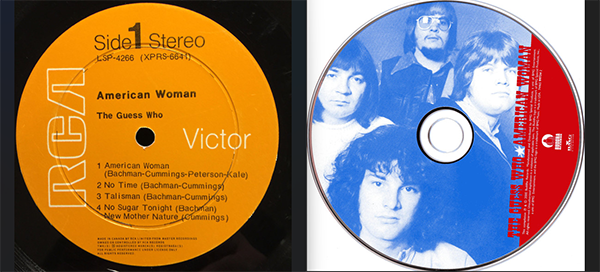 Mettler: It all seeped into what you guys wound up doing, for sure. Here's a question for both of you to answer separately. Is vinyl the best playback medium for listening to Guess Who music, putting the needle down on any of those early records of yours and getting that analog feel out of them?
Bachman: That's how we all heard the music first. It was vinyl. CDs are a little too brittle sounding to me, and I'm glad everything’s going back to vinyl. There's nothing like the needle coming down, and you're hearing that hiss—and then bam, you get hit with some great music.
Cummings: I'm exactly the opposite. I have no vinyl left at all in my house. I have almost half-a-million MP3s in my Mac tower. I love CDs. I like the trebleness. I like the brittleness. And I'll tell you this—I sure like the fact that I can carry thousands and thousands of songs with me in MP3 style. I can't carry a truckload of vinyl with me on airplanes when I'm flying anywhere, and I don't put songs in my phone. I use the phone for talking. I still love all my iPods. To me, it's the greatest invention ever.
 Mettler: I have to imagine that you guys will be recording some of these live shows for potential release somewhere down the line. Are we allowed to say that? Is that a thought?
Cummings: We don't know. When we talk to people these days, they're always asking, "Is there gonna be some new music?" We can only take care of one thing at a time. We finally got the name back, and we're building up the momentum. We're taking all that back—and that’s enough at a time. There might be new music, and maybe some new songs down the road. Who knows? But right now—and I know I don't speak for Randy, but I'll speak for myself—I'm just looking forward like hell to the next live gig. These live gigs are tremendous right now.
Bachman: Oh yeah.
Cummings: I think the reason it took off so big initially was that the Vietnam War, in 1970, was at its worst point of escalation. But I never meant that song to be political. Those lyrics just flew out of my head. Randy was playing the riff onstage, and he wanted me to make something up. I was just trying to make things rhyme: "war machines, ghetto scenes" and "colored lights can hypnotize, sparkle someone else's eyes." It was never meant to be political. I preferred Canadian women to the American girls who were trying to grow up faster. That's what I was thinking—and what came out of my mouth was, "American woman, stay away from me." So, that's a very happy accident. Mettler: And how about that riff you were playing onstage, Randy? How were you able to connect with it and figure out something in the moment that became so iconic?
Bachman: Well, we got a gig back in Canada after touring the States, and it was in a curling arena in Ontario where we got to play three sets. When we had sets like that, we would take a break after each set, and we would drift back onstage and start to play the next song in the next set. That's how we would call each other back to the stage. There were no cell phones or anything for that. I had broken a string on a '59 Les Paul with a Bigsby [a spring-loaded vibrato arm]. You gotta put the string on the neck over the top, under the Bigsby, around this thing and on this little nipple so it all worked—and you gotta keep tuning up the Bigsby because there's a spring; and as you tighten it, it goes out of tune.
Cummings: That's Randy’s song. Go ahead, Randy.
Bachman: I was inspired by Sly and The Family Stone. Remember that long word in [their hit 1969 single] "Thank You (Falettinme Be Mice Elf Agin)"? I went, "What the heck?" Nobody had really done that. I had also heard a phrase in a Bob Dylan song called "Ballad in Plain D" [from August 1964’s Another Side of Bob Dylan]. He said something like, "She was easily undone," and I thought, "That whole little sentence says a whole bunch of stuff." So, I just elaborated on why anybody would come undone. When we all go through our teenage years, things come undone—your family, your relationship, your church, your school. Things come undone. A lot of times, you are shortening titles on setlists—like, for "American Woman," we put "AMW," right? For "You Ain't Seen Nothing Yet," we put "YASNY." "TCB" is for "Takin' Care of Business." So, how to shorten, "She's come undone"? Put "UNDUN." And then I went, "Wow, I've created a word." [smiles.]
 Mettler: Amazing. Or should I say, "AMZ"? [more laughter]. I also like seeing songs near the end of your set like "No Sugar Tonight/New Mother Nature” [from 1970's American Woman], which also seem as relevant now as when you first wrote them. At the time, did you have a sense that you were writing something that would essentially become timeless?
Cummings: You know, people ask sometimes about, "How do you feel about what you've done through the years," and about the legacy, and all of that stuff? I don't think too much about that because I can't look at it the same way you'd look at it. I'm inside it. We can't view it as a spectator—we're living it. So, we do our job, and we try and do it the best we can. I'm still trying to sing as best I can and make everybody proud when I'm up there—and Randy's playing as well as he ever has. I think we're out there honoring the music. And that's the way we’re putting it: we're out there honoring the music.
Bachman: Well, I remember the day—and I'm sure Burton does too—when they stopped making our vinyl. We were deleted, and we weren't in the stores anymore. You couldn't get our records anymore. After the classic rock format really took off, all the vinyl that was deleted comes back out on CD, and everything comes alive again—and now vinyl has come back again too. And then we see all those songs go into the video games, the movies, and television. So, you know what? The songs do last forever.
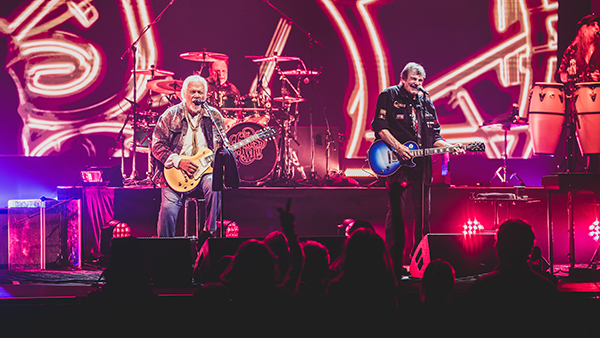
Who They Are: Bachman (left) and Cummings don't leave anyone guessing.
Footnote 1: The Guess Who's reunion lineup backing Cummings and Bachman on the Takin' It Back Tour includes drummer Sean Fitzsimons, bassist Jeff Jones, percussionist and vocalist Nick Sinopoli, and guitarists Tim Bovaconti and Joe Augello. Footnote 2: "Albert Flasher" was a non-album B-side for the 1971 Guess Who single "Broken." Footnote 3: That CBC show, called Let's Go, was hosted by their onetime Guess Who bandmate Chad Allan, and the band appeared on it during 1967–68. Footnote 4: If you want to go down The Guess Who's Let's Go rabbithole on YouTube, go here to experience their take on The Beatles' "With a Little Help From My Friends" (wherein Cummings does his best Joe Cocker impression), and then go here to witness their spot-on cover of The Small Faces' "Tin Soldier."