Brian Wilson in 2015. (Photo by Brian Bowen Smith.) Though he long ago guessed he just wasn't made for these times, Brian Wilson left a musical legacy that was built to last, long after summer's gone.
Outside of Vincent Van Gogh, Brian Wilson had the most infamous—and ultimately the most valuable—left ear in the world. Wilson—the chief architect of countless Beach Boys pop classics, who passed away at age 82 on June 11, 2025—lost the hearing in his right ear at an early age (footnote 1). One could reasonably argue that he only ever heard all the sonic masterpieces he constructed, for that quintessential California band he cofounded, in mono.
In fact, he told me as much during a March 2015 phone interview. "I only have one good ear, so I only hear mono anyway," he confirmed. "My goal is to try to make the listener know and feel what I sound like—and I know in my head, in my brain, how to do it. Mono was very important. I like what Phil Spector did in mono, and a lot of different artists like the Beatles. The Beatles inspired me. They didn't influence me, but Rubber Soul inspired me to make a great album." (footnote 2)
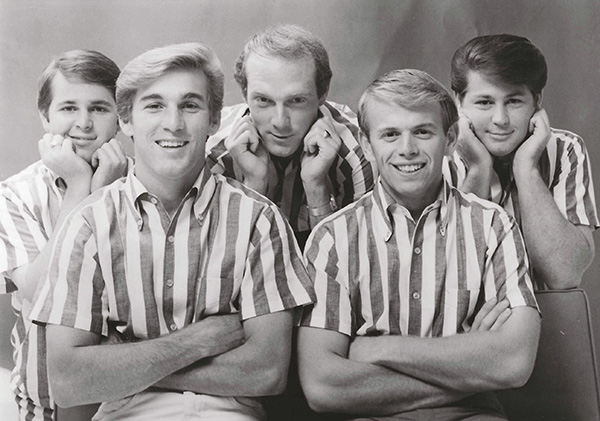
The Beach Boys in the early 1960s. Left to right: Carl Wilson, Dennis Wilson, Mike Love, Al Jardine, and Brian Wilson (Photo Courtesy of Capitol Records.)
One man who can shed direct light on the connective threads between the Fabs' and the Boys' respective universes is producer-engineer Giles Martin, son of Beatles producer Sir George Martin. In recent years, the younger Martin helmed several remixes for key entries in both bands' catalogs, in various stereo and multichannel incarnations. "The otherworldly sounds of Pet Sounds came from a combination of instruments, instrumentation, and orchestration in the same way the traditional classical composers would do the same thing," Martin explained to me during a Zoom interview in June 2023. "For example, Ravel"—yes, he means the 19th century French composer—"famously tried to create sunrise and shimmering strings, and that was where Brian was going, and what Brian did, in his arrangements. Funnily enough, I think that probably influenced my dad to a certain degree for what he did with the Beatles. Because people hadn't heard anything like it before, it was probably surprising for the Beach Boys as well, who were essentially thought of as a pop band—or even a boy band—at the time. The fact is, Pet Sounds is actually not otherworldly. It's fairly traditional, but only as far as what instruments were used on it. Probably the best way of putting it is they were strange in how they were used."
In the first quarter of the 13-month window bookended by Pet Sounds and Sgt. Pepper—a pair of albums that both required time to pass before they reached their corresponding zeniths of acclaim—Wilson upped the ante with "Good Vibrations," which the Beach Boys released as a standalone Capitol single in October 1966. It reached No.1 on both sides of the Atlantic by December.
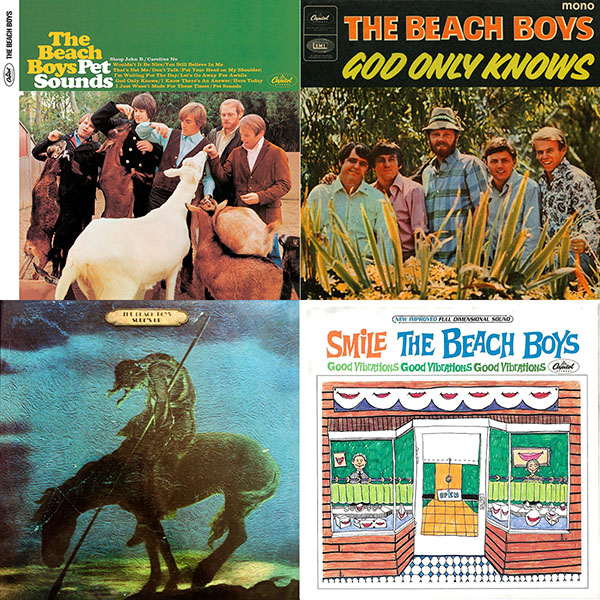 Following the one-two breakthrough punches of Sounds and "Vibrations," Wilson continued to toil on his aural white whale, SMiLE. The strain of trying to top the topmost of his production craft eventually became too much. He retreated from the band and wrestled with mental illness and other recurring problems for the rest of his life. Some tracks from SMiLE would emerge on ensuing Beach Boys albums, including the pseudo-psychedelic saga "Heroes and Villains," which leads off the September 1967 pastiche LP Smiley Smile, and the transformationally divine title track that closes out August 1971's Surf's Up.
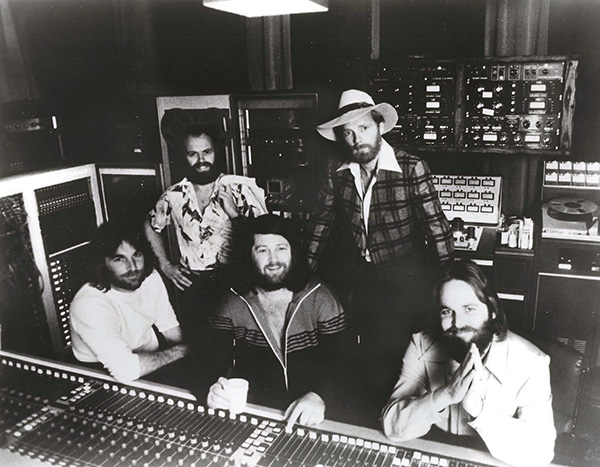
In the studio circa 1976–1977. (Photo Courtesy of Capitol Records.)
SMiLE Sessions co-producer Alan Boyd told me around that time that "Good Vibrations" was the nexus point. "So much of the modular fashion of recording that Brian employed—the way he would direct the musicians in the studio and then put all the fragments together later—really starts there." Co-producer Mark Linett added, "In one sense, the technology of the day limited the completion of SMiLE because it made those modular techniques so difficult to fully realize. On the other hand, that technological limitation meant Brian needed to record the way he did, with so many musicians in the room and blocked for sound for two or sometimes three tracks. I've always felt it worked to his advantage because he could go with his instincts as a flow. If they hadn't been so good, and technology hadn't forced things to be compressed down to a point, it would have been even more difficult to keep that going."
Even with all that went on in the studio, Wilson was adamant that SMiLE was a mono record. "That is the way he intended his records to be made," Linett continued. "He started out as a kid listening to AM radio, which was in a mono format, but also, he truly believed mono was the only way the listener was guaranteed to hear what he intended. Stereo presented the listener with too many variables—like speaker placement and whether they're in phase—to guarantee what Brian wanted to be heard. By and large, to achieve what Brian wanted in terms of multiple tape transfers and dubbing various tracks as he went, mono was really the only way to create pop music." Giles Martin concurred in a separate interview. "Part of what makes Brian's work so brilliant is because he planned on it being in mono. For the textures and the density, those elements need to be together."
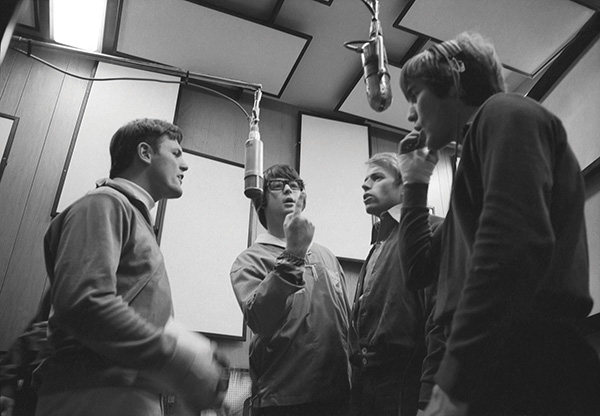
Photo Courtesy of Capitol Records.
Speaking of things needing to be together, a word (or a hundred) is called for now about the Beach Boys' ever-enchanting, multilayered harmonies. Pet Sounds' "God Only Knows"—which even Sir Paul McCartney has long acknowledged as "the greatest song ever written"—shines on as a universally lauded example of how to marry baroque textures with secular intentions. In June 2015, Dave Edmunds told me from his home in Wales, "It's a miracle of pop record making. It's one of my favorite records, and I dismantled it musically in my head over the years many, many times." He studied it religiously so he could cover it for On Guitar ... Dave Edmunds: Rags & Classics, which was released the same month on RPM. "I took it apart by listening to it over and over again. I finally figured out the cascade vocal on the end of the Beach Boys version only has three vocal parts—Brian does two [the top and bottom], and Bruce Johnston does the other one [the middle]. Carl [Wilson]'s voice got tired, apparently, so he left—and they finished it off with just the three-part harmony." (footnote 4)
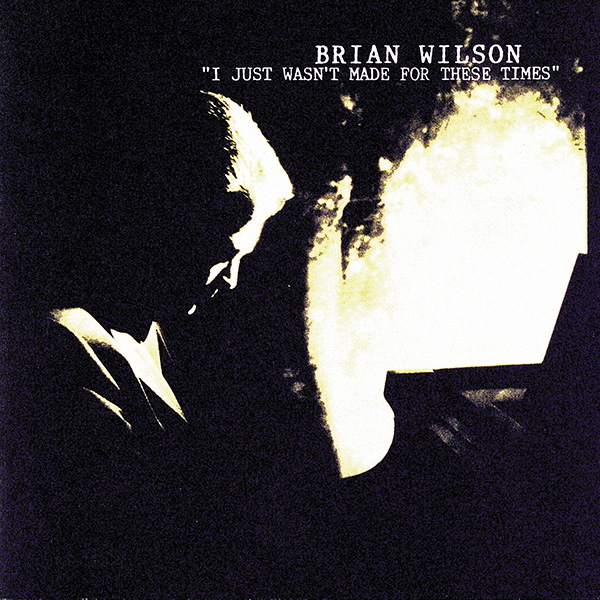 Besides his harmonic aptitude, Wilson had an inherent knack for composing songs entrenched in optimistic melancholy: the emotional numbness of "The Warmth of the Sun"; the hopeful pleading for "Love and Mercy," the opening cut on his first solo LP on Sire, July 1988's Brian Wilson; or the step-back acceptance of "Summer's Gone," the very last track on the Beach Boys' final studio album on Capitol Records, June 2012's That's Why God Made the Radio.

Brian Wilson in 2015. (Photo by Brian Bowen Smith.)
Footnote 1: Reportedly, the permanent hearing loss Brian experienced in his right ear resulted from a physical altercation instigated by his father, Murry Wilson, the frustrated songwriter/manager who was often outwardly hostile toward his son's talents. Footnote 2: Rubber Soul was released in December 1965 on Capitol. Footnote 3: Sung by Cliff Edwards as Jiminy Cricket in Pinocchio, "When You Wish Upon a Star" was composed by Leigh Harline with lyrics by Ned Washington. Wilson later covered "Star" on his 2011 CD on the Disney Pearl Series label, In the Key of Disney.