Sidebar 4: More Measurements
I used optical S/PDIF data for the digital input testing, as well as network data played with Roon and test tones stored on CDs. The Eversolo's optical and coaxial inputs accepted data sampled at rates up to 192kHz, and the digital inputs inverted absolute polarity at the speaker output. With the volume control set to "0dB," the output level from the speaker output with a 1kHz tone at –12dBFS was 5.64V into 8 ohms. This is 12.7dB below the clipping voltage into that load; the Play's DAC gain architecture is managed well. I examined the digital inputs' behavior at the speaker outputs with the volume control mainly set to –6dB.
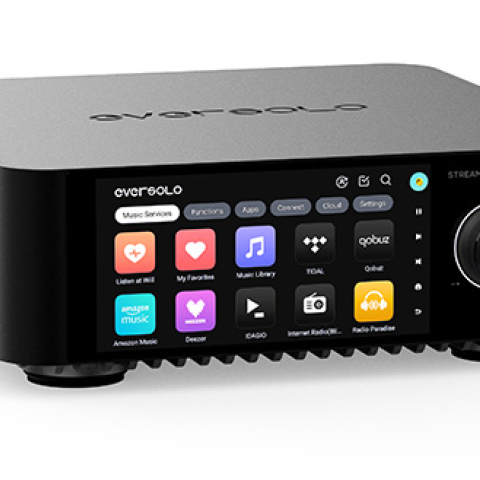
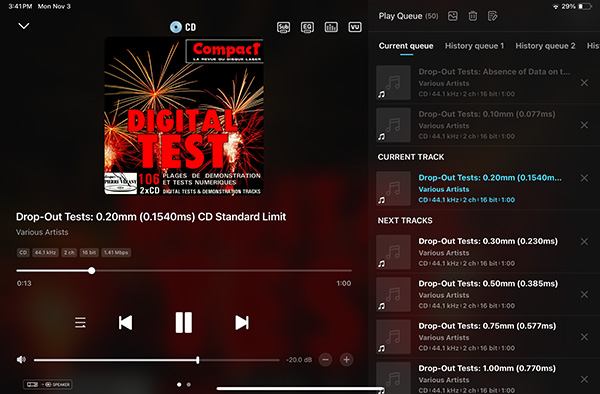 I used the Pierre Verany Digital Test CD to check the Play CD Edition's error correction when playing CDs. (To my surprise, the Play's front-panel display showed the cover art and the information for each track on this obscure, 37-year-old CD.) The Eversolo played the tracks with gaps in the data spiral up to 3mm in length without any problems, but there were audible glitches when the gap was longer than that or when there were two 3mm gaps in succession. The Compact Disc standard, the so-called Red Book, requires only that a player cope with gaps of up to 0.2mm; the CD Edition's error correction is one of the best I have encountered.
Eversolo's Play offers surprisingly good measured performance considering its very affordable price.—John Atkinson
I used the Pierre Verany Digital Test CD to check the Play CD Edition's error correction when playing CDs. (To my surprise, the Play's front-panel display showed the cover art and the information for each track on this obscure, 37-year-old CD.) The Eversolo played the tracks with gaps in the data spiral up to 3mm in length without any problems, but there were audible glitches when the gap was longer than that or when there were two 3mm gaps in succession. The Compact Disc standard, the so-called Red Book, requires only that a player cope with gaps of up to 0.2mm; the CD Edition's error correction is one of the best I have encountered.
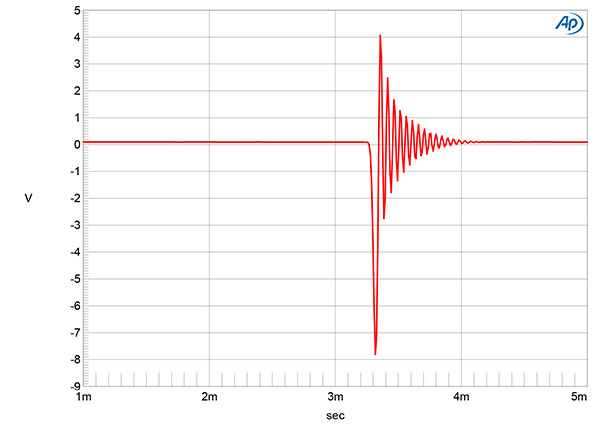
Fig.10 Eversolo Play, digital inputs, impulse response (one sample at 0dBFS, 44.1kHz sampling, 4ms time window).
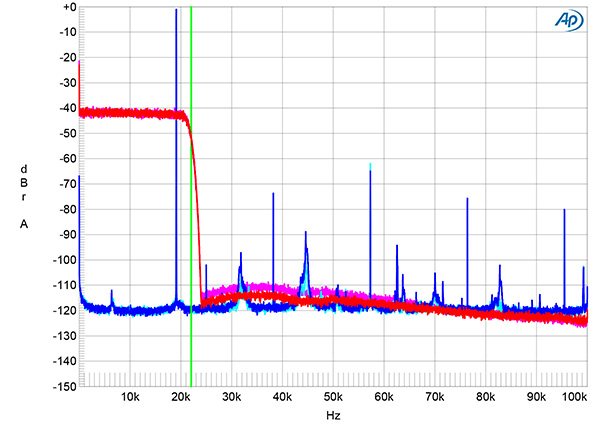
Fig.11 Eversolo Play, digital inputs, wideband spectrum of white noise at –4dBFS (left channel red, right magenta) and 19.1kHz tone at 0dBFS (left blue, right cyan) into 100k ohms with data sampled at 44.1kHz (20dB/vertical div.).
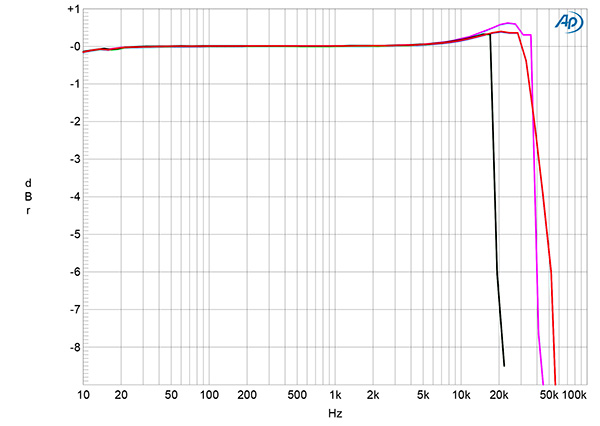
Fig.12 Eversolo Play, digital inputs, frequency response at –12dBFS with data sampled at: 44.1kHz (left channel green, right gray), 96kHz (left cyan, right magenta), and 192kHz (left blue, right red) (1dB/vertical div.).
The Eversolo Play's impulse response with PCM data (fig.10) revealed that the reconstruction filter is a long minimum-phase type, with all the ringing following the single sample at 0dBFS. The magenta and red traces in fig.10 show the ultrasonic rolloff of the Play's digital inputs with white-noise data sampled at 44.1kHz. The traces reach full stop-band attenuation just above half the sample rate (indicated by the vertical green line). The aliased image at 25kHz of a 19.1kHz tone at 0dBFS (cyan, blue) is suppressed by more than 100dB. The harmonics associated with the 19.1kHz tone all lie at or below –63dB (0.07%), with the third the highest in level. The digital frequency response with data sampled at 44.1kHz, 96kHz, and 192kHz (fig.12) was flat in the audioband with a sharp rolloff just below half of the two lower sample rates. As expected from the analog input frequency response (fig.1), the response with 192kHz data didn't extend much higher in frequency than with 96kHz data.
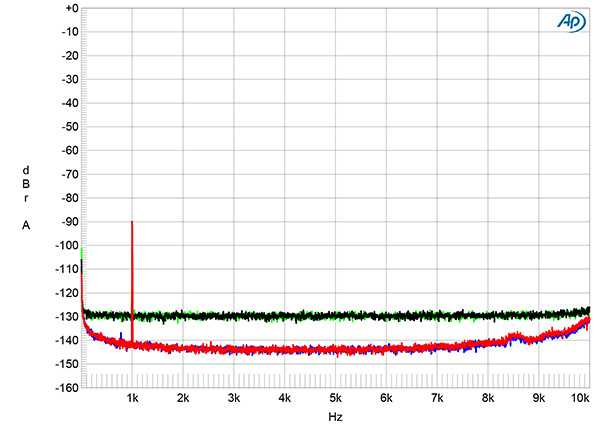
Fig.13 Eversolo Play, digital inputs, spectrum with noise and spuriae of dithered 1kHz tone at –90dBFS with: 16-bit data (left channel green, right gray), 24-bit data (left blue, right red) (20dB/vertical div.).
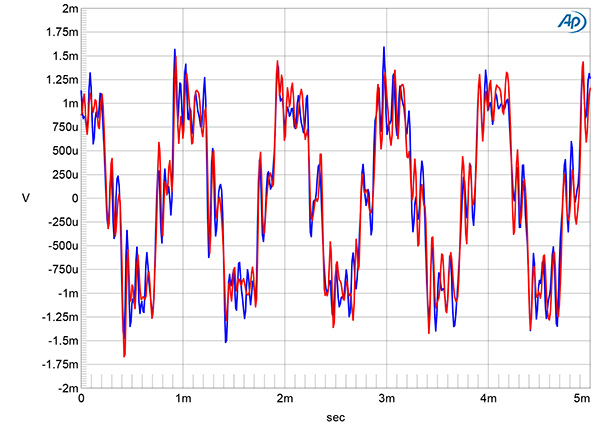
Fig.14 Eversolo Play, digital inputs, waveform of undithered 1kHz sinewave at –90.31dBFS, 16-bit data (left channel blue, right red).
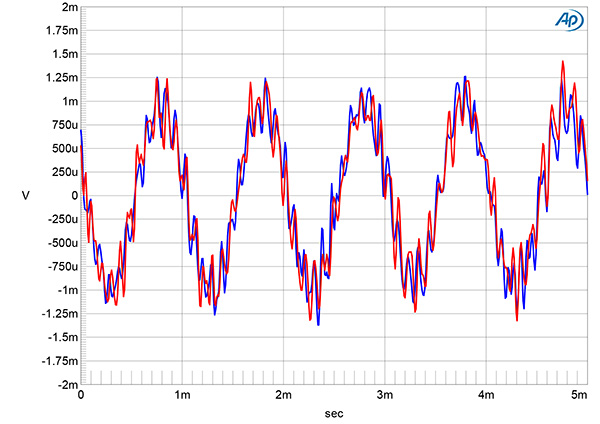
Fig.15 Eversolo Play, digital inputs, waveform of undithered 1kHz sinewave at –90.31dBFS, 24-bit data (left channel blue, right red).
An increase in bit depth from 16 to 24, with dithered data representing a 1kHz tone at –90dBFS, dropped the Play's noisefloor by 12dB (fig.13), which implies a measured resolution of 18 bits. With undithered data representing a tone at exactly –90.31dBFS, the waveform was symmetrical, with negligible DC offset, and the three DC voltage levels described by the data were clearly defined, though overlaid with random noise (fig.14). With undithered 24-bit data (fig.15), the Play output a relatively clean sinewave.
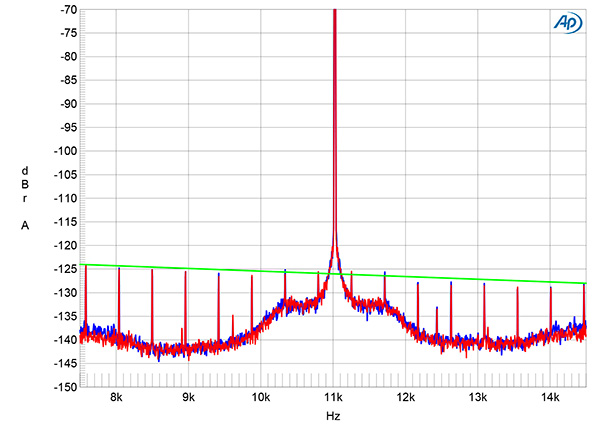
Fig.16 Eversolo Play, high-resolution jitter spectrum of analog output signal, 11.025kHz at –6dBFS, sampled at 44.1kHz with LSB toggled at 229Hz: 16-bit CD data (left channel blue, right red). Center frequency of trace, 11.025kHz; frequency range, ±3.5kHz.
The Play's digital inputs offered good rejection of data-related jitter. Fig.13 shows the output spectrum when I played a CD-R on which I had recorded 16-bit J-Test data. The odd-order harmonics of the undithered low-frequency, LSB-level squarewave all lie at the correct levels, shown by the green line, though the central spike that represents the high-level tone at one-quarter the sample rate (Fs/4) is surrounded by a symmetrical increase in the level of the random noisefloor. Repeating this analysis with 16-bit TosLink and Roon data gave similar results, except that the pair of sidebands closest to the 11.025kHz tone was 5dB too high in level.
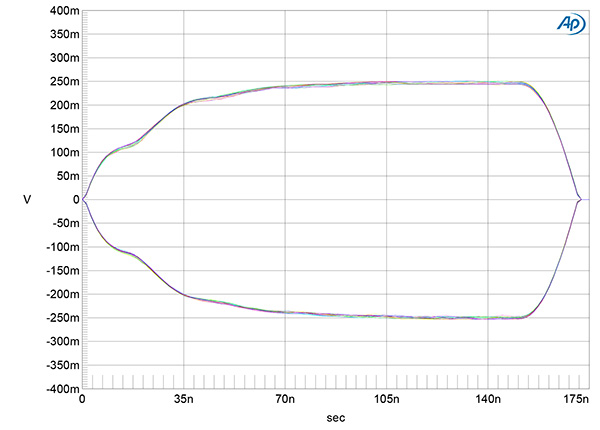
Fig.17 Eversolo Play, eye pattern of coaxial S/PDIF output carrying 16-bit, 44.1kHz J-Test data (±400mV vertical scale, 175ns horizontal scale).
In addition to its loudspeaker and subwoofer outputs, the Play has a coaxial S/ PDIF data output. With the J-Test CD-R, this output's eye pattern plotted over one "unit cycle" was wide open, with no blurring of the leading and trailing edges (fig.17). The average jitter level, assessed with a 50Hz–100kHz bandwidth, was very low, at 340.5ps.