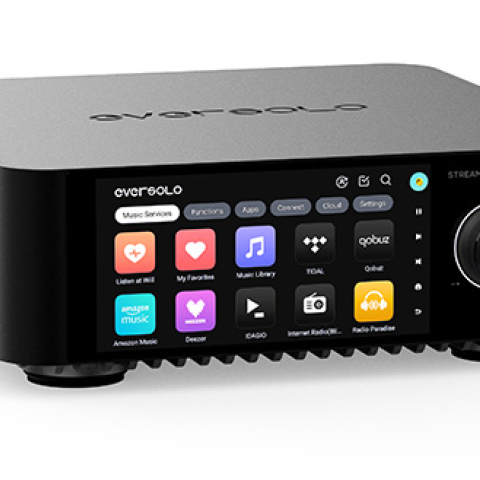
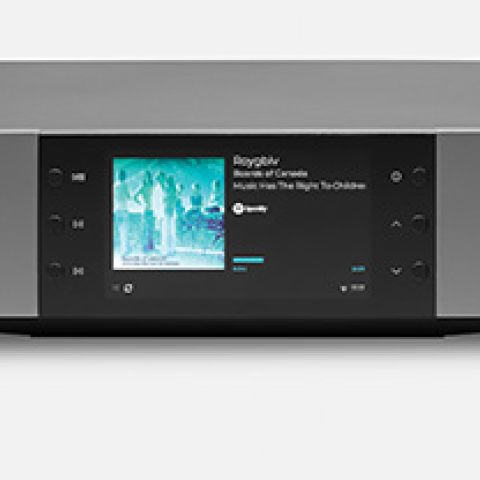
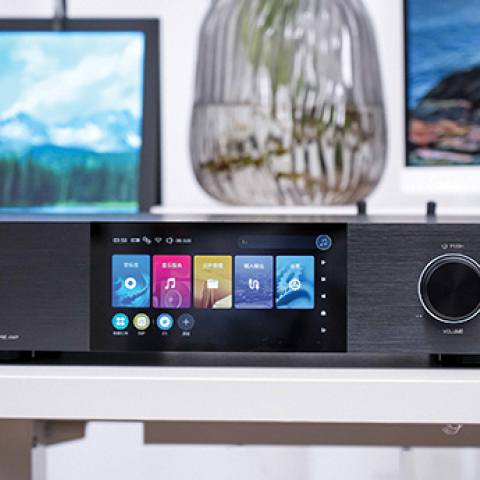
The inexpensive but versatile Eversolo Play CD Edition integrated amplifier ($799) that Rogier van Bakel reviewed in the January 2026 issue has optical and coaxial digital inputs, line and phono analog inputs, can play CDs, and can stream audio over its network connection, all for just $799! Although RvB doesn't have an LP player and was therefore unable to audition the Play's phono stage, I performed a complete set of measurements on the phono input with my Audio Precision SYS2722 system. As usual when I am measuring a phono stage, I connected the ground terminal on the amplifier's rear panel to the analyzer's ground to minimize noise. As the Play uses a class-D output stage that emits relatively high levels of ultrasonic noise that would drive my analyzer's input into slew-rate limiting, I inserted an Audio Precision AUX-0025 passive low-pass filter between the test load and the analyzer. This filter mitigates noise above 80kHz and eliminates noise above 200kHz.
I used the Eversolo Control app installed on my iPad mini to switch the phono input between moving coil (MC) and moving magnet (MM). The app doesn't allow the Play's phono input impedance to be adjusted; I found that the impedance in both modes was 9.9k ohms at 20Hz and 1kHz, 9.5k ohms at 20kHz. With the volume control set to the maximum, the gain in MM mode was 60.5dB at the loudspeaker output, 40.5dB at the subwoofer output. The gain in MC mode was 14.1dB higher at both outputs. Both modes inverted absolute polarity at the amplifier's loudspeaker outputs.
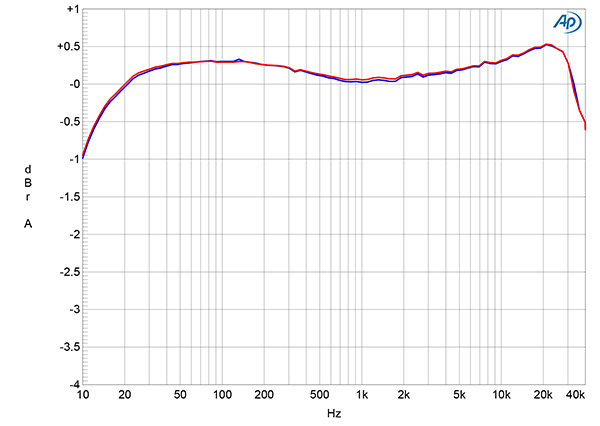
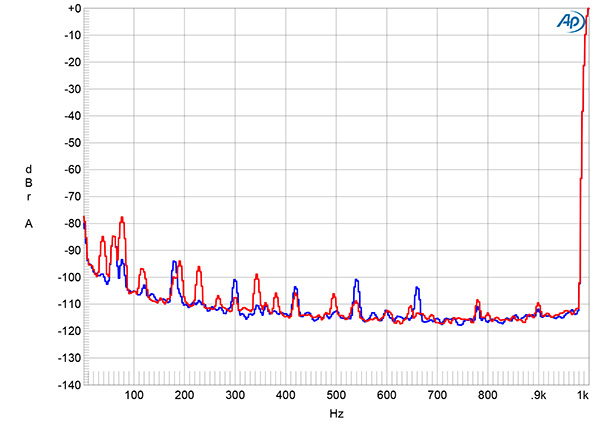
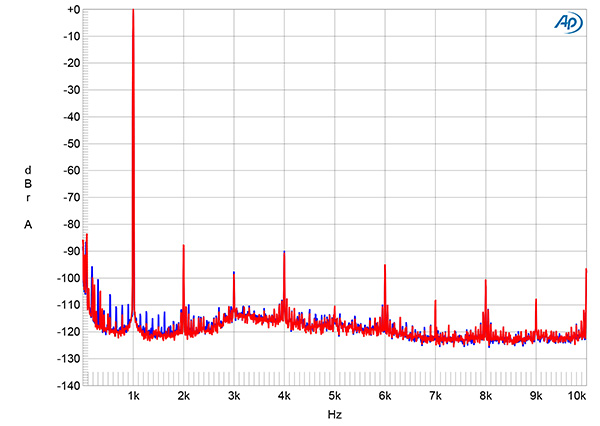
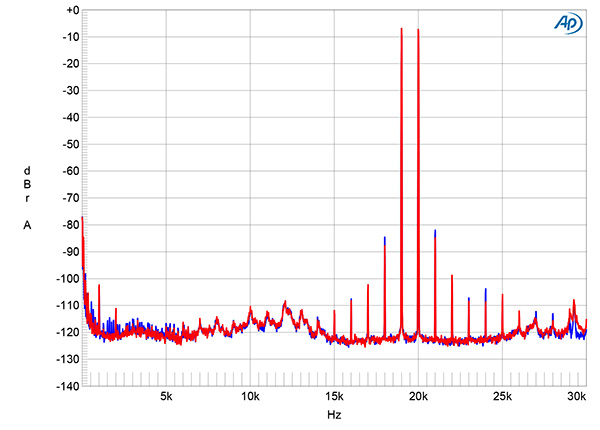
Fig.1 Eversolo Play, response with RIAA correction (left channel blue, right red) (0.5dB/vertical div.).
Fig.2 Eversolo Play, MM mode, spectrum of 1kHz sinewave, DC–1kHz, for 5mV input, volume control set to maximum (left channel blue, right red, linear frequency scale, 20dB/vertical div.).
The Eversolo's RIAA equalization (fig.2, blue and red traces) had slight boosts of 0.3dB in the upper bass and 0.5dB at the top of the audioband. Channel matching was superb. The Play phono stage's unweighted, wideband S/N ratio in MM mode, measured at the loudspeaker output with the input shorted to ground and the volume control set to the maximum, was a very good 75.3dB in both channels ref. 1kHz at 5mV. Restricting the measurement bandwidth to 22Hz–22kHz increased the ratio to 81.5dB, while the A-weighted ratio was a superb 83.9dB. The S/N ratios in MC mode, ref. 1kHz at 500µV, were respectively 64.2dB, 66.6dB, and 70.1dB. Spectral analysis of the Play's low-frequency noisefloor in MM mode (fig.2) revealed that while there were some power supply–related spuriae present, these were all very low in level.
Fig.3 Eversolo Play, MM mode, spectrum of 1kHz sinewave, DC–10kHz, for 10mV input (left channel blue, right red, linear frequency scale, 20dB/vertical div.).
Fig.4 Eversolo Play, MM mode, HF intermodulation spectrum, DC–30kHz, 19+20kHz for 100mV peak input (left channel blue, right red, linear frequency scale, 20dB/vertical div.).
I measured the Play phono input's overload margins with the volume control set to –10dB to make sure I was looking at actual input overload rather than output stage clipping. The margins in MM mode ref. 1kHz at 5mV and in MC mode ref. 1kHz at 500µV were an okay 12.5dB across the audioband in both modes. Fig.3 shows the MM mode's output spectrum with a 1kHz signal at 10mV, 6.5dB below the overload voltage. The highest-level distortion harmonics are the second and fourth, both at a very low –90dB (0.003%). Intermodulation distortion in MM mode with an equal mix of 19kHz and 20kHz tones at a peak input level of 100mV was also very low (fig.4). The difference product at 1kHz lay below –100dB (0.001%) and the higher-order products lie below –80dB (0.01%).
Overall, the Eversolo Play's phono stage offers excellent measured performance in both MM and MC modes, with very low distortion and noise despite being housed in a small chassis with a large display, a CD transport, a D/A processor, class-D amplifier circuitry, and a switch-mode power supply.—John Atkinson