Sidebar 3: In-Room Measurements
For my experiments with using the Marantz' AV8805's equalization options to optimize the T2's balance in my room, I restricted my efforts to the Bass control plus just three controls on the graphic equalizer: 63Hz, 125Hz, and 250Hz (each channel's EQ can be individually adjusted). None of the alterations I made (apart from the 1dB boost in the Treble, which I retained) altered the frequency response above 450Hz, as measured at the main listening seat. The settings were determined by measurement, not by ear (I've found the latter to be a recipe for failure). I won't provide the specifics here, as the specific settings are applicable only to my room.
All the measurements were made at or near the listening position using the OmniMic measurement system from Parts Express. All curves were smoothed to 1/6 octave. While these results won't be as precise as those made with the tools John Atkinson uses to take his full suite of measurements, they do provide a useful look at how the Emotiva Airmotiv T2s performed in my listening room. While far from perfect, the corrections produced a more linear result from 30Hz to 200Hz. A remaining dip at around 40Hz was worse in the right channel than in the left, but was now less deep than before relative to the level at 1kHz. The elevation centered at around 150Hz was also improved.
The result was a more open sound with most recordings, much like the lifting of a mild fog. The bass was definitely more powerful, though I suspect that in a different room the T2s have even more to offer in this department. Nevertheless, without yet knowing JA's measurements, I was now consistently impressed by the T2s' low end, in both extension and clarity. With good recordings the imaging was tighter and more precise, the soundstage slightly deeper, and the acoustic of the recording venue better resolved. While some listeners might find these improvements subtle, they definitely pushed the T2s further upscale than their $999/pair price might suggest.—Thomas J. Norton
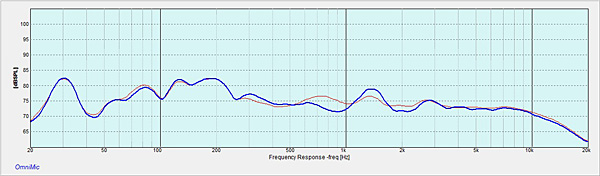
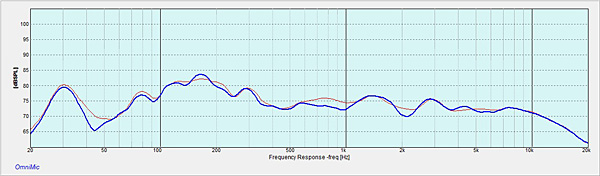
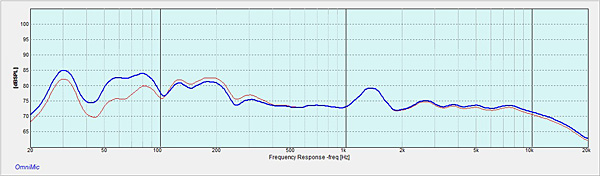
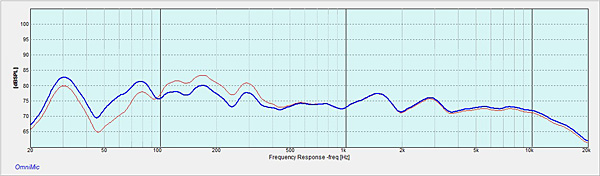
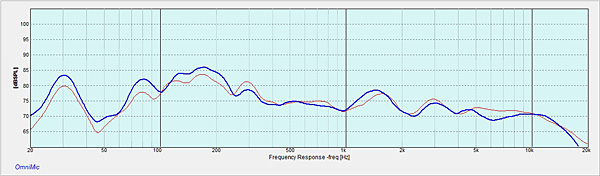
Fig.1 Emotiva Airmotiv T2, left channel, no equalization or tone control applied: average of 12 positions at ear height within ca ±18" of primary listening seat (red trace); result for a single position at primary listening seat, no position averaging applied (blue).
Fig.2 Emotiva Airmotiv T2, right channel, no equalization or tone control applied: average of 12 positions at ear height within ca ±18" of primary listening seat (red trace); result for a single position at primary listening seat, no position averaging applied (blue).
Fig.3 Emotiva Airmotiv T2, left channel: without (red trace) and with (blue) EQ and tone controls applied, as described in main review text. Both curves taken at single head position with no position averaging.
Fig.4 Emotiva Airmotiv T2, right channel: without (red trace) and with (blue) EQ and tone controls applied, as described in main review text. Both curves taken at single head position with no position averaging.
Fig.5 Frequency response of Emotiva Airmotiv T2 (red trace) and Monitor Audio Silver 10 (blue), both in single head position, with no EQ or tone controls applied, levels adjusted for equal output at 1kHz.