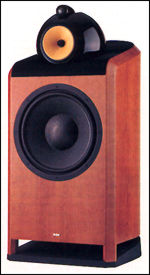
The Nautilus 801's tweeter is 43" from the floor, which is a little high for a person of normal height sitting in a sofa. (A survey performed some years ago by Stereophile's Tom Norton revealed a remarkable uniformity of ear height. Short or tall people sitting on typical domestic sofas had an ear height of 33"-39".) Fig.7, which shows the changes in the B&W's response in the vertical plane, normalized to the tweeter-axis curve, reveals that as long as the listener sits with his or her ears between the tweeter axis and the midrange axis, the perceived balance will not change too much. But if you sit so you can see the top of the speaker, or---horrors---stand up, a deep suckout appears at the upper crossover frequency (indicated in this graph by the cursor). This lack of vertically off-axis energy in the presence region might also lead to the speaker's reverberant energy being too politely balanced. 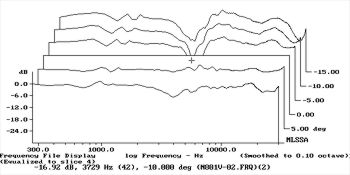 Fig.7 B&W Nautilus 801, vertical response family at 50", normalized to response on tweeter axis, from back to front: differences in response 20 degrees-5 degrees above HF axis; reference response; differences in response 5 degrees-10 degrees below HF axis. The impulse response on the tweeter axis (not shown) is absolutely conventional, while the step response (fig.8) indicates that all three units appear to be connected with the same, positive acoustic polarity. As is usual with a high-order crossover design, however, the Nautilus 801 is not time-coherent, the tweeter's output arriving at the microphone a small fraction of a millisecond before that of the midrange unit, and the woofer's output lazily following that.
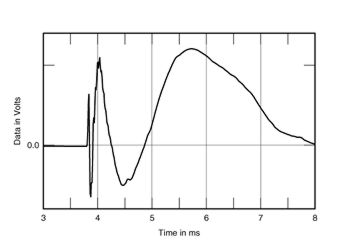 Fig.8 B&W Nautilus 801, step response on tweeter axis at 50" (5ms time window, 30kHz bandwidth).
 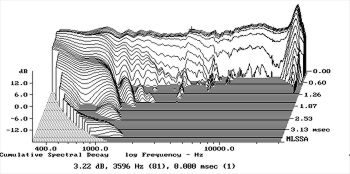 Fig.9 B&W Nautilus 801, cumulative spectral-decay plot at 50" (0.15ms risetime). Finally, the cumulative spectral-decay plot on the tweeter axis (fig.9) is astonishingly clean and free from resonant modes. No wonder the B&W sounds so grain-free and easy on the ear.---John Atkinson
Fig.7 B&W Nautilus 801, vertical response family at 50", normalized to response on tweeter axis, from back to front: differences in response 20 degrees-5 degrees above HF axis; reference response; differences in response 5 degrees-10 degrees below HF axis. The impulse response on the tweeter axis (not shown) is absolutely conventional, while the step response (fig.8) indicates that all three units appear to be connected with the same, positive acoustic polarity. As is usual with a high-order crossover design, however, the Nautilus 801 is not time-coherent, the tweeter's output arriving at the microphone a small fraction of a millisecond before that of the midrange unit, and the woofer's output lazily following that. Fig.8 B&W Nautilus 801, step response on tweeter axis at 50" (5ms time window, 30kHz bandwidth). Fig.9 B&W Nautilus 801, cumulative spectral-decay plot at 50" (0.15ms risetime). Finally, the cumulative spectral-decay plot on the tweeter axis (fig.9) is astonishingly clean and free from resonant modes. No wonder the B&W sounds so grain-free and easy on the ear.---John Atkinson