From right to left, fig.4 shows the responses of the midrange/tweeter, the woofer, and the port. The latter covers the narrow bandpass centered on 20Hz, confirming the Nautilus' excellent bass extension. While some peakiness can be seen in its output at 300Hz, this is well down in level and will also be suppressed by the fact that the port faces downward. As expected, the woofer's minimum-motion point lies at 21Hz, with its output starting to roll off above 100Hz. The acoustic crossover to the midrange unit appears to be set at 250Hz, a little lower than specified. The slopes also seem asymmetrical: the midrange unit rolls out with a fourth-order, 24dB/octave slope, while the woofer's low-pass rolloff is more leisurely. 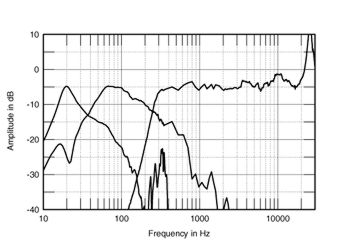 Fig.4 B&W Nautilus 801, acoustic crossover on tweeter axis at 50", corrected for microphone response, with nearfield midrange, woofer, and port responses plotted below 350Hz, 300Hz, and 1kHz, respectively. Higher in frequency, the enormous peak at 26kHz is the tweeter resonance mentioned in connection with the impedance plot. It will be inaudible, however, though it might make the speaker sound somewhat different with LP replay. (With CD replay, there just isn't enough energy above 20kHz to fully excite the resonance, while the wider bandwidth offered by an MC cartridge, which might itself have a resonance in the same region, will lead to the tweeter resonance being excited, which in turn might lead to intermodulation effects.) There appears to be a slight excess of on-axis energy centered on 10kHz, but the response trend through the region covered by the midrange unit and tweeter is otherwise very flat.
This flatness can also be seen in fig.5, which shows the Nautilus 801's overall response averaged across a 30 degree horizontal window on the tweeter axis. Below 300Hz, the traces show the complex sum (amplitude and phase) of the nearfield outputs of the midrange unit, woofer, and port. Fig.4 suggests that the woofer starts to roll out a little early, which leads to a slight lack of energy in the transition region to the midrange unit, which can be seen in fig.5. This is also the region where room boundary effects make their presence known, so predicting any subjective consequences is difficult. As this is the orchestra's "power" region, I do wonder whether it ties in with the lack of loudness noted by WP in his auditioning, though such politeness usually correlates with a lack of presence-region energy.
Fig.4 B&W Nautilus 801, acoustic crossover on tweeter axis at 50", corrected for microphone response, with nearfield midrange, woofer, and port responses plotted below 350Hz, 300Hz, and 1kHz, respectively. Higher in frequency, the enormous peak at 26kHz is the tweeter resonance mentioned in connection with the impedance plot. It will be inaudible, however, though it might make the speaker sound somewhat different with LP replay. (With CD replay, there just isn't enough energy above 20kHz to fully excite the resonance, while the wider bandwidth offered by an MC cartridge, which might itself have a resonance in the same region, will lead to the tweeter resonance being excited, which in turn might lead to intermodulation effects.) There appears to be a slight excess of on-axis energy centered on 10kHz, but the response trend through the region covered by the midrange unit and tweeter is otherwise very flat.
This flatness can also be seen in fig.5, which shows the Nautilus 801's overall response averaged across a 30 degree horizontal window on the tweeter axis. Below 300Hz, the traces show the complex sum (amplitude and phase) of the nearfield outputs of the midrange unit, woofer, and port. Fig.4 suggests that the woofer starts to roll out a little early, which leads to a slight lack of energy in the transition region to the midrange unit, which can be seen in fig.5. This is also the region where room boundary effects make their presence known, so predicting any subjective consequences is difficult. As this is the orchestra's "power" region, I do wonder whether it ties in with the lack of loudness noted by WP in his auditioning, though such politeness usually correlates with a lack of presence-region energy. 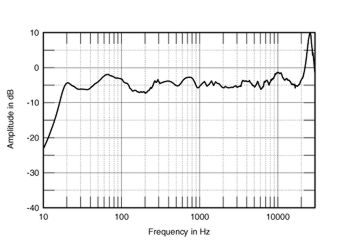 Fig.5 B&W Nautilus 801, anechoic response on tweeter axis at 50", averaged across 30 degrees horizontal window and corrected for microphone response, with complex sum of the nearfield midrange, woofer, and midrange responses plotted below 300Hz. The horizontal dispersion plot (fig.6) does show a slight lack of presence-region energy at extreme angles to the speaker's sides. I wouldn't have thought this enough to affect the perceived balance, but if you compare the dispersion an octave lower at 1kHz, which is very wide, it is possible that the ear latches on to the contrast between the wide dispersion in this region and at the base of the tweeter's passband, and the significantly narrower dispersion in between. Note also the even spacing of the "contour lines" in fig.6, which suggests excellent control of the speaker's dispersion with respect to frequency. This always correlates with stable, well-defined imaging performance.
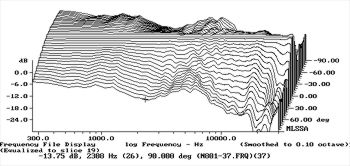 Fig.6 B&W Nautilus 801, horizontal response family at 50", normalized to response on tweeter axis, from back to front: differences in response 90 degrees-5 degrees off-axis; reference response; differences in response 5 degrees-90 degrees off-axis.
Fig.4 B&W Nautilus 801, acoustic crossover on tweeter axis at 50", corrected for microphone response, with nearfield midrange, woofer, and port responses plotted below 350Hz, 300Hz, and 1kHz, respectively. Higher in frequency, the enormous peak at 26kHz is the tweeter resonance mentioned in connection with the impedance plot. It will be inaudible, however, though it might make the speaker sound somewhat different with LP replay. (With CD replay, there just isn't enough energy above 20kHz to fully excite the resonance, while the wider bandwidth offered by an MC cartridge, which might itself have a resonance in the same region, will lead to the tweeter resonance being excited, which in turn might lead to intermodulation effects.) There appears to be a slight excess of on-axis energy centered on 10kHz, but the response trend through the region covered by the midrange unit and tweeter is otherwise very flat. Fig.5 B&W Nautilus 801, anechoic response on tweeter axis at 50", averaged across 30 degrees horizontal window and corrected for microphone response, with complex sum of the nearfield midrange, woofer, and midrange responses plotted below 300Hz. The horizontal dispersion plot (fig.6) does show a slight lack of presence-region energy at extreme angles to the speaker's sides. I wouldn't have thought this enough to affect the perceived balance, but if you compare the dispersion an octave lower at 1kHz, which is very wide, it is possible that the ear latches on to the contrast between the wide dispersion in this region and at the base of the tweeter's passband, and the significantly narrower dispersion in between. Note also the even spacing of the "contour lines" in fig.6, which suggests excellent control of the speaker's dispersion with respect to frequency. This always correlates with stable, well-defined imaging performance. Fig.6 B&W Nautilus 801, horizontal response family at 50", normalized to response on tweeter axis, from back to front: differences in response 90 degrees-5 degrees off-axis; reference response; differences in response 5 degrees-90 degrees off-axis.