Sidebar 3: Measurements
I performed a full set of measurements on the Burmester 232 using my Audio Precision SYS2722 system. Before I started the testing, I preconditioned the amplifier by operating it at 1/8 the specified power into 8 ohms for 30 minutes. At the end of that time, the temperature of the side-mounted heatsinks was 117.5°F/47.5°C.
Looking first at the Burmester 232's balanced line inputs: The amplifier inverted absolute polarity at the speaker and headphone outputs but preserved polarity at the balanced Preamplifier output. (Polarity can be adjusted for each input via a menu setting.) The line input impedance was a usefully high 35k ohms at 20Hz and 1kHz, dropping inconsequentially to 28.4k ohms at 20kHz. The volume control operates in accurate 0.5dB steps; with the volume control set to the maximum, "60," the voltage gain at 1kHz from the loudspeaker output into 8 ohms was 35.75dB. It was 16.3dB from the Preamplifier output and 9.4dB from the headphone output.
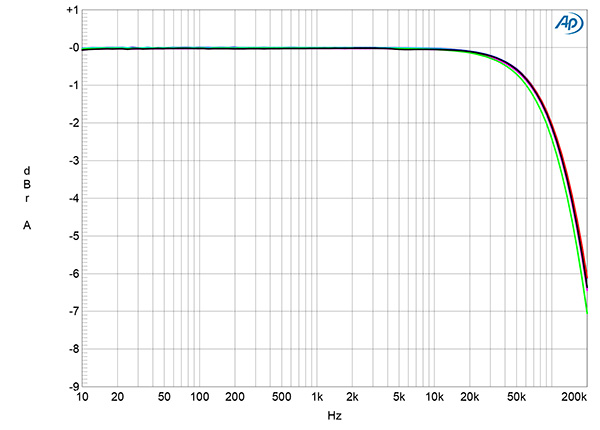
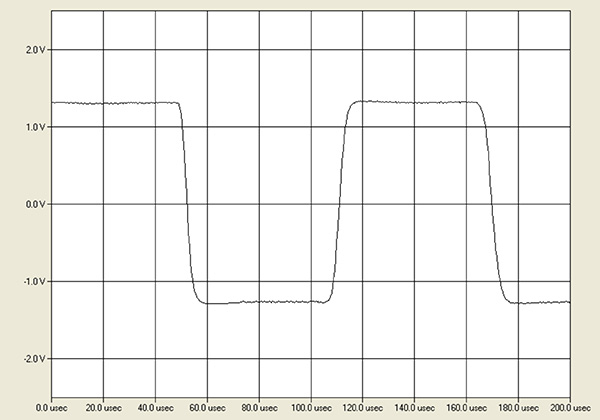
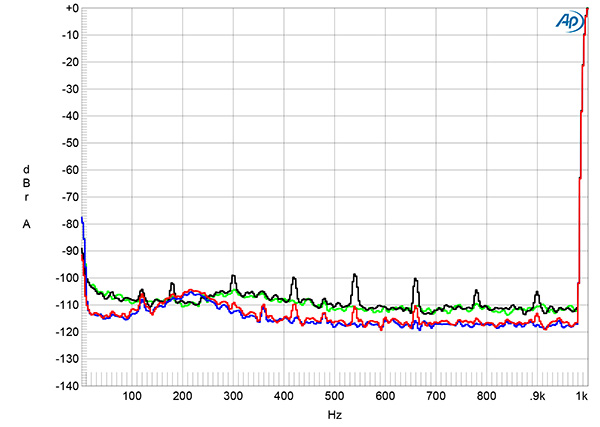
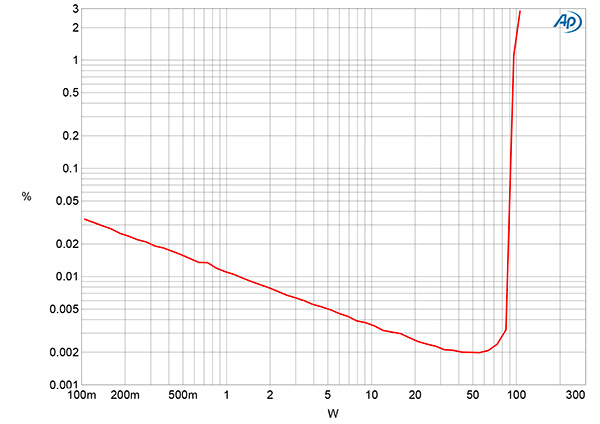
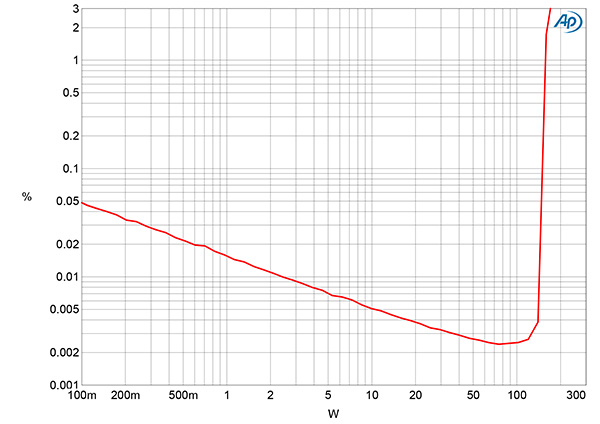
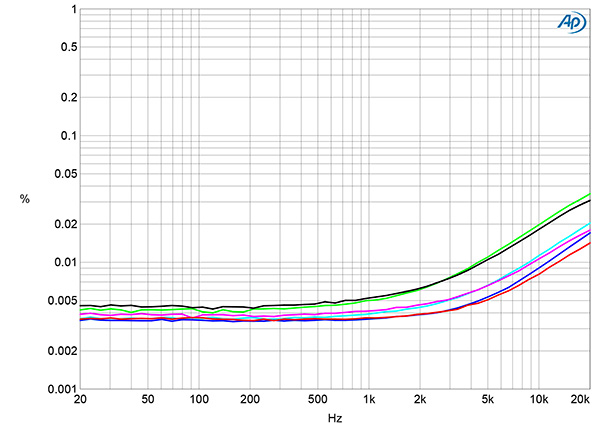
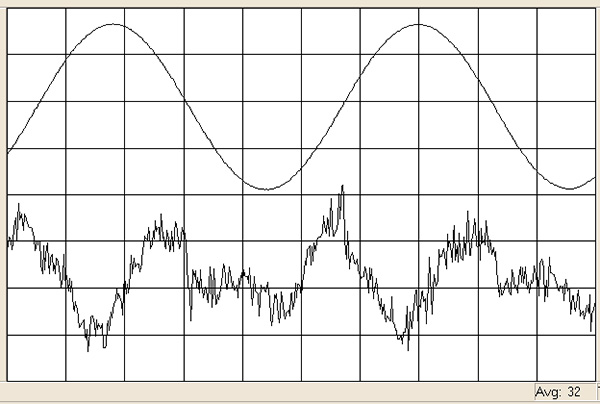
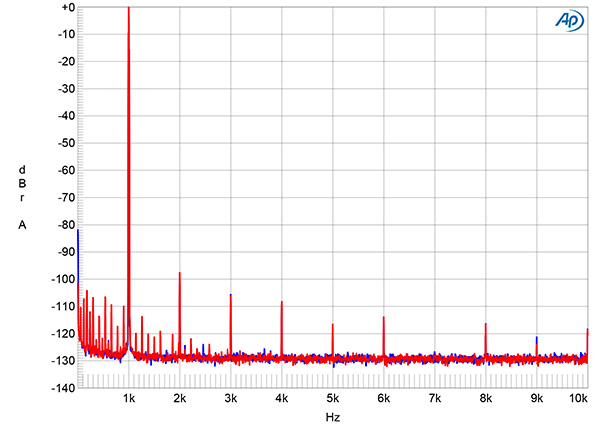
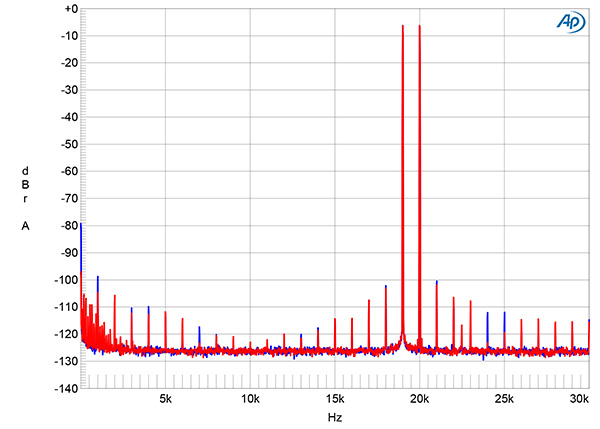
Fig.1 Burmester 232, line input, frequency response at 2.83V into: simulated loudspeaker load (gray), 8 ohms (left channel blue, right red), 4 ohms (left cyan, right magenta), 2 ohms (green) (1dB/vertical div.).
Fig.2 Burmester 232, line input, small-signal, 10kHz squarewave into 8 ohms.
The Preamplifier output impedance was relatively low, at 198 ohms, though the single-ended headphone output's impedance was moderately high, at 33 ohms. (Both figures were consistent across the audioband.) The loudspeaker output impedance was extremely low, at 0.006 ohm from 20Hz to 20kHz. The modulation of the Burmester 232's frequency response due to the Ohm's Law interaction between this impedance and the impedance of our standard simulated loudspeaker was therefore negligible (fig.1, gray trace). The amplifier's response into resistive loads (blue, red, cyan, magenta, and green traces) was flat in the audioband and –3dB at 120kHz. Both the very close channel balance and the overall response were preserved at lower settings of the volume control. The response from the preamplifier and headphone outputs was down by 2.5dB at 200kHz. There was no overshoot or ringing on the Burmester 232's reproduction of a 10kHz squarewave into 8 ohms (fig.2).
Fig.3 Burmester 232, line input, spectrum of 1kHz sinewave, DC–1kHz, at 1Wpc into 8 ohms with volume control set to the maximum (left channel green, right gray) and to –12dB (left blue, right red) (linear frequency scale).
Channel separation was superb, at >100dB below 10kHz. The wideband, unweighted signal/noise ratio, taken with the balanced input shorted to ground and the volume control set to its maximum, was a good 68.3dB in both channels, ref. 2.83V, which is equivalent to 1W into 8 ohms. This ratio improved to 78.7dB when the measurement bandwidth was restricted to the audioband, and to 81.2dB when A-weighted. The spectrum of the Burmester 232's low-frequency noisefloor at 1Wpc into 8 ohms with the volume control set to its maximum is shown by the green and gray traces in fig.3. The relatively low levels of both supply-related spuriae and random noise components dropped by up to 10dB when I set the volume control to –12dB and increased the level of the input signal so that the output was the same 1Wpc into 8 ohms (blue, red traces). However, there is now a slight rise in the noisefloor between 150Hz and 300Hz.
Fig.4 Burmester 232, line input, THD+N (%) vs 1kHz continuous output power into 8 ohms.
Fig.5 Burmester 232, line input, THD+N (%) vs 1kHz continuous output power into 4 ohms.
Fig.4 plots how the THD+noise percentage in the Burmester's output varies with power into 8 ohms with both channels driven. With our usual definition of clipping, when the THD+N reaches 1%, the Burmester 232 met its specified output power of 95W into 8 ohms (19.8dBW). The maximum power into 4 ohms is specified as 155W (18.9dBW); I measured 1% THD+N at 150Wpc into 4 ohms (18.75dBW, fig.5), though the wall AC voltage had dropped from 118.9V with the amplifier idling to 117.4V at this power. The FTC's updated "Amplifier Rule" states that maximum power should also be assessed at frequencies other than 1kHz. I therefore repeated the clipping test with a 20kHz signal. The THD+N reached 1% at 95W into 8 ohms (19.8dBW) at this frequency.
Fig.6 Burmester 232, line input, THD+N (%) vs frequency at 17.9V into 8 ohms (left channel blue, right red), 4 ohms (left cyan, right magenta), and 2 ohms (left green, right gray).
The downward slope of the traces in figs.4 and 5 indicates that true distortion lies beneath the noisefloor below 50W into 8 ohms and 100W into 4 ohms. Fig.6 shows how the Burmester 232's THD+N percentage changed with frequency at 17.9V, equivalent to 40W into 8 ohms (blue, red traces), 80W into 4 ohms (cyan, magenta traces), and 160W into 2 ohms (green, gray traces). The distortion+noise into all three loads is extremely low, with only a slight rise evident in the top audio octaves.
Fig.7 Burmester 232, line input, 1kHz waveform at 50W into 8 ohms, 0.0033% THD+N (top); distortion and noise waveform with fundamental notched out (bottom, not to scale).
Fig.8 Burmester 232, line input, spectrum of 1kHz sinewave, DC–1kHz, at 80Wpc into 4 ohms (left channel blue, right red, linear frequency scale).
Fig.9 Burmester 232, line input, HF intermodulation spectrum, DC–30kHz, 19+20kHz at 80Wpc peak into 4 ohms (left channel blue, right red, linear frequency scale).
The THD+N waveform, taken at 50W into 8 ohms (fig.7), appears dominated by the second harmonic, which was confirmed by spectral analysis (fig.8). Even into 4 ohms, the second harmonic lies at a very low –99dB (0.001%), with higher-order harmonics much lower in level. Similarly, intermodulation distortion with an equal mix of 19kHz and 20kHz tones at a peak level of 80W into 4 ohms was extremely low in level (fig.9).—John Atkinson